
Hiring engineers for oil and gas projects is taking too long – over 60 days on average, and this could exceed 75 days by 2026. This delay impacts project timelines, causing cost overruns and safety risks. To fix this, companies are turning to faster hiring methods using pre-vetted talent pools, automated matching, digital onboarding, and real-time compliance tracking.
Here’s how you can reduce hiring time from months to days:
- Identify Key Certifications and Experience: Focus on must-have qualifications like PE licenses, OSHA 30-Hour training, and API/ASME standards.
- Use Pre-Vetted Talent Pools: Access verified engineers ready to start within 48 hours.
- Automate Matching: Filter candidates by certifications, experience, and location instantly.
- Digitize Onboarding: Replace manual paperwork with mobile tools for faster deployment.
- Leverage Geo-Location Technology: Find and assign the nearest qualified engineer for urgent tasks.
- Track Compliance in Real-Time: Ensure certifications and safety credentials stay up to date.
Platforms like ABLEMKR streamline this process, cutting time-to-hire and ensuring compliance. By adopting these methods, companies can fill critical roles quickly, avoid costly delays, and meet project demands efficiently.
Step 1: Define Required Certifications and Experience
Before posting a job, it’s critical to identify the qualifications that truly matter. In regulated industries, missing a key certification can delay project timelines and increase compliance risks. Separate legally required certifications from those that are simply preferred to ensure alignment with project needs.
Certifications for Oil and Gas Engineers
Start with the basics: a bachelor’s degree in engineering – usually in mechanical, civil, petroleum, or chemical disciplines – is the standard entry point for this field. Beyond this, certifications fall into two main categories: licensure and essential safety certifications.
A Professional Engineer (PE) license is often required for roles that involve signing and sealing designs, approving drawings, or taking legal responsibility for public safety. Many states require PE oversight for critical infrastructure like pipelines and facilities. If the role involves stamped drawings or regulatory submissions, a PE license is non-negotiable. For other roles, it can be considered a preferred qualification.
On the safety side, OSHA 30-Hour training (Construction or General Industry) is a must for engineers who work on-site. This training covers hazard recognition, proper use of personal protective equipment, lockout/tagout procedures, and incident reporting – essential for meeting OSHA regulations. Additional certifications, like H2S training (for hydrogen sulfide exposure) and a TWIC card (for access to ports or terminals), should be prioritized based on the project’s location and scope.
Familiarity with API (American Petroleum Institute) and ASME standards is another key requirement. For midstream and downstream projects, certifications like API 1104 (pipeline welding), API 570 (piping inspection), API 510 (pressure vessel inspection), API 650 (aboveground storage tanks), and ASME B31.3, B31.4, B31.8 (piping codes) demonstrate an engineer’s ability to meet design and compliance standards.
Lastly, project management certifications like PMP or CAPM are often considered "nice to have." These are particularly helpful for large-scale projects where managing scope, schedule, costs, and risks is a priority.
With certifications clarified, the next step is to align these with practical, hands-on experience.
Prioritizing Hands-On Experience
Certifications establish a baseline of competency, but hands-on experience determines whether an engineer can effectively contribute from day one. Instead of broadly asking for "oil and gas experience", focus on candidates with project-specific expertise.
For most roles, aim for candidates with 3 to 7 years of experience on projects similar in scale and complexity to yours. For instance, if you’re working on a long-haul crude pipeline, prioritize candidates with documented experience in pipeline construction, including details like miles covered and diameter specifications. Similarly, for refinery turnarounds, seek engineers who’ve completed multiple shutdown cycles and can provide specific examples of their contributions, such as leading heat exchanger replacements during a turnaround.
Segment-specific experience also plays a big role. Upstream (drilling and production), midstream (pipelines and compressor stations), and downstream (refineries and terminals) operations each come with unique challenges, regulatory requirements, and risk profiles. Field-based experience – whether it’s time spent on rigs, compressor stations, or pipeline rights-of-way – shows that a candidate is prepared to handle real-world constraints like weather, site access, and contractor coordination. Familiarity with U.S. codes and standards further ensures that candidates can quickly adapt to project requirements with minimal ramp-up time.
Finally, prioritize candidates with proven experience in managing budgets, schedules, and change orders. Engineers in the oil and gas sector often juggle design responsibilities with coordination tasks, ensuring projects meet both regulatory and industry standards.
Certifications and Experience Comparison Table
| Certification / Credential | Must-Have or Nice-to-Have | Typical Experience Level | Primary Compliance Benefit |
|---|---|---|---|
| Bachelor’s in Engineering (Mechanical, Civil, Petroleum, Chemical) | Must-Have | Entry-level and above | Baseline technical competency |
| Professional Engineer (PE) License | Must-Have for design approval/public safety; Nice-to-Have otherwise | 3–7+ years | Legal authority to sign/seal designs; state regulatory compliance |
| OSHA 30-Hour (Construction or General Industry) | Must-Have (for field-facing roles) | All levels | Hazard recognition, proper PPE use, lockout/tagout, and incident reporting |
| API/ASME Standards Training (e.g., API 1104, API 570, API 510, API 650; ASME B31.3, B31.4, B31.8) | Must-Have (for midstream/downstream); Nice-to-Have (for upstream) | 3+ years | Ensures compliance with design, inspection, and repair standards |
| H2S Safety, TWIC, First Aid/CPR, SafeLand/SafeGulf | Must-Have (based on project location and scope) | All levels | Facilitates site access and hazard-specific safety compliance |
| PMP or CAPM | Nice-to-Have | 5+ years (for project leads) | Provides formal project management methodology |
| Shutdown/Turnaround Experience (multiple full cycles) | Must-Have (for turnaround roles) | 5+ years | Demonstrates ability to manage schedule compression and coordination |
| Pipeline Construction Experience (miles, diameter, terrain) | Must-Have (for pipeline projects) | 3–7+ years | Ensures right-of-way negotiation and adherence to PHMSA guidelines |
| Offshore or Remote Environment Experience | Must-Have (for offshore/remote projects) | 3+ years | Addresses logistics, weather constraints, and offshore-specific safety |
Clearly defining the required certifications and relevant experience helps streamline the hiring process and ensures that the right candidates are ready to contribute immediately.
Step 2: Use Pre-Vetted Talent Pools with Automated Matching
After identifying the certifications and experience you need, the next logical step is to connect with engineers who already meet those criteria. When working on tight timelines – like shutdowns, emergency pipeline repairs, or offshore campaigns – speed becomes a top priority. Pre-vetted talent pools combined with automated matching systems can help you skip many of the usual hiring delays. This approach sets the groundwork for swift deployment and efficient hiring in the following steps.
Why Pre-Vetted Talent Pools Save Time
A pre-vetted talent pool is essentially a ready-to-go database of engineers whose education, certifications, and safety training have already been verified. This means hiring teams can skip the tedious process of manually checking credentials. Instead of wading through countless resumes, companies get direct access to shortlists of pre-qualified candidates.
Specialized recruiters using these pools often deliver qualified petroleum engineers in as little as 48 hours – a stark contrast to the traditional hiring process, which can take over 60 days. For urgent cases, like a refinery turnaround where every day of downtime costs millions, this kind of speed is a game-changer. Platforms such as ABLEMKR keep a continuously updated network of pre-screened engineers across key U.S. energy hubs, ensuring companies can quickly mobilize talent when projects go live. By verifying certifications and safety credentials upfront, these platforms guarantee that only engineers meeting all technical and compliance standards show up in search results. This not only ensures compliance but also enables the fast mobilization required for time-sensitive projects.
How Automated Matching Works
Pre-vetted talent pools are just the beginning – automated matching takes things a step further by fine-tuning the selection process. Instead of sifting through profiles manually, hiring managers can input specific criteria – such as certifications (e.g., PE, API 510, OSHA 30-Hour), experience in a particular industry segment (upstream, midstream, downstream), project size, location, availability, and pay range in USD – and receive an instantly ranked shortlist of candidates.
ABLEMKR’s platform uses these criteria to match pre-vetted engineers with job sites in real time. For instance, if a Gulf Coast refinery needs a project engineer with API 510 certification and turnaround experience who can start within two weeks, the system filters the talent pool instantly. It prioritizes engineers within a reasonable travel distance who also have the necessary credentials for the project’s duration. Using real-time geo-location and mobile technology, ABLEMKR ensures immediate matches, cutting down mobilization time and costs. Worker profiles are continuously updated, so the system adapts seamlessly even as project timelines shift.
This streamlined process condenses the hiring timeline from weeks to just hours, allowing companies to move directly to technical interviews or deployment. For industries where production schedules, safety, and regulatory deadlines are non-negotiable, this speed and efficiency can make all the difference.
Step 3: Speed Up Onboarding and Track Compliance
Once you’ve identified and matched the right candidates, the next step is getting them ready to hit the ground running. In the oil and gas industry, traditional onboarding can drag on for 10–14 days, bogged down by paperwork, safety orientations, and manual checks. But in a field where delays can cost millions, that kind of timeline just doesn’t cut it. By combining automated matching with faster onboarding and compliance tracking, companies can get engineers site-ready in record time. In fact, digital tools now slash onboarding times by 50–70%, while also reducing the risk of compliance violations.
Digital Onboarding Processes
Mobile tools have replaced the old-school paper forms and in-person processes. Engineers can now upload their certifications – like Professional Engineering (PE) licenses, OSHA 30-Hour cards, or API 510 credentials – straight from their smartphones. E-signatures make it easy to finalize contracts and safety acknowledgments instantly, while automated background checks and I-9/E-Verify processes run in the background. For engineers traveling to remote sites like offshore platforms or pipeline projects, this means they can complete safety modules, risk assessments, and site-specific orientations during transit instead of waiting until they arrive.
Pre-vetted profiles also speed things up. For instance, when a Gulf Coast refinery needs a project engineer for a turnaround, the engineer can complete the entire onboarding process – including safety protocols and permit acknowledgments – within hours. The mobile app facilitates document uploads with digital verification tools, allowing companies to deploy engineers to job sites in as little as 48 hours, compared to the traditional two-week process.
Real-Time Compliance Tracking
Onboarding is just the beginning – compliance needs to be maintained throughout the project. Real-time tracking systems now make it easier than ever to stay on top of certifications, safety training, and medical clearances. These systems use live dashboards to monitor every engineer’s status, sending automated alerts when certifications like H2S awareness training or confined space permits are nearing expiration. Notifications 30, 60, or 90 days in advance give project managers enough time to renew credentials before any scheduling issues arise. This proactive approach is essential in an industry where OSHA penalties can exceed $15,000 for serious violations and $156,000 for willful or repeated ones.
Platforms like ABLEMKR integrate compliance tracking directly into workforce management systems, giving supervisors instant visibility into each engineer’s status. They can see who’s fully cleared, who’s still pending (like waiting on drug test results), and who needs immediate attention. The system even prevents job assignments for workers with expired credentials, ensuring compliance is enforced automatically rather than relying on manual checks. For high-stakes projects like pipeline construction or offshore drilling – where regulatory scrutiny is intense – this kind of built-in compliance tracking helps avoid shutdowns, hefty fines, and costly delays.
Step 4: Deploy Engineers Using Geo-Location and Mobile Technology
Once engineers are onboarded and meet compliance requirements, the next hurdle is ensuring they reach the right site quickly. In the oil and gas sector, where assets are scattered across vast areas – miles of pipelines, remote well pads, and offshore platforms – it’s not enough to know an engineer’s qualifications. Operators also need to pinpoint where they are and how fast they can respond. Geo-location and mobile technology turn deployment into a streamlined, data-driven process, cutting response times from days to mere hours. This precise approach integrates seamlessly with real-time mobile management in the field.
Using Geo-Location for Fast Deployment
Geo-location tools give dispatchers a live map view of available engineers, filtered by certifications, experience, and current availability. For instance, operators can locate the nearest qualified engineer within a 50-mile radius of a leak in the Permian Basin or find a controls engineer close to a Gulf Coast refinery issue. This combination of real-time location and skills data ensures that the dispatched engineer is both nearby and properly qualified.
This approach is especially effective during emergencies. Imagine a pipeline pressure anomaly is detected – control rooms can instantly run a geo-search that ranks candidates by proximity, estimated arrival time, and credentials. The platform notifies the top candidate via mobile, providing GPS directions, safety protocols, and a list of required gear. Live tracking updates their ETA, allowing operations teams to prepare permits, lockout/tagout procedures, and other pre-arrival tasks. Geo-fencing further simplifies the process by automatically confirming check-ins when an engineer enters a designated perimeter, time-stamping their arrival for billing and incident logs without requiring manual input.
Mobile Platforms for On-the-Go Management
Real-time location data becomes even more powerful when paired with mobile platforms designed for on-site task management. Supervisors can post urgent work orders that include detailed scopes, drawings, and procedures. Mobile platforms instantly notify nearby qualified engineers, who can accept assignments, access offline resources, and check in with a single tap.
Take ABLEMKR as an example. Its mobile-first design combines geo-location, compliance tracking, and job management into one integrated app. When a remote compressor station in West Texas needs immediate attention, the platform identifies qualified engineers in the area who meet certification and work-hour requirements. The assigned engineer receives the work order, navigates to the site with turn-by-turn directions, and uploads photos and inspection reports directly from the field. Even in areas with limited connectivity, all documentation syncs automatically once a connection is restored, feeding into operations, quality assurance, and regulatory records. This end-to-end workflow allows operators to mobilize teams far more efficiently than traditional methods, making platforms like ABLEMKR indispensable for high-pressure energy projects.
sbb-itb-aa28329
Step 5: Monitor Worker Status and Integrate Payroll
Real-Time Worker Status Updates
Once workers are deployed using geo-location and mobile tools, the next step is keeping track of their status while seamlessly integrating payroll processes. Managers need up-to-the-minute updates on worker locations, task progress, and compliance details. Live dashboards make this possible, showing where engineers are, how far along they are with their tasks, and whether they meet certification requirements.
This level of visibility becomes even more critical when schedules shift unexpectedly. Automated alerts notify managers of changes, allowing them to reassign tasks quickly. GPS-enabled check-ins replace outdated manual sign-ins, while progress tracking highlights task completion rates. This makes it easier for managers to redistribute work and keep deadlines on track.
The ABLEMKR platform takes this a step further by offering real-time insights into worker availability, geo-location, certifications, and safety compliance. The mobile app feeds these updates directly into dashboards, so when an engineer wraps up a pipeline repair in the Permian Basin, that status change is instantly reflected. This data not only supports billing and compliance but also helps with resource planning. Real-time tracking fosters accountability and ensures smoother transitions into payroll processing.
Automated Payroll and Payment Processing
With real-time tracking in place, automated payroll becomes a natural extension, ensuring workers are paid accurately and on time. Delayed payments can damage trust, and engineers – especially those working long hours in remote locations – expect their compensation to arrive promptly. Entry-level roles in this field often start at $70,000, while experienced specialists can earn upwards of $150,000. Automated payroll systems eliminate the delays and errors associated with manual timesheet processing, ensuring payments are made within 24–48 hours.
These systems sync directly with time-tracking data collected through GPS check-ins and supervisor approvals. Once hours are logged, they automatically flow into payroll workflows, guaranteeing direct deposits on a weekly or bi-weekly basis. This efficiency is vital in an industry where recruitment costs are expected to rise by 18% by 2026, and talent shortages could increase by 22% by 2028.
ABLEMKR’s integrated payroll system connects worker profiles, verified hours, and compliance data into a single streamlined process. When an engineer finishes a shift, their hours are verified through geo-location and supervisor approval, then processed immediately – no administrative bottlenecks. This lets engineers focus on their work instead of chasing payments, while operators save time and reduce overhead when managing contractors across multiple locations.
Step 6: Platform Hiring vs. Traditional Hiring Methods
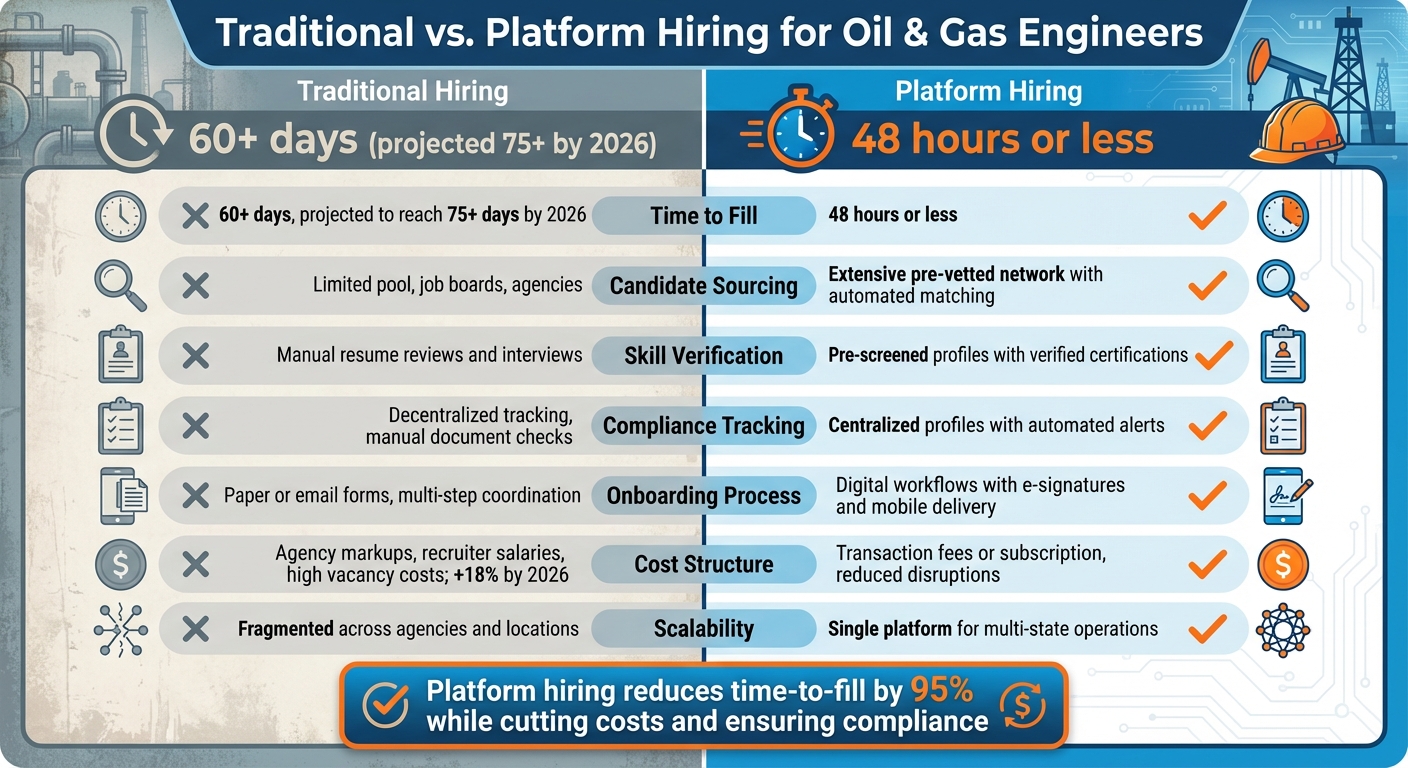
Traditional vs Platform Hiring for Oil and Gas Engineers: Speed and Efficiency Comparison
When it comes to hiring oil and gas engineers, traditional methods rely heavily on internal recruiters, staffing agencies, and job boards. These approaches often involve time-consuming steps like manual resume reviews, scheduling interviews, and collecting compliance documents through email or even paper forms. The process can be bogged down by inefficiencies, especially when verifying licenses, safety certifications, or coordinating with engineers who are on rotation. Add in the need to meet OSHA, DOT, and state regulations, and you’re looking at delays that can stretch the time-to-fill by weeks – a real challenge when projects face unexpected shutdowns or urgent needs in remote locations. This is where platform-based hiring offers a modern, efficient alternative.
By leveraging technology, platform hiring simplifies and accelerates the entire process. Instead of starting from scratch with every new role, platforms provide access to pre-vetted talent pools. These profiles are structured to include everything from skills and certifications to recent project experience, location, and availability. With automated candidate matching, hiring managers can identify the right engineer in hours rather than days or weeks. Additionally, digital workflows streamline onboarding by automating the collection of essential forms like I-9s, W-4s, NDAs, and site-specific documents. Mobile-first platforms even deliver assignments, directions, and pre-read safety materials directly to workers, cutting down on orientation time once they arrive on-site.
Compliance management is another area where platform hiring stands out. Traditional methods often rely on fragmented systems, making it hard to track whether every worker has up-to-date certifications. In contrast, platform-based systems centralize compliance, storing all documentation in a single digital profile. Tools like ABLEMKR ensure that only workers meeting all requirements are assigned, turning compliance checks into a proactive process rather than reactive spot-checks.
The cost difference between the two approaches is also striking. Traditional hiring comes with agency markups, recruiter salaries, and the high costs of project delays caused by unfilled positions or non-compliant workers being turned away. Platform hiring, on the other hand, typically operates on a transaction fee or subscription model, reducing recruiting expenses and minimizing the risks of non-compliance. By consolidating hiring efforts into one system, operators can manage costs more effectively across multiple locations, improving both budgeting and forecasting.
To put it all into perspective, here’s a side-by-side comparison of traditional and platform hiring:
Comparison Table: Traditional vs. Platform Hiring
| Aspect | Traditional Hiring | Platform Hiring |
|---|---|---|
| Time to Fill | 60+ days, projected to reach 75+ days by 2026 | 48 hours or less |
| Candidate Sourcing | Limited pool, job boards, agencies | Extensive pre-vetted network with automated matching |
| Skill Verification | Manual resume reviews and interviews | Pre-screened profiles with verified certifications |
| Compliance Tracking | Decentralized tracking, manual document checks | Centralized profiles with automated alerts |
| Onboarding Process | Paper or email forms, multi-step coordination | Digital workflows with e-signatures and mobile delivery |
| Geo-Location & Mobilization | Manual self-reporting, generic travel estimates | GPS-based filtering, real-time tracking, proximity matching |
| Worker Status Visibility | Phone calls, delayed email updates | Live dashboards with GPS check-ins and task tracking |
| Timesheet & Payroll | Paper timesheets, manual entry, delays | Automated time capture, GPS verification, fast payouts |
| Cost Structure | Agency markups, recruiter salaries, high vacancy costs; +18% by 2026 | Transaction fees or subscription, reduced disruptions |
| Scalability | Fragmented across agencies and locations | Single platform for multi-state operations |
Conclusion
Hiring oil and gas project engineers quickly is essential for maintaining both quality and compliance. The six steps outlined in this guide – defining necessary certifications and experience, tapping into pre-vetted talent pools with automated matching, digitizing onboarding and compliance processes, leveraging geo-location and mobile tools for deployment, tracking worker status in real time, and integrating payroll – can reduce hiring timelines from over 60 days to just a few days. This efficient approach ensures companies can meet urgent project demands without compromising standards.
ABLEMKR brings all six steps together in one streamlined system. By using a live pool of pre-vetted engineers, automated matching ensures candidates meet the required certifications and are immediately available, allowing hiring managers to secure the right talent in hours rather than weeks. Geo-location and mobile tools enable operators to respond to critical needs like shutdowns, pipeline repairs, or turnarounds with precision and speed. These integrated solutions are pivotal in addressing the growing talent gap while avoiding costly delays.
A logical starting point for companies is to test a platform-based approach on a single project or region – such as an upcoming shutdown or a new pipeline spread. This allows operators to compare metrics like time-to-fill, compliance results, and overall costs with traditional methods. Once the benefits are clear, expanding these digital workflows across additional projects and locations can make fast, compliant hiring a standard practice.
With the oil and gas industry facing a projected 22% talent gap increase by 2028 and hiring costs expected to rise 18% by 2026, treating workforce deployment as a critical system – on the same level as schedule, cost, and safety – can provide a significant competitive advantage. By adopting these six steps and utilizing platforms like ABLEMKR, companies can mobilize teams efficiently, ensure compliance, and keep operations running smoothly, even under tight deadlines and complex conditions.
FAQs
How do pre-vetted talent pools help companies hire engineers faster?
Pre-vetted talent pools make hiring faster and easier by providing a carefully chosen group of skilled engineers who have already been evaluated for their certifications, experience, and compliance. This approach cuts down on the time and effort spent on lengthy interviews and background checks, streamlining the entire process.
With access to pre-vetted professionals, companies can quickly bring in the expertise they need for important projects. This ensures they stay on track with deadlines while meeting all necessary safety and regulatory standards.
How does geo-location technology help deploy engineers faster?
Geo-location technology is a game-changer when it comes to deploying engineers efficiently. By matching pre-vetted professionals to job sites based on their current location, companies can quickly mobilize teams for urgent or hard-to-reach projects.
This technology also offers real-time updates on worker availability and their proximity to job sites. With these insights, businesses can keep operations running smoothly and cut down on delays when time is of the essence.
Why is it important to track compliance in real time for oil and gas projects?
Real-time compliance tracking plays a crucial role in the oil and gas industry by ensuring safety, minimizing risks, and keeping operations running smoothly. With the ability to instantly verify worker certifications, confirm safety training, and check regulatory compliance, companies can sidestep expensive delays and potential legal troubles.
This system gives project managers peace of mind, knowing that every team member on-site meets the necessary standards. The result? A safer, more efficient work environment for everyone involved.


