
Working offshore? Health risks are a big deal. Whether it’s cramped spaces, limited medical access, or contagious illnesses spreading fast, staying prepared is non-negotiable. Employers must follow strict health checks and vaccination protocols to keep crews safe and operations stable. Here’s what matters most:
- Pre-Deployment Health Checks: Workers need a valid OEUK medical certificate, physical/mental fitness tests, and compliance with weight limits for evacuation equipment.
- Vaccinations: Core vaccines (like Tetanus, Hepatitis B, and COVID-19) are mandatory. Region-specific shots (e.g., Yellow Fever) may also be required.
- Continuous Monitoring: Regular health checks during deployment and tools like ABLEMKR help track certifications and vaccination updates.
Skipping these steps risks health, safety, and legal compliance. Proper planning ensures crews are ready for the challenges of offshore work.
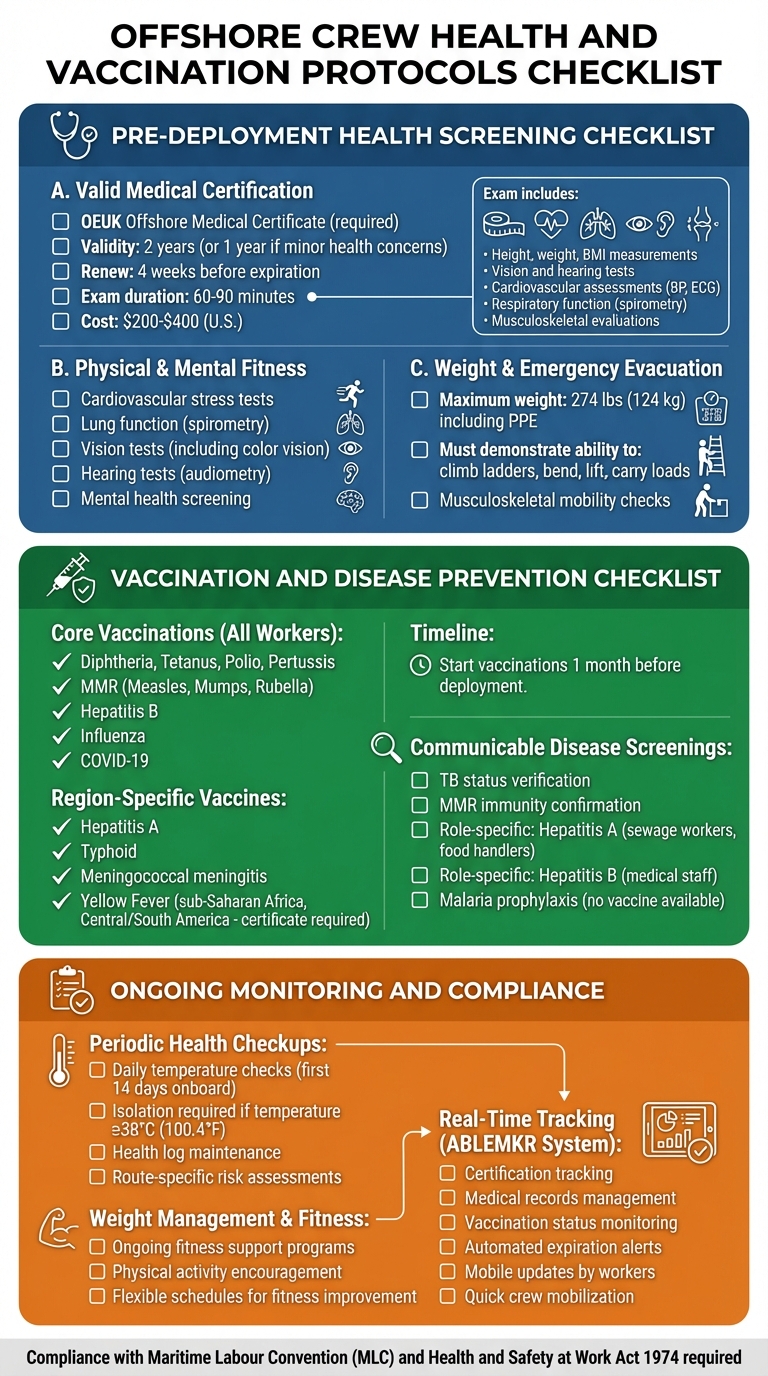
Offshore Crew Health and Vaccination Protocol Checklist
Protecting the Mental Health of Offshore Workers
Pre-Deployment Health Screening Checklist
Offshore workers must pass strict health screenings to demonstrate their physical and mental preparedness for deployment. The OEUK (formerly OGUK) Offshore Medical Certificate is a globally recognized requirement for offshore work. Without it, workers are not permitted to board offshore installations.
Valid Medical Certification
Every offshore worker is required to have a valid OEUK medical certificate issued by an approved clinic. This certificate verifies that the individual is fit – both physically and mentally – for offshore duties. Typically, the certificate is valid for 2 years, though it may be limited to 1 year if minor health concerns are identified. Workers should renew their certificates at least 4 weeks before they expire.
The medical exam itself takes about 60–90 minutes and includes several evaluations, such as:
- Height, weight, and BMI measurements
- Vision and hearing tests
- Cardiovascular assessments, including blood pressure checks and ECGs if needed
- Respiratory function tests using spirometry
- Musculoskeletal evaluations
The certification is accepted worldwide, covering areas like the North Sea, Middle East, Asia, Africa, and the U.S. In the United States, the exam typically costs between $200 and $400. Employers are advised to use real-time tracking systems to monitor certificate expiration dates.
Next, a more detailed assessment ensures workers are fully prepared for the physical and mental challenges of offshore work.
Physical and Mental Fitness Assessment
The OEUK medical exam dives deeper than basic health checks. Cardiovascular tests, including blood pressure and heart rhythm evaluations, ensure workers can handle high-stress emergency situations. Lung function is tested through spirometry to confirm sufficient stamina for demanding tasks, such as climbing rig structures. Vision tests, including color vision, are critical for interpreting safety signals, while hearing is assessed through audiometry to ensure workers can function effectively in noisy environments.
Mental health is another important focus. Workers undergo screenings to evaluate stress resilience and review medical histories for any conditions that could impair judgment or safety in high-pressure roles. To prepare for the exam, workers should:
- Bring medical records for chronic conditions (e.g., diabetes or asthma)
- Bring prescribed glasses or contact lenses
- Avoid alcohol and smoking for 24 hours before the exam
These evaluations ensure that workers are equipped for both routine duties and emergency scenarios.
Weight and Emergency Evacuation Requirements
Physical assessments also evaluate whether workers can handle emergency tasks, such as climbing ladders, bending, lifting, and carrying loads. Compliance with helicopter and lifeboat weight limits is essential, with a common maximum weight of 274 lbs (124 kg), including personal protective equipment. Adhering to these limits ensures compatibility with evacuation equipment.
Musculoskeletal checks focus on the spine, joints, and overall mobility to confirm workers can safely perform manual tasks and evacuate in emergencies. Conditions like uncontrolled high blood pressure, severe sensory impairments, or substance abuse can lead to exam failure. However, failing the medical does not necessarily end a career. Workers can seek treatment, consult specialists, and reapply for certification once their condition improves.
Vaccination and Disease Prevention Checklist
After thorough pre-deployment health checks, vaccination protocols play a critical role in safeguarding offshore crew members. These vaccinations protect workers from infectious diseases, especially during deployments to high-risk, multi-country regions. It’s essential to ensure all required immunizations are up to date before deployment. As highlighted by the Maritime & Coastguard Agency:
"Shipowners and employers have a duty to protect the health and safety of workers… including providing and paying for relevant pre travel preventive measures such as immunisations and malaria prophylaxis."
Below is a breakdown of the core, region-specific, and communicable disease protocols to follow.
Core Vaccinations
All offshore workers should have up-to-date immunizations for Diphtheria, Tetanus, Polio, Pertussis, MMR (Measles, Mumps, Rubella), and Hepatitis B. Tetanus boosters are particularly crucial since workers often handle equipment that can lead to cuts or punctures. In addition, vaccinations for Influenza and COVID-19 are mandatory in densely populated offshore environments to minimize respiratory outbreaks.
Employers should initiate the vaccination process at least one month before deployment to ensure full immunity. Depending on the deployment location, additional vaccines may also be required.
Region-Specific Vaccines
For assignments beyond North America and allied regions, workers may need extra immunizations. Common examples include vaccines for Hepatitis A, Typhoid, and Meningococcal meningitis. In certain areas, such as sub-Saharan Africa and parts of Central and South America, Yellow Fever vaccination is mandatory, along with an internationally recognized vaccination certificate for entry.
Employers should consult occupational health professionals or trusted resources like the National Travel Health Network and Centre (NaTHNaC) to identify specific vaccine requirements based on the vessel’s planned route and ports of call.
Communicable Disease Screenings
In addition to vaccinations, targeted screenings can further enhance crew safety. These include verifying TB status and confirming immunity to MMR. Screenings should be tailored to job responsibilities:
- Sewage maintenance workers: Require protection against Hepatitis A.
- Medical staff: Must have confirmed immunity to Hepatitis B.
- Food handlers: Should be screened for Typhoid and Hepatitis A, especially if they come from or work in endemic areas.
Since no vaccine exists for malaria, prevention depends on prophylactic medication and avoiding insect bites. This includes using repellents and mosquito nets to reduce risk effectively.
sbb-itb-aa28329
Ongoing Monitoring and Compliance
Once pre-deployment protocols are met, the work doesn’t stop there. Continuous monitoring offshore is critical to ensure compliance and maintain the well-being of workers. The Maritime Labour Convention (MLC) requires employers to have systems in place to monitor worker health throughout their deployment.
Periodic Health Checkups
For extended assignments, regular health checkups are essential to ensure workers remain fit for duty. Employers should stay informed about ship routes and destinations to prepare for any health risks specific to those regions as vessels move between ports. During the first 14 days onboard, daily temperature checks should be conducted, and a health log maintained. If a worker’s core body temperature reaches 38°C (100.4°F) or higher, they must be isolated immediately for further evaluation.
Consistent health monitoring isn’t just about compliance – it’s about ensuring workers are supported throughout their deployment.
Weight Management and Fitness Support
Rather than disqualifying workers outright, employers can offer programs to help them meet fitness standards for future deployments. Encouraging physical activity, combined with flexible schedules, can make it easier for workers to focus on improving their fitness levels.
Real-Time Tracking with ABLEMKR

The ABLEMKR system simplifies health and certification management by tracking worker certifications, medical records, and vaccination statuses in real time across offshore locations. Workers can update their health documentation directly from their smartphones, while automated alerts notify managers when certifications are about to expire. This streamlined system allows crews to be mobilized quickly for urgent tasks, such as shutdowns or remote repairs. By integrating real-time tracking from initial health screenings through final demobilization, ABLEMKR ensures crew readiness is maintained without interruptions.
Conclusion
Offshore health and vaccination protocols play a critical role in protecting lives and keeping operations running smoothly. When employers establish strong health measures, they not only safeguard their workforce but also minimize costs linked to sick leave, avoid costly medical evacuations, and prevent disruptions that could jeopardize entire projects.
Work-related illnesses affect far more workers than industrial accidents ever do. In tightly packed offshore environments, illnesses like Norovirus can spread quickly, making proactive vaccination and hygiene measures essential. These efforts protect not just individual employees but entire teams and project schedules.
Beyond operational benefits, these protocols help companies meet strict legal obligations. Adhering to regulations like the Health and Safety at Work etc Act 1974 and the Maritime Labour Convention ensures compliance while promoting workforce well-being. This commitment to health and safety not only reduces risks but also supports long-term operational success, as illnesses often cause more prolonged challenges than accidents.
A structured approach – covering everything from pre-deployment screenings to continuous health monitoring – provides a solid foundation for safety and efficiency. Digital tools like ABLEMKR make it easier for employers to manage health certificates, vaccination records, and fitness assessments in real time, ensuring compliance and enabling quick crew mobilization. This integrated strategy keeps worker health at the forefront of offshore operations.
By prioritizing robust health protocols, companies create a safer, more caring work environment. As the Health and Safety Executive emphasizes:
"The main responsibility for controlling risks lies with those whose operations create them, so the owner or operator of an installation has responsibilities to everyone working on the installation".
Ultimately, protecting worker health is not just a legal obligation – it’s a cornerstone of every successful offshore operation.
FAQs
What vaccinations are essential for offshore workers before deployment?
Offshore workers often need specific vaccinations to protect themselves and others in their work environment. Commonly recommended vaccines include hepatitis B, Tdap (tetanus, diphtheria, and pertussis), and influenza. Depending on the job site or region, additional vaccinations might also be required to address localized health risks.
Employers are encouraged to work closely with medical professionals or occupational health services to determine the appropriate vaccinations for their workforce. Following these health guidelines not only safeguards the well-being of employees but also helps ensure operations run smoothly in challenging work conditions.
What is the purpose of the OEUK medical certificate for offshore workers?
The OEUK medical certificate is designed to ensure that offshore workers are both physically and mentally equipped to face the tough and sometimes risky conditions of offshore environments. It serves as a standardized way to assess whether workers meet the industry’s health and safety standards.
By obtaining this certification, employers can stay aligned with safety regulations while safeguarding the health and well-being of their teams in these demanding work settings.
Why is regular health monitoring crucial for offshore workers?
Keeping a close eye on the health of offshore workers is crucial for catching potential problems early. This ensures they stay fit and capable of handling the physically demanding and often remote nature of their work. Offshore environments leave little room for error, so staying ahead of health concerns is key.
Regular health checks don’t just help individuals – they benefit the entire operation. By addressing health issues proactively, employers can reduce downtime, maintain safety standards, and support workers’ long-term well-being. After all, some conditions may take years to surface but can seriously affect job performance and safety if ignored.


