
Construction noise can harm workers and disrupt communities, but it’s manageable. Here’s how you can reduce noise on job sites effectively:
- Upgrade Equipment: Use quieter machinery like electric compressors or low-noise saw blades to cut noise at the source.
- Install Barriers: Acoustic barriers or enclosures around loud equipment can reduce noise by up to 12 dBA.
- Plan Smartly: Position noisy equipment away from sensitive areas and schedule loud tasks during less disruptive hours.
- Monitor Noise: Real-time noise monitoring helps identify and address problems before they escalate.
- Train Workers: Teach proper equipment use and ensure personal protective equipment (PPE) is worn correctly.
These steps protect workers’ hearing, meet regulations, and avoid project delays caused by noise complaints. Even small changes, like lowering noise by 3 dB, can make a big difference.
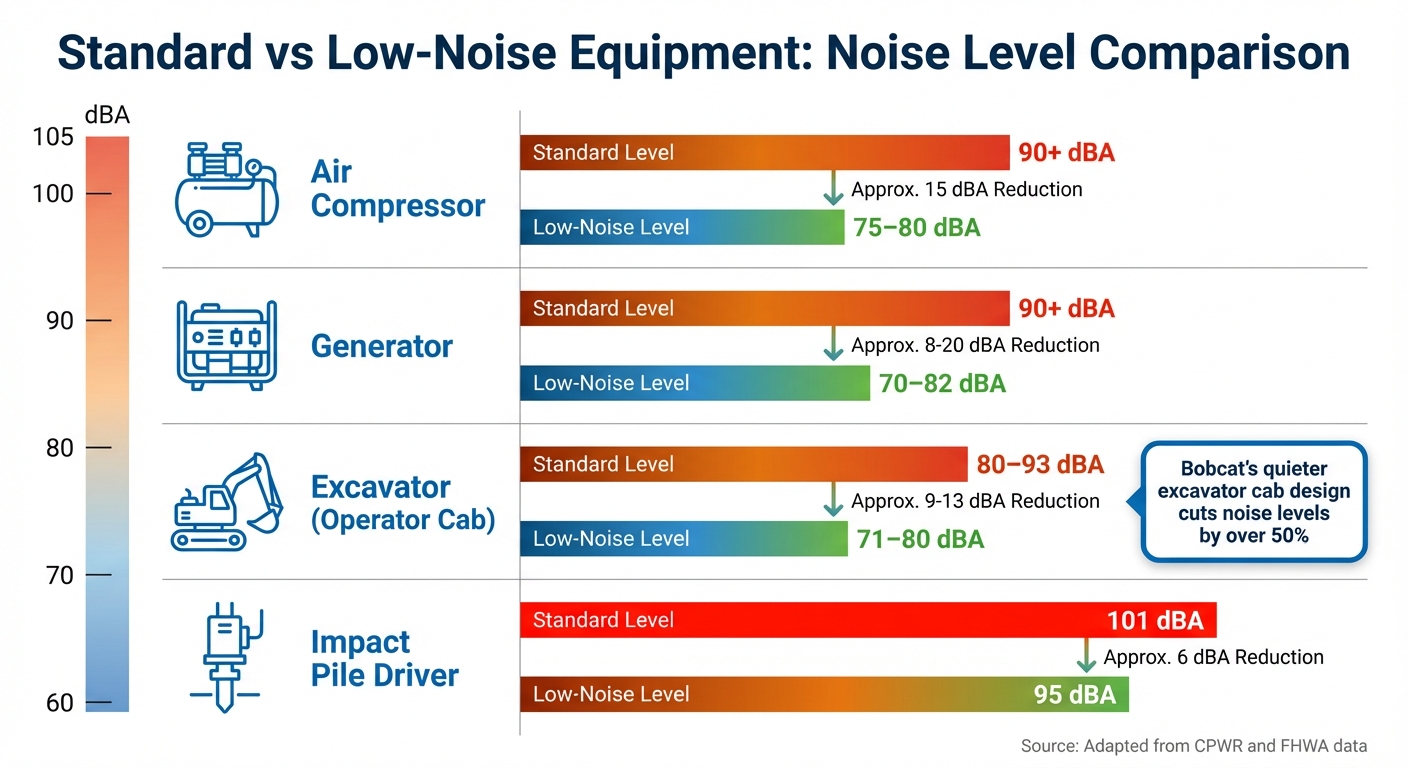
Noise Levels Comparison: Standard vs Low-Noise Construction Equipment
This is how the noise control barriers work most effectively on your construction site!
sbb-itb-aa28329
1. Upgrade to Low-Noise Equipment
Swapping out outdated machinery for low-noise alternatives is one of the most effective ways to tackle noise at its source. Unlike earplugs or administrative controls, this method addresses the issue before it even reaches workers’ ears, making it a proactive and efficient solution. Plus, it lays the groundwork for additional noise-reduction strategies.
For example, Bobcat‘s quieter excavator cab design cuts noise levels by over 50%. Similarly, noise-reducing saw blades can slash sound levels in half during masonry cutting.
How Modern Equipment Reduces Noise
Today’s machinery is engineered with noise reduction in mind. Features like redesigned engine air intakes, advanced cooling systems, upgraded exhaust systems, and vibration-dampening mounts all contribute to quieter operation. Electric compressors and tools tend to be quieter than their diesel or gas-powered counterparts, while hydraulic tools outperform pneumatic ones in noise control.
For particularly loud tasks, substituting the process itself can make a big difference. Impact pile drivers, for instance, generate 101 dBA, but switching to methods like boring, hydraulic insertion, or vibration techniques can significantly reduce noise levels. The Kobelco Integrated Noise and Dust Reduction (INDR) system is a great example – it lowers engine noise by 5 dBA. These advancements not only reduce noise but often deliver long-term cost savings as well.
Is It Worth the Cost?
"The cost of implementing noise controls can be offset by savings on the costs of a hearing loss prevention program, workers’ compensation premiums, and claims for hearing loss." – NIOSH
While low-noise equipment can come with higher upfront costs due to precise manufacturing and specialized parts, these investments frequently pay off. Companies save on workers’ compensation claims, lower insurance premiums, and fewer lawsuits related to hearing loss. On top of that, routine maintenance – like tightening bolts, replacing mufflers, and lubricating components – can cut noise levels by as much as 50%.
Meeting Noise Regulations
Low-noise machinery also helps construction sites comply with both "absolute" noise limits (specific decibel caps for equipment, such as 80 dBA for a backhoe at 50 feet) and "relative" standards (typically no more than 5 dBA above ambient noise levels). This compliance is especially beneficial for projects near sensitive areas like hospitals, schools, or residential neighborhoods, where local ordinances often restrict noisy activities.
| Equipment Type | Standard Level | Low-Noise Level |
|---|---|---|
| Air Compressor | 90+ dBA | 75–80 dBA |
| Generator | 90+ dBA | 70–82 dBA |
| Excavator (Operator Cab) | 80–93 dBA | 71–80 dBA |
| Impact Pile Driver | 101 dBA | 95 dBA |
Source: Adapted from CPWR and FHWA data
2. Install Acoustic Barriers and Enclosures
When upgrading equipment isn’t an option, acoustic barriers and enclosures provide a solid solution to limit noise spread. These physical shields block noise waves, making them particularly useful for stationary machinery like generators, compressors, and HVAC systems. They work well alongside equipment upgrades, especially when replacing machinery isn’t feasible.
Noise Reduction Effectiveness
Properly placed plywood barriers can achieve a 10–12 dBA noise reduction. To maximize their effectiveness, barriers should extend at least 2 feet above the line of sight and be positioned as close as possible to the noise source or receiver.
However, barriers aren’t perfect. They are most effective at blocking mid- to high-frequency sounds from activities like grinding or cutting but struggle with low-frequency noise. For those deeper sounds, a fully sealed enclosure made of dense materials like brick or sheet steel is necessary. Adding sound-absorbing linings – such as mineral wool or foam – on the side facing the noise source prevents sound reflections, which can otherwise amplify noise on-site.
Ease of Implementation
Temporary noise barriers are lightweight, modular, and can be assembled in about 15 minutes. Many systems are also mountable, making them ideal for semi-permanent setups around continuously running equipment. The key to success? Ensure there are no gaps or holes. Even small openings can allow noise, especially low-frequency sounds, to escape.
Compliance with Regulations
Like equipment upgrades, acoustic barriers help meet both "absolute" noise limits (fixed decibel caps for specific equipment) and "relative" standards (typically no more than 5 dBA above the ambient noise level). Regulations vary depending on location and time of day. For example, noise-sensitive areas like hospitals and residential neighborhoods have stricter limits, particularly during evening and nighttime hours.
| Receptor Type | Daytime Limit (7 AM – 6 PM) | Evening Limit (6 PM – 10 PM) | Nighttime Limit (10 PM – 7 AM) |
|---|---|---|---|
| Noise-Sensitive (Residences, Hospitals) | 75 dBA or Baseline + 5 | Baseline + 5 | Baseline + 3 to 5 |
| Commercial (Offices, Stores) | 80 dBA or Baseline + 5 | N/A | N/A |
| Industrial (Factories, Plants) | 85 dBA or Baseline + 5 | N/A | N/A |
Source: Adapted from FHWA/Central Artery/Tunnel Noise Specifications
Cost Efficiency
While there is an upfront cost for barriers, they can save money in the long run by avoiding project delays and reducing workers’ compensation claims for hearing-related issues. High-performance acoustic barriers not only cut down noise but also help maintain smooth operations without triggering community complaints or violating regulations.
"Effective construction noise management isn’t just about compliance – it’s about extending work hours, maintaining community relations, and ensuring project success." – Matt R. Cott
3. Optimize Site Layout and Scheduling
Beyond equipment upgrades and acoustic barriers, smart site planning offers a practical way to reduce noise without adding material costs.
Strategic site planning can significantly lower noise levels. By carefully positioning equipment and scheduling operations, noise exposure can be reduced effectively. For example, doubling the distance from a stationary noise source decreases noise exposure by about 6 dBA. For linear noise sources, like haul roads, doubling the distance results in a 3 dBA reduction.
Noise Reduction Effectiveness
Placing exhausts and engine compartments away from sensitive areas such as homes, schools, and hospitals can noticeably reduce noise levels. It’s also crucial to avoid placing noisy machinery against hard walls or in corners, as these surfaces amplify sound through reflection. As NIOSH explains:
"The closer you place the noise source to a hard surface, the louder the reflected noise will be. Usually, the best placement for a noise source is away from the walls and suspended between the floor and ceiling".
Natural site features like earth berms, material storage piles, or trailers can act as barriers, creating "sound shadows" that protect workers and nearby communities from excessive noise. Running multiple noisy operations simultaneously, rather than spreading them out, can also help, as the overall noise level rarely exceeds that of the loudest individual operation. These strategies not only reduce noise but can also streamline site operations.
Cost Efficiency
This approach to noise control is budget-friendly. By using distance, orientation, and existing site elements, noise mitigation becomes a cost-effective alternative to more expensive solutions like specialized acoustic enclosures. Additionally, reducing noise can help avoid costs associated with workers’ compensation claims or legal disputes. These methods integrate easily with other noise management techniques already in use.
Ease of Implementation
Making these adjustments on-site is straightforward. For instance, shutting down unused equipment, centralizing portable machinery, and rotating workers between noisy and quieter tasks require no special tools. Establishing noise perimeter zones – areas where noise levels reach 90 dBA or higher – can help enforce hearing protection policies and restrict access to essential personnel only.
Compliance with Regulations
For projects operating around the clock, a tiered scheduling approach can help meet local noise regulations. Full operations can take place during unrestricted daytime hours (typically 7 AM to 6 PM), scaled-back activities can occur in the evening, and minimal-impact work can be reserved for overnight shifts. Conducting baseline ambient noise surveys can further ensure compliance. Since residential noise limits often drop to baseline + 3 to 5 dB during nighttime hours, scheduling the loudest activities during mid-day (typically 10 AM to 4 PM) can help meet legal requirements while minimizing disruptions to the community.
4. Implement Real-Time Noise Monitoring
Real-time noise monitoring systems provide immediate alerts when sound levels approach regulatory limits. This allows project managers to step in and address the issue before it escalates into a violation. This quick feedback is especially helpful for projects near sensitive areas like homes, schools, or hospitals, where excessive noise can lead to complaints, delays, or even legal challenges.
By analyzing the collected data, teams can identify noise trends and pinpoint problem areas. For instance, monitoring might show that impact pile drivers producing 101 dBA are the main culprits behind complaints, while smaller generators operating at 73 dBA cause fewer issues.
Compliance with Regulations
Continuous monitoring not only helps maintain compliance but also provides documented evidence of proactive measures. As Matt R. Cott points out, real-time monitoring ensures adherence to regulations and offers proof of efforts to manage noise effectively. This documentation is invaluable in cases of complaints or disputes, shielding contractors from fines or project delays.
For workplace safety, OSHA mandates a hearing conservation program for workers exposed to an 8-hour time-weighted average of 85 dBA or higher. Additionally, reducing noise levels by even a single decibel can save an estimated $100 in long-term costs tied to noise hazards. This makes investing in monitoring systems a practical way to lower expenses related to workers’ compensation claims and hearing loss prevention programs.
Ease of Implementation
Setting up real-time noise monitoring doesn’t require expensive equipment. The NIOSH Sound Level Meter App, available for free on iOS devices, offers a simple way to screen noise levels. For more robust monitoring, you can establish different alert thresholds for daytime, evening, and nighttime operations to align with community expectations and regulatory requirements. Incorporating these protocols into the site’s Noise Management Plan ensures a clear process for addressing alerts. This integration complements other noise control measures on-site, creating a safer and more compliant work environment.
5. Provide Worker Training and PPE
To round out a complete noise control strategy, worker training and proper use of personal protective equipment (PPE) are crucial. These measures build on the foundation of equipment upgrades, acoustic barriers, site planning, and monitoring, ensuring comprehensive protection.
Educating workers about noise hazards and the correct use of PPE adds an extra layer of safety, especially when engineering controls alone aren’t enough. It’s all about making sure workers understand why and how to protect themselves effectively.
Compliance with Regulations
According to OSHA’s Occupational Noise Exposure Standard (29 CFR 1910.95), employers must implement a hearing conservation program when noise exposure reaches 85 dBA as an 8-hour time-weighted average. This program includes noise monitoring, audiometric testing, hearing protection, and employee training. Once noise levels hit 90 dBA, OSHA mandates control measures.
A simple way to check compliance? The 2-to-3 foot rule: if someone has to shout to be heard from 2 to 3 feet away, the noise level is likely at or above 85 dBA, meaning hearing protection is necessary.
Cost Efficiency
Training workers to maintain equipment properly doesn’t just protect hearing – it can also cut noise levels by up to 50%. This makes training a smart investment, complementing other noise control efforts while saving costs.
Ease of Implementation
Making PPE readily available at all job site locations encourages workers to use it consistently. Tools like the NIOSH Sound Level Meter app for iOS devices can help workers quickly check equipment noise levels. Training should emphasize proper PPE fit – earplugs and earmuffs only work as intended when worn correctly. Administrative controls, such as using modern construction staffing to rotate workers out of high-noise areas and reduce exposure time, should also be part of the training. For particularly noisy environments, combining earplugs with earmuffs offers the highest level of protection.
Despite the risks, only 52% of construction workers regularly wear hearing protection. This statistic underscores the importance of training. Workers need to grasp that noise-induced hearing loss is permanent but entirely preventable with simple precautions. Dr. John Howard, Director of NIOSH, puts it best:
"Hearing loss can greatly impact a worker’s overall health and well-being".
Conclusion
Managing noise effectively not only protects workers but also plays a key role in the success of construction projects. The strategies discussed earlier work together to prevent permanent hearing damage, reduce stress-related fatigue, and ensure a healthier, more productive workforce. By focusing on noise control, companies can also avoid costly OSHA violations, workers’ compensation claims, and delays caused by community complaints.
Even small reductions in noise – achieved through equipment maintenance, acoustic barriers, and thoughtful site planning – can lead to big benefits. These include improved worker health and regulatory compliance, with potential savings of $100 per decibel reduced in long-term costs associated with noise hazards. This highlights how equipment upgrades, acoustic solutions, strategic planning, and real-time monitoring can deliver measurable results on job sites.
Effective noise management also strengthens relationships with local communities. It reduces conflicts and allows for extended work hours without breaching local noise ordinances. As Matt R. Cott, author of the Construction Noise Handbook, explains:
"Effective construction noise management isn’t just about compliance – it’s about extending work hours, maintaining community relations, and ensuring project success".
By combining these strategies, companies can create a well-rounded noise control plan that enhances both safety and efficiency. Workers benefit from better communication and hearing protection, while job sites operate more smoothly. This approach demonstrates that prioritizing safety, operational efficiency, and social responsibility is not only possible but essential.
Additionally, tools like ABLEMKR‘s mobile-first platform simplify workforce deployment and compliance tracking, ensuring that noise mitigation efforts contribute to safer job sites and improved operational performance.
FAQs
What are the best noise controls to start with on a tight budget?
Start with budget-friendly administrative measures to tackle noise pollution on job sites. For instance, opt for quieter equipment, ensure machinery is properly maintained, and position noisy tools or machines as far away as possible from workstations. These simple steps are both practical and easy on the wallet, making them effective first-line solutions.
How can I tell if my site is exceeding OSHA or local noise limits?
To measure on-site noise levels, use sound level meters or noise dosimeters. These tools help determine if noise exposure exceeds OSHA’s threshold of 85 dBA over an 8-hour workday. It’s also important to check local regulations, as they may have additional noise exposure limits. Regularly monitoring noise levels not only ensures compliance but also helps safeguard workers from potential hearing damage.
What’s the easiest way to reduce complaints from nearby residents?
Reducing complaints from nearby residents can be as simple as adopting effective noise control measures. For instance, constructing noise barriers can significantly dampen sound, scheduling louder activities during times when they’re less likely to disturb, and opting for quieter equipment can make a big difference. These practical steps help ensure the surrounding community experiences less disruption while allowing work on-site to continue smoothly.


