
The National Labor Relations Board (NLRB) and the Department of Labor (DOL) have introduced major updates in 2026 that affect worker classification and union rights:
- NLRB Reinstates 2020 Joint Employer Standard: As of February 25, 2026, a business is a joint employer only if it has "substantial direct and immediate control" over employment terms like wages and hours. Indirect influence or unused authority doesn’t qualify.
- DOL Proposes New Independent Contractor Rule: On March 2, 2026, the DOL proposed replacing the stricter 2024 rule with a 2021 economic reality test. This test focuses on two main factors: employer control and workers’ profit or loss opportunities. Public comments are open until April 28, 2026.
These changes impact industries like construction, energy, and infrastructure, where staffing agencies and subcontractors are common. Employers now face stricter requirements to prove direct control, while workers classified as independent contractors lose unionization rights under the National Labor Relations Act (NLRA). Compliance depends on actual practices, not just contracts, making it critical for businesses to align their operations with these standards.
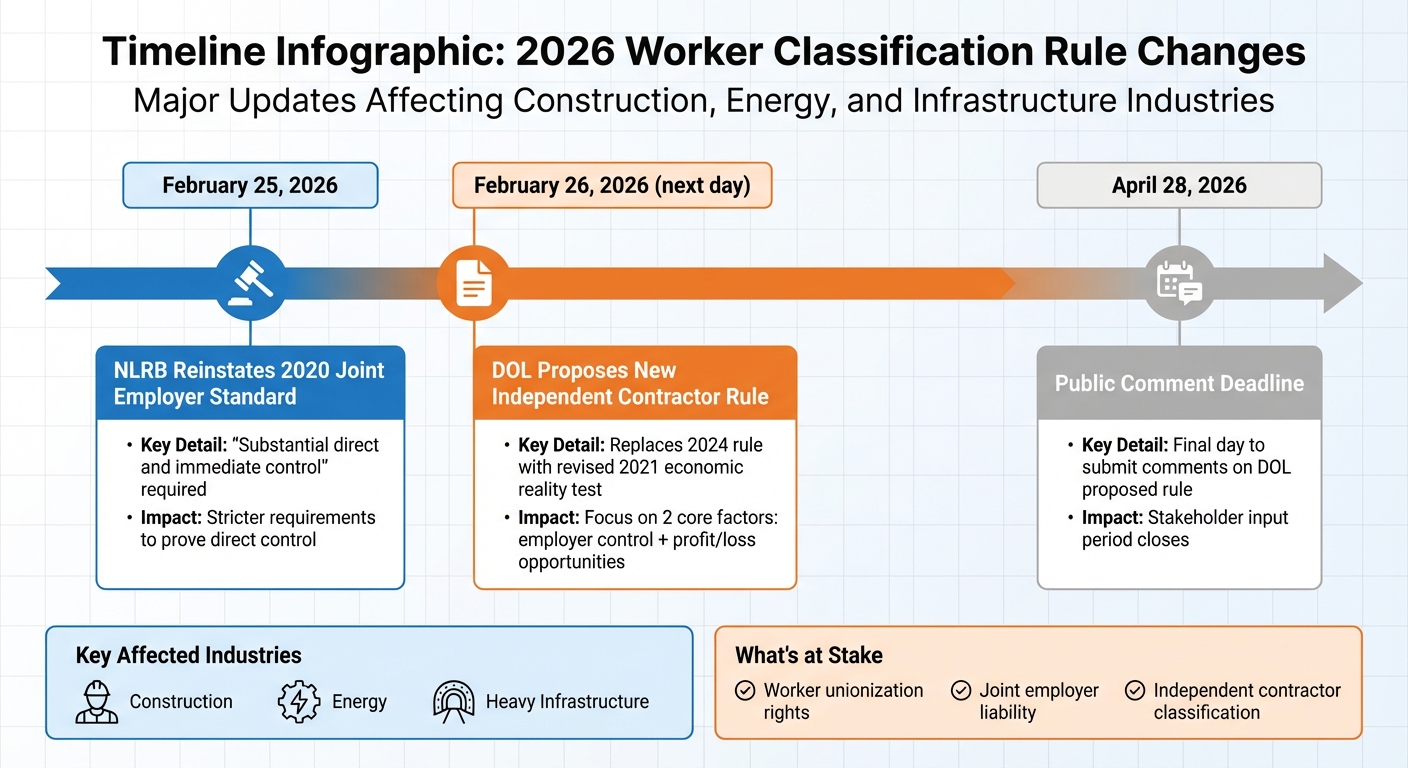
2026 NLRB and DOL Worker Classification Rule Changes Timeline
Worker Classification: Employees vs. Independent Contractors
Legal Standards for Worker Classification
The line between employees and independent contractors boils down to one key question: Are workers truly independent, or are they dependent on an employer? This distinction carries significant implications for taxes, benefits, and union rights.
The Department of Labor (DOL) applies a five-factor "economic reality" test under the Fair Labor Standards Act (FLSA). As of the proposed rule on February 26, 2026, the test emphasizes two "core factors" above the others: the degree of control an employer has over the work and the worker’s ability to experience profit or loss based on their own efforts. These two factors hold more weight than the remaining three, making it somewhat simpler for businesses to classify workers as independent contractors compared to the stricter 2024 standard.
Meanwhile, the National Labor Relations Board (NLRB) uses a more comprehensive approach. In the Atlanta Opera, Inc. decision, the NLRB adopted a holistic agency test, evaluating all aspects of the worker-employer relationship without focusing on a single factor. The Board has shifted away from prioritizing "entrepreneurial opportunity" and instead examines whether workers realistically have the ability to work for others, retain ownership in their work, and make independent business decisions.
Notably, the DOL’s independent contractor test has been revised three times in just five years. These shifting legal frameworks have a direct impact on workers’ rights, particularly when it comes to unionization.
How Classification Affects Unionization Rights
Worker classification plays a critical role in determining union rights and employer responsibilities. Independent contractors fall outside the protections of the National Labor Relations Act (NLRA). This means they lack statutory rights to unionize, engage in collective bargaining, or strike. Only employees are entitled to these protections.
For workers classified as employees, employers are legally required to bargain with their unions. The NLRB outlines key employment terms that are subject to bargaining, including wages, benefits, work hours, hiring practices, disciplinary actions, and supervision.
The reinstated 2020 joint employer rule adds another layer of complexity. Under this rule, if two businesses both exercise "substantial direct and immediate control" over workers, they share responsibility for bargaining obligations and liability for unfair labor practices. This is particularly impactful in industries that rely heavily on staffing agencies, subcontractors, or franchise models, where worker classification can have far-reaching consequences.
Recent NLRB Rulings and Their Effects
The 2020 Joint Employer Rule Reinstatement
On February 25, 2026, the NLRB reinstated the 2020 joint employer standard, replacing the broader 2023 rule that had been struck down by a federal court. This decision aligns with the U.S. District Court for the Eastern District of Texas’s March 2024 ruling, which vacated the 2023 rule.
The reinstated 2020 rule defines a joint employer as a company that both possesses and exercises “substantial direct and immediate control” over essential employment terms. These terms are limited to eight key employment factors, and indirect influence or unexercised contractual authority no longer meet the criteria.
"The reinstated rule rewards structures where the direct employer retains authority over day-to-day employment decisions and the contracting entity limits its role to setting business objectives and performance standards." – Andrea James and Carson Blakely, Attorneys, Holland & Knight
This adjustment raises the bar for companies like staffing agencies, subcontractors, and franchises when it comes to bargaining obligations. They now face fewer situations where they must negotiate with unions representing workers employed by a secondary employer. However, legal uncertainty persists, as the Service Employees International Union (SEIU) has challenged the 2020 rule, with the case now pending in the U.S. Court of Appeals for the District of Columbia Circuit.
These changes also pave the way for updates to independent contractor standards.
Updated Independent Contractor Standards
The Department of Labor (DOL) is simultaneously revising independent contractor standards. On February 26, 2026 – just one day after the NLRB reinstated the 2020 joint employer rule – the DOL proposed rescinding the 2024 independent contractor standard in favor of an updated version of the 2021 economic reality test. Public comments on this proposal are being accepted through April 28, 2026.
This proposed standard focuses on two main factors: the degree of control over the work and the worker’s opportunity for profit or loss. Compared to the 2024 totality-of-the-circumstances approach, this revision simplifies the process, making it somewhat easier for businesses to classify workers as independent contractors.
These rulings reflect a shift toward evaluating actual practices rather than relying on contractual terms. The joint employer standard has seen significant changes since 2015, moving from the broader Browning-Ferris framework to the narrower 2020 rule, briefly transitioning to the 2023 rule, and now returning to the 2020 standard. This back-and-forth highlights the need for businesses to keep a close eye on their day-to-day operations, as both the NLRB and DOL increasingly emphasize real-world actions when determining worker status.
Effects on Construction, Energy, and Heavy Infrastructure Industries
Employer Compliance Requirements
The reinstated 2020 joint employer rule presents immediate hurdles for construction, energy, and heavy infrastructure companies that depend on subcontractors and staffing agencies. To qualify as joint employers, these businesses must now demonstrate direct control over key employment factors like wages, benefits, hours, hiring, firing, discipline, supervision, and work direction.
Under this "direct control" standard, companies are not automatically liable for merely having unused contractual authority. However, if a general contractor actively assigns tasks, sets schedules, or disciplines workers employed by a subcontractor, they could risk being classified as a joint employer.
Additionally, the Department of Labor’s proposed independent contractor rule – open for public comment until April 28, 2026 – shifts focus to two primary factors: the degree of control over the work and the worker’s ability to influence profit or loss. This approach simplifies the previous, more complex totality-of-the-circumstances analysis. Still, companies could face joint and several liability for unfair labor practices if they are found to significantly impact the employment relationship of subcontractor workers. While indirect control alone isn’t enough to establish joint-employer status, it can strengthen the case when combined with evidence of direct control.
It’s also worth noting that federal rules don’t override stricter state laws. Many states use tougher classification tests, like the "ABC test", to determine compliance with wage, hour, and workers’ compensation regulations. These evolving compliance standards are reshaping employer responsibilities and redefining how they interact with unions.
New Unionization Opportunities for Workers
As compliance becomes more stringent for employers, unionization options for workers have narrowed. Under the reinstated 2020 standard, workers employed by subcontractors or staffing agencies can only bargain with their direct employer. A secondary employer – such as a general contractor or project owner – must exhibit substantial direct and immediate control for unions to extend bargaining obligations.
Critics argue this standard limits workers’ ability to organize effectively. Senator Patty Murray described the 2020 rule as giving "the biggest corporations cover to deny workers their ability to band together for better wages and working conditions and leaving millions of workers in the lurch, vulnerable to egregious violations of their rights". Workers classified as independent contractors under the proposed DOL rule would also lose their right to organize and bargain collectively under the NLRA. This is especially impactful in the construction industry, where independent contractor arrangements are prevalent.
The AFL-CIO has supported the 2024 rule for its attempts to curb the practice of misclassifying workers as independent contractors, which often deprives them of protections under the Fair Labor Standards Act. However, ongoing legal disputes could alter these standards again, potentially reopening unionization opportunities that are currently restricted.
These changes highlight the broader regulatory shifts shaping worker classification and employer liability in these industries.
sbb-itb-aa28329
How ABLEMKR Helps Navigate Workforce Compliance

Using Technology for Classification Compliance
ABLEMKR’s platform simplifies compliance with the eight employment categories outlined in the reinstated 2020 Joint Employer rule. By offering real-time compliance insights, it provides workforce visibility without exerting direct control over employment terms, a critical factor for staying within legal boundaries.
The platform’s verified worker profiles play a key role in proper classification. By confirming workers’ certifications, skills, and employment status, ABLEMKR helps employers avoid misclassification issues. This is particularly important since the National Labor Relations Board (NLRB) has previously ruled that misclassifying workers as independent contractors can, on its own, violate the National Labor Relations Act (NLRA). With ABLEMKR, employers can document their good faith efforts and the legal reasoning behind their classifications, helping to counter claims that misclassification was done intentionally to avoid unionization.
ABLEMKR also keeps employers prepared for regulatory updates, such as the Department of Labor’s March 2026 proposal. This proposal shifts focus to whether workers are economically dependent on their employer. The platform’s automated job matching and transparent cost structures highlight workers’ opportunities for profit and loss – key factors in the Department of Labor’s analysis. By addressing these criteria, ABLEMKR helps employers stay ahead of regulatory changes while supporting worker rights.
Protecting Workers’ Rights and Access to Jobs
ABLEMKR goes beyond compliance by ensuring workers’ rights are upheld. Its W2 employment model and workers’ compensation coverage guarantee that workers receive protections provided under the NLRA, including Section 7 rights to organize and engage in collective activities. The platform also offers guaranteed payments and flexible scheduling, making labor management more efficient while respecting workers’ legal entitlements.
#WorkforceWednesday: NLRB and DOL Take Action on Joint Employer and Independent Contractor Rules
Conclusion
The regulatory framework for worker classification and union rights underwent a major shift in early 2026. The National Labor Relations Board (NLRB) brought back the 2020 joint employer standard, which requires "substantial direct and immediate control" over key employment terms for an entity to qualify as a joint employer. Meanwhile, the Department of Labor (DOL) proposed rolling back the 2024 independent contractor rule in favor of a revised 2021 standard, focusing on direct control and profit opportunities.
These updates carry significant weight for industries like construction, energy, and heavy infrastructure, where subcontracting and staffing arrangements are common. The more specific standards decrease the likelihood of employers being held accountable for subcontractors’ labor practices or being forced into collective bargaining with workers they don’t directly employ. However, legal compliance depends on actual practices – even the best-written contracts won’t shield a company if its operational behavior shows direct control.
As employers adjust to these changes, they must also consider how these shifts impact workers’ rights under the National Labor Relations Act (NLRA). Auditing operational practices is critical to avoid unintentionally exercising direct control over subcontracted workers, as misclassification could lead to NLRA violations. Stakeholders have until April 28, 2026, to submit public comments on the DOL’s proposed rule.
For workers, these clarified standards provide stronger protections that bolster job security and collective bargaining rights. Understanding classification rules empowers workers to recognize when they’re entitled to Section 7 rights under the NLRA, which include organizing and engaging in group activities. Tools like ABLEMKR support both employers and workers by verifying employment profiles, ensuring transparency, and tracking compliance as regulations shift.
The legal environment remains fluid, with the Service Employees International Union challenging the 2020 rule in the D.C. Circuit Court of Appeals. Staying informed and leveraging technology to document classification decisions will be crucial for both employers and workers as these standards continue to evolve. These ongoing changes highlight the need for adaptable, technology-driven compliance systems to navigate the complexities of the regulatory landscape.
FAQs
What counts as “substantial direct and immediate control” under the 2020 joint employer rule?
Under the 2020 joint employer rule, “substantial direct and immediate control” refers to a company’s notable influence over key aspects of an employee’s work conditions. This could involve actions like hiring, firing, disciplining, supervising, or directing employees in a direct and timely manner.
How can I tell if I’m an employee or an independent contractor under the DOL’s proposed 2026 test?
Under the Department of Labor’s proposed 2026 test, your classification – whether as an employee or an independent contractor – will hinge on several key factors. Two primary considerations are the nature and degree of control over your work and your opportunity for profit or loss. Beyond these, the proposed rule includes additional factors that could influence your classification, offering a clearer framework for determining your employment status.
What actions might make a contractor or project owner a joint employer?
Actions that might identify a contractor or project owner as a joint employer revolve around having control over key employment terms such as wages, hours, or working conditions. This could mean directly overseeing work schedules, determining pay rates, or managing daily tasks. Additionally, frequent participation in decisions related to hiring, firing, or employee discipline can play a role. According to the NLRB, the focus is on substantial, direct, and immediate control over these employment terms, as merely having indirect influence doesn’t meet the threshold.


