
Monitoring workforce compliance in the green energy sector is critical to avoid regulatory penalties, project delays, and financial losses. Here’s what you need to know:
- Regulatory Challenges: Compliance with laws like the Inflation Reduction Act and OSHA standards is mandatory. Missteps, such as misclassifying workers or failing to meet prevailing wage requirements, can lead to fines or project shutdowns.
- Workforce Complexity: Managing certifications, work visas, and safety credentials for thousands of workers – especially in large-scale projects like offshore wind farms – requires robust systems.
- Technology Solutions: Digital tools simplify compliance by automating worker verification, tracking certifications, and sending renewal alerts. Platforms like Veriforce WorkerPass and ABLEMKR streamline these processes, reducing administrative burden and improving accuracy.
- Documentation: Proper records, including certified payroll reports and safety certifications, are essential. Non-compliance can result in penalties of up to $10,000 per worker for intentional violations.
- Centralized Platforms: Cloud-based systems consolidate compliance data, making it easier to manage multi-site projects and prepare for audits.
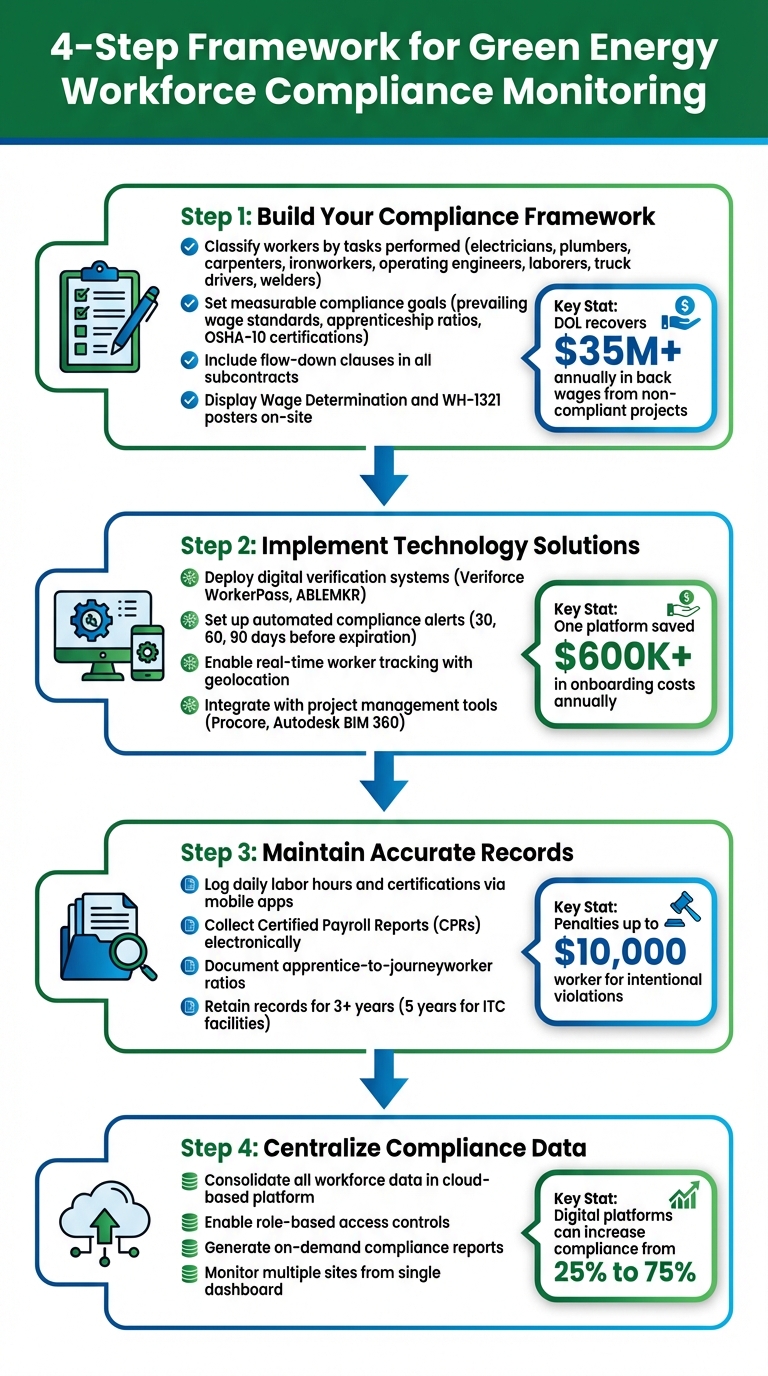
4-Step Framework for Green Energy Workforce Compliance Monitoring
Clean energy, job ready: Building a safe and skilled workforce
sbb-itb-aa28329
Building a Compliance Framework
Creating a reliable compliance framework begins with understanding your workforce and their specific responsibilities. Green energy projects rely heavily on skilled trades, including electricians (inside wiremen), plumbers/pipefitters, carpenters, sheet metal workers, ironworkers, and operating engineers who manage cranes and power equipment. Additionally, support roles such as laborers, truck drivers, flaggers, survey crews, cement masons, and welders must also be included in compliance monitoring efforts. The critical step here is to classify workers based on the tasks they perform on-site, not their job titles or union affiliations. Once these roles are clearly defined, measurable compliance goals can be established.
After identifying your workforce, the next step is setting specific compliance targets. The Inflation Reduction Act has extended Davis-Bacon requirements to clean energy tax credits for solar, wind, and battery storage projects. This means you’ll need to set clear goals around prevailing wage standards, apprenticeship ratios, and safety certifications like OSHA-10. For apprentices, ensure they are registered with the Department of Labor or a state agency; otherwise, they must be paid full journeyman wages. Contractors must be made aware that these compliance requirements are binding contractual obligations, with penalties for non-compliance. Taking these proactive steps can help avoid the costly mistakes seen in earlier projects.
"Compliance doesn’t belong to a single role, it spans energy, legal, operations and sustainability teams." – Equity Energies
Documentation is another critical piece of the puzzle. To avoid compliance issues, include flow-down clauses in every subcontract, display the Wage Determination and WH-1321 "Employee Rights" poster prominently, and ensure materials are translated for multilingual teams. Contractors are required to submit weekly certified payroll reports (Form WH-347), and all records must be retained for at least three years after the project wraps up. Proper documentation is essential, as the Department of Labor recovers over $35 million annually in back wages from non-compliant projects.
Beyond documentation, think of your compliance framework as a communication system rather than just a set of rules. Build contact lists and monitoring plans before construction begins. For example, when Environmental Science Associates acted as a third-party compliance monitor for California’s Arica and Victory Pass solar projects in 2021, they highlighted the importance of strong communication. These projects, designed to produce 465 megawatts of electricity and 400 megawatts of battery storage, required coordination among federal, state, and local stakeholders. Clear expectations and consistent briefings were key to navigating the complex approval process.
The penalties for non-compliance can be steep. For instance, overtime violations under the Contract Work Hours Act currently result in fines of $29 per day per violation. Prime contractors are held accountable for their subcontractors’ compliance, making weekly payroll audits essential to catch and correct issues before they escalate into federal investigations. A well-organized and documented compliance framework can turn what might feel like a reactive burden into a proactive advantage.
Using Technology for Real-Time Compliance Monitoring
Relying on manual compliance tracking can slow down green energy projects and increase the likelihood of violations. Digital verification systems streamline this process by checking worker qualifications before they even enter the site, removing the need for tedious manual record searches. Tools like Veriforce WorkerPass use straightforward red or green indicators, giving site managers instant clarity on who is approved to work and who isn’t.
Set Up Workforce Verification Systems
The best verification systems combine digital IDs with smart access controls – like NFC, Bluetooth, or QR code-based check-ins – to automate worker verification and onboarding. These systems can connect directly to access points, automatically blocking entry for workers with expired or missing certifications. For remote wind and solar farms without physical gates, QR code check-ins allow workers to use their phones to confirm their compliance status before starting their tasks. Pre-arrival onboarding ensures that workers complete necessary inductions and upload required documents ahead of time. One site management platform reportedly saved a client over $600,000 in onboarding costs within a year by replacing manual processes. These automated checks integrate smoothly into broader compliance management systems.
Enable Automated Compliance Alerts
Beyond verification, automated alerts add another layer of security. Systems can be configured to notify workers 30, 60, or 90 days before their certifications or licenses expire, giving them ample time to renew. These alerts tie directly into access control systems – when a certification lapses, the worker’s badge status updates automatically, denying entry until the issue is fixed. Robyn Spencer, a Health & Safety Professional, emphasized:
"Your company will see an advantage with a decrease in administrative work, instant reporting features, expiry alerts, all while easing the process in going paperless".
Monitor Worker Presence and Activities
Real-time tracking not only confirms who is on-site but also ensures compliance with established protocols. Using geolocation and time tracking, managers can verify that workers are deployed where they’re supposed to be and are actively working on the correct tasks. Integration with tools like Procore or Autodesk BIM 360 allows attendance data to populate daily logs and project dashboards automatically, cutting down on manual data entry. For large-scale operations, centralized compliance dashboards offer a single, reliable view of regulatory adherence across multiple sites, both locally and internationally. A Southern Power representative shared the impact of implementing Veriforce WorkerPass:
"The implementation of Veriforce WorkerPass has been a game changer for us. It’s a new era of efficiency, transparency, and accountability for our organization. We no longer need to worry about things slipping through the cracks".
With over 3,200 hiring clients and 140,000+ contractors relying on these platforms, their scalability for the renewable energy industry is well-established.
Keeping Accurate Compliance Records
Green energy projects operate under intense scrutiny from regulators, tax authorities, and auditors, making thorough documentation a must. Failing to maintain proper records can result in penalties of $5,000 per underpaid worker – or $10,000 if the violation is deemed intentional. For facilities using the Investment Tax Credit (ITC), compliance records must be preserved for a five-year recapture period, while Production Tax Credit (PTC) facilities require documentation for the entire duration of the credit. Beyond meeting regulatory demands, accurate records are essential for supporting the integrated compliance monitoring systems discussed earlier. Effective record-keeping is the foundation for tracking labor and managing certifications accurately.
Log Labor Hours and Certifications
Daily labor hours, job classifications, and certification statuses for each worker should be logged meticulously. Mobile apps make it easier for field supervisors to record hours, conduct wage interviews, and cross-check this data against certified payrolls to identify discrepancies early. Employers must also maintain records for safety training, equipment-specific training (like aerial lift operations), and professional certifications for roles such as solar or wind technicians. Automated systems for managing certifications can securely store these credentials, reducing the risk of compliance issues.
Collect Evidence for Prevailing Wage Compliance
Meeting prevailing wage requirements demands more than basic timesheets. Employers should electronically gather Certified Payroll Reports (CPRs) from contractors, use automated tools to validate the data, and ensure payroll records include details like tax contributions, social security, health insurance, retirement plans, and worker’s compensation to demonstrate full compliance with labor laws. For apprenticeship programs, it’s important to document apprentice-to-journeyworker ratios, wage rates, and registration details. Gibson Dunn emphasizes the importance of this responsibility:
"The onus is on the taxpayer to carefully monitor compliance with the PWA Requirements, ensure its contractors and subcontractors comply with the PWA Requirements, and maintain adequate records demonstrating compliance".
Once the necessary evidence is collected, organizing it efficiently becomes critical for smooth audit processes.
Organize Data for Audits
Being prepared for audits depends on having well-structured and accessible compliance data. Cloud-based systems can centralize regulatory records and ensure that information stays updated across departments. These digital platforms allow auditors to retrieve records in minutes instead of hours, significantly reducing administrative workloads. Standardizing reporting procedures across all projects also creates consistency, making it easier for auditors to navigate the data. This approach ties directly into the real-time compliance tracking capabilities mentioned earlier. Julie Wade, Technical Administrator at PWG Connections, highlighted the benefits of such a system:
"Ctrl Hub has reduced our admin time by 75% – having everything in one place, from training to equipment checks, has drastically improved our workflow".
Role-based access controls further enhance security by ensuring that only relevant data is visible to operatives, managers, and auditors.
Using a Centralized Platform for Compliance Data
Managing compliance across multiple renewable energy sites becomes increasingly challenging as projects expand. Relying on traditional spreadsheets or paper-based systems often leads to fragmented data, making it tough to maintain real-time oversight across solar farms, wind installations, and battery storage sites. A centralized digital platform solves this by bringing all workforce data – like certifications, labor hours, training records, and compliance documentation – into one cloud-based system. This approach not only simplifies oversight but also enhances the strategies already in place for real-time monitoring and accurate record-keeping. Let’s dive into how this consolidation improves efficiency and accuracy.
Benefits of a Centralized Compliance Platform
Switching from manual processes to automated systems can lead to noticeable improvements in both efficiency and accuracy. Take BHP, for example. Laurentiu Aldea, Superintendent of Site Systems, implemented a digital worker management platform that revolutionized compliance reporting. Before the system was in place, contractor compliance sat at just 25%. After implementation, this figure jumped to 75% – a remarkable 50% increase.
The platform’s automated alerts flag upcoming license and certification expirations, ensuring compliance is maintained without manual tracking. Features like role-based access, often enabled by QR codes or NFC badges, make sure only qualified personnel can enter restricted areas. On top of that, on-demand reporting tools simplify the process of generating compliance and manpower logs. What used to take hours of manual work can now be done in minutes with automated outputs.
Scaling for Large Projects
When it comes to large-scale projects, centralized data makes scaling operations much smoother. Renewable energy developments, such as regional solar grids or offshore wind farms, often involve managing numerous contractors across various locations, each with its own set of local regulations. Centralized platforms tackle this complexity by allowing administrators to manage multiple sites from a single dashboard. Workers can even complete site-specific training remotely via mobile apps before arriving on-site, which is particularly helpful for installations in remote areas.
Integration with LTE-enabled smart devices further automates tasks like time tracking, ensuring daily logs are updated even in isolated locations. As Zoya Khan, Product Management and Operations Lead at VComply, points out:
"Multi-site renewable energy compliance must be thorough and coordinated so that each site operates within legal boundaries. It requires an ongoing, proactive approach to compliance to guarantee that policies are consistent, risk factors are mitigated, and audits are prepared for all jurisdictions."
Subcontractor portals also enhance transparency, enabling prime contractors to oversee compliance across their entire supply chain.
ABLEMKR: A Platform for Workforce Compliance

Taking these centralized benefits a step further, ABLEMKR’s platform optimizes compliance by matching certified workers to job sites in real time. Designed with a mobile-first approach, ABLEMKR streamlines green energy projects through embedded compliance tracking and real-time worker verification systems. The platform ensures that only qualified personnel are deployed by matching pre-vetted workers based on certifications, safety training, availability, and location.
Employers gain real-time insights into worker status through integrated dashboards that consolidate data like certifications, labor hours, and compliance records across all project sites. Automated job matching verifies workers’ credentials before assignments, while integrated payroll workflows help maintain accurate records. For green energy operators managing widespread teams across solar farms, wind installations, and utility-scale battery projects, ABLEMKR’s centralized platform eliminates the hassle of manual tracking and strengthens compliance management efforts.
Conclusion
A strong compliance strategy is the backbone of successful green energy workforce management. By combining clear frameworks, real-time technology, and centralized data, organizations can navigate the complex web of regulations while avoiding costly setbacks. The first step? Understanding local labor laws to classify workers correctly and establish a permitting plan. As Devi Narayanan from V-Comply highlights:
"Regulatory compliance for renewable energy projects directly impacts timelines, budgets, and overall project success".
This groundwork ensures projects stay on track, avoiding legal and financial pitfalls that could jeopardize renewable installations.
Technology plays a key role in transforming compliance from a challenge into an advantage. Automated alerts for certification renewals, real-time tracking of worker attendance, and digital verification tools replace manual processes that can eat up as much as 35% of administrative time. These tools allow organizations to stay ahead of compliance requirements without getting bogged down by inefficiencies.
ABLEMKR takes this a step further by seamlessly integrating compliance management into renewable energy projects. The platform ensures that only certified workers are assigned to job sites, matching their qualifications to specific project needs. From solar farms to wind installations, real-time dashboards provide a clear view of labor hours, certifications, and compliance records across all locations. Integrated payroll workflows also simplify audit preparation and maintain accurate documentation.
As renewable energy projects expand across regions with varying regulations, relying on manual spreadsheets or disconnected systems becomes unsustainable. A centralized, tech-driven approach not only simplifies compliance but also provides the operational agility needed to scale projects efficiently. By adopting these strategies, organizations can meet regulatory requirements while driving forward the green energy transition.
FAQs
What’s the fastest way to prevent unqualified workers from entering a jobsite?
The fastest way to keep unqualified workers off a jobsite is by using a compliance and access control system that verifies credentials before they can enter. Tools like ABLEMKR use mobile-first technology to perform real-time checks on certifications, safety training, and qualifications. This ensures that only properly qualified individuals gain access to the site, helping to maintain safety standards, meet compliance requirements, and minimize delays or risks.
How do I prove prevailing wage and apprenticeship compliance during an audit?
To demonstrate compliance, it’s crucial to keep thorough records, such as certified payroll reports and apprenticeship employment records, to confirm workers are paid prevailing wages and meet required apprentice ratios. Store payroll data electronically – this includes wage rates, hours worked, and apprentice ratios – to ensure quick and easy access when needed. If the "good faith" apprenticeship exception applies, document all efforts to meet its requirements. Also, make sure wage determinations are up to date. Well-organized and accessible records not only simplify audits but also clearly show that regulations are being followed.
What should a centralized compliance platform track across multiple sites?
A centralized compliance platform serves as a hub to oversee adherence to various regulations, standards, and guidelines across multiple sites. It plays a crucial role in tracking worker credentials and certifications, ensuring that safety protocols are consistently followed. Additionally, it manages compliance related to energy production and distribution while also supporting audit preparation. These capabilities are essential for maintaining uniform operations and prioritizing safety across all locations.


