
Choosing between mobile and in-person safety training comes down to cost, accessibility, and effectiveness. Here’s the quick takeaway:
- Cost: Mobile training has lower long-term costs with a one-time setup, while in-person training requires ongoing expenses like venue rentals and instructor fees.
- Accessibility: Mobile training is available anytime, anywhere through smartphones, making it ideal for remote or shift-based teams. In-person sessions are tied to fixed locations and schedules.
- Effectiveness: Mobile platforms, especially with interactive tools like quizzes and VR, improve retention (up to 90%) compared to lecture-based in-person training (20–30%).
Quick Comparison
| Feature | In-Person Training | Mobile Training |
|---|---|---|
| Cost | High, recurring | Low, one-time setup |
| Accessibility | Limited to location/time | Anytime, anywhere |
| Effectiveness | Retention: 20–30% | Retention: 75–90% |
Mobile training is better for delivering scalable, flexible, and engaging safety education, while in-person sessions are still useful for hands-on skills. For industries managing dispersed teams, mobile training is a smart, modern solution.
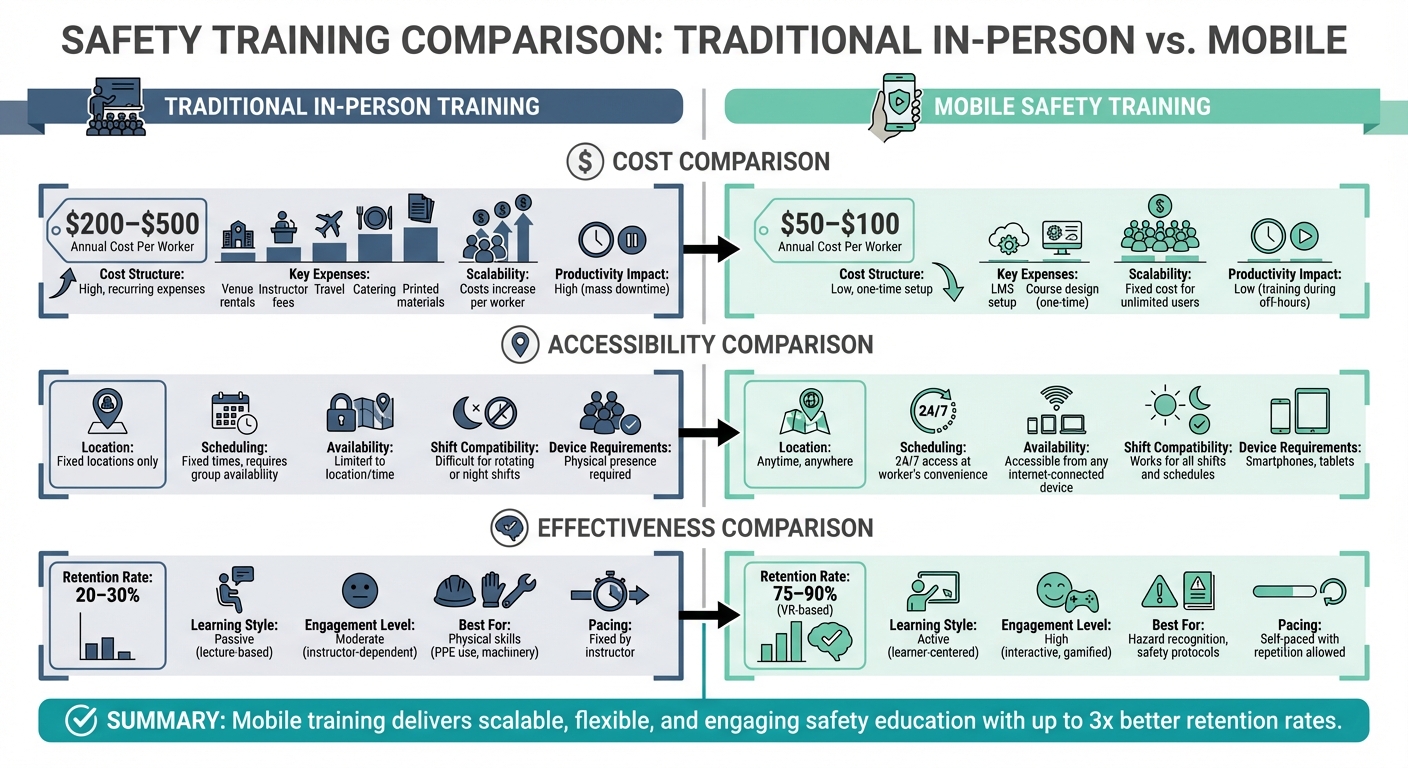
Mobile vs Traditional Safety Training: Cost, Accessibility & Effectiveness Comparison
Effective safety training in 2022? Benefits of going digital
sbb-itb-aa28329
Cost Comparison
Balancing budget constraints with compliance requirements means taking a closer look at training costs. The expenses for in-person training and mobile training vary significantly – not only in obvious areas like instructor fees but also in less apparent costs that can quietly drive up overall spending.
In-Person Training Costs
Traditional classroom-based training comes with a hefty price tag. Think about facility rentals, instructor fees, catering, printed materials, and travel expenses. If your company operates across multiple sites, these costs can multiply quickly. Every time a new session is scheduled – whether for new hires or to make up for absences – the costs essentially reset.
But the real financial hit often comes from lost productivity. Pulling workers off the job for training means pausing revenue-generating activities. And when safety standards change or new regulations roll out, companies face additional costs for reprinting materials and redistributing them. On top of that, managing attendance, scheduling, and compliance audits manually adds administrative strain.
Mobile Training Costs
Mobile training operates on a fixed-cost model, which is a game-changer. Instead of paying for each session, companies make a one-time investment to set up the system. This includes costs for setting up a learning management system (LMS), designing courses, and integrating the technology. While the initial costs might seem steep, they don’t recur with every new hire or training cycle.
As the San Francisco Examiner explains, "Online platforms turn safety training into a one-time investment. Create the content once – or license it from a provider – and you can use it over and over again, across locations, shifts, and departments". Marginal costs stay low, no matter how large the workforce grows. There’s no need for larger venues, additional instructors, or extra printed materials.
Travel costs? Gone. Employees can complete training modules on their smartphones or tablets, whether they’re on a remote worksite or between shifts. The microlearning format – breaking content into short, manageable pieces – means training can happen during slower work periods, minimizing disruptions. Plus, mobile platforms handle enrollment, track progress in real time, and generate compliance reports automatically, cutting down on administrative work.
Cost Comparison Table
| Cost Category | In-Person Training | Mobile Training |
|---|---|---|
| Annual Cost Per Worker | $200–$500 | $50–$100 |
| Setup Fees | Minimal (recurring per session) | Higher (one-time fixed cost) |
| Travel & Logistics | High (transportation, lodging, venue rental) | Eliminated (digital delivery) |
| Scalability | Costs increase per worker | Fixed cost for unlimited users |
| Content Updates | Expensive (reprinting, redistribution) | Inexpensive (instant digital updates) |
| Productivity Impact | High (mass downtime for sessions) | Low (training during off-hours) |
| Administrative Labor | High (manual tracking, scheduling) | Low (automated reporting) |
Over time, mobile training offers clear financial advantages. As D2L points out, "The initial setup fee might seem high, but remember, it’s a one-time fixed cost, unlike the in-person costs that are duplicated each time you plan a training session". For industries managing large, dispersed teams – like energy, mining, or infrastructure projects – mobile training transforms unpredictable costs into a manageable, scalable investment.
Next, we’ll explore how these methods address accessibility challenges.
Accessibility Comparison
Delivering the right training to workers at the right time can feel like solving a logistical puzzle, especially when teams are spread across multiple locations. Beyond just cutting costs, accessibility plays a huge role in how quickly and effectively workers can get the training they need. The method of delivery – whether it’s in a traditional classroom or through a smartphone – makes a big difference in both accessibility and timing.
In-Person Training Limitations
Classroom-based training ties workers to a specific location and schedule, which can be a major hurdle for companies with workers spread across different sites. As Matthew R. Hallowell et al. point out in Safety Science:
"The geographical spread of the job sites and the diversity of the training methods further necessitated the involvement of multiple trainers to manage the logistical challenges associated with time and cost".
Industries like construction, energy, and mining face added challenges because their workforces are often transient. Pulling workers from remote sites for classroom sessions not only disrupts productivity but also adds travel expenses. Fixed schedules are another sticking point – they don’t easily accommodate night shifts, rotating schedules, or emergency callouts. This can lead to inconsistent training coverage and even compliance gaps. Mobile training, on the other hand, sidesteps these issues.
Mobile Training Flexibility
Mobile training flips the script on these challenges. Workers can access safety modules on-demand using their smartphones or tablets, cutting out the need to travel to a central location. Robert Miller from KARM Safety Solutions explains:
"Online safety training… is particularly beneficial for remote or geographically dispersed teams. This flexibility ensures that all employees, regardless of location, receive the same quality of training".
With the "anywhere, anytime" model, a pipeline technician in West Texas can complete the same OSHA module as a refinery worker in Louisiana – whether it’s during a break, between shifts, or while waiting for equipment. Pre-recorded videos can deliver essential training in as little as 18 minutes, and microlearning formats break down complex topics into 3–7 minute chunks. This makes it easy for workers to digest information during natural downtime. The Health & Safety Institute highlights this advantage:
"Put safety in the hands of your workforce by mobilizing audits, inspections, hazard identification, etc.".
Another big plus? Workers can revisit modules as needed, allowing them to learn at their own pace.
For companies aiming to streamline mobile safety training, platforms like ABLEMKR offer a mobile-first solution. These tools deliver on-demand, location-independent training that fits the needs of today’s decentralized teams.
Accessibility Comparison Table
Here’s a quick breakdown of how in-person and mobile training stack up:
| Feature | In-Person Training | Mobile Training |
|---|---|---|
| Delivery Method | Classroom lectures, hands-on workshops | On-demand apps, mobile-responsive courses, interactive videos |
| Location | Fixed locations | Accessible anywhere with an internet connection |
| Scheduling | Fixed times; requires group availability | 24/7 access; completed at the worker’s convenience |
| Device Requirements | None (physical presence required) | Smartphones, tablets, or any internet-connected device |
| Reach | Limited by venue capacity and instructor availability | Scalable across unlimited workers and multiple remote sites |
| Pacing | Instructor-led; fixed duration (40–120 mins) | Learner-controlled; supports microlearning and repetition |
| Connectivity | Not required | Offers offline functionality |
| Shift Compatibility | Difficult for rotating or night shifts | Works for all shifts and schedules |
For companies with workers stationed in remote energy corridors, offshore platforms, or rural mining operations, the accessibility gap is clear. Mobile training ensures that every worker – no matter where they are or what shift they work – gets standardized, company-approved instruction. This approach eliminates the logistical headaches of classroom sessions while supporting better safety outcomes and compliance across distributed teams.
Effectiveness Comparison
Teaching workers safety protocols is one thing; ensuring they remember and apply that knowledge on the job is another. The method of training plays a huge role in how well employees retain and use safety information. In-person sessions and mobile training take different approaches to learning, and their effectiveness varies significantly.
In-Person Training Effectiveness
In-person training often relies on lectures, which can create a passive learning environment – something that doesn’t work well for hands-on industries. As researchers Matthew R. Hallowell and Alex Albert explain:
"Traditional lectures, often used in safety and health training, tend to result in passive learning, which is less effective for construction workers who are experiential learners".
Long classroom sessions can overwhelm workers with too much information at once. When safety protocols are crammed into hours of lectures, retention takes a hit. Studies show that lecture-based training typically results in retention rates of only 20–30%, meaning most of the information – up to 80% – is forgotten within weeks. That said, in-person training does shine when teaching physical skills like using safety harnesses or operating machinery, as instructors can provide immediate, real-time feedback to correct mistakes.
Mobile Training Effectiveness
Mobile training, on the other hand, takes a more interactive approach with tools like quizzes, scenario-based modules, and VR simulations. This active learning style keeps workers engaged and significantly improves retention – VR-based training, for example, achieves retention rates of 75–90%.
A study by Mikko Nykänen at the Finnish Institute of Occupational Health compared VR-based safety training to traditional lectures among 119 construction workers across eight workplaces. The results showed that the VR group had a greater increase in safety confidence and performance one month later. The researchers concluded:
"Safety training in virtual reality provides a promising alternative to passive learning methods. Its motivating effect complements other safety training activities".
Mobile platforms also use microlearning, which breaks down complex topics into short, focused lessons. This method avoids the information overload common in long classroom sessions and allows workers to revisit material whenever they need to. Between 2024 and 2025, Hallowell and Albert conducted a field study with 591 construction workers across U.S. and Canadian sites. They found that interactive, learner-centered training improved hazard recognition scores by 26%.
For theoretical knowledge – like hazard recognition, risk perception, and safety protocols – mobile training consistently outperforms lectures. Features like self-paced learning, interactive content, and the ability to revisit material lead to better retention and practical application.
Effectiveness Comparison Table
| Metric | In-Person Training | Mobile Training |
|---|---|---|
| Retention Rate | 20–30% | 75–90% (VR-based) |
| Engagement Level | Moderate (instructor-dependent) | High (interactive, gamified) |
| Learning Style | Passive (lecture-based) | Active (learner-centered) |
| Best For | Physical skills (e.g., PPE use, machinery) | Hazard recognition, safety protocols |
| Feedback Type | Immediate, face-to-face | Automated and instant (quizzes, VR) |
| Pacing | Fixed by instructor | Self-paced; allows repetition |
| Scalability | Limited by venue/trainer availability | High (unlimited users) |
The differences in effectiveness are even clearer when looking at real-world outcomes. Between October 2013 and November 2015, the New Jersey Safe Schools Program transitioned a safety law course from in-person to an online format with 10 modular sections and integrated quizzes. Results showed that 95% of online participants felt the course objectives were fully met, compared to 83% of in-person participants. Online learners also scored an average of 94.4% across all lessons.
For companies managing high-risk teams across multiple locations, mobile training offers a clear edge in both engagement and retention. Occasional in-person sessions can still be valuable for physical, hands-on skills, but mobile platforms deliver the flexibility and effectiveness needed for theoretical learning.
Final Comparison and Conclusion
Full Comparison Table
When comparing mobile safety training to traditional in-person methods, the differences are clear, especially in areas that matter most to construction and energy companies. While both approaches deliver comparable learning outcomes, mobile training stands out in terms of cost, accessibility, and scalability.
| Feature | Traditional In-Person Training | Mobile Safety Training |
|---|---|---|
| Direct Costs | Instructor fees, venue rental, travel expenses | Platform subscriptions, device costs |
| Indirect Costs | High due to worker downtime, manual record-keeping | Reduced downtime with microlearning and automated workflows |
| Accessibility | Limited by location and scheduled sessions | 24/7 access from smartphones or tablets |
| Scalability | Restricted by instructor/venue availability | Unlimited deployment to users instantly |
| Update Speed | Slow; requires new sessions and materials | Instant updates via cloud-based platforms |
| Compliance Tracking | Manual and paper-based processes | Automated with real-time analytics |
| Best Use Case | Hands-on physical skills training | Hazard recognition, safety protocols, compliance |
This comparison highlights the operational and strategic advantages of mobile safety training.
Conclusion
The data paints a clear picture: mobile safety training offers a practical, modern solution for construction and energy industries. While traditional in-person training remains valuable for teaching physical skills, mobile platforms excel in cost management, accessibility, and efficiency. As Tyechia Paul noted:
"Mobile learning and e-learning offer the same outcome as FTF training. Therefore, managers must consider other factors, such as cost and deployment time, when selecting a training delivery method".
Key takeaways include the ability of mobile training to turn fluctuating costs into predictable investments, provide 24/7 access for distributed teams, and achieve retention rates of 75–90% through interactive content. Platforms like ABLEMKR further enhance the process by streamlining certification tracking and speeding up workforce readiness. Whether it’s for remote pipeline repairs, mine development, or utility infrastructure projects, mobile training ensures teams are prepared and compliant from day one.
Ultimately, mobile training supports a scalable, engaged safety culture, meeting the demands of today’s fast-paced industries.
FAQs
How does mobile safety training help workers retain information better than traditional methods?
Mobile safety training helps workers absorb information more effectively by providing short, interactive lessons directly on their devices when it’s most relevant. These lessons often include features like quizzes and real-time feedback, which strengthen understanding and allow progress tracking for accountability.
Research shows that mobile-based training results in higher test scores after training and better long-term memory retention compared to traditional classroom methods. With its engaging, on-demand format, mobile training keeps workers attentive, ensures consistent learning, and makes it easier to remember essential safety procedures than in-person sessions.
What are the cost advantages of using mobile safety training instead of traditional in-person sessions?
Mobile safety training helps businesses save a lot of money by cutting out the hefty expenses tied to traditional in-person sessions. Think about it: classroom-based programs often require spending on things like printed materials, renting venues, employee travel, lodging, and even catering. These costs can pile up fast, especially as your team grows. On top of that, there are hidden costs – like lost productivity when employees are away from their jobs, traveling, or sitting in a classroom.
With mobile training, all of this changes. The same training content is delivered straight to employees’ smartphones, eliminating the need for physical materials, travel, or renting spaces. Workers can complete their training right on-site, meaning less disruption to their day-to-day tasks. Plus, companies don’t have to invest in extra hardware since most mobile platforms use a "bring-your-own-device" approach. Tools like ABLEMKR take it a step further by offering real-time tracking of training progress, reducing administrative work and ensuring compliance – all without the steep costs of traditional training methods.
How does mobile safety training make learning easier for remote or shift-based teams?
Mobile safety training lets workers access course materials right from their smartphones or tablets. This flexibility makes it especially useful for employees with rotating shifts, those stationed at remote locations, or anyone working off-site. Even better, training modules can be completed anytime – even without a stable internet connection – since data is stored locally and syncs once a connection is available.
This method keeps every team member current without the hassle of traveling for in-person sessions. Managers can track progress in real time, quickly identifying who has completed required courses. With training available 24/7, mobile learning eliminates geographic and scheduling challenges, ensuring teams remain compliant while reducing downtime.


