
Misclassifying workers as independent contractors instead of employees is a costly mistake for both workers and employers. Here’s why it matters:
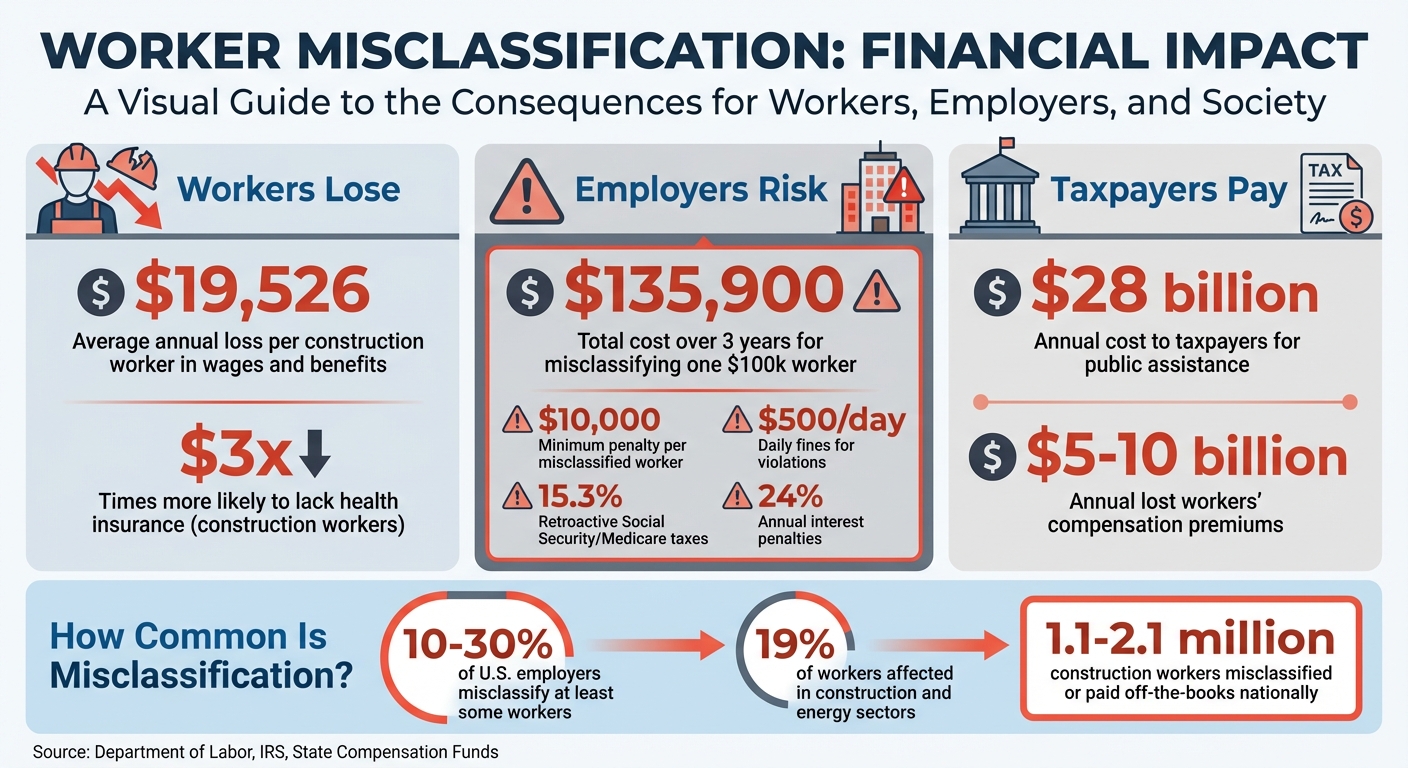
- Workers lose protections: Misclassified workers miss out on benefits like workers’ compensation, minimum wage, and overtime pay. For example, construction workers can lose up to $19,526 annually in wages and benefits.
- Employers face penalties: Employers risk fines, retroactive taxes, and even criminal charges. Misclassification can cost an employer up to $135,900 over three years for a single worker earning $100,000 annually.
- Industries most affected: Construction and energy sectors see high rates of misclassification, with up to 19% of workers impacted.
Key Takeaways:
- Misclassification denies workers access to workers’ compensation benefits, leaving them financially vulnerable after injuries.
- Employers often misclassify to avoid paying up to $5 billion annually in workers’ compensation premiums.
- Legal tests like the Department of Labor‘s six-factor economic reality test help determine worker status.
To avoid disputes, employers should conduct regular audits, use compliance tools, and follow federal and state guidelines. Misclassification isn’t just a paperwork issue – it has real financial and legal consequences.
Worker Misclassification Financial Impact: Costs to Workers, Employers, and Taxpayers
What Is Worker Misclassification?
Definition and Implications
Worker misclassification happens when an employer incorrectly categorizes an employee as an independent contractor. This misstep denies the worker important protections like minimum wage, overtime pay, and workers’ compensation benefits. The distinction matters because employees are entitled to these rights, while independent contractors are not.
Some employers mistakenly assume that having a worker sign an "independent contractor agreement", issuing a 1099 form, or even the worker forming an LLC or obtaining an Employer Identification Number (EIN) automatically makes them an independent contractor. However, the U.S. Department of Labor makes it clear:
"Labeling employees as ‘independent contractors’ does not make these protections inapplicable."
The proper classification hinges on the economic reality of the relationship. According to the Fair Labor Standards Act (FLSA), an employee is someone economically dependent on an employer for their work. In contrast, an independent contractor operates their own business – making decisions, investing in tools or equipment, marketing their services, and taking on the risks of profit or loss.
Legal Tests for Classification
Determining a worker’s status isn’t always straightforward, so various legal tests are applied. On March 11, 2024, the Department of Labor introduced a final rule that uses a six-factor economic reality test to evaluate worker status. This test looks at the entire working relationship, and no single factor is decisive. The factors include:
- Whether the worker can experience profit or loss based on their actions
- Whether they make capital investments (like purchasing equipment)
- The permanence of their relationship with the employer
- The level of control exerted by the employer
- Whether the work is integral to the employer’s business
- Whether the worker demonstrates skill and initiative in a business-like manner
For instance, a landscaper who advertises their services, negotiates contracts, chooses jobs, and hires assistants is likely considered an independent contractor. These actions show they operate independently and can influence their profit or loss. On the other hand, a worker hired to pick tomatoes on a farm – where the task directly supports the farm’s operations – is more likely to be classified as an employee.
The IRS, when evaluating worker status for federal tax purposes, uses a different test. It focuses on behavioral control, financial control, and the overall nature of the relationship. This test examines how much control the employer has over the worker’s activities and the broader dynamics of their working arrangement. These legal tests are essential for determining whether workers qualify for protections like workers’ compensation benefits.
sbb-itb-aa28329
How Misclassification Affects Workers’ Compensation
Coverage Gaps for Misclassified Workers
When workers are classified as independent contractors instead of employees, they lose access to workers’ compensation insurance. This distinction creates a legal loophole that bars them from receiving coverage for medical expenses and lost wages. Since workers’ compensation benefits are strictly for employees, misclassified workers are left without this essential safety net.
The financial burden shifts heavily onto the injured worker. Without employer-provided insurance, they may have to cover costs out of pocket or depend on public assistance. For instance, misclassified construction workers are three times more likely to lack health insurance. This reliance on public programs to fill the gap costs taxpayers a staggering $28 billion annually.
A real-world example highlights the human toll of misclassification. In 2022, José Alfredo Gómez, a construction worker in Minnesota, suffered severe injuries after falling two stories. His employer initially tried to avoid hospital expenses by offering him just $200 per week in private payments. With legal help from Centro de Trabajadores Unidos en la Lucha (CTUL), it was revealed that Gómez had been misclassified as an independent contractor. Once corrected, he became eligible for workers’ compensation benefits.
Beyond the personal hardships, the broader economic impact is immense. Misclassification leaves billions of dollars in workers’ compensation premiums unpaid. Studies show that 10% to 30% of employers misclassify at least some workers, with construction workers alone losing an average of $19,526 annually in income and benefits. These gaps not only harm workers but also expose employers to steep penalties.
Employer Penalties and Costs
Misclassification doesn’t just harm workers – it poses serious financial and legal risks for employers. When workers are denied workers’ compensation benefits, they can file civil lawsuits, where damages are often unlimited. This removes the liability protections employers would typically have under workers’ compensation laws.
"I’m persuaded this failure to enforce existing laws is unfair. It’s unfair to workers who are working very hard to support themselves and their families, and it’s unfair to businesses who obey the law and are then put at a disadvantage." – David Shafer, President Pro Tempore, Georgia Senate
Employers caught misclassifying workers face hefty costs, including retroactive premiums, unpaid Social Security and Medicare taxes (totaling 15.3%), and interest penalties that can reach 24% annually. There are also daily fines of $500 per day and minimum penalties starting at $10,000. For example, in Massachusetts alone, misclassification led to $91 million in unpaid workers’ compensation premiums between 2001 and 2003.
The risks don’t stop at financial penalties. Employers who knowingly fail to provide workers’ compensation insurance could face criminal charges ranging from misdemeanors to Class 4 felonies. In some cases, business owners and corporate officers may be held personally responsible for unpaid penalties and contributions, putting their personal assets at risk. Misclassification can also prompt joint investigations by multiple agencies, such as Departments of Labor, Revenue, and Workers’ Compensation Commissions. These severe penalties underline the importance of proper worker classification and its legal implications.
Worker Misclassification: How it Affects Workers and Employers
How to Prevent Misclassification Disputes
Avoiding misclassification disputes is crucial to ensure proper workers’ compensation coverage and reduce legal risks.
Regular Classification Audits
Employers should routinely review how workers are classified to stay compliant with both federal and state laws. It’s important to focus on the actual working relationship rather than relying solely on a signed agreement or a 1099 form – those alone don’t automatically define someone as a contractor.
Effective audits should align with the 2024 Department of Labor’s six core economic factors, evaluating each worker or role individually instead of applying broad classifications. Additionally, employers must consider state-specific rules, like the "ABC test", when required.
For construction companies, this process involves verifying subcontractor credentials through state websites and keeping classification records for at least three years. Signed independent contractor agreements should be dated within 30 days of starting work. Reviewing how workers are compensated can also provide clarity: payment by commission, per-job, or competitive bid often points to contractor status, whereas hourly or salary-based payments typically indicate an employee relationship.
To simplify compliance, manual audits can be supplemented with digital tools.
Using Technology for Compliance
Technology can make staying compliant more manageable and efficient. Digital platforms help automate record-keeping, ensuring the required three-year history of worker data – such as names, addresses, classifications, pay rates, and signed notices – is securely maintained. These systems can also integrate with state databases to verify subcontractor licenses, LLC registrations, and certifications. Automated contract management ensures agreements are executed within the correct timeframes, while electronic payment systems reduce the risks associated with untracked cash payments.
Misclassification is a widespread issue, particularly in construction. Nationally, between 1.1 and 2.1 million construction workers are either misclassified or paid off-the-books, costing taxpayers an estimated $5 billion to $10 billion annually.
Platforms like ABLEMKR tackle these challenges by offering W2 employment for workers, eliminating the gray area between independent contractors and employees. ABLEMKR maintains verified worker profiles, tracks certifications and safety training, and integrates compliance tracking with payroll systems. This ensures workers receive proper compensation and coverage while giving employers clear insight into worker status. By automating compliance processes, companies can reduce the risk of costly penalties and disputes while keeping their records in order.
Misclassification Case Examples
Court decisions provide real-world insight into how disputes over worker classification are resolved. These cases reveal the financial risks of misclassification and the consequences for workers denied proper protections.
Key Court Decisions
In State Compensation Insurance Fund v. Workers’ Comp. Appeals Board (October 1985), Virgil Meier suffered a life-altering injury – a fall from a scaffold that left him quadriplegic – while remodeling a ranch for Warren Chichester. Meier had submitted a bid, brought his own tools, and even hired additional help, all of which suggested he was an independent contractor. However, the California Supreme Court ruled otherwise. Because Meier lacked the required contractor’s license, the court deemed him an employee under Labor Code section 2750.5. As the court stated, "Any person performing any function or activity for which a license is required… shall hold a valid contractors’ license as a condition of having independent contractor status". Consequently, the homeowner’s insurance fund was held responsible for paying workers’ compensation benefits.
In S. G. Borello & Sons, Inc. v. Department of Industrial Relations (March 1989), the case centered on 50 migrant cucumber harvesters who had signed agreements labeling them as "sharefarmers" and self-employed. Despite these contracts, the California Supreme Court determined that the grower exercised "pervasive control" over every aspect of the farming operation, from planting to selling the crops. The harvesters, who performed manual labor essential to the grower’s business, were reclassified as employees, making them eligible for workers’ compensation benefits.
A major shift occurred in 2018 with Dynamex Operations West, Inc. v. Superior Court. Delivery drivers Charles Lee and Pedro Chevez argued they were misclassified when Dynamex changed their status in 2004 to reduce costs. The California Supreme Court adopted the stricter "ABC test" for classification. Under the "B" prong of the test, drivers were deemed employees because their work – delivering goods – was central to Dynamex’s business. This ruling enabled nearly 184 drivers to pursue claims for wage order violations and established a higher standard for companies attempting to classify workers as independent contractors.
These cases highlight that written agreements alone cannot override legal requirements for worker classification. Courts consistently prioritize the actual nature of the working relationship, licensing obligations, and whether the work is fundamental to the employer’s business. These rulings emphasize the importance of thorough classification reviews and compliance measures to avoid costly legal disputes.
Conclusion
Worker misclassification isn’t just a paperwork issue – it has real consequences for both workers and employers. Around 10%-30% of U.S. employers misclassify workers, leading to losses of up to $19,526 per worker annually. For workers, this often means losing access to critical benefits like workers’ compensation, leaving them without medical care or wage replacement if they’re injured on the job.
For employers, the financial stakes are even higher. Misclassifying a single worker earning $100,000 annually can lead to retroactive premiums, employment tax liabilities, and penalties that could total $135,900 over three years – not to mention fines of up to $10,000 per worker. Attorney Haley Harrigan emphasizes the risks:
"Simply calling a worker an ‘independent contractor’ in a contract or compensating a worker with a 1099 does not necessarily make them a contractor".
The key takeaway? Courts look beyond labels and contracts to assess the actual working relationship. To minimize risks, employers should conduct regular audits, focusing on factors like control over work, ownership of tools, and whether the work is central to the business.
Tools like ABLEMKR can help simplify compliance by tracking worker status, managing payroll, and ensuring proper classification. With its W2 employment model and built-in workers’ compensation coverage, the platform helps protect workers while shielding employers from costly misclassification errors.
FAQs
How can I tell if I’m misclassified as a 1099 contractor?
If you meet the conditions to be classified as an employee under the Fair Labor Standards Act (FLSA), but you’re being treated as a 1099 contractor, you might be misclassified. Just because you receive a 1099 form doesn’t automatically mean you’re an independent contractor. This holds true regardless of how your pay is structured or what your employer’s documentation states. To clarify your status, it’s worth reviewing the FLSA guidelines.
Can I still get workers’ comp if I was misclassified?
Yes, you might still be eligible for workers’ compensation even if you were labeled as an independent contractor. Misclassification can complicate things, but many state laws focus on the actual nature of your job rather than the title you were given. If your work involves a high-risk environment, it could strengthen your case for receiving coverage, regardless of the incorrect classification.
What should employers document to prove proper classification?
Employers need to keep detailed records of the main factors that influence worker classification. These include the type of work being performed, the degree of control the employer has over the worker, and the worker’s level of independence. Proper documentation of these aspects is crucial for staying compliant with laws like the Fair Labor Standards Act (FLSA) and provides evidence that workers are being classified correctly.


