
Microlearning is transforming how workers in construction and energy industries learn and stay safe. Here’s why it works:
- Short, on-the-job training: Lessons are 5–10 minutes long, accessible via smartphones, and fit into busy schedules.
- Improved safety and efficiency: Workers can access critical safety instructions instantly, reducing risks and downtime.
- Proven results: Companies using microlearning report a 20–28% productivity boost and 75% better knowledge retention after 30 days.
- Cost-effective: Digital training cuts onboarding time by 4.3 months and reduces overall training expenses.
- Growing demand: The mobile learning market grew from $60.97 billion in 2023 to a projected $184.42 billion in 2024.
Microlearning is especially useful for high-risk jobs like solar installation, modular construction, and oil & gas work. With features like gamification, AI-driven personalization, and on-demand access, it’s reshaping workforce training to be faster, safer, and more engaging.
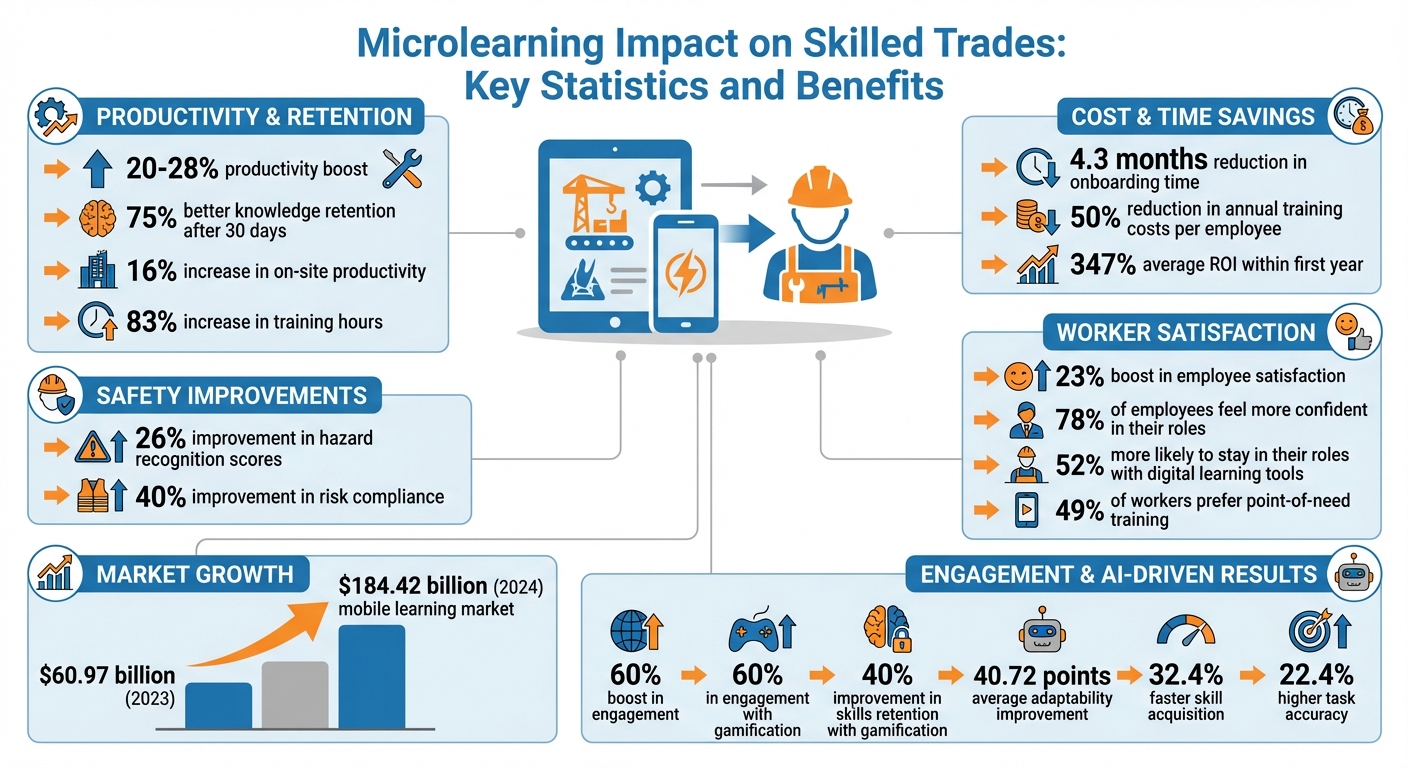
Microlearning Impact on Skilled Trades: Key Statistics and Benefits
24/7 Construction Training – aQuiRe™ – Mobile App
sbb-itb-aa28329
Main Benefits of Microlearning for Skilled Trades
Microlearning isn’t just another training method – it’s a game-changer for improving safety, efficiency, and cost management. Studies reveal that companies using microlearning report a 20% increase in employee productivity and a 23% boost in employee satisfaction. For industries like construction and energy, where safety and precision are critical, these benefits directly impact workplace outcomes. Let’s break down how microlearning delivers these results.
Improved Safety Training and Compliance
Safety training can be overwhelming, especially in high-risk industries where protocols are complex. Microlearning simplifies this by delivering 3-to-5-minute modules that focus on specific tasks or roles. Workers get the information they need, exactly when they need it – whether it’s before cutting pipe or working near energized lines. This "just-in-time" approach ensures that critical safety knowledge is fresh and actionable in high-risk situations.
Digital platforms make compliance easier, too. Managers can track training completion in real time, quickly identify gaps, and resend modules to workers who need them. For instance, if a crew struggles with lockout-tagout procedures, safety managers can immediately provide targeted refresher content. This creates a continuous improvement cycle that keeps teams current and prepared. As one industry leader put it:
"A 5-minute training today can prevent a 5-month recovery tomorrow." – Field1st
On-Demand, Task-Specific Training
Workers in skilled trades often don’t have the luxury of attending lengthy training sessions. Microlearning addresses this by offering on-demand training through smartphones and tablets. In fact, 49% of workers prefer accessing training at the point of need rather than sitting in a classroom.
This flexibility is especially helpful when workers encounter new equipment or move into unfamiliar roles. Instead of waiting for formal training, they can access quick modules that guide them through the task at hand. The result? Faster problem-solving, reduced downtime, and a workforce that feels supported rather than left to figure things out alone.
Higher Engagement and Knowledge Retention
Traditional training can feel like a box-checking exercise, but microlearning transforms it into an engaging experience. Interactive features like quizzes, badges, and gamification keep workers involved and motivated to revisit content. This approach works – 78% of employees report feeling more confident in their roles after using microlearning.
The bite-sized format also helps prevent cognitive overload. Instead of cramming information into one session, microlearning uses spaced repetition to reinforce concepts over time. This method not only improves retention but also ensures workers can apply what they’ve learned on the job. It’s about building habits, not just memorizing procedures.
Lower Training Costs and Productivity Increases
Microlearning isn’t just effective – it’s cost-efficient. By reducing time spent in extended classroom sessions, eliminating travel, and relying on digital materials, companies save significantly on training expenses. Workers can stay focused on their primary tasks, minimizing disruptions.
The productivity benefits are clear. For example, mobile-based training initiatives have shown a 16% increase in on-site productivity. Simulation-based modules can also cut technician onboarding times by an average of 4.3 months. Doug Donovan, CEO of Interplay Learning, sums it up well:
"When companies modernize their training, they’re not just improving workforce readiness – they’re accelerating their own profitability."
Retention is another big win. 52% of workers are more likely to stay in their roles when they have access to digital learning tools. For industries like construction and energy, where turnover can be costly, this helps preserve institutional knowledge and reduces hiring expenses. For companies operating on tight margins, microlearning delivers results that make a real difference.
Research Findings from Recent Studies
Productivity Improvements in Construction Trades
Recent research highlights the tangible benefits of microlearning in skilled trades. In December 2025, Interplay Learning published its 2025 State of Skilled Trades Training Report, which surveyed contractors in HVAC, electrical, and plumbing sectors. The results were eye-opening: nearly 70% of firms reported significantly faster technician ramp-up times when using simulation-based microlearning. Additionally, the study revealed an 83% increase in training hours, as workers utilized downtime on job sites to enhance their skills.
Safety training also experienced a boost. A study in Safety Science (July 2025) examined five training delivery methods with 591 construction workers. The interactive methods used in the study improved hazard recognition scores by 26%, particularly when teaching energy-based hazard definitions. This is especially critical since workers are three times more likely to face injuries during their first month on a project.
| Metric | Traditional Training | Microlearning/Immersive Training | Improvement |
|---|---|---|---|
| Onboarding Speed | Standard baseline | Noticeable time savings | Faster technician ramp-up |
| Hazard Recognition | Baseline awareness | 26% score improvement | Improved site safety |
| Training Engagement | Fixed/Scheduled | 83% increase in hours | Better use of downtime |
| Productivity | Baseline | 16% increase | Clear output gains |
These findings show how microlearning is reshaping training strategies, with AI-driven tools pushing these advancements even further.
AI-Driven Adaptive Microlearning
Artificial intelligence is revolutionizing microlearning by tailoring content to individual skill levels. A quasi-experimental study involving 111 in-service workers compared AI-driven adaptive microlearning (AML) systems to standard microlearning. Using algorithms like the Three-Parameter Logistic model, the AML system evaluated workers’ existing knowledge and created personalized learning paths. This approach led to an average adaptability improvement of 40.72 points and a 20.02-point reduction in unnecessary cognitive load.
Further advancements include a cross-modal deep learning framework that integrates motion capture, eye-tracking, and audio data. This technology enabled 32.4% faster skill acquisition and 22.4% higher task accuracy in construction tasks compared to traditional methods. By digitizing tacit knowledge – such as the intuitive decision-making and situational awareness of experienced workers – companies can retain critical expertise from an aging workforce and speed up training for new hires.
These developments highlight the growing potential of microlearning, especially as modular and mobile training platforms continue to evolve.
Current Trends in Microlearning for 2026
Support for Modular and Green Construction
The construction industry is grappling with a major workforce shortage – an additional 499,000 workers will be needed by 2026 to meet growing demand. At the same time, the shift toward prefabrication and renewable energy projects is creating a demand for highly specialized training. Microlearning is stepping in to fill this gap with targeted training modules focused on prefabrication and renewable energy installation techniques, helping workers adapt to the evolving demands of green construction.
Jobs like solar PV installers and wind turbine technicians are expected to grow by 48% and 60%, respectively, by 2034. These roles demand detailed knowledge of renewable energy systems, high-risk maintenance tasks, and safety protocols specific to each site – making them perfect candidates for short, mobile-friendly training sessions. Workers can now access step-by-step work instructions and on-demand guidance right from their smartphones, which eliminates the need for lengthy classroom sessions that take them away from the job site.
The rise of modular construction is also changing how and where training happens. With more mechanical, electrical, and plumbing (MEP) assemblies being pre-built off-site in controlled environments, microlearning platforms are offering modules tailored to off-site fabrication and installation processes. This approach helps contractors assemble a workforce already familiar with these specialized techniques before they even step onto a construction site, supporting the industry’s move toward more sustainable building practices.
Growth of Gamification and Mobile Platforms
Digital engagement tools like gamification are making microlearning even more effective as the construction industry evolves. Training platforms that incorporate gamification have reported a 60% boost in engagement and a 40% improvement in skills retention. Features like interactive quizzes, digital badges, and leaderboards are replacing traditional text-heavy assessments, making training more engaging and practical.
The psychological benefits of this approach are clear. As Josh Bersin, a Deloitte Partner, explains, the future of learning is about "learning in the flow of work". Field workers increasingly prefer training that’s accessible exactly when and where they need it. The growth of the mobile learning market – from $60.97 billion in 2023 to a projected $184.42 billion in 2024 – highlights this shift in how frontline workers interact with training content. Gamification strategies not only make learning more engaging but also reinforce the productivity and retention benefits already seen with on-demand microlearning.
Specialized Training for High-Risk Industries
Microlearning is also proving to be a game-changer for high-risk industries like oil & gas, mining, and utilities. Workers in these sectors often need specific certifications – such as OSHA 10/30, state licenses, or equipment-specific training – before they can even set foot on a job site. Microlearning platforms are now integrating automated certification tracking directly into onboarding processes, which speeds up crew mobilization for urgent projects.
Platforms like ABLEMKR are taking this a step further by matching pre-certified workers to job sites based on their qualifications, training, availability, and location. This mobile-first approach allows companies to quickly deploy crews for last-minute emergencies, remote pipeline repairs, or scheduled mining operations. By embedding compliance tracking and real-time updates on worker status, these platforms turn safety training into a seamless operational advantage.
The benefits go beyond efficiency. As Stephen Zocchi, CMO of ROO.AI, points out, "Microlearning courseware delivered at the point of need can make significant improvements in overall training programs". In high-risk environments, where even a single safety lapse can have devastating consequences, just-in-time access to safety protocols and equipment instructions is essential for protecting workers and ensuring smooth operations.
Future Outlook and Research Needs
ROI Prediction Models for Microlearning
The construction and energy industries are starting to adopt predictive ROI models to estimate the long-term financial benefits of microlearning. These models consider factors like shorter onboarding periods, increased training activity, and better knowledge retention to project profitability. Preliminary data reveals that microlearning generates an average 347% ROI within the first year for learning and development initiatives. Companies have also reported cutting annual training costs per employee by 50%.
To make these ROI predictions more precise, businesses rely on metrics like time-to-proficiency and error reduction rather than just completion rates. In fact, 51% of companies now evaluate microlearning success using performance KPIs such as these, alongside worker retention rates. Studies have shown that microlearning significantly reduces onboarding times, a finding echoed by Doug Donovan, Founder and CEO of Interplay Learning:
"Digital and simulation-based training can close the gap between the urgent need for skilled workers and the time it traditionally takes to develop them. When companies modernize their training, they’re not just improving workforce readiness – they’re accelerating their own profitability".
While construction training has demonstrated the value of these models, the energy sector still lacks similarly detailed predictive frameworks.
More Field Studies Needed for Energy Sector
Although microlearning has proven its worth in construction trades, more real-world studies are essential to confirm its effectiveness in high-risk energy environments like oil and gas, mining, and utilities. Existing research shows that teaching hazard definitions specific to energy work – particularly those tied to serious injuries or fatalities – can boost workers’ hazard recognition scores by 26%. However, further investigation is needed to determine if this increased awareness leads to safer practices and fewer workplace accidents.
The transition to renewable energy and sustainable construction introduces new challenges for worker training that remain underexplored. For example, field studies are needed to assess how microlearning supports workers adapting to sustainable materials, energy-efficient retrofits, and energy management systems. Platforms like ABLEMKR are already integrating tools like compliance tracking and certification verification for energy workers. However, more data is required to evaluate how these digital solutions impact safety and operational efficiency, especially in remote or high-risk settings.
Summary of Main Points
Microlearning is reshaping how skilled trades workers adapt to evolving industry needs. Research highlights its advantages, including a 28% increase in productivity, 75% better knowledge retention after 30 days, and a 40% improvement in risk compliance. Key trends driving this transformation include mobile-first platforms, gamified learning experiences, and specialized training for high-risk industries. Emerging technologies like AI-driven personalization and blockchain for credentialing are also influencing workforce development.
As industries continue to evolve, combining predictive ROI models with expanded field research will enable smarter training investments. This approach will help create a more capable and safer workforce in both construction and energy sectors.
FAQs
How do I pick the right microlearning topics for each trade role?
To choose the best microlearning topics, zero in on areas like specific skills, safety procedures, or compliance requirements unique to each trade. Design short, mobile-friendly modules that directly address the tasks and challenges workers face in their roles. Adding multimedia elements – like videos or interactive quizzes – can make the learning experience more engaging and effective. Offering micro-credentials is another great way to validate skills, enabling workers to grow professionally while enhancing safety, compliance, and expertise on job sites.
What metrics show microlearning improves job safety?
Microlearning has a proven track record of improving job safety with clear, measurable results. For instance, it leads to a 78% boost in employee confidence, a 16% uptick in productivity, and a noticeable reduction in workplace injuries. Research also shows it enhances ergonomic safety practices and improves training retention, creating safer and more efficient work environments.
How can microlearning fit OSHA and certification requirements?
Microlearning improves OSHA compliance and certification processes by delivering short, focused training modules that workers can access on their mobile devices. These bite-sized lessons make it easier for employees to quickly review safety protocols and retain essential information. Plus, platforms often include real-time tracking features, allowing supervisors to monitor progress and ensure compliance with required standards.
For certifications, microlearning offers on-demand, task-specific training that fits seamlessly into busy schedules. Digital credentialing systems also play a key role by documenting completed training sessions, streamlining audits and simplifying the process of meeting regulatory requirements.


