
The energy sector is facing a leadership crisis. With 76 million U.S. workers nearing retirement, companies risk losing decades of expertise unless they act fast. Training and mentorship are two key solutions to this problem, but they serve different purposes:
- Training delivers technical skills – like safety protocols, estimating, and project management tools. It’s structured, short-term, and focuses on measurable outcomes like certifications.
- Mentorship develops leadership qualities – like decision-making, crisis management, and intuition. It’s personalized, long-term, and passes down wisdom gained from years of experience.
Both are essential. Training equips leaders with the tools to perform their jobs, while mentorship teaches them how to apply those tools in complex situations. Companies combining these approaches – like Kinder Morgan and MD&A – are already seeing better-prepared, more confident leaders.
Key takeaway: To close the leadership gap, energy companies must invest in both training and mentorship. One without the other leaves critical gaps in skills or judgment.
Training: Building Technical Skills for Energy Projects
What Training Programs Offer
Formal training plays a crucial role in equipping energy leaders with the technical expertise needed to manage complex projects both safely and efficiently. While mentorship passes down hands-on experience and wisdom, structured training focuses on delivering actionable skills that can be applied immediately. These programs cover a wide range of topics, from the basics – like exploration, drilling, and production – to advanced areas such as refining, energy economics, and financial management. Unlike the gradual nature of mentorship, training offers a direct path to measurable skill development through well-organized curricula.
The scope of these programs is intentionally broad but targeted. Participants learn essential project management tools such as scheduling and estimating, alongside safety protocols and advanced software like BIM (Building Information Modeling). For professionals without a financial background, courses like Finance for Non-Finance Professionals bridge the gap between technical tasks and their financial implications, focusing on critical concepts like cash flow, profitability, and strategic decision-making. This ensures leaders can connect their technical decisions to the overall success of the organization.
"When employees understand how the business runs, they make smarter decisions, use resources more effectively, and drive greater impact." – Energy Workforce
Programs like the SecureWell: Well Control Certification Program highlight how structured training ensures technical readiness. SecureWell uses a three-tiered system – classroom instruction, field assessments, and skills verification – to prepare professionals for high-stakes well-servicing operations. Another example is the Mechanical Dynamics & Analysis (MD&A) Engineers in Training (EIT) program, launched in 2009 to address the shortage of skilled engineers. Each year, MD&A hires around 10 recent graduates and combines classroom learning with on-the-job training. Participants work closely with experienced managers to master the intricacies of steam, gas, and industrial turbines. This approach not only strengthens internal leadership but also creates a dependable network of experts for new engineers to consult when they encounter technical challenges.
These programs are more than just skill-building exercises – they prepare professionals to handle specific, high-pressure scenarios where formal training is indispensable.
When Training is Necessary
Formal training becomes especially critical in certain operational contexts: onboarding new hires, implementing new technologies, and maintaining safety in high-risk environments. As seasoned professionals retire, structured programs help new employees quickly adapt and start contributing effectively.
Safety and regulatory compliance are fundamental in energy operations, yet many frontline managers lack training in key areas. For instance, fewer than 50% of foremen receive training in quality control or scheduling, and less than 25% are trained in estimating, workface planning, or lean construction. These gaps can lead to costly mistakes, such as rework or project delays, which mentorship alone cannot fully address. This makes formal training an essential tool for bridging these knowledge deficits.
"Investing in [frontline managers’] development improves retention, strengthens safety culture, and builds a scalable leadership pipeline. This program ensures your new leaders are not just promoted, they’re prepared." – Energy Workforce
The most effective programs combine classroom learning with real-world application. For example, MD&A’s EIT program integrates structured lessons with weekly review meetings, ensuring that technical knowledge is applied directly in the field. This blend of theory and practice not only builds confidence but also enables new leaders to tackle complex projects from the start. Such an approach underscores how training is a vital element in a comprehensive development strategy for energy professionals.
sbb-itb-aa28329
Mentorship: Developing Long-Term Leadership
Main Benefits of Mentorship
While training equips individuals with technical skills, mentorship goes deeper, fostering judgment and intuition. These are the traits that can’t be taught in a classroom but are critical for real-world problem-solving. For example, a mentor might guide a mentee on when to delay a foundation pour due to sudden weather changes or how to reroute utilities to prevent conflicts on a job site. This "jobsite intuition" – a mix of experience, pattern recognition, and systems thinking – can only be passed down through hands-on mentorship.
Mentorship also plays a key role in building emotional resilience, an essential quality for leaders managing high-stakes energy projects. By shadowing seasoned professionals during client disputes, safety challenges, or budget crises, mentees witness decision-making under pressure firsthand. This experience not only builds their confidence but also prepares them to navigate uncertainty and make ethical decisions when it matters most.
"The leadership challenges of navigating uncertainty, empowering teams, and driving innovation are rooted in the very principles I learned on the rig floor." – Mobolaji Adediran, Senior Leader, Oilfield Services
Another important but often overlooked benefit is cross-cultural leadership. In global energy operations, mentors help mentees understand how to build trust and establish authority across different cultural contexts. These skills are rarely taught in formal training but are vital for leading diverse teams and managing complex projects. Such insights become indispensable in large-scale energy initiatives where cultural dynamics can significantly impact outcomes.
Mentorship in Complex Energy Projects
Leading complex energy projects requires more than just technical know-how. It demands leaders who can juggle multiple stakeholders, anticipate risks, and adapt to ever-changing conditions. Mentorship steps in to bridge this gap by preserving institutional knowledge that might otherwise be lost. With an estimated 76 million U.S. workers nearing retirement, companies face a looming leadership vacuum. Mentorship programs help retain critical company-specific knowledge, such as unique processes, customer relationships, and project intricacies, ensuring they don’t disappear with retiring employees.
Strategic pairings are key to making these programs effective. For instance, pairing a retiring superintendent with a promising foreman creates a two-way learning dynamic. The senior leader can share their oversight expertise, while the junior colleague introduces fresh, modern approaches. This strategy is especially important given that 53% of HR teams in construction and energy sectors report difficulties finding specialized talent to fill leadership roles.
"We want people to share knowledge, learn from each other, and grow their skills. Our hope is that the knowledge gained through mentorship will help employees be more effective in their day-to-day responsibilities." – Mary Burtner, Human Resources Director, Kinder Morgan
The most impactful mentorship programs include real-time shadowing during pivotal moments. By observing how experienced leaders respond to crises or navigate regulatory hurdles, mentees gain insights that no textbook or training session could replicate. This hands-on exposure transforms theoretical leadership concepts into practical, actionable skills. When combined with formal training, these mentorship-driven qualities equip the next generation to tackle the complex challenges of modern energy projects, ensuring a stronger and more capable leadership pipeline.
Training Coaching Mentoring – What’s the Difference?
Mentorship vs. Training: Main Differences
Mentorship vs Training in Energy Leadership Development
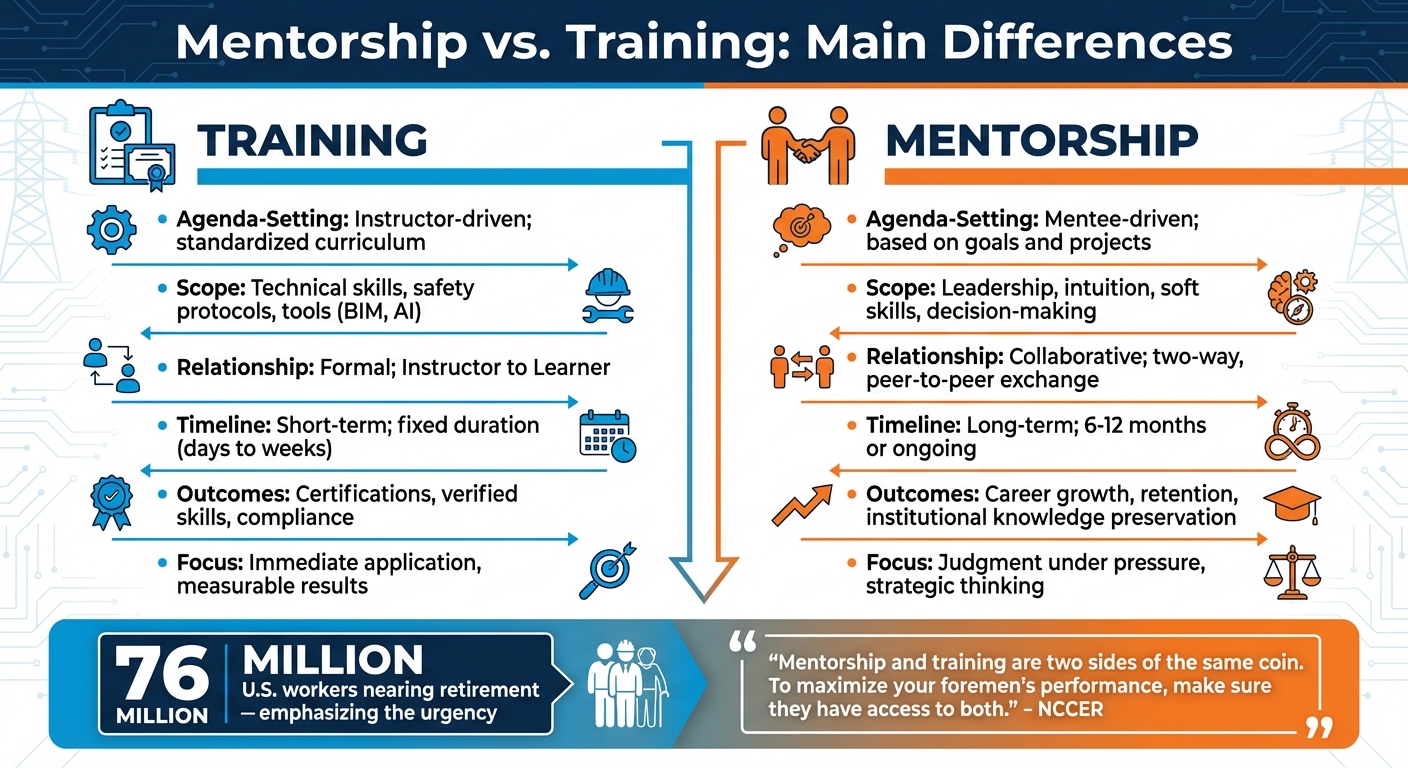
Let’s break down the key distinctions between training and mentorship. Recognizing these differences is crucial for energy leaders who want to allocate resources wisely. Training follows a standardized curriculum, often focusing on specific skills like safety protocols, regulatory compliance, or software tools such as BIM. It’s structured, with the agenda set by the instructor or program. On the other hand, mentorship is more flexible and driven by the mentee. Its focus shifts based on immediate project needs and long-term career aspirations.
The nature of the relationship also sets these two apart. Training typically follows a formal, instructor-to-student dynamic with a clear start and end date. However, mentorship fosters a collaborative, two-way exchange. Senior leaders share their expertise, while younger workers often bring fresh perspectives, such as insights into AI-powered tools. This mutual learning creates engagement, especially for seasoned workers who might otherwise see mentorship as just another obligation.
Timelines and outcomes further highlight the contrast. Training programs are short-term and results-oriented – think a two-day workshop or a six-week certification course. These programs often yield tangible results like certifications or demonstrated proficiency in a specific skill. Mentorship, on the other hand, is a long-term commitment, typically lasting 6–12 months or more. While its outcomes are harder to measure, they are equally important: better decision-making under pressure, expanded professional networks, and the preservation of institutional knowledge as senior leaders prepare for retirement.
Comparison Table: Mentorship vs. Training
| Feature | Training | Mentorship |
|---|---|---|
| Agenda-Setting | Instructor-driven; standardized | Mentee-driven; based on goals and projects |
| Scope | Technical skills, safety, tools (e.g., BIM, AI) | Leadership, intuition, and soft skills |
| Relationship | Formal; Instructor to Learner | Collaborative; two-way, peer-to-peer |
| Timeline | Short-term; fixed duration | Long-term; 6–12 months or ongoing |
| Outcomes | Certifications, verified skills, compliance | Career growth, retention, institutional knowledge |
Both approaches address distinct needs in developing energy leaders. For example, training is essential for filling technical gaps in areas like estimating, workface planning, and BIM modeling. At the same time, mentorship builds the leadership and decision-making skills needed for long-term success. As NCCER aptly states:
"Mentorship and training are two sides of the same coin. To maximize your foremen’s performance, make sure they have access to both".
These differences highlight how training and mentorship can work together to shape well-rounded leaders for energy projects.
Why Energy Leaders Need Both
Training and mentorship each address critical but distinct aspects of leadership development. Training lays the groundwork by equipping workers with the technical know-how they need to hit the ground running. This can include everything from learning how to repair turbines to mastering safety protocols. Mentorship, on the other hand, fills in the gaps that training can’t cover – like developing on-the-job intuition and crisis management skills that come with experience. Together, these approaches create leaders who are not only technically skilled but also capable of thinking strategically under pressure.
With 76 million U.S. workers nearing retirement, the energy sector faces the daunting challenge of preserving decades of institutional knowledge. Without proper training, new managers may struggle with technical tasks. Without mentorship, they might lack the judgment to handle high-stakes situations, such as safety incidents or project delays. To ensure a smooth transition, energy organizations must embrace both methods.
How Both Approaches Work Together
Training provides the technical tools and shared terminology that managers need to perform effectively. Mentorship takes it a step further by teaching how to apply those tools in real-world scenarios. For example, while training might cover the basics of project scheduling, mentorship can show how to adapt plans during unexpected challenges, like weather disruptions or utility rerouting.
The ideal process begins with structured training to build a solid technical foundation. Mentorship then follows, helping leaders internalize these skills and navigate the nuances of organizational dynamics. As Mary Burtner, Human Resources Director at Kinder Morgan, puts it:
"The knowledge gained through mentorship will help employees be more effective in their day-to-day responsibilities."
Mentorship isn’t a one-way street. Senior leaders pass down years of field experience and crisis-handling expertise, while younger employees introduce modern tools like AI-powered scheduling software and digital collaboration platforms. This exchange strengthens the mentor–mentee relationship and ensures both parties stay current in an ever-changing industry.
By blending these two approaches, energy companies are shaping a new generation of leaders prepared to tackle the sector’s unique challenges.
Examples from the Energy Sector
Several energy companies are already reaping the benefits of combining training and mentorship. Mechanical Dynamics & Analysis (MD&A) has been running its "Engineers in Training" (EIT) program since 2009. This initiative pairs recent graduates with senior project managers at turbine and generator repair sites. Field engineer Colin Baker shared that the program allowed him to apply classroom knowledge directly to real-world repairs while building a network of experts to consult for on-the-spot problem-solving.
Kinder Morgan launched a formal Mentorship Program in September 2025, following a successful pilot in 2024. One new manager credited the program with helping them quickly transition into a leadership role and foster a "thriving team" environment.
In June 2025, Monark collaborated with Magnum Services and Young Women in Energy to roll out an AI-driven leadership development initiative. Targeting 130 leaders across Alberta, British Columbia, and Saskatchewan, the platform offers instant feedback on management and decision-making during one-on-one meetings. This approach supplements formal training with tailored recommendations to build resilience and adaptability.
These real-world examples highlight how a combination of technical training and mentorship fosters leaders capable of navigating the complexities of modern energy projects.
Conclusion
With 76 million U.S. workers nearing retirement, the energy sector faces a critical challenge: the potential loss of decades of institutional knowledge. Relying solely on training produces managers who may excel technically but falter in high-pressure situations. On the other hand, focusing only on mentorship can leave leaders with gaps in technical and procedural expertise. The key isn’t choosing one over the other – it’s understanding that mentorship and training work hand in hand. Together, they form a comprehensive approach to leadership development.
Training provides the technical skills necessary for immediate effectiveness, while mentorship builds the adaptive judgment required for navigating complex, real-world challenges. As NCCER aptly states:
"Mentorship and training are two sides of the same coin. To maximize your foremen’s performance, make sure they have access to both."
The stakes are high. Recent reports reveal significant gaps in areas like communication, quality control, estimating, and workface planning. These deficiencies can contribute to burnout, delays, and safety issues – problems no company can afford to ignore.
Energy companies that prioritize workforce development as a core operational focus – not just an HR initiative – are better equipped to succeed in a rapidly changing industry. Programs like MD&A’s Engineers in Training (EIT) and Kinder Morgan’s mentorship initiatives show how combining training and mentorship produces well-rounded leaders. This dual investment ensures companies can meet today’s demands while preparing for future challenges.
FAQs
How do I know if we need training, mentorship, or both?
Deciding whether to focus on training, mentorship, or a mix of both depends on the specific needs of your workforce – things like their skill levels, experience, and professional goals. Training is excellent for equipping newer employees with the essential knowledge and technical skills they need to perform their roles effectively. On the other hand, mentorship is more suited for helping seasoned employees grow in areas like leadership, career advancement, and gaining industry-specific expertise.
Often, combining these approaches is the most effective strategy. Training lays the groundwork by building technical expertise, while mentorship helps employees develop leadership qualities and adapt to change. This is especially important in fast-evolving industries, like energy, where staying ahead requires both skill and adaptability.
What’s the fastest way to capture retiring workers’ knowledge?
The fastest way to keep the expertise of retiring employees alive is by setting up structured mentorship programs. These programs create a direct and organized way for seasoned workers to pass on their skills, insider tips, and industry know-how to newer team members. Unlike traditional training, mentorship focuses on transferring the kind of unwritten, experience-based knowledge that’s tough to put into a manual. It’s a practical and efficient way to preserve valuable expertise before it walks out the door.
How can we measure mentorship results in energy teams?
Mentorship’s impact on energy teams can be evaluated through both numbers and personal insights. Quantitative metrics like leadership skill growth, career advancements of mentees, and noticeable improvements in team performance are crucial benchmarks. On the other hand, qualitative indicators – such as engagement levels, retention rates, and feedback gathered through surveys or interviews – add depth to understanding the program’s effectiveness.
Technology plays a big role here too. Tools that track participation, skill development, and the overall influence of mentorship programs can make the process more efficient. This ensures that mentorship efforts stay aligned with broader workforce development objectives.


