
Mentorship in construction is a game-changer for addressing workforce challenges like high turnover, skill shortages, and an aging workforce. By pairing seasoned professionals with newer employees, companies can transfer critical knowledge, improve job satisfaction, and build safer, more productive teams. Here’s why mentorship matters and how to implement it effectively:
- Key Benefits:
- Reduces turnover by 49%.
- 91% of mentored employees report job satisfaction; 57% feel "very satisfied."
- Speeds up skill development and knowledge transfer.
- Improves safety, quality, and team morale.
- Challenges Solved:
- Prevents loss of expertise due to retirements.
- Supports diversity and inclusion in construction teams.
- Attracts younger workers by offering career growth opportunities.
- How to Build a Program:
- Set clear expectations for mentors and mentees.
- Use a structured schedule with milestones (Orientation, Initiation, Active Learning, Evaluation).
- Match mentors and mentees based on skills, personality, and proximity.
- Track success with metrics like retention, productivity, and safety performance.
Mentorship not only strengthens your workforce but also prepares the next generation of leaders. Whether you’re combating turnover or fostering career growth, a well-structured mentorship program is your blueprint for success.
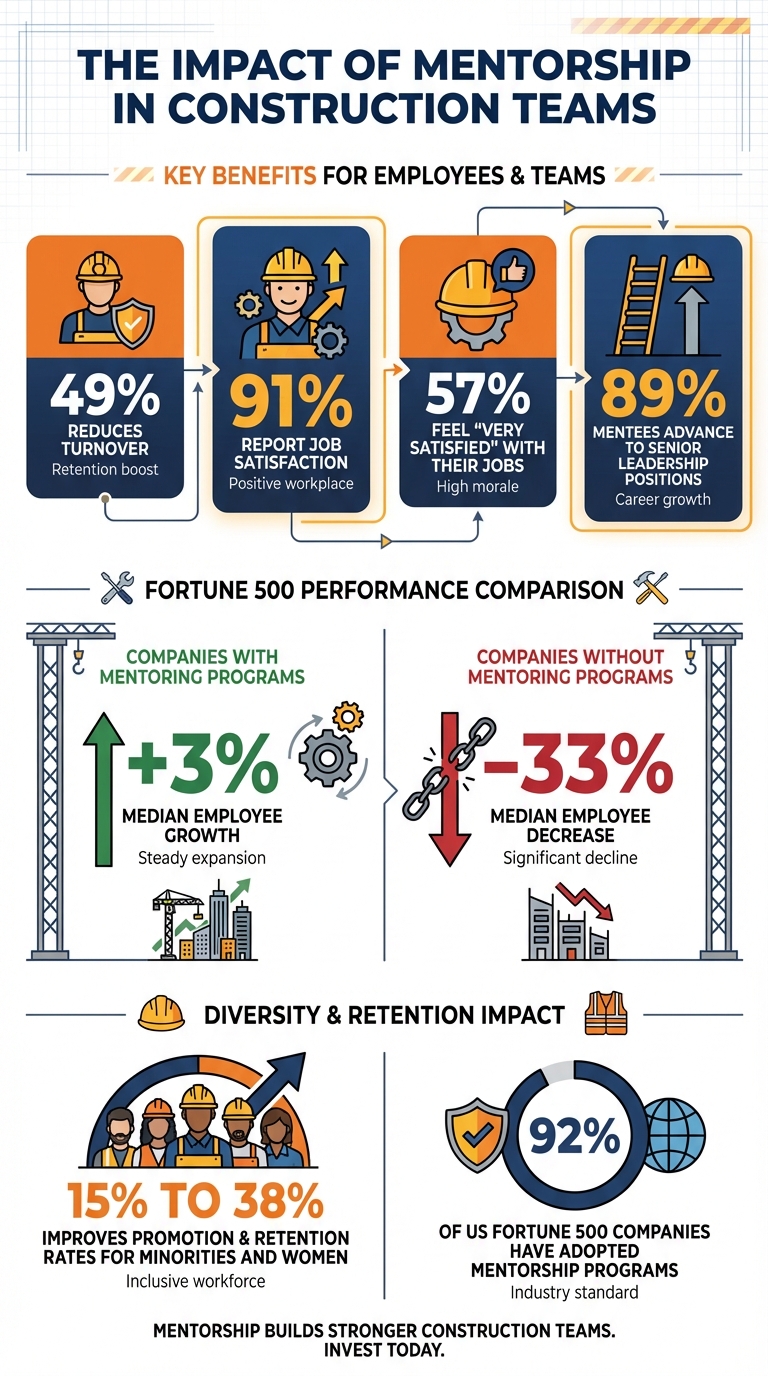
Construction Mentorship Program Benefits and Impact Statistics
Benefits and Challenges of Mentorship in the Construction Industry
sbb-itb-aa28329
Benefits of Mentorship in Construction Teams
Mentorship programs bring value to every layer of a construction team’s operations. From sharpening skills to boosting morale and curbing turnover, the positive impacts are both measurable and meaningful.
Faster Skill Development and Knowledge Transfer
Construction sites are where the real education happens. With mentors on hand, new workers get immediate feedback as they tackle tasks, helping them correct errors right away instead of repeating them for weeks. This hands-on guidance speeds up learning far more effectively than classroom training. For instance, an electrician mentor showing the correct way to install conduit ensures that best practices stick.
Mentorship also safeguards valuable expertise that might otherwise be lost as experienced workers retire. Pairing seasoned professionals with newer hires creates a pipeline of talent ready to take on advanced roles. And it’s not just technical skills being passed along – mentors also teach essential soft skills like communication, problem-solving, and leadership. These skills prepare workers for future management roles, with 89% of mentees eventually moving into senior leadership positions. This rapid transfer of knowledge strengthens team dynamics and builds connections on-site.
Better Team Relationships and Job Site Morale
Mentorship fosters emotional bonds that go beyond technical training. When experienced workers take the time to guide newer team members, it creates an environment of mutual respect and support. This sense of being valued boosts confidence and inspires loyalty as workers grow more skilled. The data supports this: Fortune 500 companies with mentoring programs reported a median employee growth of just over 3%, while those without such programs saw a median decrease of 33%.
Mentors also set the tone for safety and quality. Watching respected veterans consistently follow proper procedures helps new hires adopt these habits more effectively than any manual could. This reinforcement of best practices reduces workplace incidents and ensures project standards are upheld. Stronger relationships between team members also lead to clearer career paths and a reduction in turnover.
Lower Turnover and Clear Career Paths
High turnover is a costly problem for construction companies, with expenses piling up from construction staffing, onboarding, and lost productivity. Mentorship combats this issue by showing employees that their growth matters to the company. When workers feel supported, they’re less likely to leave, even when competitors offer higher wages.
Another key benefit of mentorship is the clarity it brings to career advancement. Workers who see a defined path – from apprentice to journeyman to foreman – are more likely to stay and commit to improving their skills. Mentors actively prepare them for each step, making career progression both achievable and transparent. Studies have shown that mentorship improves promotion and retention rates for minorities and women by 15% to 38% compared to those without mentors. By using performance metrics and structured milestones, companies can provide clear evidence of progress, giving employees confidence in their future within the organization.
How to Build a Mentorship Program for Construction Teams
Now that the benefits of mentorship are clear, the next step is creating a program that brings these advantages to life. Building a mentorship program takes thoughtful planning and a solid structure. Companies that implement mentorship often see concrete results, such as improved retention and skill development. In fact, 92% of US Fortune 500 companies have adopted mentorship programs for these reasons.
Setting Clear Expectations for Mentors and Mentees
Clarity is key when defining roles for mentors and mentees. Mentors should focus on offering guidance and constructive feedback, not micromanaging tasks. Meanwhile, mentees are responsible for driving their own learning by coming prepared with questions and seeking feedback actively. Supervisors play a critical role in ensuring both parties stay accountable and tracking their progress throughout the mentorship.
It’s also important to remember that being technically skilled doesn’t always mean someone is ready to teach. Mentors need training in soft skills like active listening, providing constructive feedback, and adapting to different learning styles. For example, a highly skilled electrician might excel at conduit installation but may need support to translate that expertise into effective teaching.
"It’s incumbent upon the mentee to branch out, take their mentor’s tacit knowledge, and do something that breaks new ground. The mentee has a big responsibility for their own success." – Brian Uzzi, Professor, Kellogg School of Management
Once roles are established, it’s time to focus on scheduling structured interactions.
Building a Program Schedule with Milestones
A clear schedule ensures that the program stays on track. A four-phase structure – Orientation, Initiation, Active Learning, and Evaluation – spread over six to 12 months works well.
- Orientation: Introduce program goals and key performance indicators.
- Initiation: Mentors and mentees meet, align on goals, and plan their first project together.
- Active Learning: Mentees shadow mentors, develop skills, and provide regular progress updates.
- Evaluation: Review achievements, gather feedback, and set new goals for continued growth.
Consistency is essential, so establish a meeting frequency that suits both parties. Some pairs might meet every two weeks, while others prefer monthly check-ins depending on their schedules. To simplify coordination, consider using digital scheduling tools to assign mentors and mentees to the same job sites. This minimizes logistical headaches and keeps the mentorship relationship running smoothly.
Choosing Mentors and Pairing Them with Mentees
With expectations and schedules in place, the next step is selecting and pairing mentors with mentees. Seniority isn’t the only factor to consider when choosing mentors. The best mentors combine technical expertise with leadership skills, effective communication, and a commitment to company values. A good way to identify potential mentors is by asking employees who they naturally turn to for advice – those who already provide informal guidance often make excellent mentors.
Before committing to a long-term pairing, test the match by sending the mentor and mentee on a single job together. Collect feedback from both to see if their communication styles and personalities align. Successful pairings often depend on factors like matching the mentor’s strengths to the mentee’s skill gaps, geographic proximity for easier coordination, and complementary personalities.
To ensure mentors don’t feel overburdened, adjust their workloads or offer incentives such as formal recognition, cash bonuses, or promotion opportunities. When mentors feel supported, they’re more likely to invest the time and energy needed to help their mentees succeed.
Measuring Mentorship Program Results
To maximize the advantages of a mentorship program, it’s crucial to measure its performance. Tracking specific metrics not only highlights the program’s value but also helps construction companies identify areas that need improvement.
Metrics for evaluation generally fall into five categories. Retention rates show if mentored employees stay with the company longer than their non-mentored counterparts. Productivity metrics – like job completion speed, revenue per technician, and weekly job counts – indicate whether mentees are becoming more efficient. Safety performance measures the frequency of incidents and adherence to safety protocols, while skill development tracks how quickly new hires reach full productivity and how often mentees obtain certifications. Finally, engagement indicators – such as participation rates and employee satisfaction scores – reveal how well the program connects with employees. For instance, 91% of mentored workers report job satisfaction, with 57% describing themselves as "very satisfied". These metrics provide actionable insights to fine-tune the program.
Metrics to Track Program Performance
Start by gathering baseline data before launching the mentorship program. Use tools like date filters in management software to compare pre- and post-program performance metrics. Digital scorecards can further simplify tracking key data points like revenue, task completion, and mentee growth, giving mentors clear and actionable insights.
Set SMART goals – specific, measurable, attainable, realistic, and time-bound. For example, instead of vaguely aiming to "improve training", set a goal like "reduce time to full productivity for new hires by 20% within six months." Track both leading indicators (e.g., meeting frequency, goal completion rates) that signal future success and lagging indicators (e.g., promotion rates, turnover reductions) that confirm long-term impact.
| Metric Category | Specific KPIs to Track |
|---|---|
| Retention | Turnover rate of mentees vs. non-mentees; promotion rates |
| Productivity | Job completion speed; revenue per technician; jobs per week |
| Safety & Quality | Number of safety incidents; rework rates; customer satisfaction scores |
| Engagement | Program participation rates; mentor-mentee meeting frequency; employee satisfaction scores |
| Skill Development | Time to reach full productivity; competency checklist completion; certifications earned |
While quantitative metrics provide hard data, qualitative feedback adds depth and context to the results.
Collecting Feedback from Mentors and Mentees
While numbers show the "what", feedback explains the "why." Regular input from both mentors and mentees helps track progress and assess overall effectiveness. Use a mix of methods – such as interviews, group discussions, and anonymous surveys – to encourage honest and varied perspectives.
Anonymous surveys, in particular, allow participants to share openly without fear of damaging relationships. Depending on the program’s duration, schedule these feedback sessions every two weeks or monthly.
Combine this feedback with performance data for a complete picture of program success. Look for recurring themes to refine mentorship pairings and program design. For example, if communication mismatches between mentors and mentees are a common issue, consider adjusting pairings or offering communication training. Most importantly, act on the feedback – visible changes based on employee input build trust and reinforce the program’s value.
Common Challenges and Solutions in Construction Mentorship
Even the best mentorship programs in the construction industry can hit roadblocks. Issues like tight schedules, resistance from employees, and coordination headaches across multiple sites are common. Tackling these challenges head-on with practical strategies can make a big difference in achieving positive outcomes.
Managing Time Constraints and Scheduling
Construction workers often juggle demanding workloads, and adding mentorship responsibilities can feel overwhelming. According to ServiceTitan, mentors may see the program as just another task, leading to rushed sessions and lower morale. To combat this, consider lightening a mentor’s workload to free up time for meaningful guidance. Offering incentives like public recognition, bonuses, or promotion opportunities can also show that mentoring is valued.
Another useful approach is to color-code projects in your scheduling system to flag “training-friendly” jobs across sites. Breaking the program into clear phases – such as Orientation, Initiation, Active Learning, and Evaluation – over six to twelve months provides structure and helps both mentors and mentees stay on track.
These adjustments make it easier to address resistance and skepticism among employees.
Handling Employee Skepticism About Mentorship
Resistance to mentorship often comes from two sides: experienced workers who feel unprepared to teach and new hires worried about micromanagement. To tackle this, start by identifying natural leaders within your team. Ask employees who they already go to for advice – these informal leaders are often more open to formal mentoring roles. Providing mentors with training in active listening and constructive feedback can also boost their confidence.
Data can be a powerful tool here. Use technician scorecards to highlight metrics like revenue generation, task completion rates, and skill development, showing the program’s tangible benefits. Statistics back this up: 91% of workers with mentors report job satisfaction, and 89% of mentees eventually move into senior leadership positions. Establish anonymous feedback channels so participants can share concerns without fear, and act on their input to build trust.
Addressing these concerns naturally sets the stage for integrating technology to improve mentorship efficiency.
Using Technology to Support Mentorship Programs
Technology can ease both time pressures and skepticism by simplifying processes and making training more consistent. Digital tools take the hassle out of scheduling and administrative tasks that can bog down mentorship programs. For instance, automated scheduling platforms can replace manual coordination, ensuring mentor-mentee pairs are consistently assigned to the same projects. Digital checklists standardize training on safety protocols, while performance tracking software provides scorecards that monitor key metrics like task completion and customer feedback.
Platforms like ABLEMKR offer a great example of how technology can streamline mentorship in construction. For companies managing teams spread across various sites, ABLEMKR provides real-time updates on worker status, certifications, and availability. Its geo-location–based matching ensures mentors and mentees with complementary skills are paired effectively, whether for pipeline repairs, infrastructure projects, or other tasks. The platform even tracks compliance with safety training and certifications, cutting down on paperwork and letting mentors focus on skill-building instead of admin tasks.
Conclusion: Building a Stronger Workforce Through Mentorship
Key Takeaways for Construction Companies and Workers
Mentorship delivers tangible results. Consider this: 91% of workers with mentors report job satisfaction, and 89% of mentees eventually advance to senior leadership roles. For construction companies facing challenges like an aging workforce and skill shortages, mentorship isn’t just helpful – it’s essential.
A well-structured program lasting six to twelve months can make all the difference. Break it into clear phases: Orientation, Initiation, Active Learning, and Evaluation. Equip your mentors with skills like active listening and giving constructive feedback – don’t assume technical expertise equals teaching ability. Keep mentors motivated with formal recognition, bonuses, or even promotions. And when pairing mentors and mentees, focus on compatibility rather than just seniority. This creates a two-way street where seasoned workers share their expertise while also learning about newer technologies and methods from younger team members.
Measure success by tracking promotions, safety records, and task efficiency. These metrics not only demonstrate the return on investment but also help address talent shortages and preserve critical knowledge as experienced leaders approach retirement. With these steps, mentorship becomes a strategic tool for maintaining and passing on expertise.
Creating a Culture of Learning and Development
The benefits of mentorship go beyond immediate improvements. It fosters a workplace culture where continuous learning becomes the norm, laying the groundwork for future leadership. When 57% of mentored employees report being "very satisfied" with their jobs, it’s clear that mentorship builds loyalty, which in turn reduces costly turnover. Shifting from traditional instruction to more open-ended guidance – where mentors encourage exploration and independent problem-solving – helps mentees develop critical thinking skills essential for leadership roles.
Make mentorship a permanent part of your operations. Use anonymous surveys to gather feedback and refine your program. Tools like ABLEMKR can help align mentor-mentee pairs with project needs, ensuring consistent learning on the job. By embedding mentorship into your company’s daily workflows, you’re not just addressing today’s challenges – you’re preparing tomorrow’s leaders to uphold your standards and drive long-term success.
FAQs
What is the difference between a mentor and a supervisor?
Mentors play a key role in shaping a mentee’s long-term growth. They share their expertise, provide advice, and help guide career development. Their focus is on building trust and supporting professional progress over time.
On the other hand, supervisors are responsible for managing daily tasks. They ensure safety, enforce standards, and oversee productivity. Their primary concern is meeting project deadlines and maintaining operational efficiency.
While both mentors and supervisors are crucial, their purposes differ significantly. Mentors focus on personal and professional growth, whereas supervisors prioritize immediate goals and workplace performance.
How do we start a mentorship program with small crews and tight schedules?
To kick off a mentorship program with small teams and busy schedules, it’s crucial to keep things structured and straightforward. Incorporate brief, on-the-job mentoring sessions during regular work hours to share practical knowledge without throwing off project timelines. Regular check-ins and feedback sessions help ensure everyone stays on track. Additionally, using digital tools can streamline coordination and make it easier to support remote or asynchronous mentoring, keeping the program adaptable and efficient.
How can we prove mentorship is paying off in dollars and safety?
Mentorship provides clear, measurable benefits, particularly when it comes to improving ROI and safety performance. By monitoring decreases in accidents, incidents, and safety violations, you’ll notice lower insurance premiums and fewer delays on projects. On top of that, tracking gains in productivity and skill development showcases both financial and operational advantages.


