
Offshore medical care is a balancing act between routine health management and life-saving emergency responses. Here’s what you need to know:
- Routine Care: Focuses on keeping workers healthy through primary care, managing chronic conditions, and preventing illness. Medics on-site handle minor issues, supported by telemedicine and digital tools for health monitoring.
- Emergency Response: Deals with critical situations like cardiac events or severe injuries. It requires rapid action, specialized teams, and equipment such as helicopters and rescue vessels for evacuations.
Key Differences:
- Objective: Routine care maintains long-term health; emergency response saves lives during crises.
- Time Sensitivity: Routine care is planned; emergencies demand immediate action.
- Staffing: Routine care relies on medics; emergencies need specialized rescue teams.
- Equipment: Routine care uses diagnostic tools; emergencies require advanced life-support systems.
- Patient Focus: Routine care handles stable conditions; emergencies address life-threatening cases.
Quick Comparison:
| Feature | Routine Medical Care | Emergency Medical Response |
|---|---|---|
| Goal | Health maintenance | Life-saving actions |
| Time Sensitivity | Low to moderate | Critical |
| Staff | On-site medics | Rescue specialists, pilots |
| Equipment | Basic diagnostic tools | Helicopters, life-support gear |
| Patient Type | Stable conditions | Life-threatening conditions |
Both systems are essential for offshore operations, ensuring worker safety and operational continuity. Advances in telemedicine and data-driven tools are helping integrate these two aspects for better health outcomes offshore.
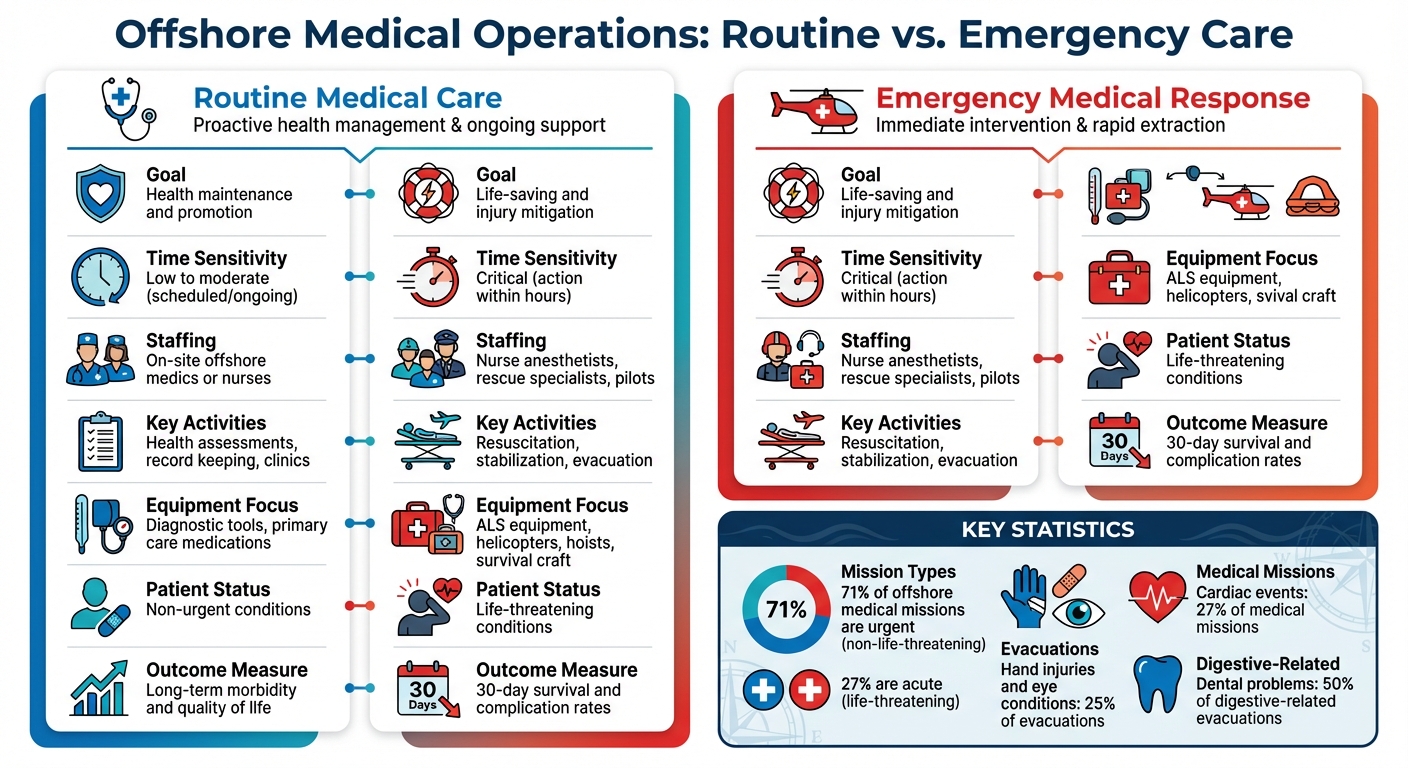
Routine vs Emergency Medical Care Offshore: Key Differences
Routine Medical Care Offshore
What Routine Care Includes
Routine medical care offshore plays a vital role in keeping workers healthy and ready for demanding assignments. At its core, this care focuses on primary healthcare services, addressing general medical needs and managing chronic conditions like diabetes or hypertension during deployments. Managing infectious diseases is especially important in offshore environments due to the tight living quarters. As Ipieca highlights:
In these types of locations [offshore installations], infectious diseases can spread rapidly, affect workers, and disrupt operations.
Programs for drug and alcohol testing are in place to minimize accident risks. Climate health monitoring helps protect workers from extreme conditions – whether it’s heat stress in tropical waters or cold exposure in northern regions. Additionally, fitness-to-work assessments ensure that personnel are physically capable of meeting the demands of their roles throughout their rotations.
Medical Staff and On-Site Facilities
Offshore medics and first aiders provide routine medical care while adhering to strict regulatory standards. In the UK, for instance, the Offshore Installations and Pipeline Works (First-Aid) Regulations 1989 set the requirements for their qualifications and training. These regulations mandate oversight by a registered health professional for the clinical aspects of medic training. Furthermore, training providers must complete a 12-month provisional period before obtaining a full certification valid for five years.
Most offshore platforms are equipped with clinics stocked with essential medications and medical equipment, following standardized guidelines. Many operations also leverage telemedicine, allowing on-site medics to consult with remote physicians for managing chronic conditions or handling complex cases that don’t require immediate evacuation. External medical service providers often collaborate with internal HSE (Health, Safety, and Environment) teams to enhance both primary healthcare and emergency response capabilities. These efforts are supported by digital management systems, ensuring consistent and reliable health monitoring.
Using Technology for Workforce Management
Digital tools have transformed the administration of offshore medical care. For instance, ABLEMKR‘s workforce management system tracks critical data like medical clearances, certification statuses, and training compliance before deployment. This ensures that only medically fit and properly certified workers are mobilized.
Automation plays a key role in scheduling periodic drug testing, monitoring chronic conditions, and managing medication and equipment inventory to prevent shortages. Additionally, training organizations now maintain HSE approval by submitting digital portfolios for trainers and assessors via email. These systems create a centralized digital record of each worker’s fitness-to-work status, vaccination history, and upcoming health requirements. This streamlined approach allows for better coordination of care across multiple installations and rotation schedules, setting the stage for the integrated offshore medical operations discussed later.
Emergency Medical Response Offshore
Common Emergencies and Response Triggers
Offshore medical emergencies generally fall into two main categories: injuries and illnesses. On the injury side, hand injuries and eye conditions account for 25% of all evacuations, while suspected fractures make up about one-third of injury-related responses. When it comes to illnesses, cardiac events, digestive issues, and infectious outbreaks often require immediate attention. Interestingly, dental problems alone are responsible for 50% of digestive-related evacuations.
Response protocols are triggered by specific scenarios like man overboard incidents, fires, flooding, or when the vessel master deems conditions hazardous. These situations demand well-coordinated action plans. The method of evacuation depends on the patient’s condition: life-threatening cases call for MEDEVAC, while SANEVAC is used for stable patients. These triggers form the backbone of the structured response plans outlined below.
What Emergency Response Plans Include
Emergency Response Plans (ERPs) are designed to ensure on-scene stabilization and efficient evacuation. On larger offshore installations, there’s typically one medic assigned to each site (such as an FPSO) and a specialized doctor overseeing the entire block. These plans also include Station Bills, which are posted in visible locations and clearly detail assigned duties – like operating safety equipment, launching rescue boats, and mustering workers during emergencies.
Evacuation methods are chosen based on urgency and resource availability. Helicopters are the preferred mode of transport, but in 7.7% of cases, chartered helicopters are required. When helicopters are not an option, Fast Supply Intervention Vessels (FSIVs) step in. These vessels are equipped to stabilize and treat patients while en route to shore.
Training and Drills for Emergency Readiness
Regular drills are critical in preparing offshore workers for emergencies. Safety training is mandatory for all personnel and includes key topics like emergency exits, proper lifejacket use, survival craft assignments, and recognizing emergency signals. Workers assigned to survival craft must also hold certifications, such as merchant mariner credentials with lifeboatman endorsements.
Drills are tailored to specific offshore environments and activities, such as engine rooms, helidecks, diving operations, and working at height. For instance, in man overboard drills, crews practice throwing ring buoys, keeping lookouts, and launching rescue boats. Fire drills, on the other hand, involve actions like sealing hatches to cut off airflow, de-energizing electrical systems, and using portable extinguishers. The International Marine Contractors Association emphasizes the need for job-specific training and first aid drills to ensure workers are prepared to act quickly and effectively.
Technology plays a key role in supporting these efforts by tracking certifications and scheduling refresher sessions. Emergency Action Plans are reviewed with employees when they are first assigned, whenever responsibilities change, or when updates are made. Consistent training and clear protocols are essential to maintaining a high level of emergency readiness offshore.
Key Differences Between Routine Care and Emergency Response
Goals and Time Requirements
Offshore routine medical care is all about maintaining the long-term health of workers. This involves managing occupational health, running scheduled "well man" clinics, and ensuring compliance with safety protocols. It’s a steady, ongoing process, with 24/7 support available for non-urgent issues like minor illnesses or dental concerns.
Emergency medical response, on the other hand, focuses on saving lives and reducing early mortality during crises. Time is critical here – actions often need to be taken within hours, such as evacuating a patient within 3 hours from an offshore site located 154 miles out at sea. While routine care revolves around planned assessments and record-keeping, emergency response is all about immediate action: resuscitation, stabilization, and evacuation.
"The primary objectives of the emergency services are to minimize early mortality and complications, although longer-term morbidity, quality of life and late mortality may also be influenced by early actions." – R West, University of Wales College of Medicine
Resources and Equipment Needs
The resources and staffing for routine care and emergency response differ significantly. Routine care is handled by on-site medics or nurses who provide primary healthcare and perform initial triage. Their tools include diagnostic equipment and medications for managing stable conditions, from digestive discomfort to dental emergencies.
Emergency response, however, requires highly specialized teams. Search and Rescue (SAR) operations involve professionals like nurse anesthetists, rescue specialists, hoist operators, and pilots. These team members undergo annual certifications to maintain advanced life support (ALS) skills. The equipment they use is far more specialized, including helicopters, hoists, immersion suits, lifejackets, survival craft, and resuscitation tools. Both systems utilize telemedicine, but emergency response often relies on real-time video to make critical decisions, such as administering thrombolysis for a heart attack.
Side-by-Side Comparison
| Feature | Routine Medical Care | Emergency Medical Response |
|---|---|---|
| Primary Objective | Health maintenance and promotion | Life-saving and injury mitigation |
| Time Sensitivity | Low to moderate (scheduled/ongoing) | Critical |
| Staffing | On-site offshore medics or nurses | Nurse anesthetists, rescue specialists, pilots |
| Key Activities | Health assessments, record keeping, clinics | Resuscitation, stabilization, evacuation |
| Equipment Focus | Diagnostic tools, primary care medications | ALS equipment, helicopters, hoists, survival craft |
| Patient Status | Patients with non-urgent conditions | Patients with life-threatening conditions |
| Outcome Measure | Long-term morbidity and quality of life | 30-day survival and complication rates |
These differences highlight the importance of having a system that combines routine care with rapid emergency response.
The numbers back this up: about 27% of offshore medical missions are classified as acute (life-threatening), while 71% are urgent but not immediately life-threatening. This breakdown shows why both systems are essential – routine care handles the majority of medical needs, while emergency response is there for the critical, life-or-death situations that require swift action.
sbb-itb-aa28329
Building an Integrated Offshore Medical System
Moving from Routine to Emergency Care
Offshore operations categorize incidents based on their severity. Minor injuries, like cuts or burns, are handled with routine care, while major incidents – such as evacuations, fatalities, or multiple injuries – trigger the Emergency Response Plan. In these critical situations, a designated Site Director steps in to coordinate efforts, and standardized alarm systems signal the necessary response.
A great example of this approach comes from Equinor (formerly Statoil). Between 2015 and 2016, they used real-time video consultations with onshore physicians at Haukeland University Hospital to transition seamlessly from routine care to emergency response. Offshore nurses utilized the "Pride Journal" electronic record system to manage 381 evacuations during this period. This system allowed routine consultations to escalate quickly into emergency diagnoses, ensuring that all patient data was readily accessible throughout the process. This strong connection between offshore medics and onshore specialists improved continuity of care and set the stage for better coordination through advanced technology.
Using Technology for Better Coordination
Modern telemedicine and diagnostic tools play a key role in linking routine monitoring to emergency care. For example, pre-hospital diagnostics, like transmitting ECGs to emergency units, help bridge this gap. ABLEMKR’s platform takes this a step further by providing real-time visibility into worker statuses and certifications. This allows operators to quickly mobilize medical teams based on geo-location data, safety training, and availability, ensuring that responders are always up to date on their certifications.
TOTAL E&P Angola showcased another integrated approach in 2016–2017 when Super Puma helicopters were grounded. They introduced Fast Supply Intervention Vessels (FSIVs) equipped with medical teams and facilities capable of treating two patients at the same time. These vessels supported 2,500 workers across four FPSOs, with constant communication between onshore and offshore teams ensuring seamless care for both routine consultations and critical emergencies.
Improving Systems Through Data and Feedback
Continuous improvement in offshore medical systems relies heavily on analyzing data and incorporating feedback. For instance, evacuation data has revealed that chest pain now accounts for 27% of all offshore medical missions, while trauma-related evacuations have dropped to about 18%. A study of 2,162 evacuations also highlighted a trend: as offshore workers age, illness-related evacuations are becoming more common, while injury-related evacuations are declining.
Atlantic Offshore Medical Services (AOMS) has embraced this data-driven approach in developing integrated health and safety plans for Atlantic Canada’s petroleum sector. Their system ensures that response teams can be airborne within an hour of an emergency call. Meanwhile, routine pre-employment medical exams help maintain baseline health across the workforce. Dr. O’Shea, an Occupational Health Consultant at AOMS, emphasized the importance of these plans:
"The integrated health and safety plans developed ensure that every employee is aware of his/her responsibilities in the event of an emergency, and covers the most challenging situations likely to arise".
Regular drills using actual equipment further enhance preparedness. These hands-on exercises give crews valuable experience with deployment procedures and generate feedback that helps refine both routine and emergency protocols. This ongoing cycle of practice and improvement strengthens the entire offshore medical system.
What Steps Are In Oil Rig Medical Evacuation?
Conclusion
Offshore medical support isn’t just about choosing between routine care and emergency response – it’s about creating a system where both work hand in hand. Over the years, the focus has shifted. Back in the 1980s, 75% of evacuations were due to trauma. Now, acute illnesses dominate, with 27% related to cardiac issues and 20% to abdominal conditions. This shift underscores the need for a strategy that combines prevention with fast, effective intervention.
The case for integration is straightforward. Routine care helps prevent emergencies, while a strong emergency response system ensures workers get critical care when it’s needed most. Examples from the field show that combining these systems strikes the right balance between day-to-day health management and crisis response.
Technology is a key player in linking these two areas. Tools like real-time monitoring devices, telemedicine platforms, and systems like ABLEMKR – designed to track worker certifications and availability – make it easier to mobilize the right medical professionals quickly. This coordination becomes even more vital as the offshore workforce ages. For instance, the average age for illness-related evacuations has risen to 34.4 years, compared to 28.3 years for injuries.
The best offshore medical systems treat routine care and emergency response as two sides of the same coin. Regular checkups catch potential problems early, while standardized action plans and frequent drills ensure that everyone knows their role when emergencies strike. As Paul Savage OBE from RMI puts it:
Robust and defendable Clinical Governance, appropriate for the remote working environment, allows RMI Providers to offer safe and effective care for their patients working inside a system that protects them as well as their patients.
This integrated approach doesn’t just safeguard workers; it also keeps operations running smoothly. A focus on both prevention and rapid response creates a medical framework ready to handle everything from minor dental issues to life-threatening cardiac events. Companies that succeed in this space are the ones using data to fine-tune their health programs and emergency protocols, ensuring they’re prepared for any situation.
FAQs
How does telemedicine improve medical care for offshore workers?
Telemedicine is transforming offshore medical care by offering real-time access to healthcare professionals, even in isolated locations like rigs or vessels where having an on-site doctor isn’t an option. Using high-definition video and satellite or LTE connections, offshore medics or trained crew members can connect directly with physicians onshore. This setup allows doctors to visually assess patients, track vital signs, and provide treatment recommendations promptly. The result? Fewer unnecessary evacuations, less downtime, and quicker medical interventions.
Beyond emergency situations, telemedicine also enhances routine healthcare and helps manage chronic conditions for offshore workers. With remote guidance, non-clinical staff can confidently handle medical tasks, ensuring faster and more precise care. Advancements like 5G and satellite-backed networks are further improving real-time monitoring and medical support, bolstering safety and efficiency in offshore operations.
Platforms such as ABLEMKR incorporate telemedicine into workforce management systems, giving workers instant access to medical assistance. This not only ensures compliance but also reduces response times and keeps operations running smoothly across offshore sites.
How do digital tools improve health management for offshore workers?
Digital tools are reshaping how offshore worker health is managed, turning remote sites into interconnected, data-focused hubs. Telemedicine platforms play a key role by enabling the transmission of critical medical data – like ECG readings, blood pressure, and oxygen levels – via satellite to onshore medical teams. This real-time data exchange allows onshore professionals to provide immediate assessments and guide on-site responders during emergencies. These systems typically operate using Wi-Fi or LTE/5G networks installed on offshore platforms or vessels.
Beyond emergencies, these tools are invaluable for routine health management. They track essential metrics such as communication reliability, the speed of patient data transfers, and evacuation times. This information can be displayed on dashboards, giving companies a clear view of performance, highlighting potential weaknesses, and helping refine safety measures.
By integrating health data with logistics and resource management systems, these tools simplify medical evacuations, improve staffing decisions, and ensure medical supplies arrive when needed. This proactive strategy not only boosts worker safety and well-being but also cuts down response times in critical situations.
How are emergency response plans customized for different offshore environments?
Emergency response plans are designed to address the distinct challenges of each offshore setting, prioritizing worker safety and ensuring access to prompt medical care when necessary. These plans take into account the type of operation, the location, and the potential risks involved.
For vessels and mobile platforms, U.S. regulations mandate safety orientations before departure and routine crew briefings. These cover evacuation procedures, proper use of life jackets, and the location of survival crafts. On fixed offshore installations, such as drilling rigs, emergency preparedness often includes on-site medical facilities, stocked medical supplies, and arrangements with external providers for evacuations or specialized care. In remote or harsh environments, factors like weather, sea conditions, and distance from shore play a critical role in determining the best course of action. Options may range from helicopter evacuations to advanced medical care provided directly on-site.
These tailored plans ensure that offshore workers are equipped to handle emergencies, regardless of their location or the conditions they face.


