
Managing your workforce effectively can save you time and money. Manual processes, like paper timesheets, are error-prone and inefficient, while digital systems streamline tasks, reduce costs, and improve accuracy. Here’s the key takeaway: manual workforce management inflates costs through errors, inefficiencies, and compliance risks, whereas digital tools provide real-time insights and automation to cut expenses and improve project outcomes.
Key Points:
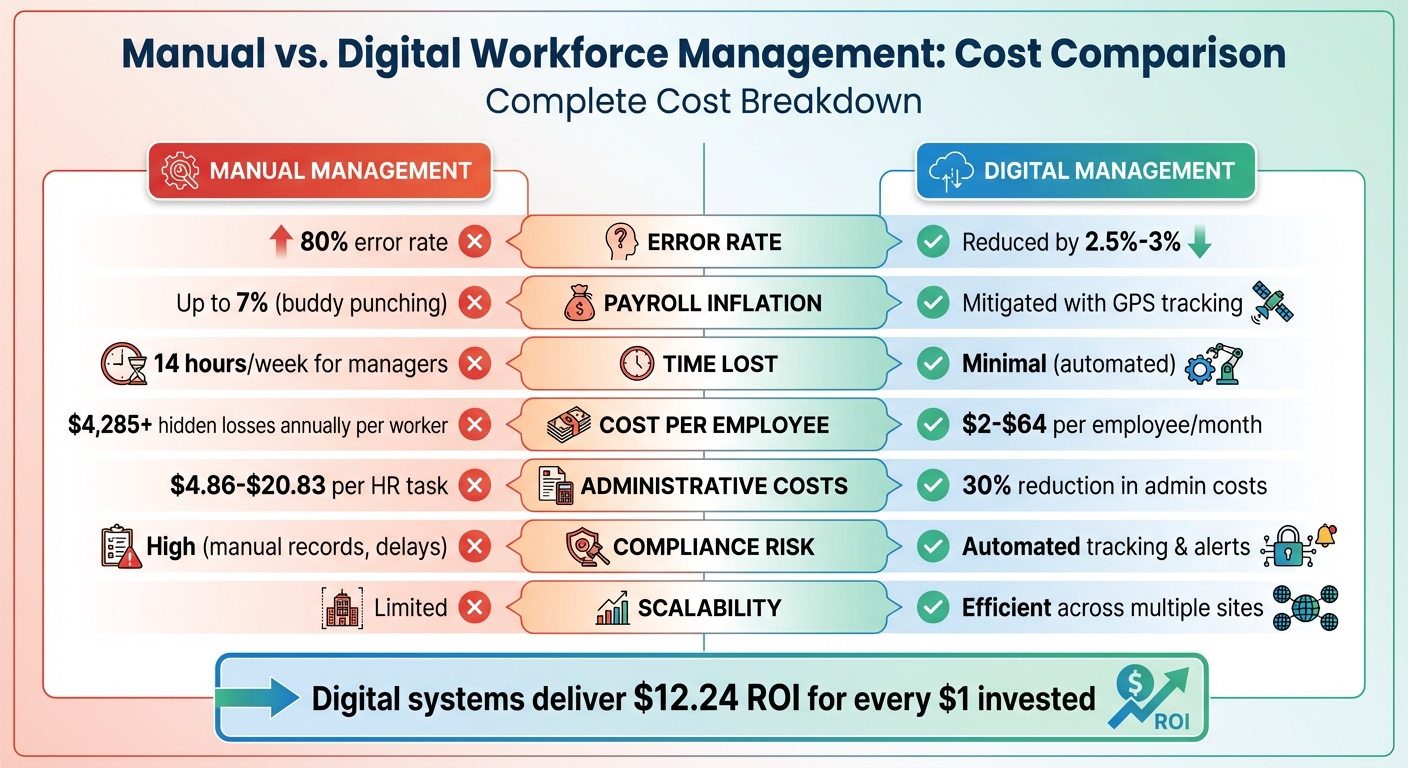
- Manual systems: Error rates of up to 80%, payroll inflation by 7%, and significant time lost (e.g., 14 hours/week for managers fixing timesheets).
- Digital systems: Reduce payroll errors by 2.5%-3%, cut administrative costs by 30%, and save thousands annually per employee by automating processes.
- Cost impact: Manual methods lead to hidden losses like $4,285+ per worker annually, while digital solutions offer predictable pricing (e.g., $2-$64 per employee/month).
Quick Comparison:
| Criteria | Manual Management | Digital Management |
|---|---|---|
| Error Rate | 80% | Reduced by 2.5%-3% |
| Payroll Inflation | Up to 7% (e.g., buddy punching) | Mitigated with GPS tracking |
| Cost per Task | $4.86-$20.83 per HR task | $2-$64 per employee/month (software) |
| Manager Time Lost | 14 hours/week | Minimal due to automation |
| Compliance Risk | High (manual records, delays) | Reduced with automated tracking |
| Scalability | Limited | Efficient across multiple sites |
Switching to digital workforce management saves time, reduces errors, and improves cost control. While there’s an upfront investment, the long-term savings and efficiency gains far outweigh the costs.
Manual vs Digital Workforce Management Cost Comparison
How much does workforce management software cost? | Budgeting and Value Analysis
What Manual Workforce Management Actually Costs
Manual workforce management isn’t just outdated; it’s expensive. While the upfront costs, like administrative salaries, are obvious, the hidden expenses – errors, compliance issues, and productivity losses – add up quickly. These inefficiencies drain budgets daily, often without companies realizing the full impact. Here’s a closer look at the costs tied to manual processes.
Administrative Labor Costs
Processing paper timesheets and other manual HR tasks isn’t cheap. By 2025, the average cost of a single manual HR data entry task reached $4.86. When you consider tasks like verifying timecards, creating payroll, recording tax forms, reviewing shift swaps, and searching for employee information, the expenses grow fast. Just check out the table below for specifics.
HR teams spend an average of four full weeks annually on manual tasks. In industries like construction, where labor makes up 30% to 50% of total costs, these inefficiencies directly cut into profits.
A real-world example? Life Time, a health and fitness company with 38,000 employees, discovered they were losing 50,000 manager hours per year to manual time management tasks. Switching to a digital system saved them all that time.
“We have reallocated close to 50,000 manager hours per year with automated time management”.
Errors and Payroll Leakage
Manual systems are error-prone, and those mistakes are costly. Manual time tracking has an error rate as high as 80%, with each error costing an average of $291 to fix. On top of that, practices like "buddy punching" can inflate payroll by up to 2.2%. For contractors, time theft and inaccuracies cost an average of $4,285+ per worker annually.
For instance, a contractor with 200 employees and a $10 million payroll could lose $220,000 every year to these inefficiencies. Axcon Corporation faced this exact problem in 2025. Supervisors routinely logged a flat 60 hours per week for employees, regardless of actual hours worked. After adopting digital tracking, Axcon saved 5% in monthly wages and $246 in administrative hours per employee annually. This also improved their bid win rate by 5% due to more accurate labor cost estimates.
Another example is LPL Solar, which eliminated flat-hour estimates entered manually by foremen. This change saved them $7,500 per foreman annually.
“The real win was the clarity… They finally had data they could trust, and that trust helped drive smarter decisions across every job”.
Compliance and Safety Expenses
Manual systems don’t just cost money – they also invite compliance risks. Poor record-keeping can lead to penalties. In 2022, the U.S. Department of Labor recovered over $38 million in back wages for construction workers due to wage and hour violations, many tied to manual record-keeping.
Tracking certifications, safety training, and OSHA documentation manually is a recipe for disaster. When inspectors or clients request records, manual systems make it nearly impossible to deliver clean, verifiable documentation. This is especially problematic for Time & Materials (T&M) contracts, where disputes over labor costs can force contractors to absorb expenses they can’t prove.
Additionally, payroll errors and unclear communication about certifications or schedules drive employee turnover. Replacing an employee who leaves due to these frustrations can cost 1.5x to 2x their annual salary.
Lost Time and Inefficiency
Construction professionals spend 35% of their time on non-productive activities like searching for project information or fixing mistakes. Without real-time data, managers face delays and inefficiencies that inflate costs. Manual scheduling often leads to either overstaffing – wasting money – or understaffing, which delays projects and increases overtime expenses.
Only 31% of construction projects stay within 10% of their original budget, with poor labor management being a key factor. Over the past two decades, the construction industry has seen just 1% annual productivity growth. Compare that to the global economy’s 2.8% growth, and it’s clear that reliance on manual processes is holding the industry back.
| Manual HR Task | Cost Per Task |
|---|---|
| Single Manual Data Entry | $4.86 |
| Verifying Timecard Accuracy | $17.54 |
| Creating Payroll | $20.83 |
| Recording W-4/Tax Forms | $12.85 |
| Reviewing Shift Swaps | $15.06 |
| Searching for Employee Info | $11.75 |
What Digital Workforce Management Costs
Managing a digital workforce involves an upfront investment, but the costs are fairly straightforward and predictable. Smaller platforms range from $20 to $1,000 per month, while enterprise-level solutions have shown an estimated net present value (NPV) of $4.6 million over three years. Initial setup costs typically include software licensing, integration with existing systems like ERP or accounting platforms, and employee training. The implementation process, which unfolds over 1 to 12 weeks, is broken into three distinct phases.
Software and Setup Expenses
Breaking down the costs helps illustrate how the investment leads to greater efficiency. Key expenses include software licensing, API integration, data cleaning, and employee training. Implementation often requires specialists to handle workflow automation and system integration. Surprisingly, the technical aspect isn’t the biggest hurdle – it’s getting the workforce on board. Employees need focused training to acquire new skills and overcome resistance to change. In fact, successful implementations typically allocate 70% of the budget to change management and skill-building, with only 20% going toward the technology itself.
Cost Reductions from Automation
Automation delivers significant savings. Digital systems can slash document processing costs by 60–80% compared to manual methods. For example, processing time drops from 10–15 minutes to under 2 minutes. Similarly, invoice processing costs, which average $15–$16 manually, can fall to as little as $3 per invoice. Companies adopting integrated workforce technologies report spending 26% less on HR costs and operating with 32% fewer staff.
A real-world example? In 2023, a Global Chemical Manufacturer introduced intelligent document processing for purchase orders, achieving a 90% reduction in order errors (from 10% to 1%) and a 93% boost in processing speed, cutting order times from 15 minutes to just 12 seconds. These kinds of results highlight the transformative potential of automation.
Compliance Cost Savings
Beyond the initial setup, automation also tackles hidden compliance costs. Digital platforms simplify compliance by providing automated alerts and audit-ready documentation. Certified payroll reports for government projects can be generated automatically, saving hours of manual work and reducing the risk of non-compliance. These systems also handle multi-state tax compliance, calculating varying tax rates, unemployment contributions, and local requirements seamlessly across multiple locations.
Features like GPS-verified time tracking and geofencing prevent costly practices like buddy punching, which can cost construction companies over $1,100 per employee annually. Additionally, organizations can reduce payroll errors by 2.5% to 3% by adopting digital time and attendance solutions. Even small tasks like processing a Form W-4, which costs $12.85 manually, are eliminated entirely with digital self-service options.
Scaling Across Multiple Sites
One of the standout benefits of digital platforms is their ability to scale efficiently. Whether a company is managing 50 workers across three sites or 200 workers across ten, the software fees remain roughly the same, as costs are tied to workload rather than headcount. Real-time data access allows managers to spot cost overruns instantly, avoiding the delays associated with manual reporting.
Mobile solutions further enhance flexibility, allowing field teams to clock in, submit timecards, and access schedules from anywhere. For instance, in 2023, Sumitomo Warehouse adopted an OCR-based platform for customs documentation, cutting shipping invoice processing times by 90%, from 40 minutes to just 4 minutes per document. These kinds of efficiencies are especially crucial for managing remote job sites or handling last-minute workforce adjustments. By scaling seamlessly, digital platforms help reduce overall project costs while addressing hidden inefficiencies.
sbb-itb-aa28329
Side-by-Side Cost Comparison
Labor Costs vs. Software Fees
Relying on manual processes for workforce management comes with steep per-transaction costs – like $17.54 to verify a single timecard, $20.83 to process payroll, and $15.06 for handling a shift swap. On top of that, construction supervisors and managers spend about 14 hours each week correcting timesheet errors. That’s nearly two full workdays lost – time that could be spent focusing on project management instead.
In contrast, digital platforms offer a more predictable pricing structure. Mid-market solutions typically cost between $2 and $12 per employee per month, while enterprise-level systems can go up to $64 per employee per month. Initial setup fees for mid-sized companies generally range from $5,000 to $50,000. By automating tasks like timecard verification, these systems eliminate the per-transaction costs tied to manual processes, while also addressing hidden inefficiencies that drive up costs.
Hidden Costs: Errors, Delays, and Fines
Manual systems come with hidden pitfalls that can significantly inflate expenses. Paper timesheets, for instance, have an 80% error rate, and "buddy punching" – when employees clock in for each other – impacts 75% of U.S. businesses, increasing payroll costs by as much as 7%. These inefficiencies contribute to a staggering $177 billion in lost productivity every year.
Digital platforms help tackle these issues head-on. Features like GPS geofencing verify that employees are physically present at the job site before clocking in. Automated compliance alerts also flag potential violations early, reducing the risk of costly fines.
Time Savings and Project Margins
The inefficiencies of manual systems don’t just affect costs – they also jeopardize project timelines and budgets. Around 35% of commercial projects exceed their budgets by 15% to 28%, partly because manual systems fail to provide real-time labor data. Without this information, managers often waste hours sifting through outdated spreadsheets and whiteboards, unable to make informed adjustments in time.
Digital workforce management tools change the game by offering real-time insights. Dashboards provide instant visibility into labor costs, showing which crews are on-site, how hours compare to the budget, and where skills gaps may exist. This level of transparency allows managers to reassign workers based on certifications and availability, reducing idle time ("benched" labor) and cutting down on pricey last-minute hires. The result? Tighter control over project margins and fewer surprises along the way.
How ABLEMKR Reduces Workforce Management Costs

Lower Administrative Overhead
ABLEMKR takes the hassle out of workforce management by automating tedious tasks like timesheet collection, entry verification, and payroll integration. Workers can clock in and out using their mobile devices, with GPS location and photo ID verification automatically recorded. This allows payroll teams to resolve discrepancies and fix errors as they happen, saving time and reducing headaches.
Did you know that construction professionals spend about 35% of their working hours on non-productive tasks? On top of that, manual payroll processing can lead to errors in up to 8% of entries. These inefficiencies aren’t just inconvenient – they can cost businesses between 10% and 30% of their annual revenue. By switching to automated workflows, companies can slash administrative costs by 30% and reduce task volumes by 40%. ABLEMKR also simplifies compliance tracking by automating processes like prevailing wage rate calculations and certified payroll report generation, eliminating the need for manual intervention. These improvements not only save money but also streamline operations.
Faster Crew Deployment
ABLEMKR’s mobile-first platform ensures workers are deployed efficiently by matching pre-vetted employees to job sites based on factors like certifications, safety training, availability, and location. With dynamic scheduling, tasks can be assigned or adjusted in real time, allowing managers to quickly adapt if plans change. Mobile data entry means updates are instant, cutting out delays caused by manual timesheet processing.
Features like GPS tracking and geofencing add another layer of control, ensuring workers log time only from approved job sites. This helps prevent time theft and attendance fraud. Plus, these tools allow managers to monitor task progress and make adjustments before small delays turn into costly overruns. It’s a proactive way to keep projects on track and within budget.
Built-In Compliance Tracking
Once administrative overhead and deployment issues are under control, compliance becomes the next key focus. ABLEMKR’s built-in compliance tools automatically verify certifications and safety training, reducing risks like fines, insurance claims, and project delays. The platform keeps detailed audit trails and documentation to prove compliance across industries such as oil & gas, mining, utilities, and heavy infrastructure.
Conclusion
Relying on manual workforce management drains resources through mistakes, inefficient use of supervisors’ time, and compliance issues that collectively cost billions each year.
To tackle these challenges, many organizations are turning to digital management solutions. Automation can reduce processing times by 25% and cut overtime expenses by 50%. Additionally, businesses adopting cloud-based workforce management systems report an average return of $12.24 for every dollar invested. A real-world example? In November 2017, ABLEMKR introduced digital labor tracking, which freed up 36 hours of management time per week across just six project managers.
FAQs
What are the hidden costs of managing your workforce manually?
Managing your workforce manually might seem like a budget-friendly choice at first glance, but hidden costs can quickly add up. Managers often spend 5–10 hours each week juggling tasks like creating and updating schedules. That’s not just time lost – it’s hundreds of dollars in productivity slipping through the cracks. On top of that, manual processes come with 10–30% error rates, leading to headaches like missed shifts, unplanned overtime, and compliance slip-ups that can result in hefty fines or expensive rework.
As your operations grow, manual management only becomes more of a burden. You’ll likely need additional administrative staff, which increases payroll expenses without necessarily boosting efficiency. Manual timekeeping and data entry bring their own set of complications, from incorrect paychecks to wasted time fixing errors. Plus, the lack of real-time insights can frustrate employees and contribute to higher turnover rates. In industries like construction, where safety and compliance are critical, these problems are amplified. A single mistake in certifications or safety records could delay projects and rack up penalties.
That’s where digital tools like ABLEMKR come in. By automating scheduling, tracking certifications in real time, and offering instant access to labor and payroll data, these solutions cut down on errors, save valuable time, and ensure compliance. They also enable businesses to grow without the need to expand administrative teams, keeping costs in check while improving overall efficiency.
How can digital tools help reduce compliance risks in workforce management?
Digital workforce management systems simplify compliance by automating essential tasks such as time tracking, certification checks, payroll processing, and safety documentation. These platforms centralize all this information in real time, helping businesses stay aligned with legal and regulatory requirements.
By minimizing errors, avoiding missed deadlines, and reducing the chance of non-compliance, companies can protect themselves from fines and operational hiccups. With tools like real-time updates and built-in compliance monitoring, these systems make managing a compliant workforce far more efficient.
What are the long-term cost benefits of using digital tools for workforce management?
Switching to digital workforce management can lead to impressive financial benefits over the long term. For every $1 invested, businesses typically gain a return of around $12.24. By addressing common issues like labor inefficiencies, payroll mistakes, and scheduling conflicts, companies often reduce labor-related expenses by 2–5% each year.
Beyond saving money, digital tools simplify operations, help retain employees by reducing turnover, and make compliance tracking much easier. These improvements not only boost profits but also create a more flexible and efficient workforce.


