
When independent contractors are injured on-site, employers can face serious legal and financial risks. Unlike employees covered by workers’ compensation, contractors can sue for negligence, seeking damages for pain, suffering, and lost income. Misclassification of workers as contractors instead of employees can escalate these liabilities, leading to retroactive penalties, unpaid taxes, and steep fines. High-risk industries like construction and energy are particularly vulnerable due to inherent job hazards and multi-layered subcontractor arrangements.
Key risks employers face include:
- Negligence lawsuits: Contractors can sue for full tort damages, including pain and suffering, if employer negligence is proven.
- Misclassification penalties: Misclassified workers can trigger back taxes, retroactive premiums, and state fines.
- Upstream liability: General contractors may be held responsible for subcontractors’ failures to provide workers’ compensation.
- Non-delegable duties: Employers remain accountable for site safety, even when hiring contractors.
To reduce liability, employers should ensure proper worker classification, require proof of insurance from contractors, and use tools like compliance platforms to track documentation. Contracts should emphasize contractor independence, and regular audits can help maintain compliance. By taking these steps, employers can minimize financial exposure and avoid costly legal disputes.
Who is Liable for Damages & Injuries: Employer vs. Contractor
sbb-itb-aa28329
The Rising Problem of Liability in High-Risk Industries
Industries like construction, energy, and mining are navigating an increasingly complex web of liability concerns. Beyond the traditional employer-employee dynamics, recent legislative changes are broadening the scope of responsibility, especially when contractors get injured.
In Delaware, amendments to the Workplace Fraud Act set to take effect in January 2026 impose joint and several liability on general contractors for subcontractor misclassification. Violations can result in penalties up to $20,000 and a three-year ban from bidding on projects for repeat offenders. As Duane Morris LLP explains:
"Under the newly amended statute, general contractors are liable not only for their own misclassification of workers, but also for any misclassification by their subcontractors".
This reflects a growing national trend toward stricter liability standards. Across the U.S., courts are increasingly scrutinizing contractor relationships, particularly in industries where risk is inherent to the work.
Common Injury Scenarios and Employer Exposure
In high-risk sectors, injuries often stem from falls, equipment failures, or hazardous site conditions. When incidents occur, hiring companies can face liability if they provided faulty equipment, failed to maintain a safe worksite, or exerted excessive control over how tasks were carried out.
The principle of "non-delegable duties" plays a critical role here. It means that even if you hire contractors, you remain responsible for ensuring safety in certain situations. For example, if the worksite is inherently dangerous – like during demolition or pipeline repairs – you could be held accountable for injuries regardless of who performed the work. Courts also assess whether you dictated specific methods, supplied key tools, or controlled the contractor’s schedule. When hiring companies provide machinery or tools that lead to injuries, they can be directly liable. This is especially challenging in the energy and extraction industries, where site operators often supply specialized equipment.
How Misclassification Affects Liability
Misclassification adds another layer of complexity to contractor relationships. Workers who perform tasks central to your business, follow your schedule, and are paid hourly may be deemed employees by the courts. This can open employers up to retroactive workers’ compensation claims, back taxes, and statutory penalties.
For instance, New York’s Construction Industry Fair Play Act applies the "ABC test", which assumes all workers are employees unless you can prove they operate independently, perform work outside your core business, and maintain an established trade. This shift places the burden of proof squarely on employers.
If misclassification is uncovered after an injury, the legal and financial consequences escalate quickly. In New York, Workers’ Compensation Law § 56 allows injured subcontractors to hold general contractors accountable, adding yet another layer of liability. These compounded risks often lead to aggressive legal claims, making compliance and proactive safety measures more crucial than ever.
Main Risks Employers Face When Contractors Are Injured
When an independent contractor suffers an injury on your job site, the potential financial and legal consequences can be far-reaching. Unlike employees, contractors aren’t covered under the same protective umbrella of workers’ compensation, leaving employers vulnerable to significant liability. Below, we break down the key risks and legal exposures associated with contractor injuries.
Workers’ Compensation Gaps and Negligence Claims
The legal protections for employees and contractors differ drastically. Employees injured on the job are generally restricted to workers’ compensation benefits, which cover medical expenses and partial wage replacement. This "exclusive remedy" rule prevents employees from suing their employers for additional damages. Contractors, however, are not bound by this limitation. If they can demonstrate that your negligence caused their injury, they can pursue a lawsuit seeking damages that include pain and suffering. These claims can result in massive judgments, sometimes reaching six or seven figures.
As employment attorney Janette Levey explains, "An injured independent contractor who can show… that your actions and omissions amounted to negligence might result in you having to defend a lawsuit". The situation becomes even more complicated if the contractor doesn’t carry their own workers’ compensation insurance. In such cases, if the contractor is later reclassified as an employee, you could be on the hook for retroactive premiums, back taxes, and unpaid benefits. State laws further amplify these risks, enforcing strict guidelines to ensure coverage and accountability.
Third-Party Liability Under State Laws
State-specific regulations add another layer of exposure. For instance, New York’s Workers’ Compensation Law § 56 permits injured subcontractors to hold general contractors accountable if the subcontractor fails to provide workers’ compensation coverage. This concept, known as "upstream liability", means you could bear the financial burden of another party’s failure to insure their workers. Non-compliance with these laws often results in hefty fines, which can escalate quickly for repeat offenses or intentional misclassification.
Subcontractor Chain and Upstream Liability
Liability risks don’t stop with direct contractors – they extend throughout the subcontractor chain. If one of your subcontractors hires their own workers and fails to insure them, any injury claim could move up the chain to you as the general contractor or property owner. This is especially problematic in industries like energy and extraction, where multi-layered contractor arrangements are common.
Insurance audits add another complication. Payments made to uninsured 1099 contractors may be reclassified as employee payroll, leading to substantial retroactive premium adjustments. As Podor Law points out, "The actual working relationship is what matters, not what anybody calls it or what papers you signed". If you control the contractor’s schedule, provide tools, or oversee their work methods, you risk reclassification – and the liability that comes with it.
Employee vs. Independent Contractor Liability Comparison
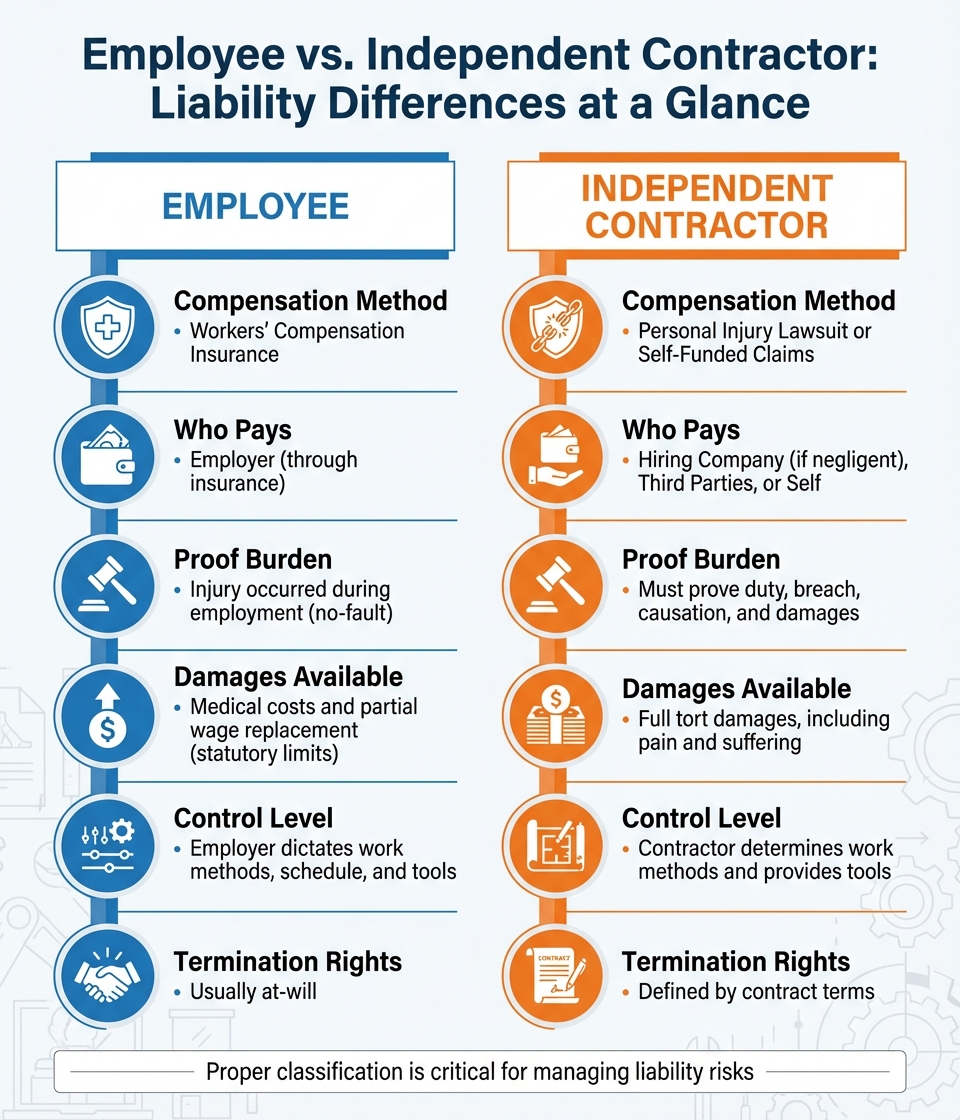
Employee vs Independent Contractor Liability Comparison Chart
Understanding the liability distinctions between employees and independent contractors is crucial for managing risks effectively. These differences not only highlight potential exposures but also guide strategies to prevent costly legal claims. Since injuries involving contractors can lead to significant financial and legal challenges, grasping these nuances is essential for creating targeted preventative measures.
Employees benefit from no-fault workers’ compensation coverage. This includes medical expenses and partial wage replacement. They don’t need to prove any fault to access these benefits. However, in exchange for this coverage, employees are typically barred from suing their employers for additional damages like pain and suffering.
Independent contractors, on the other hand, face a more challenging legal process. They must establish four critical elements: duty, breach, causation, and damages. If they succeed, they can recover full tort damages, including pain and suffering and lost wages – far beyond the limited statutory benefits available to employees.
Worker classification often hinges on the level of control over tasks, tools, and schedules. For example, in New York, construction workers are automatically presumed to be employees unless the hiring entity can prove they meet all three conditions of the ABC test.
Comparison Table: Liability Differences
| Feature | Employee | Independent Contractor |
|---|---|---|
| Compensation Method | Workers’ Compensation Insurance | Personal Injury Lawsuit or Self-Funded Claims |
| Who Pays | Employer (through insurance) | Hiring Company (if negligent), Third Parties, or Self |
| Proof Burden | Injury occurred during employment (no-fault) | Must prove duty, breach, causation, and damages |
| Damages Available | Medical costs and partial wage replacement (statutory limits) | Full tort damages, including pain and suffering |
| Control Level | Employer dictates work methods, schedule, and tools | Contractor determines work methods and provides tools |
| Termination Rights | Usually at-will | Defined by contract terms |
These distinctions emphasize why accurate worker classification and comprehensive risk management are essential for minimizing liability and ensuring compliance. Properly addressing these factors can help avoid disputes and reduce exposure to legal and financial risks.
Practical Ways to Reduce Employer Liability
Ensure Proper Worker Classification
To avoid misclassification issues, use the streamlined economic reality test, which focuses on factors like control and profit opportunities. However, keep in mind that federal rules don’t override stricter state laws. For example, states like California, New York, and New Jersey apply the "ABC test", which assumes workers are employees unless proven otherwise. In Florida, construction workers must hold a specific state exemption certificate to qualify as independent contractors.
It’s essential to regularly audit contractor relationships to ensure they meet the criteria for independence. Independent contractors should provide their own tools, set their schedules, and bear financial risks tied to their business decisions. Misclassifying workers can have serious consequences. For instance, a typical construction worker misclassified as an independent contractor loses an average of $16,729 annually in income and benefits. Penalties for misclassification vary by state and may include fines, back premiums, and even felony charges.
"The actual practice of the parties involved is more relevant than what may be contractually or theoretically possible." – U.S. Department of Labor
To safeguard your business, document contractor independence thoroughly. Keep records such as business licenses, third-party invoices, and proof of contractor status. While written contracts are helpful, courts will always prioritize the actual working relationship over the terms outlined on paper.
Once classification is confirmed, the next step is ensuring contractors carry proper insurance.
Require Proof of Insurance from Contractors
Always collect Certificates of Insurance (COI) before contractors begin work. This precaution protects your business from becoming a statutory employer, which could make you liable for injuries to workers employed by uninsured subcontractors.
Check that the insurance policies provide actual coverage, and track expiration dates to ensure timely renewals. Make sure the policy isn’t just a formality but offers meaningful protection. For extra security, request "additional insured" status on contractors’ liability policies. In states like Florida, general contractors are legally obligated to verify subcontractor coverage or face penalties.
These steps not only protect against liability but also prepare you for advanced compliance solutions.
Use Platforms Like ABLEMKR for Compliance

Handling compliance manually for numerous contractors can leave room for errors and liability exposure. Platforms like ABLEMKR simplify this process by automating compliance checks, maintaining digital records, and streamlining payroll workflows. This reduces the risk of contractor reclassification by keeping accurate records of COIs, contracts, and worker status.
ABLEMKR also ensures accurate worker-to-job assignments by verifying certifications, safety training, availability, and location. This clear documentation of independence – such as contractors using their own tools and methods – further minimizes liability risks.
In high-risk industries like construction, energy, oil & gas, and mining, where independent contractors make up about 6.9% of total employment, automated compliance tracking is more than a convenience. It’s a vital tool for managing risks and avoiding statutory employer designations that could lead to vicarious liability.
Long-Term Risk-Reduction Methods
Contractual Safeguards and Regular Risk Audits
Well-structured contracts can shift liability for injuries to contractors. By including indemnification clauses, you can transfer the financial burden of legal claims to the contractor. Clearly outline deliverables while avoiding control over their work methods. This distinction is crucial in legal settings.
"Contractual clause requiring contractor to comply with owner’s safety rules does not signify the requisite right of operational control necessary to vitiate the independent contractor relationship." – Davenport v. Amax Nickel, Inc.
Your contract should emphasize the contractor’s independence by identifying them as a separate business entity with their own license, branding, and tools. Payments should be handled through purchase orders or invoices, not through payroll. Avoid non-compete clauses or references to employee handbooks, as these can blur the lines of contractor independence.
Conduct regular audits to ensure contractors maintain active insurance coverage that includes your company as an additional insured. During these audits, review your interactions with contractors to confirm that supervisors focus solely on deliverables, not on managing schedules or work methods. Document evidence that contractors set their own rates, cover their own expenses, and hire their own staff. This documentation is invaluable if worker classification is legally challenged, especially since plaintiffs often use safety manuals as evidence of operational control.
Additionally, keep a detailed log of known site hazards and ensure you disclose these to contractors. This practice can help protect against negligence claims stemming from concealed hazards.
Combining these contractual safeguards with technology-driven compliance measures can create a more reliable and long-term strategy for managing risks.
Use Technology for Safer and Faster Deployment
Technology complements contractual measures by automating compliance and reducing liability. Digital platforms help eliminate manual errors that can increase risks. For instance, ABLEMKR’s centralized documentation showcases contractor independence by proving they control how tasks are performed, while you remain focused on outcomes.
The platform’s geo-location tools and pre-vetted worker profiles enable quick crew deployment without the need for day-to-day oversight that could imply an employer-employee relationship. Time-stamped digital records, such as photos and electronic communications, provide strong evidence against claims of operational control.
ABLEMKR also simplifies payment processes by treating payments as invoices, preserving contractor independence. Real-time tracking of worker status and automated job matching let you monitor progress and deadlines without dictating work methods – exactly the level of separation courts look for when evaluating contractor relationships.
In industries like construction, energy, and mining – where independent contractors account for 6.9% of total employment – this tech-driven approach offers a structured way to reduce the financial risks tied to worker misclassification. It also helps mitigate the average annual loss of $16,729 often experienced by misclassified workers, while shielding your business from liability.
Conclusion
Contractor injuries can lead to serious financial and legal risks for employers. The gap between a $45-per-month insurance premium and a $50,000 penalty – or a lengthy lawsuit – often hinges on how effectively you handle classification, documentation, and compliance.
Start by verifying worker status using tools like the IRS 20-factor test or your state’s ABC test, and back this up with clear, written contracts. But keep in mind, courts focus on the reality of the working relationship, not just what’s on paper. As employment attorney Janette Levey explains:
"If you have correctly classified the worker as an independent contractor, you do not have to worry about workers’ compensation issues, but you still aren’t off the hook".
Requesting proof of insurance with additional insured status and performing regular audits helps shift the financial burden away from your company while reinforcing compliance.
For added protection, technology platforms like ABLEMKR simplify compliance by centralizing records such as certifications, insurance verifications, and time-stamped documentation. This reduces manual errors and provides a solid evidence trail, which can be crucial if a contractor’s classification is ever questioned in court.
FAQs
When can an injured contractor sue my company?
If a contractor gets injured and is misclassified as an independent contractor, they could sue your company – especially if they don’t have workers’ compensation coverage. The situation becomes even riskier if your company had significant control over how they performed their work, which could make your business responsible for their injuries. To reduce these risks, it’s essential to ensure proper classification and follow all compliance guidelines.
What are the biggest signs a contractor could be reclassified as an employee?
Key signs of classification issues often revolve around the employer’s control over the worker and the worker’s reliance on the employer. Some common indicators include:
- Close supervision of the worker’s tasks
- Performing duties that are central to the business
- Receiving benefits such as health insurance
- Maintaining a long-term working relationship
- Limited financial independence
Misclassifying workers can lead to serious legal and financial consequences. To avoid these pitfalls, employers should routinely review these factors and ensure they align with both federal and state regulations.
What insurance should I require from contractors to reduce liability?
Employers should ensure that contractors carry both general liability insurance and workers’ compensation insurance. These policies provide crucial protection against potential issues like accidents, injuries, or property damage. By requiring this coverage, employers can significantly reduce their own liability risks and safeguard their interests.


