
AI labor forecasting is transforming workforce management by improving accuracy, cutting costs, and saving time. By analyzing data like historical trends, weather, and real-time conditions, AI predicts staffing needs with precision, outperforming manual methods. For example:
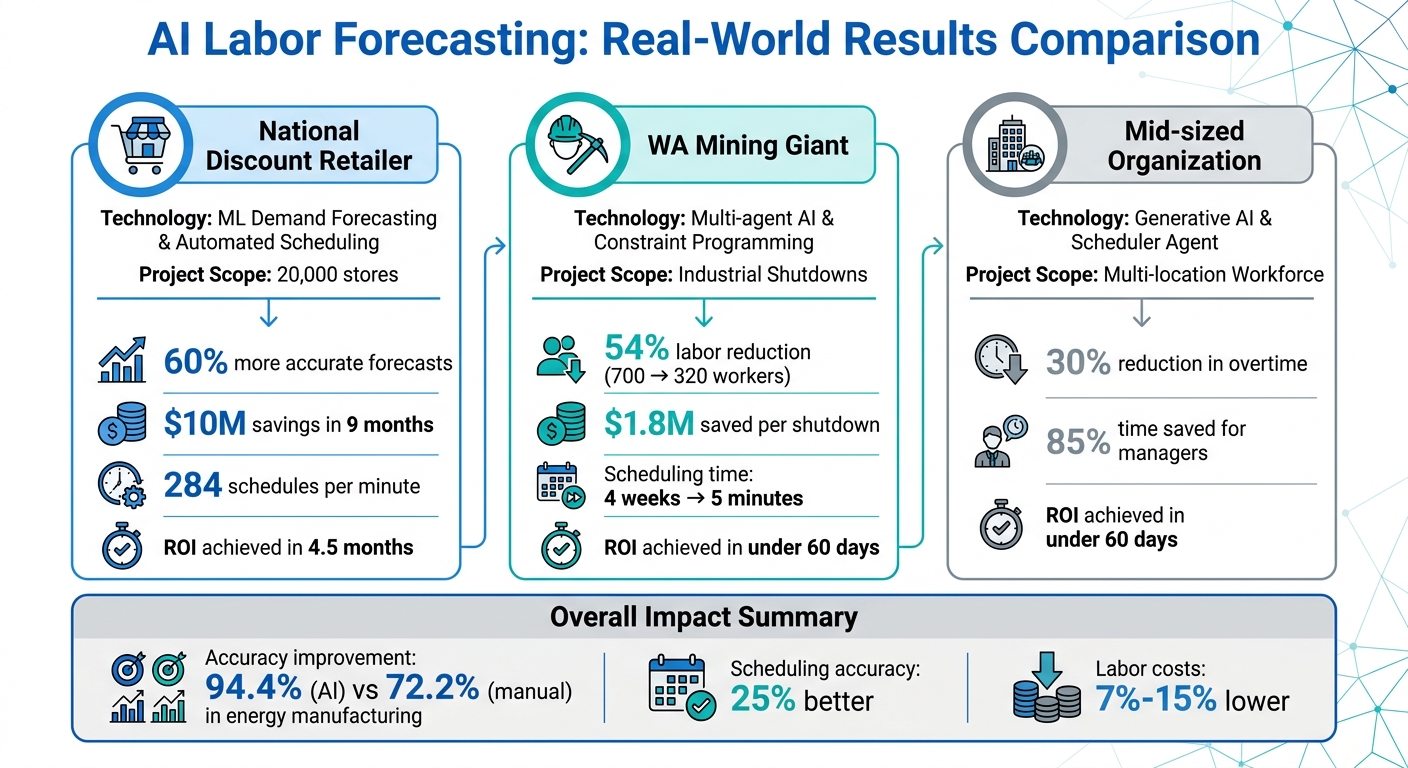
- 94.4% accuracy in energy manufacturing forecasts compared to 72.2% manually.
- 25% better scheduling accuracy and 7%-15% lower labor costs.
- Managers save 85% of time spent on manual scheduling tasks.
Real-world examples include Balfour Beatty optimizing infrastructure projects, Buildots enabling real-time adjustments, and ABLEMKR matching workers to projects with precision. These systems reduce delays, improve compliance, and adapt quickly to shifting demands.
The future of AI in labor forecasting includes advanced tools like digital twins, AI assistants, and computer vision, reshaping how industries like construction and energy manage their workforces. Companies are moving away from outdated methods to AI-driven systems that deliver faster, more accurate results while addressing labor shortages and complex regulations.
Using AI to Predict Construction Delays with Buildots | Innovation Expo
sbb-itb-aa28329
Case Studies: AI in Labor Forecasting
Real-world examples show how AI is changing the game for labor forecasting, making processes smoother and more efficient.
Balfour Beatty: Smarter Planning for Infrastructure Projects
Balfour Beatty, one of the largest infrastructure contractors in the U.S., turned to AI predictive analytics to tackle labor planning issues. Their system processes data like project schedules, progress updates, weather forecasts, and past performance to forecast labor needs. By doing so, they can spot potential scheduling clashes early and suggest the right crew sizes, ensuring resources are allocated effectively.
Buildots: Real-Time Adjustments on the Job
Buildots uses an AI platform paired with 360-degree helmet cameras worn by site supervisors to track progress as it happens. The platform compares ongoing work with project schedules, flagging issues like labor shortages or overstaffing. This instant feedback allows managers to tweak crew sizes within hours instead of days, keeping workflows smooth and avoiding delays.
ABLEMKR: Precision Workforce Deployment
ABLEMKR’s mobile-first AI platform connects pre-vetted workers with key projects in industries like construction and energy. The system evaluates factors such as certifications, safety training, availability, and location to quickly assign workers to projects, from emergency pipeline repairs to planned mining operations. It also offers real-time tracking and compliance monitoring. For workers, it means flexible, well-paid jobs with guaranteed on-time payments. This approach shifts labor deployment from a reactive process to one driven by precise, proactive planning.
Lessons from the Case Studies
AI Labor Forecasting Results: Company Performance Comparison
Common Patterns in AI Integration
The case studies highlight several strategies that have been instrumental in successfully implementing AI. One standout approach is bidirectional data integration. By linking AI systems to existing platforms like SAP and legacy HR systems, companies improved forecast accuracy while safeguarding their prior technology investments.
Another key element was the use of multi-agent architectures and machine learning models. These technologies powered forecasting engines capable of evaluating trillions of scheduling scenarios. At the same time, they ensured compliance with labor laws, union agreements, and safety protocols, which significantly reduced the workload for managers.
Outdated scheduling methods, like call-around processes, were replaced by mobile-first interfaces. These modern tools allowed employees to view schedules, swap shifts, and submit preferences directly from their devices – leading to higher engagement.
A phased rollout strategy also emerged as a common practice. Companies started with data cleansing, followed by pilot testing in a single department. Only after refining the AI models based on real-world feedback did they scale up to full deployment. This staged approach minimized risks and ensured smoother transitions.
Together, these strategies streamlined operations and delivered measurable improvements, as outlined in the results below.
Comparison of Results
AI integration drove impressive gains in both speed and cost-efficiency across various industries. For example, in mining, AI reduced scheduling time from four weeks to just five minutes. In retail, automated systems generated up to 284 schedules per minute. The financial benefits were equally striking, with savings ranging from $1.8 million per industrial shutdown to $10 million in operational costs within nine months for a major retailer.
| Company/Organization | AI Technology Used | Project Type | Key Efficiency Gains |
|---|---|---|---|
| National Discount Retailer | ML Demand Forecasting & Automated Scheduling | Retail (20,000 stores) | 60% more accurate forecasts; $10M savings in 9 months |
| WA Mining Giant | Multi-agent AI & Constraint Programming | Industrial Shutdowns | 54% labor reduction (700 to 320 workers); $1.8M per shutdown |
| Mid-sized Organization | Generative AI & Scheduler Agent | Multi-location Workforce | 30% reduction in overtime; 85% time saved for managers |
The return on investment (ROI) was achieved quickly, with timelines ranging from as little as 4.5 months to under 60 days. This shift to AI-driven scheduling transformed workforce management, enabling organizations to move from reactive problem-solving to proactive, data-informed strategies.
The Future of AI in Labor Forecasting
New Trends in AI for Workforce Management
The AI construction market is expected to grow significantly, with projections showing an increase from $1.08 billion in 2025 to $5.22 billion by 2032. This represents an impressive annual growth rate of 25.2%. By 2026, software solutions are anticipated to account for 63.5% of the market’s revenue, with North America leading at 39%.
The next wave of AI goes beyond basic automation, introducing systems capable of managing entire workflows. These advanced systems won’t just generate reports – they’ll handle tasks like opening job requisitions, scheduling interviews, and suggesting worker redeployments, all integrated into existing HRIS and workforce management tools. For example, in January 2026, Caterpillar partnered with Nvidia to integrate the "Cat AI Assistant" into its 306 CR Mini Excavator. Using Nvidia’s Jetson Thor platform, this assistant processes 2,000 machine messages per second, offering real-time safety guidance, scheduling maintenance, and even creating digital twins through Nvidia Omniverse to optimize material usage.
Digital twin technology bridges design, construction, and maintenance into one unified system, providing real-time insights that enhance forecasting accuracy throughout a project’s lifecycle. Additionally, computer vision tools, such as drones and AI-powered cameras, are becoming essential for real-time site monitoring, hazard detection, and tracking project progress. Together, these advancements are transforming labor forecasting systems, making them more precise and responsive.
The traditional workforce structure is also shifting. A new diamond-shaped model is emerging, where AI takes over routine tasks like data analysis, allowing humans to focus on complex decision-making. This evolution is driving demand for AI expertise, with job postings requiring AI skills offering a wage premium of up to 30%, and the demand for AI-related roles in construction growing by 10% annually.
These changes are reshaping workflows and delivering real benefits for both businesses and workers.
Benefits for Businesses and Workers
As AI systems evolve, their ability to optimize workforces and deliver actionable insights will only grow, offering tangible advantages for all stakeholders involved.
For workers, these advancements mean greater flexibility, transparency, and financial stability. Mobile-first platforms now allow employees to manage their schedules, swap shifts, and share their preferences directly from their devices. This leads to higher engagement and a more predictable work-life balance. Additionally, Earned Wage Access programs are helping workers access their wages immediately, reducing financial stress and improving retention rates.
Platforms like ABLEMKR are bringing these AI innovations to high-risk industries such as construction, energy, and extractives. ABLEMKR matches pre-vetted workers to job sites based on certifications, safety training, availability, and location. This allows employers to quickly mobilize crews for urgent tasks like pipeline repairs or mine development while ensuring compliance and streamlining payroll processes. Workers benefit from access to well-paying, flexible opportunities with guaranteed on-time payments, while employers gain real-time visibility into workforce status and operations.
The move toward AI-driven workforce management is not just about adopting new technology. It’s about creating systems that enable businesses to operate more efficiently while giving workers access to better, more transparent opportunities. As these technologies continue to advance, they promise to redefine how labor is forecasted, deployed, and managed in industries with high workforce demands.
"People’s acceptance of big AI and their ability to benefit from it depend on first experiencing the tangible benefits of small AI."
- Ajay Banga, President of the World Bank
Conclusion
The examples shared throughout this article highlight how AI-driven labor forecasting has moved beyond the experimental phase, delivering real-world results in industries facing high demand. For instance, a national discount retailer improved demand forecast accuracy by 60%, saving $10 million in just nine months. Similarly, in mining, AI optimization cut workforce needs from 700 to 320 workers – a 54% reduction – saving around $1.8 million per shutdown. These outcomes represent a major shift in how labor is managed and deployed.
What ties these successes together is the transition from outdated spreadsheet-based systems to real-time, integrated platforms. AI doesn’t just analyze data anymore – it acts on it. Tasks like opening job requisitions, matching certifications, and adjusting schedules are now automated and completed in seconds. This evolution from providing insights to executing actions is what distinguishes advanced AI systems from basic automation tools.
These advancements are driving operational improvements across industries like construction, energy, and mining – sectors where labor shortages, strict safety regulations, and complex projects converge. Platforms like ABLEMKR are at the forefront, offering tools to match pre-vetted workers to job sites based on certifications, location, and availability. This enables companies to rapidly deploy crews for critical tasks, such as pipeline repairs or mine development. Employers benefit from real-time workforce visibility and compliance tracking, while workers enjoy access to flexible, well-compensated opportunities with guaranteed on-time payments.
The construction sector alone is projected to need 499,000 new workers by 2026 to meet demand. Companies leveraging AI-driven workforce management not only operate more efficiently but also reduce costs and become more attractive to skilled talent. The real question isn’t whether to adopt AI for labor forecasting – it’s how quickly you can integrate it to remain competitive.
"Operational dynamics were fundamentally transformed. We had capacity for 350-400 people. OptiSchedule AI revealed that optimal workforce capacity was 320 instead of 700, fundamentally altering operational dynamics."
As industries continue to evolve, adopting AI swiftly will be key to staying ahead in an increasingly competitive landscape.
FAQs
What data do I need to start AI labor forecasting?
To get started with AI labor forecasting, gather historical demand data – this includes things like sales figures, seasonal patterns, and the impact of local events. Pair this with employee behavior data, such as attendance records, shift swap trends, and no-show rates, to evaluate workforce availability. Adding labor costs by shift, role, and location can help you manage budgets more effectively. To take it a step further, factor in service levels and customer experience metrics to align workforce planning with broader business objectives, ensuring your forecasts are both precise and actionable.
How long does it take to see ROI from AI scheduling?
Organizations often notice a return on investment (ROI) from AI scheduling tools within just 3 to 6 months. During this time, many report noticeable boosts in productivity, proving these tools to be a smart choice for enhancing efficiency.
How does AI keep schedules compliant with labor rules?
AI helps ensure that work schedules align with labor regulations by analyzing specific constraints and applying advanced algorithms to optimize how the workforce is allocated. It takes into account critical factors like safety protocols, legal mandates, and regulatory standards. For example, industries such as mining and construction have successfully used AI-driven workforce management systems to navigate these challenges. By doing so, they not only simplify compliance processes but also make scheduling and labor deployment more efficient.


