
If you’re a construction contractor, managing taxes can feel overwhelming. Here’s a quick breakdown of the essential IRS forms you need to stay compliant:
- Form W-9: Used to collect Taxpayer Identification Numbers (TINs) from subcontractors. Request this before making any payments.
- Form 1099-NEC: Required for reporting payments of $600 or more to subcontractors. Starting in 2026, this threshold increases to $2,000.
- Form W-2: For reporting employee wages and withheld taxes. Employers must also file Form W-3 as a summary.
- Form 941: Filed quarterly to report payroll taxes like Social Security and Medicare.
- Form 945: Used annually to report backup withholding for subcontractors who fail to provide a valid TIN.
- Schedule C & Schedule SE: Independent contractors use these to report income and calculate self-employment taxes.
Deadlines matter: Most forms are due January 31, while Form 941 is filed quarterly (e.g., April 30 for Q1). For electronic filers, the IRS requires e-filing if you submit 10 or more returns.
Keep records like Form W-9 for at least four years to avoid IRS issues. Use tools like payroll software to streamline compliance and reduce errors.
Staying on top of these forms ensures smooth tax reporting and helps avoid penalties. Let’s dive into the details.
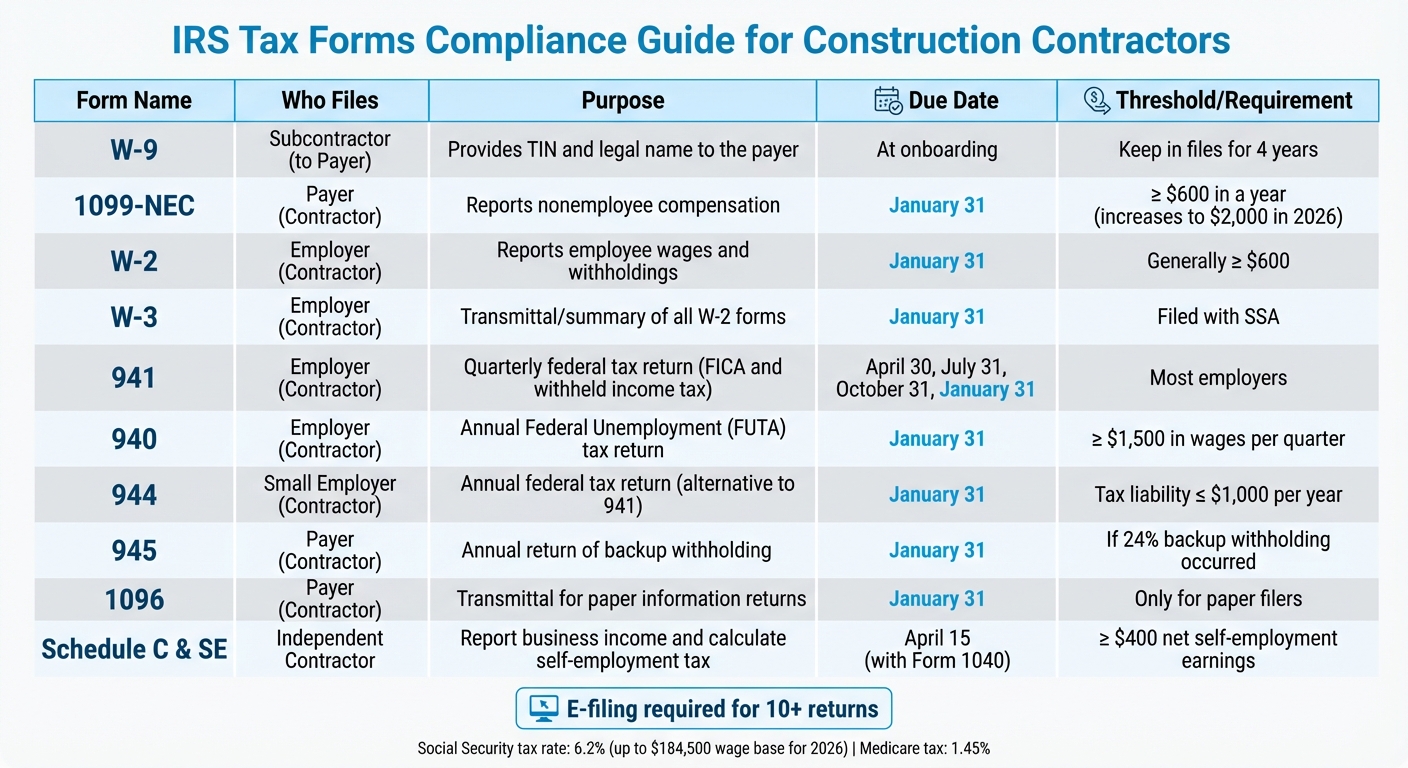
Essential IRS Tax Forms for Construction Contractors: Deadlines and Requirements
How to Fill Out 1099’s for Your Construction Business
sbb-itb-aa28329
Form W-9: Collecting Contractor Tax Information
Form W-9, officially titled "Request for Taxpayer Identification Number and Certification," is a key document for gathering tax information from independent contractors. It collects critical details such as the contractor’s legal name, business name (if applicable), tax classification (e.g., sole proprietorship, LLC, S-Corp), mailing address, and Taxpayer Identification Number (TIN). For individuals or sole proprietors, the TIN is typically a Social Security Number (SSN), while other business entities usually provide an Employer Identification Number (EIN). This form ensures that contractors acknowledge their responsibility for handling their own tax obligations. The information provided on Form W-9 is later used to prepare Form 1099-NEC, which reports nonemployee compensation at the end of the tax year. If a contractor does not submit a completed W-9, the hiring party may be required to withhold a portion of future payments as backup withholding.
When to Request Form W-9
It’s best to request a completed Form W-9 from every contractor before making their first payment. This approach helps ensure compliance with IRS regulations from the start. A W-9 is required for any contractor earning $600 or more within a calendar year. However, a new form is only necessary if the contractor’s details – such as their name, address, TIN, or tax classification – change.
How to Manage Form W-9
Keep W-9 forms stored securely and use them solely for tax reporting purposes. The IRS advises retaining these forms for at least four years after the last tax year in which they were used to prepare a 1099. Always double-check that the contractor’s legal name on Line 1 matches the name on their income tax return to avoid discrepancies with IRS records. Additionally, ensure the form includes a valid physical or electronic signature.
Managing W-9 forms correctly is essential for accurately completing tax forms like the 1099-NEC. Proper handling also supports thorough tax record-keeping throughout the year.
Form 1099-NEC: Reporting Nonemployee Compensation
Form 1099-NEC is used to report payments of $600 or more to nonemployees. This includes payments for services like subcontractor labor or professional fees paid to engineers, consultants, or accountants. The form ensures the IRS can verify that contractors properly report their income.
Even if payments are under $600, you must file Form 1099-NEC if backup withholding applies. This happens when a contractor doesn’t provide a valid Taxpayer Identification Number. If a subcontractor’s invoice combines charges for labor and materials, the entire invoice amount must be reported on Form 1099-NEC, as long as the billing includes a service component and meets the reporting threshold.
To stay compliant, it’s important to understand the filing thresholds and deadlines.
Filing Thresholds and Deadlines
For payments made through December 31, 2025, the reporting threshold remains $600. Starting with the 2026 calendar year, the threshold will increase to $2,000, and from 2027 onward, it will adjust annually for inflation. The deadline to file Form 1099-NEC with the IRS and provide copies to recipients is January 31, with no automatic extensions. If January 31 falls on a weekend, the deadline moves to the next business day (e.g., February 2, 2026, for 2025 returns).
If your business files 10 or more information returns (including W-2s and all 1099 forms combined), you must file electronically using the IRS’s free Information Returns Intake System (IRIS). Missing deadlines can result in penalties. For returns due in 2026, penalties start at $60 per form if corrected within 30 days, increase to $340 per form after August 1, and intentional disregard results in a minimum penalty of $680 per return.
Exemptions and Special Cases
Not all contractor payments require a Form 1099-NEC. Payments to C corporations and S corporations are generally exempt, with one key exception: attorney fees. For example, construction firms must issue a 1099-NEC for attorney fees of $600 or more, even if the law firm is incorporated.
Additionally, payments made via credit card or third-party platforms like PayPal are excluded from Form 1099-NEC reporting. These transactions are typically reported on Form 1099-K. To determine whether reporting is required, always verify the contractor’s tax classification using their Form W-9.
These details are essential for ensuring your IRS compliance remains on track.
Form W-2: Reporting Employee Wages
As part of the tax compliance checklist, let’s dive into employee wage reporting with Form W-2.
Form W-2 is the go-to document for construction contractors to report wages and taxes for employees – not independent contractors. You must file a W-2 for any employee who earns $600 or more in wages, including noncash benefits like housing or equipment. Even if an employee’s total pay is less than $600, a W-2 is still required if taxes are withheld. This rule also applies if income tax would have been withheld had the employee claimed no more than one allowance on their Form W-4.
It’s important to note the distinction between employees and independent contractors: employees need a W-2, while independent contractors require Form 1099-NEC. For employees, employers are responsible for withholding taxes and contributing matching amounts for Social Security and Medicare.
If you’re submitting paper W-2s, don’t forget to include Form W-3. Always double-check withholding allowances against the employee’s Form W-4 to ensure accuracy. If mistakes happen, use Form W-2c to make corrections.
Construction contractors should also keep an eye on updates from the SECURE 2.0 Act, as these could impact certain amounts reported on Form W-2. Staying on top of Form W-2 processing is a critical step in maintaining smooth tax compliance and preparing for future filings.
Form 941: Quarterly Federal Tax Returns
Form 941 is the go-to form for reporting federal payroll taxes every quarter. If you employ workers on your construction team, you’ll need to file this form four times a year to account for withheld income tax, Social Security, and Medicare taxes – along with your employer’s matching contributions.
For 2026, the Social Security tax rate is 6.2% for both employers and employees, applied up to a wage base limit of $184,500. Medicare tax, on the other hand, is 1.45% each, with no cap on wages. Be sure to report these figures accurately.
When filling out Form 941, include details such as the number of employees paid during the quarter, total wages, withheld federal income taxes, and the taxable amounts for Social Security and Medicare. You’ll also report both employer and employee shares of these taxes, along with any credits, like the Qualified Small Business Payroll Tax Credit for Increasing Research Activities (filed using Form 8974).
If your construction crew operates seasonally, check the "seasonal employer" box on line 18 each time you file. This tells the IRS not to expect returns for quarters when no payroll is processed, which is common during slower seasons like winter. If you work with a Certified Professional Employer Organization (CPEO) or a Section 3504 agent, ensure they properly mark their status in the "Aggregate Return Filers Only" section.
All federal tax deposits and any outstanding balances for Form 941 must be submitted electronically. To get refunds via direct deposit, provide your bank routing and account numbers on lines 15c–15e. Also, double-check that your Employer Identification Number (EIN) is up to date.
Filing Deadlines and Requirements
To avoid penalties, stick to the quarterly deadlines for filing. For 2026, the deadlines are:
- April 30 for the first quarter (January–March)
- July 31 for the second quarter (April–June)
- October 31 for the third quarter (July–September)
- January 31 for the fourth quarter (October–December).
If a filing date lands on a weekend or legal holiday, the deadline shifts to the next business day. Additionally, contractors who make timely deposits covering their full tax liability for the quarter get an extra 10 days to file.
Missing a deadline can lead to penalties and interest. If you’re unable to pay the full amount, consider setting up an installment agreement through the IRS website. Use the Electronic Federal Tax Payment System (EFTPS) or IRS Direct Pay to ensure compliance.
Your deposit schedule – monthly or semiweekly – depends on your employment tax liability during the IRS "lookback period." If you reported over $50,000 in employment taxes during this period or incurred a $100,000 liability in a single day, you must follow a semiweekly deposit schedule and include Schedule B with your Form 941.
At the end of the year, reconcile all four quarterly Form 941s with your annual Form W-3 and employees’ W-2s to confirm everything matches. If you discover an error after filing, use Form 941-X to make corrections electronically. Even if you’ve outsourced payroll to a service provider, the responsibility for accurate filings and timely payments ultimately rests with you.
This form is a critical piece of the IRS compliance puzzle for construction contractors.
Form 945: Backup Withholding Reporting
For construction contractors, keeping payroll and nonpayroll tax reporting separate is essential to avoid penalties and ensure compliance. Form 945 plays a key role in addressing nonpayroll withholding requirements.
What is Form 945? It’s the Annual Return of Withheld Federal Income Tax, used to report federal income tax withheld from nonpayroll payments. For contractors, this typically involves reporting backup withholding on payments to subcontractors. Backup withholding applies when the IRS notifies you that a subcontractor’s Taxpayer Identification Number (TIN) is incorrect, or when specific withholding rules under Form 945 come into play.
This form also applies to cases involving foreign agricultural workers on H-2A visas who fail to provide a TIN. In these situations, the withheld amount must be reported on Form 945, specifically on Line 2. Unlike Form 941, which deals with payroll taxes for employees, Form 945 is solely for nonpayroll withholding. Any backup withholding reported on forms like Form 1099-NEC or Form 1099-MISC should be consolidated and reported annually on Form 945.
Key Deadlines and Deposit Rules
For the 2025 tax year, Form 945 is due on February 2, 2026. However, if all tax deposits are made on time and in full, the deadline extends to February 10, 2026. If your total tax liability for the year is under $2,500, you can pay the balance when filing the return. But, if you incur a tax liability of $100,000 or more on a single day, the law requires you to deposit the tax by the next business day.
Electronic Deposits and Avoiding Penalties
All Form 945 tax deposits must be made electronically through the Electronic Federal Tax Payment System (EFTPS). It’s also crucial to ensure that the Employer Identification Number (EIN) on Form 945 matches the EIN on related forms like Form 1099-NEC. Mismatched EINs can lead to penalties and delays in processing.
Failing to withhold or pay the required taxes can have severe consequences, including a 100% Trust Fund Recovery Penalty for unpaid trust fund taxes.
The next sections will explore further compliance strategies and self-reporting obligations specific to construction contractors.
Schedule C and Schedule SE: Contractor Self-Reporting
Independent construction contractors are viewed as business owners by the IRS, meaning they’re responsible for handling their own income reporting and tax calculations. Two key forms, Schedule C (Profit or Loss from Business) and Schedule SE (Self-Employment Tax), are essential for this process. Together, these forms complete the contractor’s tax compliance responsibilities, working alongside the reporting forms discussed earlier.
Schedule C acts like a simplified income statement for your business. In Part I, you’ll report all gross receipts, including income from Form 1099-NEC and any cash payments. Part II is where you list deductible business expenses, such as advertising, office supplies, travel (fully deductible), business meals (50% deductible), insurance, and home office costs. For home office expenses, you can either use actual costs or opt for the simplified method, which allows $5 per square foot for up to 300 square feet. The net profit calculated on Line 31 of Schedule C becomes the basis for your tax obligations. This net profit is then transferred to Schedule SE to calculate self-employment taxes.
Schedule SE uses your net profit to determine self-employment tax, covering contributions to Social Security and Medicare. The IRS calculates the taxable amount by multiplying your net profit by 92.35%, and the self-employment tax rate is 15.3% (12.4% for Social Security and 2.9% for Medicare). For the 2026 tax year, the Social Security portion applies only to the first $184,500 of combined wages and net earnings. Contractors must file Schedule SE if their net self-employment earnings are $400 or more.
You can deduct 50% of your self-employment tax on Form 1040 (Schedule 1), which helps lower your adjusted gross income. Since taxes aren’t withheld from contractor payments, it’s important to plan for quarterly estimated tax payments using Form 1040-ES if you expect to owe $1,000 or more for the year. Filing Schedule SE is also essential because it ensures the Social Security Administration receives your earnings information, which impacts future retirement and disability benefits. Accurate reporting through Schedules C and SE is a key part of staying compliant with IRS rules for independent contractors.
Form 1096: Information Return Transmittal
Form 1096 is an essential document for anyone filing paper information returns with the IRS. As Aditya Nagpal from Wisemonk explains:
Form 1096 is a one-page cover sheet you mail with paper 1099s, 1098s, and other information returns to the IRS. It summarizes total forms, total payments, and tax withheld. You do not need it if you file electronically.
This form is only necessary for those filing on paper. If you’re filing electronically through IRS FIRE or IRIS, you can skip Form 1096 entirely. The electronic filing threshold has recently been lowered to 10 returns, down from 250, making electronic filing more accessible. For construction contractors, Form 1096 is often the only paper document required in the IRS compliance process.
For paper filers, it’s critical to use the official red-ink scannable forms, which can only be ordered directly from the IRS. As noted by Block Advisors:
The official printed version of Form 1096 is scannable and read by a machine using optical character recognition equipment. You cannot file Form 1096 or Copy A of Forms 1099 or 3921 that you print from the IRS website.
To get the correct form, visit IRS.gov/orderforms or call 1-800-829-3676. Keep in mind that delivery can take 7–15 business days, so plan accordingly.
Compliance Checklist Table
Managing IRS forms can feel overwhelming, but it’s a critical part of staying on top of tax compliance for construction contractors. Whether you’re hiring subcontractors, employing workers, or working on federal projects, this table highlights the key forms you need to track.
| Form | Who Files | Purpose | Due Date | Threshold |
|---|---|---|---|---|
| W-9 | Subcontractor (to Payer) | Provides TIN and legal name to the payer | At onboarding | N/A (Keep in files for 4 years) |
| 1099-NEC | Payer (Contractor) | Reports nonemployee compensation | January 31 | ≥ $600 in a year |
| W-2 | Employer (Contractor) | Reports employee wages and withholdings | January 31 | Generally ≥ $600 |
| W-3 | Employer (Contractor) | Transmittal/summary of all W-2 forms | January 31 | Filed with SSA |
| 941 | Employer (Contractor) | Quarterly federal tax return (FICA and withheld income tax) | April 30, July 31, October 31, January 31 | Most employers |
| 940 | Employer (Contractor) | Annual Federal Unemployment (FUTA) tax return | January 31 | ≥ $1,500 in wages per quarter |
| 944 | Small Employer (Contractor) | Annual federal tax return (alternative to 941) | January 31 | Tax liability ≤ $1,000 per year |
| 945 | Payer (Contractor) | Annual return of backup withholding | January 31 | If 24% backup withholding occurred |
| 1096 | Payer (Contractor) | Transmittal for paper information returns | January 31 | Only for paper filers |
| WH-347 | Federal Contractor | Weekly certified payroll for prevailing wage jobs | Weekly | Federally funded projects |
January 31 is a critical deadline for many forms, so it’s essential to plan ahead using a payroll calendar to avoid penalties. For contractors filing 10 or more returns, electronic filing is required.
How ABLEMKR Simplifies Tax Compliance

Handling tax forms for construction crews doesn’t have to feel like a full-time job. ABLEMKR’s payroll workflows take care of the heavy lifting by automatically tracking worker hours, pay, and classifications – sorting employees from independent contractors – to generate W-2s and 1099-NEC forms for payments over $600 annually. Using real-time data from job site check-ins and geo-verified shifts, the platform calculates withholdings for accurate quarterly Form 941 filings and year-end summaries, cutting manual data entry by 70%. Plus, these processes sync smoothly with IRS forms.
During onboarding, the system collects W-9 information and automatically routes wages to the correct tax forms, whether it’s a W-2 or 1099-NEC. For example, ABLEMKR once processed 150 contractor 1099s for an oil & gas shutdown in under two hours, slashing errors that typically arise from manual spreadsheets. The platform also integrates IRS guidelines to flag potential worker misclassifications, using pre-vetted profiles with certifications and employment status to ensure accurate tax treatment.
When it comes to Form 941 quarterly returns, ABLEMKR simplifies the process by consolidating federal tax withholdings, Social Security, and Medicare into pre-filled templates. Automated calculations and e-filing reminders keep everything on track with quarterly deadlines (April 30, July 31, October 31, January 31). This feature has saved contractors 15-20 hours per quarter. One firm even synced over 500 employee shifts to generate compliant filings without the hassle of reconciling spreadsheets. The platform also monitors TIN validation and W-9 compliance in real time, flagging missing data and ensuring Form 945 is ready for annual submission by January 31.
Beyond simplifying filings, ABLEMKR ensures workers get their tax forms on time. Employees across multiple job sites receive their W-2s electronically by January 31, with wages and withholdings aggregated from geo-tracked shifts nationwide. For instance, a mining operator achieved 95% on-time delivery for 1,200 workers, thanks to automated error checks for Box 12. ABLEMKR users report impressive results: 80% faster form generation, a 90% drop in classification errors, and a 50% reduction in audit risk through automated tracking. By automating these critical compliance tasks, ABLEMKR simplifies tax reporting and helps businesses stay on top of their obligations.
Conclusion
Navigating IRS tax forms is a critical task for construction contractors to stay compliant and avoid penalties. Whether it’s collecting Form W-9 before issuing payments or filing Form 1099-NEC for subcontractors earning over $600 in a year, every detail counts. Errors like misclassifications or missing e-filing thresholds can lead to audits, backup withholding, or hefty penalties. Keeping W-9 forms on hand for at least four years safeguards against IRS inquiries, while tracking payments throughout the year ensures smooth reporting without a last-minute rush. These steps form the backbone of a structured approach to managing tax obligations.
The responsibility grows when managing subcontractors across multiple job sites. Contractors must verify Taxpayer Identification Numbers (TINs) early and correctly categorize workers for Form 1099-NEC or Form W-2. Staying compliant reduces audit risks and avoids costly reporting mistakes. Thankfully, modern technology offers tools to make these processes less overwhelming.
Automated platforms take compliance to the next level. ABLEMKR simplifies critical tasks, from collecting W-9s during onboarding to generating accurate W-2s and 1099-NECs based on real-time data. Its payroll workflows integrate federal tax withholdings, Social Security, and Medicare into pre-filled Form 941 templates, ensuring timely quarterly filings. Real-time TIN validation and compliance tracking reduce manual errors and flag potential issues, minimizing audit risks.
For contractors juggling crews on projects like oil and gas shutdowns, mining operations, or heavy infrastructure builds, tax compliance shouldn’t be a bottleneck. With ABLEMKR’s mobile-first platform, workers receive their tax forms electronically by January 31, while automated checks ensure accuracy and timeliness. By streamlining these processes, contractors can focus on delivering key projects without being bogged down by the complexities of tax season.
FAQs
How do I know if a worker should get a W-2 or a 1099-NEC?
Workers receive a W-2 when they are classified as employees. This classification means their employer has control over key aspects of their job, such as their schedule, the tools they use, and the overall work process. Employers also handle tax withholdings for these workers.
On the other hand, a 1099-NEC is issued to independent contractors. These individuals operate with greater independence, managing their own taxes and controlling how they complete their work.
The distinction between receiving a W-2 or a 1099-NEC boils down to the level of control and independence in the working relationship.
What should I do if a subcontractor won’t give me a W-9?
If a subcontractor refuses to provide a W-9, you’re required to apply backup withholding at a rate of 24% to stay in line with IRS rules. This step helps shield your business from possible penalties. Make sure to keep detailed records of your attempts to obtain the W-9, as this documentation could be crucial during an audit.
Do I still file a 1099-NEC if I pay a subcontractor by credit card or PayPal?
No, you don’t need to file a 1099-NEC for payments made to subcontractors through credit card or PayPal. Payment processors like these report such transactions directly to the IRS, which means they are excluded from the 1099-NEC reporting requirements.


