
The construction industry is rapidly integrating IoT (Internet of Things) technologies, transforming job sites with tools like smart sensors, wearable devices, and predictive maintenance systems. However, many workers lack the skills to effectively use these advanced systems. IoT training is bridging this gap, improving safety, efficiency, and overall project performance. Here’s why it matters:
- Safety Improvements: Wearable tech and environmental sensors reduce workplace injuries by providing real-time alerts and monitoring.
- Efficiency Gains: Predictive maintenance and automated workflows cut downtime and optimize resource usage.
- New Roles: IoT adoption is creating specialized positions like data-driven project managers and smart site operators.
- Key Skills Needed: Workers must learn to operate IoT devices, analyze real-time data, and use safety-focused technologies.
Training programs, such as certifications from NCCER, OSHA, and Autodesk, equip workers with these skills. Companies investing in IoT training see fewer accidents, reduced project delays, and lower costs. As IoT adoption grows, trained workers are becoming essential for modern construction sites.
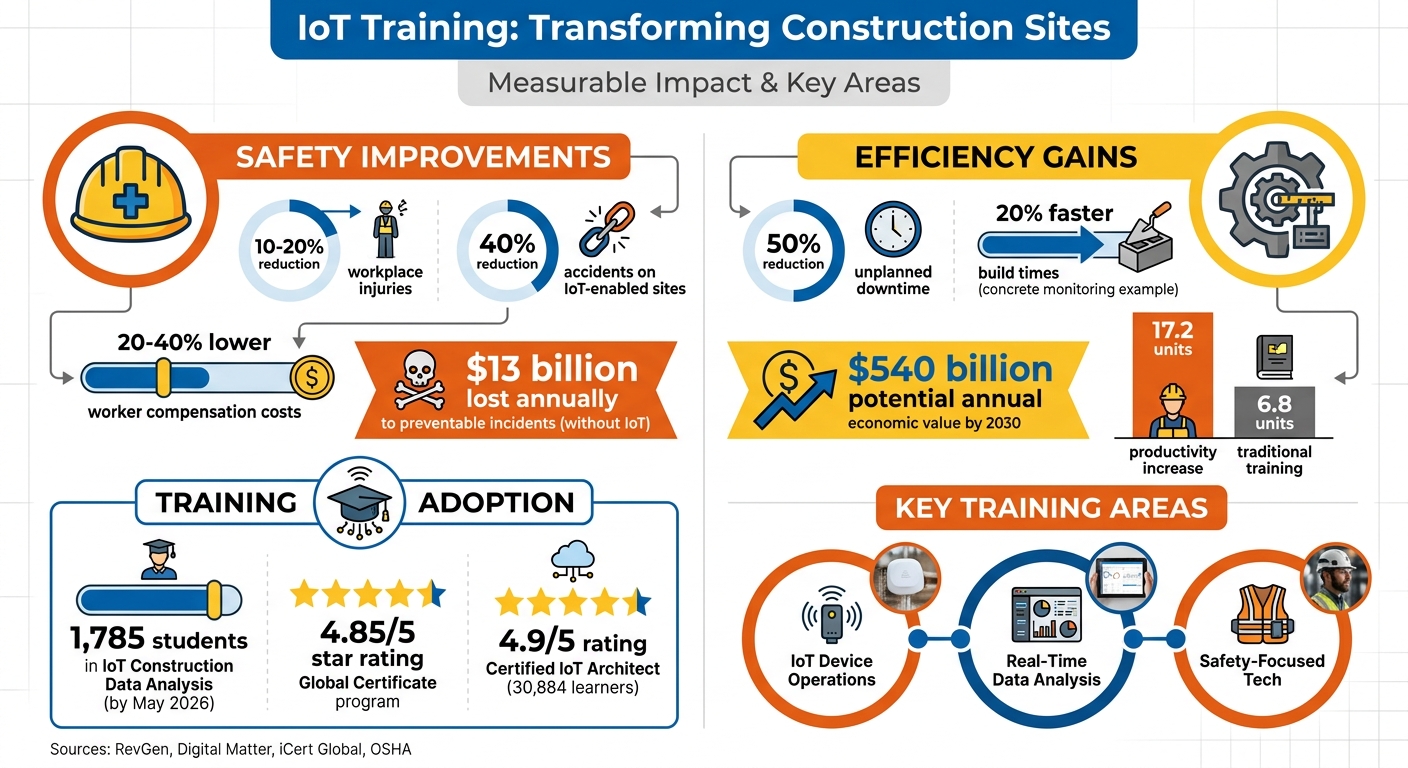
IoT Training Impact on Construction Safety and Efficiency Statistics
[Worker Safety Management System] Construction sites IoT smart safety management solution
sbb-itb-aa28329
Why IoT Training Matters for Construction Workers
The construction industry is at a crossroads: equipping workers with IoT knowledge can lead to measurable improvements in safety, efficiency, and workforce skills. With IoT technology already present on many job sites, proper training ensures workers can use these tools effectively. The results? Safer environments, smoother operations, and better project outcomes.
Improved Safety and Risk Reduction
IoT devices are transforming job site safety, but they only work when workers understand how to act on the data these devices provide. For instance, wearable tech like smart hard hats and vests can monitor vital signs or detect falls in real time. Proximity alerts warn workers when they enter hazardous zones, but training is essential to ensure these alerts lead to quick and effective action.
Take the example of Gilbane Building Company, which implemented the Triax Spot-r system. This wearable tech detects falls and alerts supervisors immediately, enabling faster emergency responses and adjustments to hazardous work practices. Similarly, Caterpillar‘s sensor-based monitoring system tracks machinery temperature and vibration, helping to identify potential issues before they escalate. This approach has reduced unplanned downtime by 50%.
"IoT and analytics are revolutionizing construction safety – reducing injuries, cutting downtime, and ensuring regulatory compliance through wearable devices, predictive maintenance, and real-time monitoring." – RevGen
The financial stakes are high. Each year, the construction industry loses nearly $13 billion due to preventable incidents like poor air quality or equipment misuse. IoT safety solutions have led to 10% to 20% reductions in workplace injuries. However, these gains depend on workers who know how to calibrate environmental sensors, fine-tune alert systems, and analyze data to spot dangerous trends.
Safety improvements are just one part of the equation. Properly trained workers also enhance efficiency and project performance.
Better Efficiency and Project Performance
IoT training helps workers prevent equipment failures and keep projects running smoothly. Predictive maintenance systems that rely on IoT sensors can cut unplanned downtime by up to 50%, ensuring projects stay on track.
For example, the John Holland Group implemented the SpoilTRAC system using Digital Matter‘s IoT trackers on heavy machinery. These rugged devices, equipped with GPS and tilt sensors, automated spoil removal tracking. This ensured materials were dumped only at approved locations, maintaining compliance and preventing unauthorized dumping.
With IoT training, workers can manage automated workflows that reduce manual checks and improve efficiency. They can monitor material locations, quantities, and conditions in real time, ensuring resources are used effectively and waste is minimized. Optimized fleet management cuts fuel consumption, while environmental sensors track air quality, noise, and temperature to maintain compliance. By 2030, IoT solutions in construction could generate up to $540 billion in annual economic value.
New IoT-Focused Construction Roles
As IoT reshapes the industry, new roles are emerging that require specialized skills. Positions like smart site operators and data-driven project managers now call for expertise in cloud automation, network protocols, and data management.
The growing demand for these skills is evident. By May 2026, 1,785 students had enrolled in the Global Certificate in IoT Applications in Construction Data Analysis. Workers are learning to operate machinery remotely using IoT connectivity, analyze aerial drone data to identify risks, and use machine learning for better site planning.
"IoT in construction has several ways of sharing data for building works. However, when using it, you need to understand IoT itself and the construction field. Knowing these two can help you use these systems and send the data correctly." – College of Contract Management
These roles are also driving green building efforts, using IoT to monitor energy use and reduce fossil fuel consumption. Workers trained in wearable health tech and machinery sensors are stepping into safety-focused supervisory roles, blending technical expertise with practical industry experience.
Required IoT Skills for Construction Professionals
To effectively harness IoT systems, construction workers need a blend of technical skills. These range from understanding hardware basics to interpreting real-time data and mastering safety-focused technologies. As the construction industry embraces digital tools, these skills are becoming indispensable.
IoT Devices and Applications Basics
Understanding the devices behind IoT systems is a fundamental skill. This includes working with sensors that monitor equipment health, GPS trackers for locating materials, RFID tags for managing inventory, and automated drones for site surveillance. Workers also need to grasp how these devices communicate – how data packets travel using protocols like IP, TCP, and HTTP. The College of Contract Management explains:
"IoT in the building works by using sensors on the building machines, construction systems, and other devices to build a high-quality structure."
In practice, this might involve using sensors to track an excavator’s performance, monitoring material quantities in real time, or employing smart systems to measure air quality, noise, and temperature on-site.
Real-Time Data Monitoring and Analysis
Once workers understand IoT devices, the next step is learning how to interpret real-time data. IoT dashboards often display critical information like equipment status, environmental conditions, and safety alerts. Training programs now frequently include Machine Learning (ML) and Artificial Intelligence (AI) to teach predictive analysis, which helps anticipate and address issues before they escalate. For example, the Global Certificate in IoT Applications in Construction Data Analysis – rated 4.85 out of 5 stars – covers essential topics like data collection, visualization, cloud computing, and hands-on labs with middleware and microcontrollers. These skills allow workers to detect problems early and adapt quickly to changing conditions, enhancing both safety and efficiency.
Safety-Focused IoT Training
IoT safety training equips workers to use wearable technology, such as smart hard hats and vests, which can detect falls, monitor biometrics like heart rate and body temperature, and issue proximity alerts near heavy machinery. Workers also learn to interpret data from environmental sensors tracking dust levels, volatile organic compounds (VOCs), and structural vibrations. Geofencing is another critical technology, creating virtual boundaries that alert workers when they enter hazardous areas. Training emphasizes responding swiftly to alerts and using biometric data to prevent heat-related stress by scheduling breaks. Additionally, IoT systems simplify compliance by automating documentation, ensuring detailed records are maintained with minimal manual effort.
| IoT Safety Tool | Primary Function | Key Worker Skill Required |
|---|---|---|
| Smart Hard Hats/Vests | Fall & Impact Detection | Responding promptly to emergency alerts |
| Biometric Sensors | Health Monitoring | Recognizing signs of fatigue and heat stress |
| Geofencing | Virtual Boundaries | Understanding and adhering to safety zones |
| Air Quality Sensors | Environmental Monitoring | Interpreting dust and VOC level readings |
| Vibration Sensors | Structural Health | Identifying potential structural issues |
IoT Training Programs and Certifications
To bring essential IoT skills into real-world applications, certification programs now offer hands-on, targeted training. These range from budget-friendly introductory courses to advanced technical certifications that cover everything from deploying sensors to integrating with cloud systems.
One example is the CPD – IoT in Construction: Smart Sensors & Data-Driven Decision Making course, offered by the College of Contract Management. Priced at around $40, this program provides practical insights into equipment monitoring, material tracking, and worker safety. It’s tailored for construction and IT professionals who want to improve project efficiency through smart sensors, without needing extensive technical expertise.
For those with more experience, the Certified IoT Architect program from iCert Global offers over 50 hours of scenario-based labs. With a 4.9/5 rating from 30,884 participants, the course focuses on building scalable IoT systems. Students work with tools like Raspberry Pi and Sense HAT sensors, learn the MQTT protocol for device communication, and explore cloud integration using Azure IoT Hub. As iCert Global explains:
"The certification is simply proof – the true value is walking into client meetings and confidently presenting a live, fully functional, and scalable IoT solution prototype".
Here’s a closer look at additional programs designed to meet the growing demand for IoT expertise.
NCCER IoT Modules for Construction

The National Center for Construction Education and Research (NCCER) offers specialized IoT modules that integrate with existing craft training programs. These modules focus on teaching workers how to use IoT-enabled tools and interpret sensor data relevant to their roles. By prioritizing practical, hands-on skills over theoretical knowledge, the curriculum ensures that workers can immediately apply what they’ve learned on active job sites.
OSHA IoT Safety Integration Courses
OSHA’s training programs focus on how IoT devices can improve workplace safety. These courses equip supervisors and safety managers with the knowledge to deploy and monitor tools like biometric wearables, proximity sensors, and environmental monitors. Participants also learn to respond effectively to automated safety alerts. On IoT-enabled construction sites, these measures have contributed to a 40% reduction in accidents and injuries, demonstrating the value of this training for companies committed to worker safety.
Autodesk BIM and IoT Certification

Autodesk offers a certification program that combines Building Information Modeling (BIM) with IoT technology. This allows participants to create digital twins for real-time monitoring and lifecycle management. For instance, in high-rise construction, IoT sensors monitoring concrete curing have reduced build times by 20%. Graduates of this program gain the skills to link on-site conditions with digital project management tools, enabling smarter decision-making.
| Program Name | Provider | Cost | Key Focus Areas | Learner Rating |
|---|---|---|---|---|
| CPD – IoT in Construction | College of Contract Management | ~$40 | Smart sensors, equipment monitoring, material tracking, worker safety | N/A |
| Certified IoT Architect | iCert Global | Varies | Azure IoT Hub, MQTT protocol, Raspberry Pi integration, cloud analytics | 4.9/5 (30,884 learners) |
These programs are designed to help professionals bridge the gap between technical knowledge and practical applications in today’s IoT-driven construction landscape. While most don’t require formal education, they do assume basic technical skills, particularly in programming languages like Python, which is widely used for device programming and prototyping. To stay current, recertification every two years is advised.
How to Implement IoT Training in Your Construction Workforce
Evaluating Training Needs and Resources
To kick things off, conduct a skills gap assessment to pinpoint where IoT capabilities are lacking. Break this analysis down by trade – whether it’s masonry, fabrication, or carpentry – since digital training can significantly improve productivity in these areas.
Focus on workers with less than 10 years of experience, as they tend to adapt more quickly to digital upskilling. A September 2025 study involving 400 workers revealed that training through audio-visual simulations led to a productivity increase of 17.2 units, compared to just 6.8 units for traditional methods (t = 12.34, p < 0.001). Among the trades, carpenters experienced the largest productivity gains, making them ideal candidates for IoT-focused training.
Before rolling out any training, establish a baseline for productivity. Use methods like time-motion studies, daily work logs, and supervisor evaluations. Then, identify which roles would benefit most from specific IoT applications. For instance, operators might use IoT for equipment monitoring, logistics coordinators for material tracking, and field workers for wearable safety tech.
Once you’ve mapped out training needs, the next step is finding workers who already have IoT certifications.
Using ABLEMKR to Find Certified Workers

After defining the training priorities, sourcing certified talent becomes the focus. Platforms like ABLEMKR simplify this process by offering access to pre-vetted workers with verified skills and certifications. ABLEMKR handles identity verification, background checks, and certification validation – like OSHA cards or IoT-specific modules – during onboarding, saving you from redundant credential checks.
When posting jobs on ABLEMKR, use the "Required Certifications" field to specify IoT qualifications, such as "CPD – IoT in Construction" or "IIoT Fleet Management." The platform’s automated system filters candidates based on these criteria, connecting you with workers who already meet your needs. It also tracks certification expiration dates automatically, ensuring compliance remains up to date.
For a lower-risk hiring strategy, consider a flex-to-hire model. This allows you to evaluate a worker’s ability to manage IoT tools and monitor real-time data on-site during a 30–90 day trial period. Workers are rated on their skill level and safety compliance after each job, creating a performance record that helps you identify top talent for long-term roles.
Measuring ROI from IoT Training
Once IoT-trained workers are in place, measure the impact by tracking productivity and safety metrics. Look for improvements in workflows, better equipment usage, and reductions in project costs. For instance, IoT sensors can monitor equipment uptime, ensuring trained workers are minimizing mechanical failures that could delay progress.
Safety improvements are another key indicator. Sites using IoT safety tools have reported fewer accidents, which directly supports the value of training investments.
You can also monitor reductions in material waste using IoT tracking devices, which provide real-time updates on material quantities and conditions. For fleet management, measure fuel savings, reduced vehicle wear-and-tear, and energy consumption improvements through smart routing systems and optimized equipment usage.
To calculate the overall ROI, weigh the costs of software, network infrastructure, and maintenance against the gains in productivity, safety, and resource efficiency. Regularly reassessing these metrics ensures the training stays aligned with the industry’s shifting demands.
Conclusion
Training in IoT is a game-changer for creating safer and more efficient construction sites. Workers skilled in using wearable technology, predictive maintenance tools, and real-time analytics can drive substantial improvements. In fact, IoT-based safety management has been shown to lower worker compensation costs by 20–40%.
Beyond safety, the operational benefits are hard to ignore. Take Caterpillar, for example – by using sensor-based monitoring on heavy machinery, they’ve managed to cut unplanned downtime by up to 50%. As Macaulan Chiaramonte, Managing Consultant at RevGen, explains:
"By transforming raw data into actionable insights, construction companies can not only protect their workers but also enhance operational efficiency and reduce costs".
For companies looking to adopt IoT training, the steps are straightforward: evaluate your team’s digital skills, emphasize data interpretation alongside device usage, and start with small-scale pilot projects. Focus on areas like fall detection or equipment tracking to see immediate results. Platforms such as ABLEMKR make it easier to roll out IoT training programs and certify your workforce quickly.
As the construction industry evolves to include IoT alongside drones, robotics, and AI, trained workers will be at the forefront of this transformation. The payoff? Fewer workplace injuries, reduced downtime, and better project performance. With workplace injuries costing the global economy an estimated $1.25 trillion annually, investing in IoT training not only safeguards employees but also cuts costs. By integrating IoT training into your workforce strategy, your company is poised for a safer and more productive future.
FAQs
Do I need coding skills for IoT training in construction?
No, coding skills are generally not necessary for IoT training in construction. Most training programs center around the practical use of IoT technology, including deploying sensors, managing data, and working with IoT platforms. While having a basic understanding of programming languages like C or C++ could be useful for advanced customizations, the primary focus is on application and analysis, making coding an optional skill for most construction-related IoT tasks.
Which IoT certification should I start with for my role?
The ideal IoT certification for you will depend on your career aspirations and current skill level. If you’re just starting out, the LSBA’s Global Certificate in IoT Applications in Construction Data Analysis is an excellent choice. It provides a solid foundation in areas like data collection, analytics, and IoT security, specifically within the construction industry.
For those looking to advance into specialized roles, certifications like IIoT Leadership Development or Big Data Analysis in Construction Management are worth exploring. These programs are tailored for professionals aiming to lead projects or work extensively with big data in construction settings.
How can I prove IoT training ROI on a job site?
To show the return on investment (ROI) of IoT training, focus on measurable outcomes like operational improvements, cost savings, and improved safety results linked to IoT applications. Use tools such as impact chain analysis and practical ROI frameworks to calculate the financial benefits effectively. Highlight concrete achievements like less downtime, greater efficiency, and fewer safety incidents to present a strong, evidence-based case for the value of IoT training.


