
Federal infrastructure spending is driving up construction wages and creating jobs. Key factors include increased demand for skilled labor, updates to wage regulations, and workforce shortages. Here’s what you need to know:
- Job Growth: Since January 2021, the construction industry has added 670,000 jobs, with highway and bridge construction seeing notable gains.
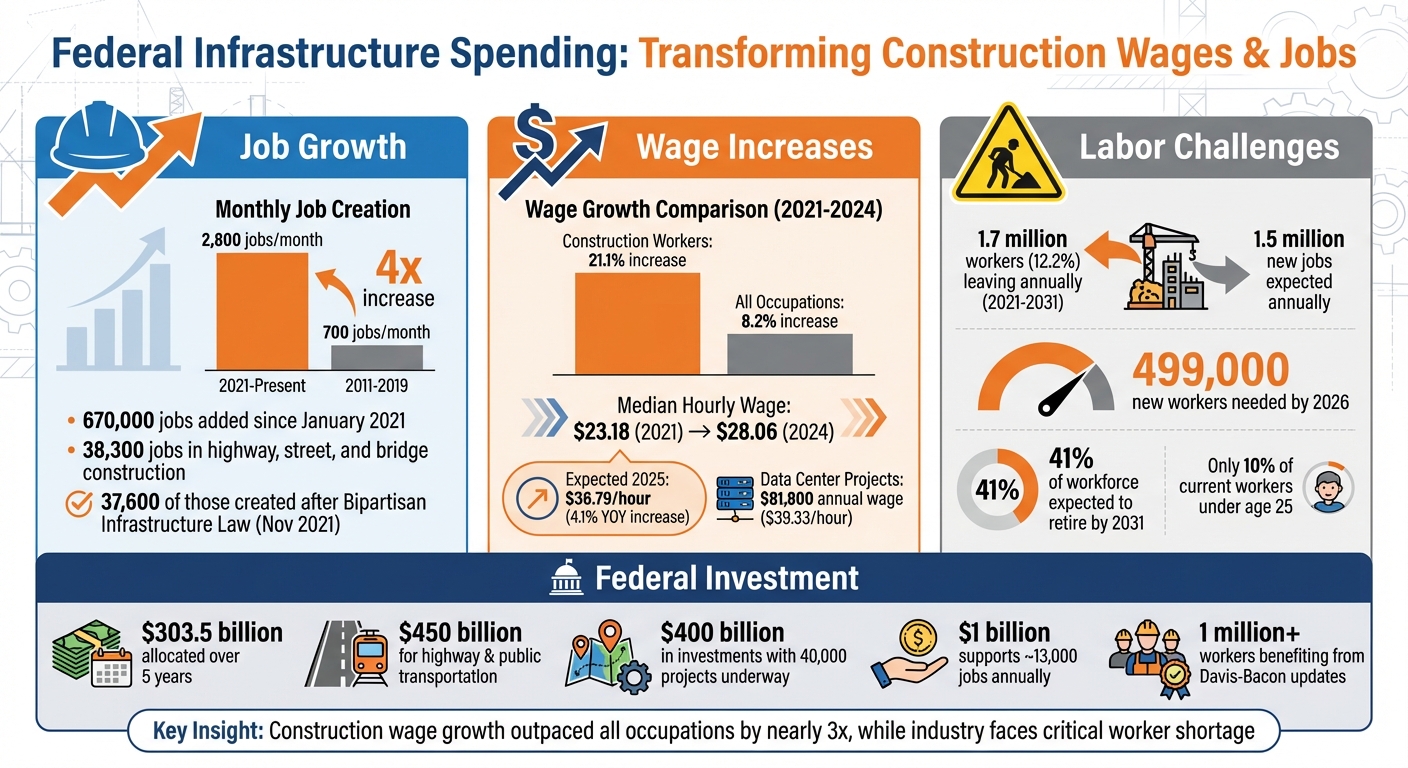
- Wage Increases: Median hourly wages for construction workers rose by 21.1% between 2021 and 2024, compared to an 8.2% increase across all occupations.
- Policy Impact: Updates to the Davis-Bacon Prevailing Wage Rule are boosting pay for over a million workers on federally funded projects.
- Labor Shortages: The industry faces challenges with an aging workforce and the need for nearly 500,000 new workers by 2026.
Federal investment, combined with workforce technology like ABLEMKR, is helping address labor gaps while maintaining upward pressure on wages. These trends highlight the growing demand for skilled workers and the evolving pay landscape in construction.
Federal Infrastructure Spending Impact on Construction Wages and Jobs 2021-2026
What Are the Economic Benefits and Multiplier Effects of Infrastructure Spending?
How Federal Infrastructure Spending Affects Construction Wages
Federal infrastructure funding has a direct impact on both job creation and worker paychecks. For instance, every $1 billion invested in federal highway projects supports approximately 13,000 jobs annually. With $303.5 billion allocated over five years, this steady investment guarantees sustained demand for labor, putting upward pressure on wages. By March 2025, average hourly earnings for production and nonsupervisory employees in construction are expected to rise 4.1% year-over-year to $36.79, outpacing the private sector’s 3.9% increase.
This financial backdrop highlights the challenges of workforce shortages and wage competition, as reflected in data from the Associated Builders and Contractors (ABC).
The Davis-Bacon Act and Wage Floors
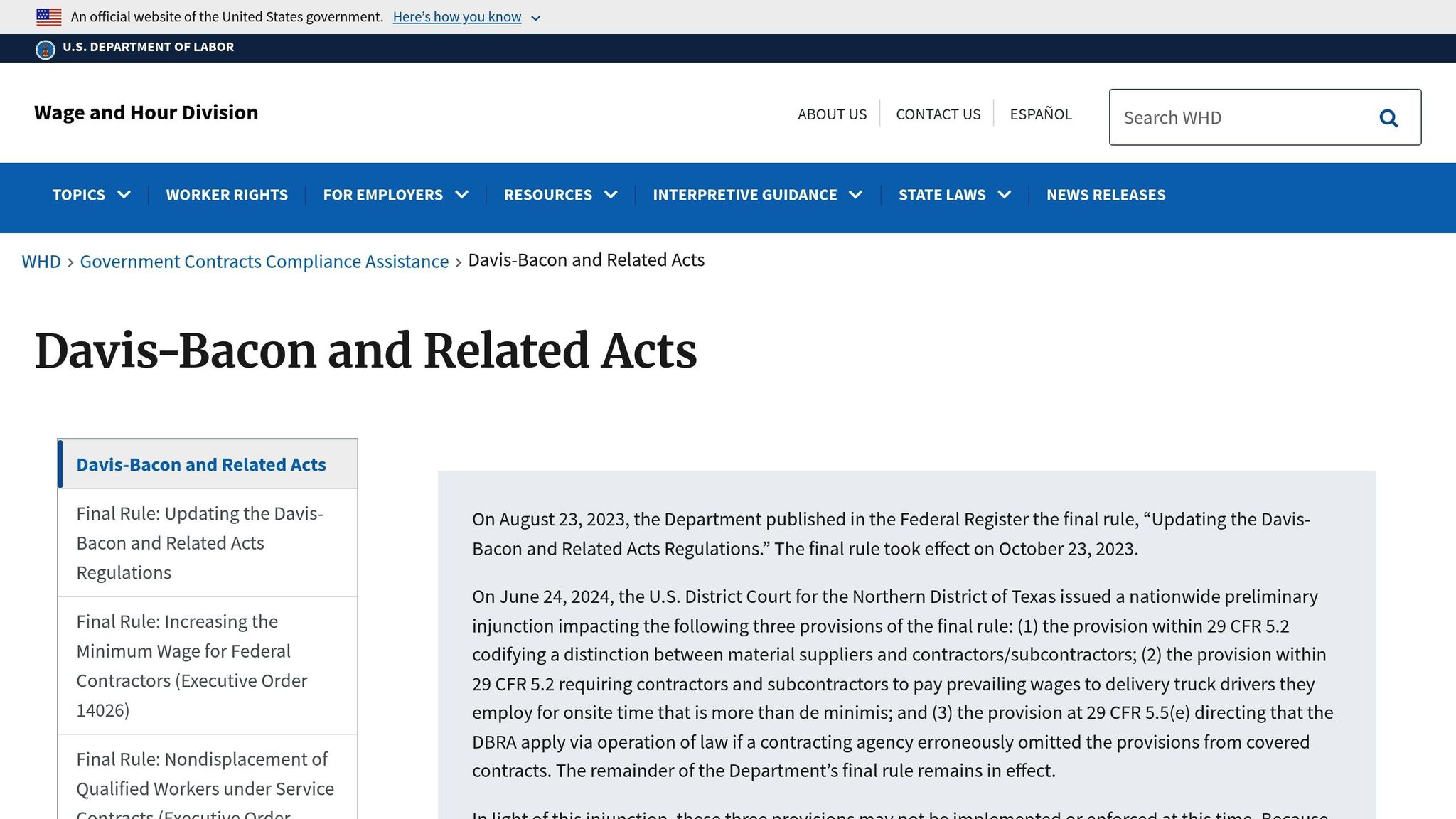
The Davis-Bacon Act plays a critical role in shaping construction wages. This regulation requires federally funded projects to pay prevailing wages based on local market rates. By establishing a wage floor, it ensures that contractors can’t compete by simply offering lower labor costs. Instead, it pushes wages higher across the board, promoting fair compensation for workers.
ABC Workforce Demand and Wage Pressures
ABC data illustrates how federal infrastructure spending intensifies workforce challenges. The construction industry faces a dual issue: 1.7 million infrastructure workers (12.2%) are projected to leave their jobs annually from 2021 to 2031, while new federal funding is expected to generate up to 1.5 million new jobs annually over the next decade. This combination of replacement demand and job creation forces employers to compete aggressively for skilled labor.
The ongoing worker shortage in the industry adds another layer of complexity. Contractors can’t simply hire more workers to meet demand; instead, they must offer higher wages to attract employees from competitors or retain experienced tradespeople who might otherwise retire.
The strain on the workforce is further confirmed by Federal Highway Administration (FHWA) data, which highlights significant job growth in transportation infrastructure projects.
FHWA Employment and Wage Growth Trends
Data from the FHWA and the Council of Economic Advisers (CEA) underscores the connection between transportation infrastructure projects and wage growth. Since January 2021, 38,300 jobs have been added in highway, street, and bridge construction, with 37,600 of those created after the Bipartisan Infrastructure Law was passed in November 2021. This sector is now adding an average of 2,800 jobs per month – four times the monthly average of 700 between 2011 and 2019.
"Job gains in the construction industry are particularly beneficial to American workers, as these jobs tend to be relatively high-paying", said Heather Boushey, Chief Economist for the Investing in America Cabinet.
Transportation projects, which receive the largest share of federal infrastructure funding, are a major driver of this trend. With $450 billion allocated to highway and public transportation investments, the demand for specialized skills – such as bridge engineers, heavy equipment operators, and civil construction crews – has surged. Employers are offering wage premiums to attract workers with the certifications and experience required for these roles, further fueling wage growth in the sector.
Wage Trends in High-Growth Infrastructure Segments
Data Centers and Megaproject Wage Structures
The surge in AI infrastructure investments has pushed annual wages for data center projects to an average of $81,800 (or $39.33 per hour). This reflects the highly technical nature of these projects, which often require expertise in mechanical, electrical, and plumbing systems.
The urgency to complete these projects on tight timelines has created fierce competition for certified professionals, leading to higher pay rates. These premiums align with broader regional trends, where wage growth varies significantly depending on local labor market conditions.
Regional and Sectoral Wage Trends
Wage growth in the construction sector has outpaced other industries, but regional differences tell a more nuanced story. Between 2021 and 2024, the median hourly wage for construction workers rose by 21.1%, more than doubling the 8.2% increase seen across all occupations. However, this growth is far from uniform across the country.
In Pennsylvania, construction wages jumped by 21.5%, a significant 13.4 percentage points above the state’s overall wage growth of 8.1%. Interestingly, this occurred despite construction employment growing by just 0.4%, compared to a 7.7% rise in total job growth. A similar pattern emerged in Massachusetts, where construction wages rose by 22.8%, outpacing the state’s overall wage growth of 6.4% by 16.4 percentage points.
On the other hand, states with fast-growing populations show a different trend. In Idaho, construction employment soared by 23.7%, more than twice the state’s overall job growth rate of 11.6%. However, construction wage growth lagged behind, increasing by only 14.4%, compared to a 23.8% rise in overall wages – a 9.4 percentage point gap. Similar dynamics can be observed in Texas, Utah, and Arizona, where booming construction employment has been accompanied by more moderate wage increases. This suggests that while demand for labor is high, the supply of workers has been sufficient to temper wage growth.
"That’s massive growth in hourly wages in such a short amount of time. That’s great news for construction workers because it hints there’s incredibly strong demand for their skills", said Matt Schulz, LendingTree chief consumer finance analyst.
sbb-itb-aa28329
Using Workforce Technology to Address Labor Shortages
With wages climbing and labor shortages persisting, workforce technology has become a game-changer for keeping projects on track.
ABLEMKR‘s Role in Construction Workforce Management

The construction industry is facing a steep challenge: by 2025, an estimated 439,000 new workers will be needed, growing to 499,000 in 2026. Meanwhile, employment growth in the sector is lagging at 8.8% compared to the overall rate of 9.4%, pushing median hourly wages up by 21.1%. This imbalance highlights the urgent need for smarter workforce solutions.
Workforce deployment platforms are stepping in to bridge the gap, making it easier for companies to find and deploy skilled labor. ABLEMKR, a mobile-first platform, stands out by using real-time geolocation to match employers with certified, safety-trained workers. This level of precision is critical for projects with tight deadlines or unexpected labor demands, whether it’s a last-minute shutdown, a remote pipeline repair, or planned infrastructure work.
Beyond worker matching, ABLEMKR offers real-time insights into worker availability, seamless payroll integration, and compliance tracking. These features help companies manage rising labor costs while improving overall efficiency.
Benefits for Employers and Workers
This streamlined approach doesn’t just address immediate labor needs – it also brings advantages for both employers and workers.
For employers, rapid crew mobilization solves one of construction’s biggest headaches. Traditional hiring methods can take weeks, but ABLEMKR’s system connects companies with qualified workers in a fraction of the time.
For workers, the platform offers flexibility and access to well-paying opportunities, along with the assurance of on-time payments. It’s a win-win, making the construction workforce more dynamic and responsive to industry demands.
The Future of Wage Growth in the Construction Industry
Federal infrastructure funding has sparked a surge in demand for well-paying construction jobs. Median hourly wages climbed from $23.18 in 2021 to $28.06 in 2024 – a 21.1% increase. And this isn’t just a short-term boost. The U.S. Bureau of Labor Statistics predicts construction employment will grow 4.7% between 2023 and 2033, outpacing the 4.0% growth rate for all industries.
This momentum is being reinforced by policy changes designed to keep wages rising. The Biden-Harris Administration’s update to the Davis-Bacon Prevailing Wage Rule – the first major overhaul in nearly 40 years – is gradually increasing pay for more than a million construction workers. With nearly $400 billion in investments and 40,000 projects underway, the groundwork for steady wage growth is already in place. Additionally, proposed legislation like the SPEED Act could further fuel this trend by streamlining project approvals, which would drive up the demand for labor.
However, wage increases alone won’t solve the industry’s labor shortages. The construction sector needs 499,000 new workers by 2026, but employment growth in the field has lagged behind, increasing by 8.8% compared to 9.4% across all industries. Compounding this issue is the aging workforce: 41% of workers are expected to retire by 2031, and younger talent isn’t stepping in quickly enough – only 10% of current workers are under 25.
To close this gap, the industry is turning to smarter workforce strategies. Platforms like ABLEMKR are stepping in to match certified workers with projects based on real-time availability, location, and credentials. These tools not only speed up crew mobilization but also help companies manage compliance more effectively. By filling labor gaps and enabling scalable growth, such technology complements the higher wages skilled workers are earning, offering a practical solution to the challenges of workforce shortages.
The future of the construction industry depends on two key factors: sustained federal investment to drive demand and the adoption of workforce technology to meet that demand. States are already putting $39 million in highway formula funds from the Bipartisan Infrastructure Law toward preparing workers for transportation-related jobs. As these initiatives progress, the combined impact of strong policy support and innovative workforce solutions will determine whether wage growth remains steady or falters due to unfilled positions.
FAQs
How does federal infrastructure spending affect wages in the construction industry?
Federal infrastructure spending has a direct impact on construction wages by increasing demand for skilled labor and enforcing prevailing-wage standards. When billions of dollars are funneled into projects like highways, transit systems, and energy infrastructure, contractors face stiff competition for a limited labor pool. This competition pushes wages higher. For instance, in October 2024, construction workers earned an average hourly wage of $36.23 – a notable jump compared to the private-sector average – as contractors sought to retain skilled crews and meet tight project deadlines.
A significant factor in this wage boost is the Davis-Bacon prevailing-wage laws, which apply to many federal projects. These laws require contractors to pay wages that align with local union rates, ensuring workers receive fair compensation and preventing local wages from being undercut. This approach directly benefits millions of construction workers. The job creation tied to these investments further amplifies the effect – each $1 billion spent on federal highway and transit projects is estimated to generate around 13,000 jobs annually, many of which are well-paying roles in construction.
To address the surge in demand for skilled labor, platforms like ABLEMKR play a crucial role. They connect contractors with pre-vetted, certified workers, ensuring projects stay on track while adhering to wage and safety standards. This streamlined approach helps fill critical labor gaps efficiently, keeping infrastructure projects moving forward.
What are the key challenges caused by labor shortages in the construction industry?
The construction industry is grappling with a labor shortage that’s driving up costs and creating operational headaches. Labor accounts for roughly 40% of total construction expenses, and with over 7.8 million workers in the field, the lack of skilled crews has caused wages to surge. Between 2021 and 2024, median pay jumped by 21.1%, far outpacing wage growth in most other industries. This sharp increase is squeezing profit margins and making it tougher for companies to stay competitive.
But rising wages are just part of the problem. Labor shortages often lead to project delays and scheduling conflicts, as contractors scramble to fill positions while adhering to strict safety and certification requirements. To cope, many firms rely on overtime or hire less-experienced workers – both of which can compromise quality and safety on the job site.
Adding to the strain are outdated practices like paper timesheets, which frequently cause payroll errors and compliance issues. These inefficiencies only worsen the situation, underscoring the urgent need for better workforce management solutions across the construction industry.
What impact does the Davis-Bacon Act have on wages for federally funded construction projects?
The Davis-Bacon Act mandates that contractors on federal or federally funded construction projects (generally those exceeding $2,000) pay their workers at least the prevailing local wage for their specific jobs, including fringe benefits. This rule establishes a wage baseline that reflects local pay standards, safeguarding workers from unfairly low wages.
By enforcing these wage guidelines, the Act supports equitable pay for laborers and mechanics while ensuring fair competition within the construction industry.


