
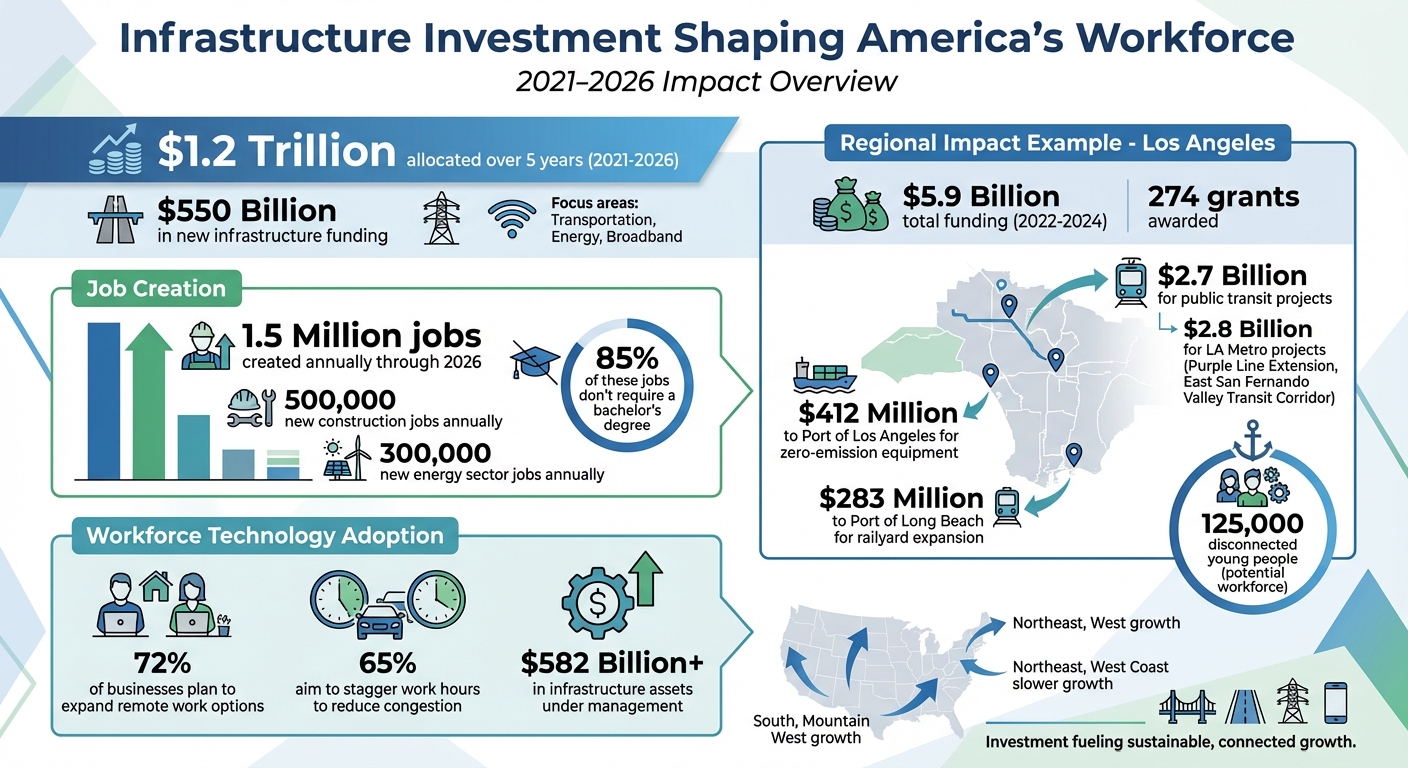
The Infrastructure Investment and Jobs Act (IIJA), signed in 2021, allocated $1.2 trillion over five years to improve transportation, energy, and broadband infrastructure. This funding is reshaping workforce patterns by creating over 1.5 million jobs annually through 2026, with major growth in construction and energy sectors. Key highlights include:
- Job growth: Construction jobs are up by 500,000, and energy roles by 300,000 annually.
- Improved mobility: Investments in highways, public transit, and digital tools make commuting and relocation easier.
- Technology integration: Platforms like ABLEMKR use geo-location to match workers with nearby job sites, reducing hiring delays.
- Regional shifts: Areas like Los Angeles and Appalachia benefit from transit upgrades and high-paying industrial roles.
Employers and policymakers are leveraging digital hiring platforms and portable credentials to meet workforce demands while addressing labor shortages. This combination of federal investment and technology is driving workforce transformation.
Infrastructure Investment and Jobs Act Impact on U.S. Workforce 2021-2026
Federal Investments and Their Impact on Workforce Mobility
What the Infrastructure Investment and Jobs Act (IIJA) Includes
The Infrastructure Investment and Jobs Act (IIJA) focuses on enhancing transportation, energy, and broadband infrastructure. The Department of Transportation (DOT) monitors these efforts through "Status of Funds" reports, ensuring transparency and accountability.
Transportation upgrades under the IIJA include improvements to highways, bridges, rail systems, and public transit. These projects are designed to enhance workforce accessibility. Meanwhile, investments in energy and broadband aim to modernize essential systems, further expanding job opportunities. By addressing these key areas, the IIJA is laying the groundwork for meaningful changes in how and where workers connect with emerging employment opportunities.
Expected Job Creation and Economic Effects
The DOT has confirmed that the IIJA is driving job creation in the transportation, energy, and broadband sectors, with impacts expected to continue through early 2026. By revitalizing critical infrastructure, the act is not only generating jobs but also improving workforce access. This momentum is contributing to economic growth and encouraging shifts in regional workforce distribution.
sbb-itb-aa28329
Fostering Inclusive Access to Infrastructure Careers by Addressing Workforce Strategies
How Technology Improves Workforce Deployment
As federal investments reshape industries, technology has become a key tool in connecting skilled workers with new opportunities. The rapid pace of growth in sectors like construction, energy, and mining has outpaced traditional hiring methods. Platforms like ABLEMKR are stepping in to bridge this gap, using mobile-first technology to match and deploy workers more efficiently.
Geo-Location: Connecting Workers to Jobs Faster
Geo-location technology is changing the way employers find and hire workers for remote or time-sensitive projects. ABLEMKR’s platform leverages this feature to link craft workers with job sites in industries such as construction, oil, gas, and mining. This real-time connection allows employers to quickly assemble crews for critical tasks, like scheduled mine development, while simplifying the hiring process. Employers can review worker profiles, ratings, and certifications directly in the app and set up appointments. The platform also supports various hiring options, including flex workers, flex-to-hire arrangements, and direct placements.
Real-Time Tracking and Streamlined Compliance
Real-time tracking ensures that employers can monitor worker attendance, minimizing delays and maintaining quality in high-risk environments. Additionally, integrated systems keep track of certifications, safety training, and worker availability, making compliance management much easier. By reducing the administrative hurdles that often slow down workforce deployment, these tools improve efficiency and transparency. These advancements are paving the way for even greater mobility and adaptability in the workforce.
How Infrastructure Spending Changes Regional Workforce Patterns
Federal investments are reshaping where people work and how they commute. Between 2022 and 2024, organizations in the Los Angeles area received $5.9 billion through 274 grants, with nearly $2.7 billion specifically allocated to public transit projects. These investments are creating stronger links between workers and high-paying industrial jobs.
Public Transit Projects Improving Job Access
Transit funding in Los Angeles has been transformative. For example, LA Metro secured $2.8 billion for major projects like the Purple Line Extension and the East San Fernando Valley Transit Corridor, which aim to connect underserved neighborhoods to major employment hubs. Beyond transit, the Port of Los Angeles received $412 million from the Environmental Protection Agency to invest in zero-emission equipment, such as tractors and forklifts, while also incorporating workforce training programs. Similarly, the Port of Long Beach was awarded $283 million to expand and reconfigure its railyard, enabling a shift from truck-based cargo movement to rail.
These initiatives are fueling job growth in industries that don’t require a bachelor’s degree. In fact, only 15% of workers in these sectors need one. Meanwhile, Los Angeles County has a significant untapped workforce: as of 2023, 125,000 young people are disconnected from both school and work. Improved transit access not only helps these individuals find jobs but also creates the foundation for broader workforce changes across the region.
Regional Examples of Workforce Redistribution
Infrastructure spending is also reshaping workforce dynamics across the country. Federal funding is driving workers to follow construction projects, often crossing state lines to fill roles in high-demand areas where local labor is insufficient. Regions like the South and Mountain West have seen notable population increases as workers relocate, while the Northeast and West Coast are witnessing slower growth.
Digital platforms are playing a pivotal role in this shift, helping match skilled, certified workers with new opportunities quickly and efficiently. This trend has increased the demand for portable licenses and standardized credentials, allowing tradespeople to transition seamlessly between regions. The result is a more adaptable labor market, where technology bridges the gap between workers and emerging opportunities.
What’s Next for Workforce Mobility and Policy
The workforce is undergoing significant changes, fueled by advancements in transit and technology. Moving forward, the focus will be on maintaining this momentum through smart policies and forward-thinking solutions.
Federal investment in the United States continues to play a key role in reshaping the workforce. The Infrastructure Investment and Jobs Act (IIJA) is allocating $550 billion toward infrastructure projects through 2026. This funding is transforming the construction industry, addressing national needs, and driving the adoption of new technologies alongside necessary policy changes.
Supporting Workforce Growth with Technology and Training
Digital hiring platforms are becoming crucial in connecting skilled tradespeople to regional projects. These tools not only verify credentials but also allow employers to evaluate candidates from a much larger geographic area. As hiring increasingly crosses state lines, such platforms are essential for streamlining the process.
One major challenge is the gap in workforce development. Tools like ABLEMKR are stepping in to address this by matching pre-vetted workers to job sites based on factors like certifications, training, availability, and location. This tech-driven approach accelerates workforce deployment and lays the groundwork for essential policy changes.
Recommendations for Businesses and Policymakers
For businesses, adopting digital hiring platforms with centralized verification capabilities is a must. These tools simplify the process of vetting and onboarding out-of-state workers. To address local labor shortages, companies are offering perks like travel allowances, relocation assistance, and multi-state project opportunities. Employers are also focusing on verified work histories and portable certifications to ensure they hire qualified talent from across the country.
Policymakers, on the other hand, need to focus on creating licensing reciprocity agreements and portable credentialing systems. Research highlights that inconsistent state licensing requirements are a major hurdle, preventing skilled workers from moving to areas where they are most needed. By developing standardized qualifications that are recognized nationwide, workers can unlock more career opportunities while employers gain access to a broader talent pool.
As Martha Ross and Zoë Dec from Brookings Metro point out, "Problems related to quality control, delays, and cost over-runs are much more likely to occur if leaders and employers treat recruitment, training, and hiring as an afterthought".
Conclusion
Federal funding is reshaping workforce mobility and access to jobs. The Infrastructure Investment and Jobs Act (IIJA) is paving the way for skilled workers to connect with high-demand projects, especially when paired with digital workforce platforms.
Tools like ABLEMKR, which matches pre-vetted workers to job sites based on their certifications and location, play a critical role in addressing the infrastructure sector’s rapid demands. However, this shift toward digital solutions requires strong partnerships to maximize its potential.
Collaboration is key. As AECOM highlights, "Agencies will have to build upon their existing systems and integrate new solutions to manage safety and improve the quality of the rider experience". This sentiment emphasizes the importance of coordinated efforts to align workforce deployment with the nation’s evolving infrastructure needs.
The data reflects this momentum: 72% of businesses plan to expand remote work options, 65% aim to stagger work hours to ease peak congestion, and infrastructure assets under management now exceed $582 billion. These trends demonstrate how workforce technology, combined with strategic infrastructure investment, is driving meaningful change.
Industries that focus on smart recruitment and efficient deployment will lead the way. By aligning infrastructure funding with forward-thinking policies and technology, the U.S. can build a workforce that is mobile, efficient, and ready to meet future challenges.
FAQs
Which IIJA-funded projects will create the most jobs near me?
The Infrastructure Investment and Jobs Act (IIJA) is driving job creation across the U.S., with a noticeable boost in industries like industrial manufacturing, energy, and infrastructure development. States such as Texas, Oklahoma, and regions along the Gulf Coast are experiencing the most significant employment growth, thanks to large-scale projects and investments in these sectors.
How do portable credentials help tradespeople work across state lines?
Portable credentials allow tradespeople to carry their certifications and qualifications across state lines without unnecessary hassle. This simplifies the process, eliminating redundant training or exams, and makes it easier for workers to move and take on opportunities in different states.
How does ABLEMKR use geo-location and certifications to mobilize crews faster?
ABLEMKR uses geo-location technology to connect pre-vetted workers with nearby job sites, allowing for quicker crew assignments. It also checks certifications to ensure workers meet the specific requirements of each project. This process simplifies onboarding and reduces delays, helping operators assemble skilled teams promptly and meet project deadlines.


