
Inclusive job postings are key to attracting diverse talent in downstream operations. Crafting these posts involves clear language, accessible application processes, and a focus on skills over rigid qualifications. Here’s what you need to know:
- Simplify Requirements: Separate "must-haves" from "nice-to-haves." For example, prefer phrasing like "training provided" over strict experience demands.
- Use Neutral Language: Avoid biased terms like "rockstar" or "aggressive." Instead, describe outcomes and necessary skills.
- Highlight Accessibility: Mention accommodations and flexible policies, such as shift-swapping or ergonomic setups.
- Show Growth Opportunities: Outline career paths, training programs, and certifications offered.
- Be Transparent: Include salary ranges and detailed benefits to build trust.
How to Create Authentic Inclusive Job Descriptions
sbb-itb-aa28329
Preparing to Write Inclusive Job Posts
Before diving into drafting a job post, take a step back and audit your job requirements. Toss out outdated templates and focus on separating essential qualifications from unnecessary legacy criteria. This groundwork ensures your job posts are clear and inclusive from the start.
Review Job Requirements
Start by categorizing qualifications into two groups: must-haves and nice-to-haves. For instance, instead of mandating a High School Diploma or GED for entry-level production roles, list it as a preference. This opens the door to trainable candidates who might otherwise be overlooked. Similarly, instead of requiring five years of downstream operations experience, consider phrasing it as "previous industrial experience preferred; training provided". This kind of framing helps you connect with local talent pools and reduces competition for a small group of seasoned professionals.
Be precise about physical requirements too. If the role involves tasks like safety checks or equipment operation, clarify whether they can be performed with reasonable accommodations. For example, you might say, "ability to identify color-coded safety labels (with or without accommodation)". This keeps the focus on the job itself while staying aligned with accessibility standards.
Check Language for Bias
Once you’ve fine-tuned the job requirements, review the language in your job post to ensure it’s free of bias. Biased wording can unintentionally deter diverse applicants. Research analyzing over 100 million job posts shows that terms like "rockstar" or "aggressive" can significantly shift applicant demographics. Atlassian, for example, found that revising their job descriptions to remove such terms improved gender diversity and reduced candidate dropout rates later in the hiring process.
Here are a few practical swaps:
- Replace "competitive" with "results-focused."
- Substitute "strong English skills" with "effective written and verbal communication."
- Avoid age-biased phrases like "digital native" by specifying the actual skills required, such as "proficient in Microsoft Excel and SAP."
While tools like Textio, Gender Decoder, or Joblint can help flag problematic phrases, don’t rely solely on software. As LinkedIn Talent Solutions points out:
"Inclusive job descriptions create a more equitable hiring process. They help organizations reach broader talent pools and ensure that great candidates don’t self-select out before they ever speak to a recruiter".
Address Downstream-Specific Requirements
For downstream roles, where safety certifications like Basic Safety Training (BST) or OSHA credentials are common, how you present these requirements matters. Instead of assuming candidates already hold these certifications, consider stating "willingness to complete Basic Safety Training (BST)". This approach emphasizes potential and demonstrates your willingness to invest in the right people.
If the role requires technical troubleshooting or reliability skills, highlight that experience gained through military service is valued and transferable. As industries adopt advanced technologies, skills in areas like analytics or robotics may also become essential. When listing these, avoid jargon. For example, instead of saying "data ninja", phrase it as "experience with predictive maintenance software or willingness to learn."
As Diversity.com aptly puts it:
"We don’t lower standards. We eliminate the barriers that keep talent hidden".
Checklist Items for Inclusive Job Posts
Once you’ve completed your initial review, it’s time to apply these key checklist items to ensure your job posts promote inclusivity effectively.
Use Neutral Language
The words you choose can make or break your efforts to attract a diverse talent pool. Gender-coded terms like "determined" or "competitive" are known to discourage women from applying. Instead, focus on describing the outcomes you want to achieve and the collaborative skills needed for success. For example, replace personality-driven sections with phrasing like, "Here’s what success looks like in this role".
Swap out rigid "must-have" lists with softer language such as "What you’ll need" or "Bonus points". This approach helps prevent qualified candidates from self-excluding because they don’t meet every single requirement. A practical hiring approach is the 70-30 rule: hire candidates who meet 70% of the criteria and can develop the rest through training. Allan Brown, a professional resume writer, explains:
"The 70-30 hiring rule is straightforward: hire candidates who meet 70% of the job requirements. The remaining 30% consists of skills or traits that can be developed after hiring through onboarding, mentoring, or on-the-job training."
Before posting, share your job description with a diverse group of employees to identify any unconscious bias you may have overlooked. This step matters, as 76% of job seekers consider workforce diversity an important factor when evaluating potential employers.
Highlight Flexibility and Accessibility
Flexibility can be a game-changer, especially for roles involving shift work, remote locations, or physical demands. Clearly outline policies for flexible scheduling, remote work options, or shift-swapping. These details resonate with caregivers, parents, and those juggling multiple responsibilities.
Encourage candidates to request reasonable accommodations during the hiring process. For instance, you could include: "We’re committed to providing reasonable accommodations throughout our hiring process. Please contact us if you need assistance or accommodation".
If you’ve invested in accessibility – like ergonomic workstations, assistive technology, or other modifications – be sure to mention it. Highlighting these efforts shows candidates that your commitment to inclusion goes beyond just words.
Show Career Growth and Training Opportunities
Downstream roles often provide clear pathways for advancement, but candidates won’t know this unless you spell it out. Highlight training programs, mentorship opportunities, or tuition reimbursement. For example, instead of simply listing "Refinery Operator I", add context: "Refinery Operator I with advancement opportunities to Operator II and III through an 18-month training program."
Mention partnerships with technical schools, certification programs, or industry associations. If your company covers safety certifications like OSHA 30-hour training or Process Safety Management, include those details. These opportunities appeal to candidates looking for long-term career development.
Provide Clear Compensation Details
Transparency around pay is no longer optional. Many job seekers view the absence of salary information as a red flag. Include a salary range, such as: "Hourly rate: $28.50–$34.75 depending on experience and certifications."
Go beyond the base pay by outlining specific benefits. Instead of vague phrases like "comprehensive benefits", list the details: "Health, dental, and vision insurance starting day one; 401(k) with 5% company match; paid safety training; $1,200 annual boot allowance." Also, mention extras like overtime pay, shift differentials, or performance bonuses. This level of detail builds trust and helps candidates make informed decisions.
Use Platforms for Skills-Based Matching
The industry is shifting toward skills-based hiring, which emphasizes certifications and proven abilities over degrees or years of experience. Structure your job posts around the competencies needed, such as: "Must hold or be willing to obtain HAZWOPER certification" or "Experience with DCS systems or willingness to complete vendor training."
Platforms like ABLEMKR can simplify this process by matching pre-vetted workers to roles based on certifications, training, availability, and location. ABLEMKR‘s mobile-first technology ensures workers are ready to perform safely from day one, while offering candidates flexible access to well-paying opportunities. By focusing on skills rather than educational backgrounds, you can attract more diverse and qualified candidates, aligning with the broader goal of reducing bias and improving access in downstream operations.
Implementing and Comparing Job Posts
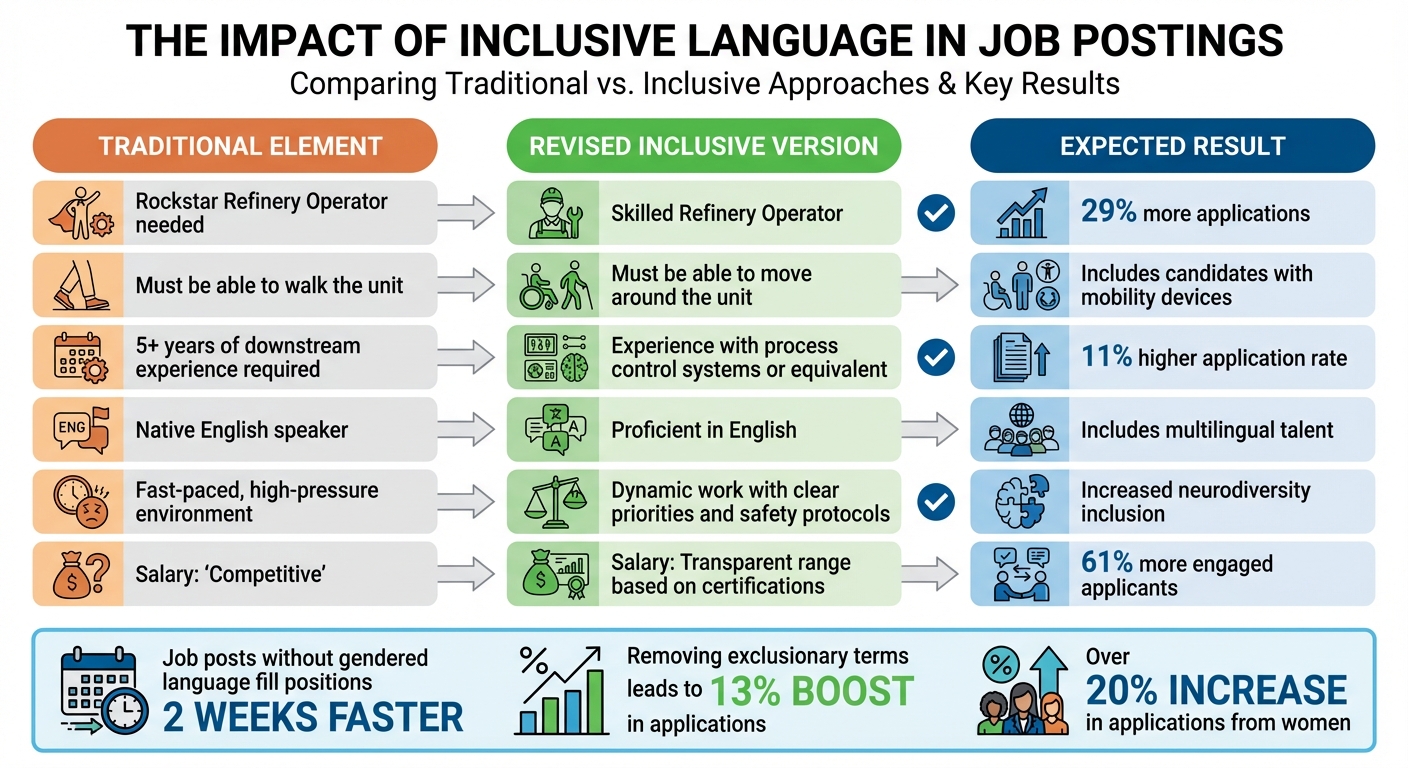
Before and After: Inclusive Job Post Language Examples with Results
Before and After: Job Post Examples
Seeing the impact of inclusive language in practice makes its value clear. Here’s a side-by-side look at traditional job post elements, their inclusive revisions, and the potential outcomes:
| Traditional Element | Revised Inclusive Version | Expected Result |
|---|---|---|
| "Rockstar Refinery Operator needed" | "Skilled Refinery Operator" | 29% more applications |
| "Must be able to walk the unit" | "Must be able to move around the unit" | Includes candidates with mobility devices |
| "5+ years of downstream experience required" | "Experience with process control systems or equivalent" | 11% higher application rate |
| "Native English speaker" | "Proficient in English" | Includes multilingual talent |
| "Fast-paced, high-pressure environment" | "Dynamic work with clear priorities and safety protocols" | Increased neurodiversity inclusion |
| "Salary: ‘Competitive’" | "Salary: Transparent range based on certifications" | 61% more engaged applicants |
These examples highlight how small adjustments can drive big results. For instance, job posts that avoid gendered language fill positions about two weeks faster, and removing exclusionary terms leads to a 13% boost in applications – over 20% of which come from women. By consistently refining language, companies can see not just more applications but also a more diverse and qualified candidate pool.
How to Review Job Posts
To maintain the advantages of inclusive job postings, regular reviews are essential. These audits ensure job descriptions stay relevant, engaging, and inclusive. Start by using free tools like Gender Decoder or Appcast Gender Bias Decoder to spot and fix biased language.
Take it a step further with A/B testing: post two versions of a job description and compare metrics like application volume, diversity in the applicant pool, and completion rates. If you notice incomplete applications, it may signal that the description is too long or the requirements are too rigid.
Gathering feedback before launching a post is another helpful step. After the post goes live, track metrics like time-to-fill and quality-of-hire to measure the effectiveness of your inclusive approach. The goal isn’t just to attract more candidates but to connect with the right talent for the role.
Measuring Results of Inclusive Job Posts
Track Application Diversity Metrics
Once your inclusive job posts are live, it’s time to measure their impact. Start by documenting your current diversity metrics – this baseline will help you track progress over time. Key metrics to watch include the Diversity Sourcing Ratio (the percentage of candidates coming from diversity-focused channels like specialized job boards or professional organizations) and the Diversity Interview Ratio (the percentage of diverse candidates advancing past initial screenings). These numbers can reveal where candidates may be dropping off in the hiring process. For instance, data from Gem highlights that many companies struggle with converting diverse candidates from the interview stage to final offers. This underscores the importance of structured interviews, as mentioned earlier.
But don’t stop at hiring. Keep an eye on retention rates for diverse employees to ensure your workplace fosters long-term inclusion. If certain groups are leaving at higher rates, it could point to systemic issues that extend beyond your job postings.
Set clear, time-specific goals rather than vague aspirations. For example, aim to increase representation in leadership roles by 15% over two years or improve the percentage of diverse candidates reaching final interviews by 10% within six months. To build trust, make demographic questions optional and separate from the main application, ensuring compliance with privacy laws. Regularly review your diversity dashboards – quarterly at minimum – to identify trends and adjust your strategies as needed.
Once your metrics are in place, focus on making real-time adjustments to improve outcomes continuously.
Adjust Based on Real-Time Data
Real-time data takes your efforts a step further by enabling immediate adjustments. Platforms like ABLEMKR provide real-time insights into worker status and application workflows, showing which job posts attract diverse, qualified candidates. This allows you to act quickly – tweaking language, requirements, or outreach methods – without waiting months to analyze results.
Incorporate A/B testing to experiment with different versions of job posts. Track metrics like application volume, diversity within the applicant pool, and completion rates to see what works best. Beyond metrics, gather qualitative insights through stay interviews with current employees. These conversations can reveal why employees choose to stay, offering valuable insights to refine not just your job postings but your overall hiring and retention strategies. Combining these real-time adjustments with your broader metrics ensures a more effective and inclusive recruitment process.
Conclusion
Inclusive job postings go beyond just ticking boxes – they open the door to a broader pool of skilled talent that’s essential for downstream operations. By using neutral language, offering clear compensation details, and emphasizing skills over exhaustive wish lists, you can attract candidates who meet 90% or more of your preferred criteria. As CDN Controls experienced after collaborating with specialized recruitment services:
"The only difficult part was selecting the final candidate because the calibre of talent we interviewed was exceptional".
For job seekers, inclusive postings provide transparent opportunities for growth in the evolving energy sector. When employers specify details like shift schedules – such as "Monday to Friday 7am to 4pm" – or list clear pay rates, it creates better alignment between companies and candidates.
The downstream sector requires expertise in areas like HSE, operations, maintenance, turnarounds, and supply chain management. Job postings should strike a balance between being precise and approachable. Applying the 70-30 hiring rule – choosing candidates who meet most requirements and training them for the rest – can significantly widen your talent pool.
To make inclusive hiring more efficient, platforms like ABLEMKR connect employers with pre-vetted workers for downstream projects. By leveraging features like real-time worker status updates, integrated compliance tracking, and geo-location matching, you can quickly assemble teams for urgent needs – whether it’s a last-minute shutdown or a remote pipeline repair – while maintaining the inclusive practices that attract top-tier talent.
FAQs
What should be a must-have vs a nice-to-have?
Must-haves are job descriptions that are clear, free of bias, and designed to attract a diverse range of candidates. These are the foundation of any effective job posting. Nice-to-haves, on the other hand, include extras like tips on language usage or formatting tweaks that can make your postings even more inclusive and appealing. While these additions can refine your approach, they should always complement – not replace – the core focus on clarity and inclusivity.
How can I remove biased wording without losing clarity?
To ensure clarity and inclusivity, replace any language that might imply stereotypes or discrimination with neutral terms. For instance, opt for ‘they’ instead of gender-specific pronouns like ‘he’ or ‘she.’ Additionally, steer clear of phrases that could reinforce stereotypes related to age, race, or abilities. The goal is to preserve the original meaning while using clear, inclusive alternatives that appeal to a broad and diverse audience, all while maintaining a professional tone.
What metrics prove my job posts are more inclusive?
Metrics that reflect more inclusive job postings include drawing in a wider range of qualified candidates, fostering greater diversity among applicants, and aligning more effectively with DEI (Diversity, Equity, and Inclusion) objectives. Achieving these outcomes often involves adhering to a well-organized checklist for crafting inclusive job descriptions.


