
Non-compliance with Illinois workers’ compensation laws is costly and risky for employers. Here’s what you need to know:
- Daily Fines: Employers without required workers’ compensation insurance face fines of $500 per day, with a minimum penalty of $10,000. Repeat offenders are fined $1,000 daily, with a minimum of $20,000.
- Legal Risks: Non-compliance removes legal protections, allowing employees to sue for unlimited damages. Corporate officers can also face personal liability and even criminal charges (Class A misdemeanor or Class 4 felony).
- Coverage Requirements: All businesses with employees in Illinois – full-time, part-time, or out-of-state – must provide workers’ compensation insurance. This includes sole proprietors and LLC members.
- Enforcement Actions: The Illinois Workers’ Compensation Commission (IWCC) can issue work-stop orders, halting operations until compliance is proven. Since 2006, over $8 million in fines have been collected.
How to stay compliant: Secure proper insurance, file proof of coverage, and conduct regular audits to avoid penalties and disruptions. Tools like ABLEMKR can help businesses monitor compliance efficiently.
Bottom line: Failing to comply with Illinois workers’ compensation laws can lead to severe financial, legal, and operational consequences. Prioritize coverage to protect your business and employees.
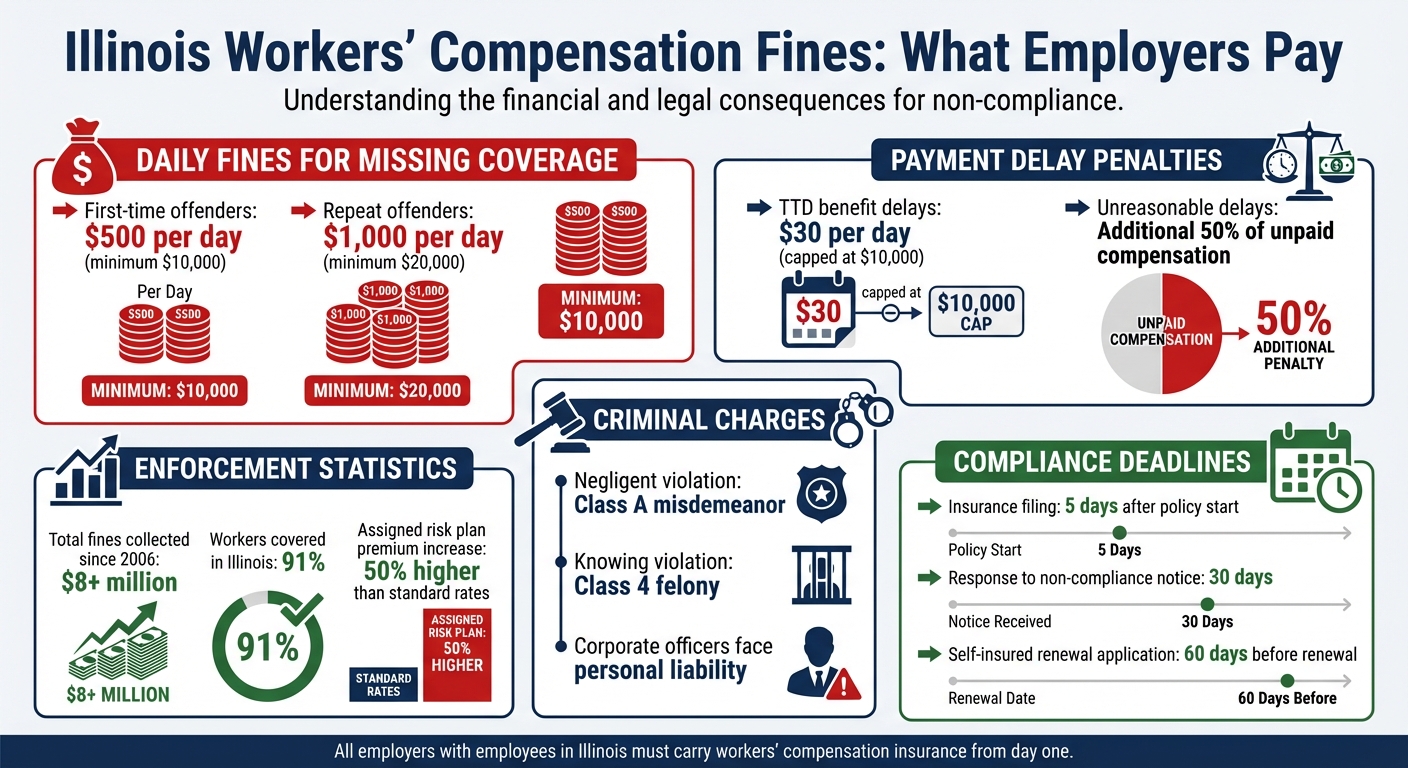
Illinois Workers’ Compensation Fines and Penalties Overview
Why Illinois Workers’ Compensation Compliance Matters
In Illinois, hiring an employee – whether full-time or part-time – automatically requires workers’ compensation insurance. This isn’t optional; it’s a legal obligation. Understanding these requirements is key to staying compliant and avoiding major consequences.
What the Law Requires
The Illinois Workers’ Compensation Act, specifically Section 4, outlines the rules. Employers must either:
- Purchase insurance from an authorized provider
- Join a workers’ compensation pool
- Obtain approval to self-insure
This applies to all employees working in Illinois, those primarily based in the state, or those hired under a contract made in Illinois. Even sole proprietors and LLC members must comply, regardless of the industry type. Out-of-state businesses with employees working in Illinois also need Illinois-specific coverage.
Insurance carriers are required to file a compliance certificate with the Illinois Workers’ Compensation Commission (IWCC) within five days of the policy’s start date. Self-insured employers must submit annual renewal applications with verified financial statements at least 60 days before the renewal date. Notably, about 91% of Illinois workers are covered under this Act, and the state leads the nation in the number of companies offering workers’ compensation insurance.
What Happens When Employers Don’t Comply
Ignoring these requirements can lead to serious penalties.
Without proper coverage, employers lose legal protections. Injured employees can sue, and there are no caps on the damages they might claim. Plus, the burden of proving non-negligence falls entirely on the employer.
The IWCC can issue work-stop orders, halting business operations until proof of coverage is provided. In high-risk industries, these orders can be enforced even before a formal hearing. Since 2006, the IWCC has collected over $8 million in fines from employers who failed to comply.
Failing to pay these fines can escalate the situation further, as corporate officers may also be held personally liable.
sbb-itb-aa28329
Fines and Penalties for Non-Compliance
Illinois enforces stringent penalties for violations of workers’ compensation laws. The financial repercussions grow depending on how severe and frequent the non-compliance is.
$500 to $1,000 Daily Fines for Missing Coverage
If an employer willfully fails to provide workers’ compensation coverage, they face a $500 daily fine, with a minimum penalty of $10,000. For repeat offenders, this increases to $1,000 per day, with a minimum fine of $20,000. These penalties continue to accrue every day until the employer becomes compliant with the law.
Penalties for Late or Delayed Payments
Even employers with active policies can face fines for delaying payments. For example, delays in Temporary Total Disability (TTD) benefit payments result in a $30 daily fine, capped at $10,000. If the delay is deemed unreasonable, an additional penalty of 50% of the unpaid compensation may be imposed.
Criminal Charges and Personal Liability
Non-compliance isn’t just about fines – it can lead to criminal charges. Failing to provide workers’ compensation insurance due to negligence is classified as a Class A misdemeanor, while knowingly violating the law elevates the charge to a Class 4 felony. Moreover, corporate officers can be held personally liable for unpaid penalties, meaning they could be pursued individually for amounts the company fails to settle.
Examples of Enforcement Actions
Enforcement actions often go beyond statutory fines, quickly turning non-compliance into hefty financial burdens. Let’s look at some cases that highlight how penalties can escalate.
Cases with Large Fines
In February 2026, an Illinois grain company faced penalties exceeding $276,000 after being cited by OSHA for multiple safety violations. This case is a stark reminder of the financial risks companies face when they fail to meet safety standards. The violations were severe enough to warrant six-figure penalties, showcasing how regulators address serious non-compliance without hesitation.
Illinois construction contractors have also faced repeated scrutiny from federal safety inspectors. In many cases, contractors were hit with six-figure fines for failing to address hazards after initial inspections. Inspectors often conducted three inspections within a month when safety issues went uncorrected. Common violations included:
- Lack of fall protection for workers at heights exceeding six feet
- Failure to certify safety training
- Improper use of equipment like ladders and forklifts
These examples demonstrate how quickly penalties can accumulate when companies fail to act on initial citations.
Enforcement Targeting Out-of-State Employers
Strict enforcement isn’t limited to local businesses – out-of-state companies operating in Illinois face the same rigorous standards. Under the Illinois Workers’ Compensation Act, every employee working in the state is protected, regardless of where their employer is based. This means companies sending workers to Illinois must comply with all state regulations or risk daily fines and penalties.
Many large out-of-state employers self-insure in Illinois, paying claims directly from their own funds. To manage these claims, they often rely on third-party administrators (TPAs) like Sedgwick or Gallagher Bassett. However, if TPAs engage in aggressive practices – such as delaying benefits or denying medical tests – this can lead to additional enforcement actions and penalties.
The Illinois Workers’ Comp Law Blog points out:
"Insurance companies in general are built around a model of the less you pay out on a claim, the more money you make".
These cases emphasize the importance of maintaining strong compliance with workers’ compensation laws to avoid costly penalties and enforcement actions.
How to Avoid Workers’ Compensation Fines
Dodging steep fines and legal trouble starts with understanding Illinois workers’ compensation laws and setting up systems to ensure compliance from the very beginning. Here’s how you can stay on track.
Get the Right Insurance Coverage
Illinois law requires every employer to carry workers’ compensation insurance starting from the day they hire their first employee. The policy must come from an insurer authorized to provide workers’ compensation coverage in Illinois, and it must specifically include Illinois-based employees – even if your business is headquartered elsewhere.
If you can’t find private market coverage, Illinois provides an assigned risk plan through the National Council of Compensation Insurance (NCCI). However, be prepared for premiums that are typically 50% higher than standard rates. To confirm your coverage, you can use tools like the IWCC online insurance database or the NCCI Policy Tracker.
Accuracy matters when it comes to NCCI classification codes. Misclassifying job roles can lead to either inflated premiums or compliance issues. Provide your insurer with detailed payroll estimates by job classification, and consider shopping for quotes from at least three carriers every 2–3 years to keep your rates competitive.
Once you’ve secured coverage, maintain compliance by keeping documentation up to date and submitting it on time.
File Annual Proof of Coverage
After obtaining coverage, you must show compliance by displaying the required notices at all work locations immediately.
If the Department of Insurance sends you a Notice of Non-Compliance, you have 30 days to provide proof of coverage, such as your policy’s information page, a self-insurance certificate, or a pooling agreement. Missing this deadline could lead to formal hearings or even work-stop orders. If you receive a notice, you have the option to request an informal conference within 15 days to resolve the issue before it escalates.
Conduct Regular Compliance Audits
Routine audits are essential to catch errors and ensure your business stays aligned with Illinois standards. Review your classification codes annually to confirm employees are categorized correctly. This helps avoid unnecessary premium increases and ensures compliance as your workforce evolves.
For companies with fluctuating payrolls – such as those in construction, energy, or seasonal industries – using pay-as-you-go billing tied to actual payroll can be a game-changer. It minimizes unexpected costs during year-end audits and helps with cash flow management. Keep all policy documents easily accessible to streamline compliance checks.
How ABLEMKR Supports Compliance

For employers in high-risk industries like construction and energy, staying on the right side of workers’ compensation laws is non-negotiable. ABLEMKR’s platform is specifically built to handle the rigorous compliance demands these sectors face, helping businesses steer clear of hefty fines and work-stop orders tied to non-compliance. By using ABLEMKR, you can ensure compliance from the start, avoiding costly penalties that can pile up daily.
Built-In Compliance Tracking
ABLEMKR offers real-time tracking of workers’ compensation coverage, certifications, and safety training. This ensures that every worker on your Illinois job site meets the state’s legal requirements. Illinois law requires coverage for every employee, and even one uninsured worker can result in a $500 fine per day. With ABLEMKR’s real-time visibility, you can instantly confirm compliance, reducing the risk of deploying uninsured workers.
The platform also verifies that out-of-state policies align with Illinois regulations – a critical feature when assembling crews from different states for urgent tasks like pipeline repairs or mine development. This continuous monitoring simplifies workforce management and ensures you can mobilize teams quickly and securely.
Fast Workforce Deployment
In addition to tracking compliance, ABLEMKR speeds up workforce mobilization. Whether you’re responding to an emergency shutdown or preparing for a scheduled infrastructure project, the platform matches prequalified workers to your job based on certifications, safety training, location, and availability. Every worker is pre-screened for insurance and safety compliance, minimizing risks during rapid deployments. This proactive approach helps avoid delays caused by work-stop orders issued by the Illinois Workers’ Compensation Commission for non-compliance.
Clear Documentation and Reporting
ABLEMKR doesn’t just track compliance – it keeps all necessary records organized and easily accessible. All compliance documents are stored digitally, making it simple to respond to audits or compliance checks. For example, if the Illinois Department of Insurance issues a Notice of Non-Compliance, you have 30 days to provide evidence like policy information or self-insurance certificates. With ABLEMKR, these records are always at your fingertips, eliminating the need to dig through piles of paperwork.
The platform also integrates seamlessly with payroll systems, ensuring accurate record-keeping even as your workforce changes. This feature is particularly useful during annual audits or when requesting an informal conference within 15 days of receiving a compliance notice. By keeping everything organized and accessible, ABLEMKR helps businesses avoid the severe financial and legal consequences of non-compliance.
Conclusion
Failing to comply with workers’ compensation requirements can lead to hefty daily fines, work stoppages, and even criminal charges. Whether you’re an Illinois-based employer, an out-of-state business, or operating in a high-risk industry, securing the right workers’ compensation coverage is non-negotiable.
To stay compliant, make sure all employees are covered, submit annual proof of coverage, and conduct regular audits. For industries like construction and energy – where workforce demands shift quickly and compliance rules are stringent – these practices are especially crucial. Tools like ABLEMKR simplify this process, helping you maintain compliance without disrupting your operations.
With features like real-time insurance verification, automated reporting, and seamless payroll integration, ABLEMKR reduces the risk of penalties and work stoppages. When managing teams across multiple states for time-sensitive projects, having compliance embedded in your workflow isn’t just helpful – it’s a safeguard against mounting fines and interruptions.
FAQs
How does Illinois decide which employees must be covered?
Illinois mandates that employers carry workers’ compensation insurance for employees whose primary work location is in the state or if their hiring contract was established there. This requirement also applies to out-of-state companies with employees working within Illinois.
How can employers fix a non-compliance notice before a work-stop order?
Employers who receive a non-compliance notice should act quickly to resolve the issue. The first step is obtaining workers’ compensation insurance from an authorized provider that covers work performed in Illinois. Once insured, provide proof of coverage to the appropriate authorities to prevent additional penalties.
Timeliness is critical here, as Illinois enforces strict fines for violations. Penalties can include daily fines of up to $500, with a minimum total of $10,000. Seeking advice from compliance experts can also be a smart move to ensure all legal requirements are fully addressed.
What steps reduce workers’ comp fines risk in fast-changing job sites?
Employers can face hefty fines – up to $500 per day, with a minimum of $10,000 – for failing to maintain proper workers’ compensation insurance. To stay compliant and avoid these penalties, it’s crucial to take proactive steps:
- Maintain Proper Insurance: Ensure your workers’ compensation coverage is always up-to-date and applies to all employees on site.
- Regularly Verify Coverage: As staffing changes, confirm that every worker is covered under your policy.
- Prevent Fraudulent Claims: Keep accurate and detailed records to help identify and prevent false claims.
- Report Injuries Promptly: Any workplace injury should be reported immediately to avoid complications or additional fines.
- Insure Workers Before They Start: Do not allow anyone to begin work until they are fully insured under your policy.
By staying vigilant and organized, you can avoid fines and ensure a safer, more compliant workplace.


