
Virtual reality (VR) is transforming how the energy sector recruits and trains workers, addressing critical staffing shortages across 81 roles. Here’s how VR is making an impact:
- Skill Testing: Simulations assess technical abilities and stress responses in high-risk scenarios like pipeline leaks or electrical issues.
- Safer Training: Candidates practice tasks like high-voltage maintenance in risk-free environments, reducing accidents and costs.
- Virtual Interviews: Employers immerse candidates in job-specific settings, offering realistic previews of roles without expensive site visits.
- Faster Hiring: VR integrates with platforms like ABLEMKR to streamline recruitment, matching pre-qualified workers to roles efficiently.
- Retention and Learning: VR improves knowledge retention (up to 80% after a year) and accelerates training by up to four times compared to traditional methods.
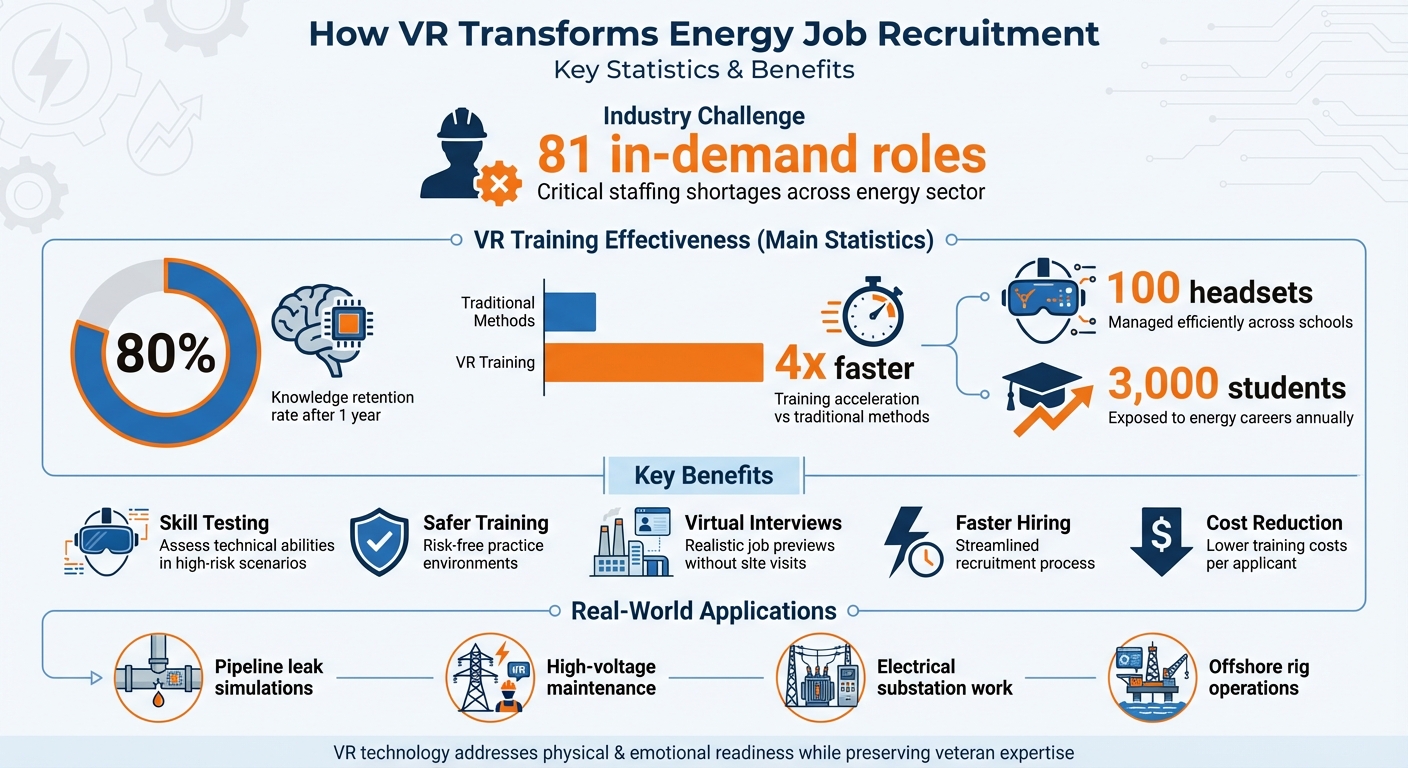
VR Training Benefits in Energy Sector Recruitment: Key Statistics and Impact
Transmission Line Repair Training in VR
sbb-itb-aa28329
Using VR for Skill Testing
Virtual Reality (VR) is reshaping how energy companies evaluate job candidates, offering a way to place them in lifelike, high-risk scenarios – without the actual danger. Instead of relying solely on resumes and interviews, recruiters can observe how applicants handle emergencies like pipeline leaks, electrical substation issues, or rig malfunctions in real time. This approach tests both technical skills and emotional reactions, revealing whether a candidate can stay composed and follow safety procedures during simulated crises, such as explosions.
Testing Technical Skills and Decision-Making
VR simulations provide a safe yet realistic platform to assess candidates on tasks that would be either too risky or too costly to replicate in the real world. Through these simulations, applicants might inspect virtual pipelines for leaks, perform maintenance in high-voltage environments, or troubleshoot equipment failures on offshore rigs. The immersive nature of VR offers insight into how candidates perform under pressure – not just their theoretical knowledge.
In October 2023, GTI Energy collaborated with Oberon Technologies to create a VR module aimed at testing pipeline technician trainees. This program evaluates whether trainees can effectively "make safe" an emergency scene in compliance with federal regulations. The module exposes candidates to rare but critical events – like explosions – that they might not encounter for years in real-world conditions. Tim Allen, CEO and Co-founder of Oberon Technologies, highlighted the benefits:
"VR experiences allow employers to gauge performance when faced with real-world scenarios, both tactically and emotionally. In hours, employees can experience what may take years for them to come across in the field".
VR’s ability to record every action creates a detailed data trail, helping companies distinguish between decisions based on knowledge and those made by guesswork. Additionally, this technology allows organizations to preserve the expertise of retiring veterans by converting their years of experience into VR scenarios. These scenarios can then test whether new recruits can match the problem-solving abilities of seasoned professionals, all while ensuring a safer, more forgiving training environment.
Reducing Risk and Preparing Candidates
VR doesn’t just test skills – it also provides candidates with a chance to learn from their mistakes in a controlled setting. Recruiters can identify physical or psychological challenges, such as fear of heights, claustrophobia, or motion sickness, before committing to full-scale onboarding.
For example, in April 2025, researchers from Portugal’s Alliance for the Energy Transition (ATE) project introduced "VR Trainee", a tool designed for electrical substation workers. Using inertial sensors, the system tracks user actions during maintenance simulations, allowing candidates to practice and improve through trial-and-error without the risks of live operations. The research team explained:
"VR Trainee allows users to interact with objects in a safe, controlled environment, enhancing training effectiveness for new maintenance employees… enabling users to learn from their mistakes without the inherent risks of live operations".
Vi Kellersohn, Chief Marketing Officer at Oberon Technologies, stressed the practical advantages of this approach:
"Knowing your employees’ capabilities before they are put into a real-world situation allows for better understanding of where additional time needs to be spent to minimize the skills gaps and critical errors caused by lack of experience".
Next, VR’s potential goes beyond skill testing, as it also revolutionizes virtual interviews by creating realistic work settings for candidates to demonstrate their abilities.
Conducting Virtual Interviews
Virtual reality (VR) interviews take job candidate assessments to a whole new level by placing applicants directly into realistic work settings. Instead of just talking about the job, recruiters can immerse candidates in environments like offshore rigs, power plants, or substations, allowing them to interact with the tools and equipment they’d use on the job. This approach not only eliminates the need for costly site visits but also helps both the candidate and employer determine if the role is the right fit. When paired with VR-based skill tests, this method offers a comprehensive view of a candidate’s readiness.
Replicating Workplace Environments
Energy companies are leveraging VR to give candidates a real-world preview of their potential roles. For instance, in April 2025, Virginia Tech‘s Power and Energy Center, under the guidance of Professor Ali Mehrizi-Sani and Executive Director Nam Nguyen, introduced a VR system connected to a digital twin of the Turner Street electric substation. This setup allows candidates to virtually tour facilities, interact with equipment, and tackle outage scenarios – all in a risk-free environment. Nam Nguyen highlighted the advantages of this approach:
"With virtual training, we exponentially reduce restrictions and increase flexibility. There are more opportunities to virtually walk around the substation. Trainees can make mistakes… all without affecting the real system or people".
By December 2024, industry leaders like Shell, BP, Chevron, and ExxonMobil had adopted VR simulations to familiarize candidates with both offshore and onshore facilities. These virtual walkthroughs prepare candidates for hazardous environments without requiring experts to travel to remote locations, offering significant savings in recruitment costs. Beyond helping candidates understand the job, VR enhances the overall experience, making it more engaging and informative.
Improving Candidate Engagement
VR leaves a stronger impression on candidates than traditional phone or video interviews. Exploring 3D environments and interacting with lifelike equipment keeps candidates engaged longer and helps them retain more information about the role. Professor Ali Mehrizi-Sani from Virginia Tech underscored this point:
"VR is our way of… providing an immersive experience with real graphics and real, lifelike interactions. Plus, it’s more fun this way".
This immersive experience also helps energy companies stand out as modern and innovative employers, a key factor when attracting tech-savvy Millennials and Gen Z candidates. But VR interviews aren’t just about first impressions – they also provide valuable, data-driven insights. By recording candidate actions, employers can establish objective evaluation criteria. Every applicant encounters the same environment and challenges, ensuring a consistent and fair process that traditional interviews often lack. These recordings offer deeper insights into decision-making patterns, showcasing how VR is reshaping recruitment in the energy sector.
Combining VR with Automated Recruitment Platforms
Integrating VR assessments with automated recruitment platforms takes hiring efficiency to the next level. These platforms manage everything from candidate matching to deployment and onboarding, streamlining the process for industries like oil & gas, utilities, and mining. By combining VR performance data with certifications, geo-location, and worker availability, companies can build a faster and more precise recruitment pipeline. This is particularly crucial for high-risk roles, where objective evaluations – like those discussed earlier in VR skill testing and virtual interviews – are essential.
Carlos Ledo, Assistant General Counsel and HR Consultant at Engage PEO, highlighted the shift in recruitment practices:
"Recruiters can now use virtual reality goggles as a means of testing a candidate’s skill set in a virtual environment. This evaluation in the metaverse allows employers to get a better assessment of a candidate’s ability to perform critical job functions".
Platforms such as ABLEMKR are designed to facilitate this integration. They match pre-vetted candidates using certifications, safety training records, and VR assessment results. This ensures the right worker is sent to the right job – whether it’s an emergency pipeline repair or a shutdown at a processing plant. With mobile-first designs, these platforms allow for remote VR assessments and real-time workforce tracking, creating a faster and more dependable hiring process.
Speeding Up Hiring and Onboarding
Hiring in the energy sector often drags on for weeks, slowed by logistical challenges like remote assessments. VR technology helps eliminate these delays. Platforms such as ABLEMKR use VR data to pre-qualify candidates, cutting down the time between application and deployment.
For example, in December 2024, Energy Safety Canada launched a VR recruitment program using ArborXR to manage 100 headsets across schools in Alberta and Saskatchewan. This initiative, led by Program Manager Kelly Johnson, introduces 3,000 students annually to 81 in-demand occupations through immersive 360° tours of drilling rigs and oil sands. Johnson shared the program’s operational benefits:
"Using ArborXR has been a game-changer. It’s streamlined our operations, allowing us to manage over 100 headsets efficiently and focus on delivering impactful experiences".
This approach doesn’t just speed up hiring – it also improves onboarding. New hires gain "locational awareness" of hazardous environments through VR before ever stepping on-site. By virtually familiarizing themselves with layouts, equipment, and safety protocols, workers are ready to contribute immediately. Platforms like ABLEMKR track onboarding progress and compliance documentation, ensuring every worker meets federal safety standards before deployment.
This streamlined process not only accelerates onboarding but also ensures workers are well-prepared for their roles, reducing risks and improving productivity from day one.
Deploying Workers More Effectively
Deploying workers in the energy sector comes with unique challenges: remote locations, tight deadlines, and strict safety requirements. In situations like emergency pipeline repairs or expanded mining operations, delays are not an option. By integrating VR performance data with geo-location tracking and certification records, platforms like ABLEMKR can mobilize skilled crews quickly and efficiently.
Vi Kellersohn, Chief Marketing Officer at Oberon Technologies, explained the importance of this approach:
"Knowing your employees’ capabilities before they are put into a real-world situation allows for better understanding of where additional time needs to be spent to minimize the skills gaps and critical errors caused by lack of experience".
VR assessments also screen for physical and emotional factors that could affect safety. For instance, testing a candidate’s response to heights or confined spaces in VR can identify potential risks before they’re sent to offshore rigs or wind turbine installations. By combining these insights with certifications, ABLEMKR ensures workers are matched to roles they’re fully prepared to handle – critical for meeting the demands of urgent projects.
Providing Instant Feedback and Scalable Training
Virtual reality (VR) doesn’t just assess skills – it also facilitates instant feedback and scalable training, making it a game-changer for recruitment and onboarding processes. With VR, every session is recorded and can be replayed immediately, allowing trainees to spot and correct mistakes on the spot. Vi Kellersohn, Chief Marketing Officer at Oberon Technologies, highlighted this advantage:
"In the moment feedback is crucial to training success. Because the training takes place in a digital environment, each session can be recorded and replayed for analysis and feedback, which helps trainees learn from their mistakes".
Cutting-edge VR tools take this further by using inertial sensors to track movements and deliver real-time feedback during simulations. For example, in April 2025, researchers unveiled "VR Trainee" at the IEEE Conference on Virtual Reality. This tool was designed specifically for electrical substation workers, offering real-time guidance as they practiced handling high-voltage equipment in a safe, simulated environment. Early results showed that new hires improved their skills significantly, with retention rates hitting 80% after one year. Compared to traditional training methods, this approach accelerated learning by up to four times.
Another perk? The data collected during VR sessions allows recruiters to identify trends, pinpoint knowledge gaps, and focus on areas where additional training is needed across large groups of applicants.
Evaluating Large Applicant Pools
Once a VR environment is created, it can be reused indefinitely, making it perfect for assessing and training multiple candidates at once – no extra facilities or travel required. For energy companies dealing with high turnover or rapid growth, this scalability is a game-changer. By reusing VR modules, businesses can cut training costs per applicant while still delivering high-quality, consistent instruction.
Take the partnership between Oberon Technologies and GTI Energy in March 2024 as an example. Together, they developed a fully immersive VR training module focused on emergency response procedures, such as securing an accident scene. This module allowed trainees and instructors to interact in real time within the same virtual space. The result? Knowledge retention rates of 80% or higher. Additionally, these modular VR setups can be adapted for various scenarios, equipment, and procedures, making it easy to scale training programs as hiring demands grow.
Improving Safety During Training
One of VR’s standout benefits is the ability to train workers on high-risk tasks without putting them – or expensive equipment – in harm’s way. Trainees can experience critical errors, such as failing to shut down machinery during a simulated explosion or mishandling high-voltage components, without real-world repercussions.
VR also evaluates physical and emotional readiness for specific roles. For instance, simulations can test how candidates handle heights, confined spaces, or emergency situations. This helps identify potential safety risks before workers are sent to offshore rigs, wind turbines, or substations. Platforms like ABLEMKR even integrate VR assessments with certifications and safety training records, ensuring only well-prepared candidates are assigned to high-risk jobs. By addressing these factors upfront, companies can reduce workplace accidents during the early stages of employment and meet federal safety standards from day one.
With its ability to provide detailed feedback, scalable training, and enhanced safety measures, VR is reshaping how companies approach recruitment and workforce readiness.
Tracking Recruitment Performance with VR
VR isn’t just transforming skills assessments and interviews – it’s also providing a way to track recruitment performance and improve hiring outcomes.
Key Metrics for Measuring Success
To see how VR is impacting your recruitment process, focus on metrics that align with the energy sector’s unique needs. One critical metric is time-to-hire. With VR, remote skill assessments can be conducted immediately, skipping the need for on-site evaluations and speeding up the hiring process.
Another important area is VR simulation proficiency scores. These provide measurable data, such as how well candidates handle tasks like high-voltage repairs or follow complex maintenance procedures. Additionally, tracking safety hazard recognition rates can help assess a candidate’s ability to identify potential risks. VR also cuts training costs by accelerating learning and improving knowledge retention, reducing the need for expensive re-training programs. Together, these metrics create a data-driven foundation for evaluating your recruitment strategy.
Using Platforms Like ABLEMKR for Data Insights
Once you’ve gathered these metrics, platforms like ABLEMKR can take it further by integrating VR data with other workforce information. ABLEMKR links VR assessment results with certifications, safety training records, and compliance data. This ensures that only candidates who excel in VR simulations are considered for critical roles, such as pipeline repairs or substation maintenance.
With ABLEMKR’s mobile-first design, employers can track worker performance and status across multiple locations – whether staffing a remote drilling operation in Texas or managing a utility project in Pennsylvania. By combining VR simulation scores with geo-location and availability data, teams can quickly deploy skilled, pre-vetted crews. This approach not only streamlines hiring but also uncovers trends in technical skills and safety practices, helping employers address gaps and improve workforce readiness.
Conclusion
Virtual reality is reshaping how energy companies approach recruitment and workforce preparation. By enabling risk-free skill assessments and engaging candidates in immersive ways, VR tackles some of the industry’s toughest hiring challenges. It not only improves employee retention but also speeds up training, cutting costs while ensuring workers are better prepared for high-risk tasks.
This shift makes recruitment a measurable, data-driven process. As Vi Kellersohn, Chief Marketing Officer at Oberon Technologies®, puts it:
"Knowing your employees’ capabilities before they are put into a real-world situation allows for better understanding of where additional time needs to be spent to minimize the skills gaps and critical errors caused by lack of experience".
Platforms like ABLEMKR take these advantages further by connecting VR assessments with real-world deployment. When simulation results are paired with certifications, geo-location data, and availability tracking, employers can quickly deploy pre-qualified workers for critical projects – whether it’s a pipeline repair in Texas or a utility shutdown in Pennsylvania. This approach creates a "virtual-first" recruitment model where workers arrive on-site already trained, tested, and ready to perform. Combined with tools that monitor compliance and worker status, this makes hiring faster, safer, and more scalable.
Beyond short-term training gains, VR offers a way to address long-term challenges. For an industry grappling with staffing shortages and an aging workforce, VR becomes a key tool. It helps preserve the expertise of seasoned employees while efficiently preparing new hires, ensuring smooth operations across the energy sector.
FAQs
What VR hardware do candidates need?
To participate, candidates must have access to a VR headset like the Valve Index or Meta Quest 3. Additionally, they’ll need a compatible computer equipped with a high-performance GPU (such as an NVIDIA RTX 4080), a multi-core CPU (e.g., Intel i7 or AMD Ryzen 7), and 16–32GB of RAM. These specs are essential to ensure smooth operation of VR applications used in recruitment and skill evaluation processes.
How do VR scores translate into hiring decisions?
Virtual reality (VR) scores, generated through immersive job simulations, give employers a clear way to assess candidates’ skills, decision-making, and safety awareness. These simulations replicate real-world scenarios, offering objective data that highlights top performers or identifies areas for growth. By incorporating VR scores into their hiring processes, companies can make quicker, data-backed decisions. This ensures candidates meet the technical and safety requirements critical for high-stakes industries like energy.
How can ABLEMKR use VR data to speed up hiring?
ABLEMKR uses virtual reality (VR) data to make hiring more efficient through immersive skill assessments and realistic performance testing. With VR, employers can gauge a candidate’s technical abilities, decision-making skills, and emotional responses in simulated scenarios. By measuring factors like task accuracy and how quickly tasks are completed, ABLEMKR helps identify top candidates more quickly. This approach reduces the need for traditional interviews and cuts down on onboarding delays, ensuring teams are ready to tackle high-demand energy projects without unnecessary holdups.


