
Hiring seasonal workers can be tricky if you’re not aware of the rules. Missteps like misclassifying workers, skipping wage laws, or ignoring safety standards can lead to hefty fines. Here’s what you need to know:
- Classify Workers Correctly: The IRS and Department of Labor (DOL) have strict rules about who qualifies as an employee versus an independent contractor. Misclassification can result in fines up to $25,000 per violation in some states.
- Verify Eligibility: Complete Form I-9 for every hire. Missing deadlines or using expired documents can cost you $281+ per form.
- Pay Proper Wages: Seasonal workers must receive at least the federal or state minimum wage and overtime pay for hours over 40 per week.
- Ensure Workplace Safety: OSHA requires employers to train workers and provide a safe environment. Non-compliance can lead to fines over $2 million, especially for heat-related violations.
- Follow Anti-Discrimination Laws: Seasonal staff deserve the same protections as permanent employees under laws like the Civil Rights Act and FLSA.
- Handle Payroll and Taxes Properly: Withhold taxes, issue W-2s, and keep records for up to seven years.
Mistakes can add up fast, but tools like automated payroll systems and compliance platforms can help you stay on track. Keep reading for detailed steps to protect your business and employees.
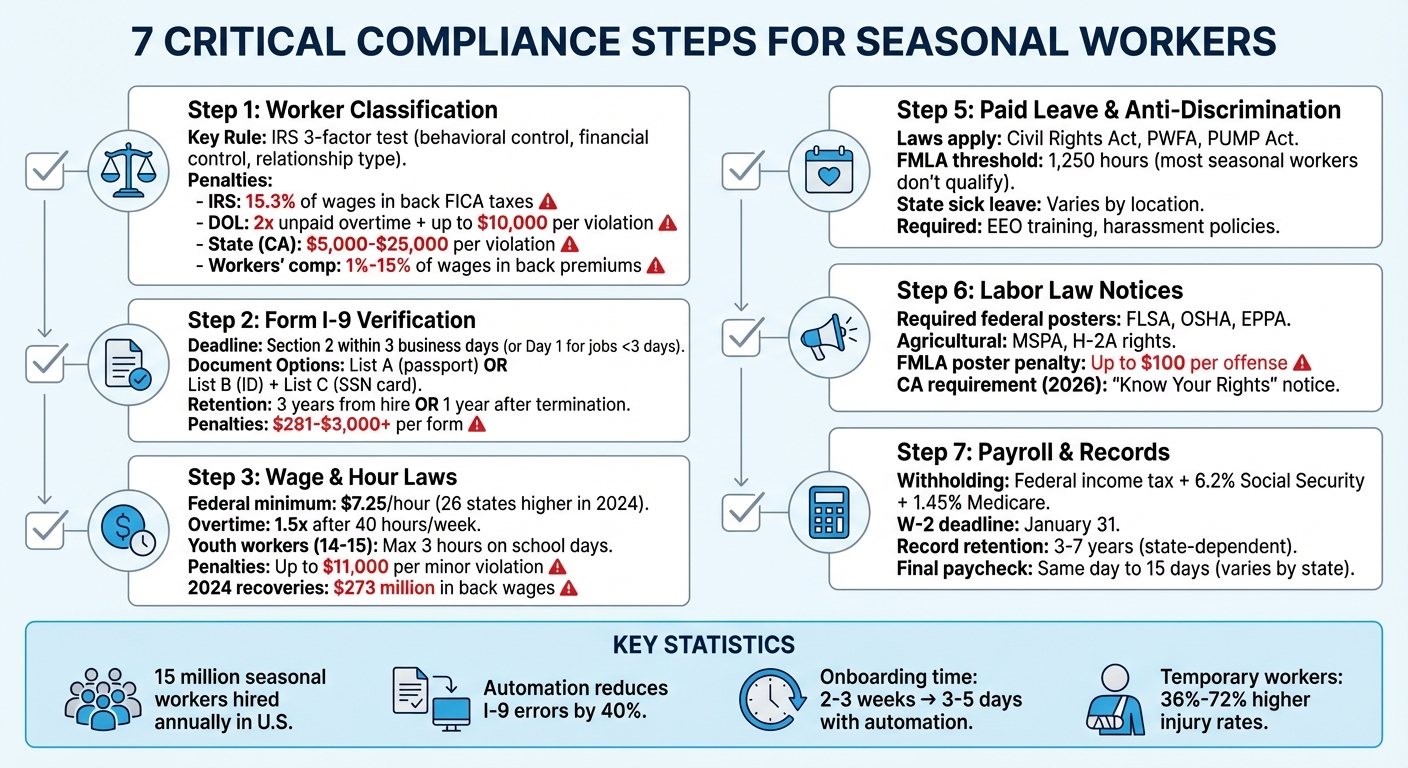
Seasonal Worker Compliance Requirements and Penalties Guide
VirgilHR Legal Update | Preparing for Seasonal Hiring and Interns
sbb-itb-aa28329
Step 1: Classify Seasonal Workers Correctly
Getting worker classification right is crucial to avoid fines and legal trouble. Both the IRS and the Department of Labor (DOL) have specific guidelines for determining whether someone is a seasonal employee or an independent contractor. These agencies focus on how the work is performed, not just the terms outlined in a contract or job description.
Understand the Classification Rules
The IRS relies on three factors – behavioral control, financial control, and the type of relationship. If you dictate schedules, provide necessary tools, and control how tasks are completed, the worker is likely an employee.
The DOL, as of February 27, 2026, emphasizes two core factors: the level of control over the work and the worker’s ability to influence their profit or loss. Employees typically don’t have the ability to affect their earnings through personal investment, while contractors often make substantial investments in their tools or business and bear the risk of profit or loss. Proper classification is a cornerstone of compliance.
Misclassifying workers can lead to steep penalties. The IRS may impose 15.3% of wages in back FICA taxes and fines ranging from $50 to $580 for each unfiled W-2. The DOL can demand two times unpaid overtime as liquidated damages and levy civil penalties up to $10,000 per violation. In states like California, penalties can skyrocket to $5,000 to $25,000 per violation. On top of that, you might owe 1% to 15% of wages in workers’ compensation back premiums for the lookback period. These costs can escalate quickly.
Conduct Regular Classification Audits
It’s a good practice to review worker classifications at least once a year to ensure they align with actual work arrangements. This involves documenting key details like who controls the work schedule, how tasks are performed, and whether workers have invested in their own tools or business. For contractors, keep records of their independence, such as business insurance, evidence of multiple clients, and clearly defined contracts with specific deliverables.
Seasonal hiring can complicate compliance, especially during busy periods when your workforce grows. Adding seasonal workers might push you over state or federal thresholds for additional legal obligations. States like California, Massachusetts, and New Jersey apply the stricter "ABC Test" for classification, which is harder to meet than federal standards. If you operate across multiple states, it’s safer to follow the strictest standard to avoid issues. Regular, documented reviews of worker classifications are essential to staying compliant across the board.
Step 2: Verify Employment Eligibility with Form I-9
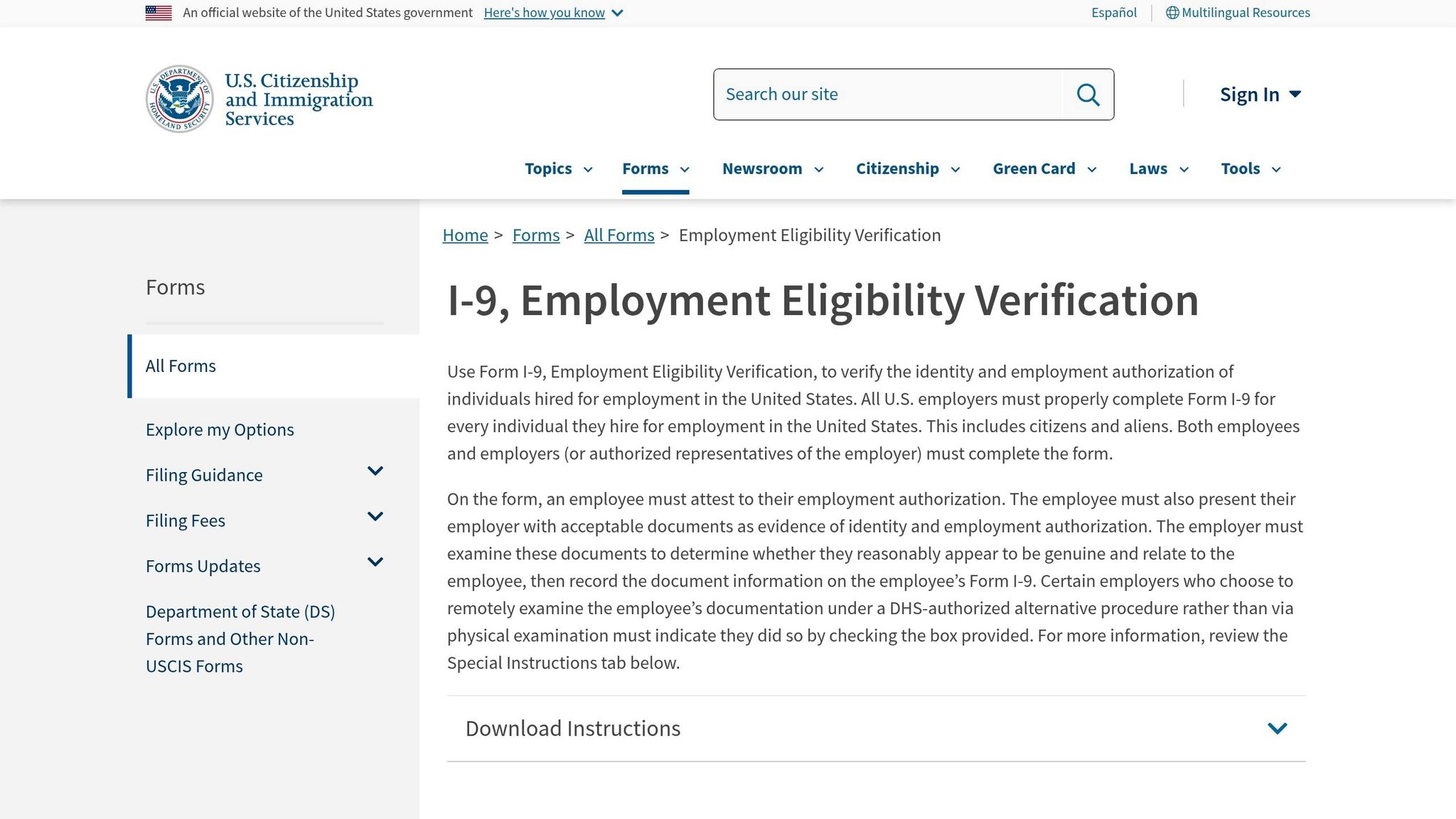
When hiring seasonal workers – whether for a week or several months – completing Form I-9 is a must. This federal requirement applies to every seasonal hire. Employees are responsible for completing Section 1 on their first day, while employers must fill out Section 2 within three business days. For jobs lasting less than three days, however, Section 2 must be completed on the first day.
For short-term roles like harvest work or event staffing, this rule often catches employers by surprise. Workers can provide either one List A document (such as a U.S. Passport or Permanent Resident Card) or a combination of one List B document (e.g., a driver’s license) and one List C document (e.g., a Social Security card) to verify their identity and work authorization. Importantly, you cannot request specific documents, such as a Green Card or Passport, as doing so violates anti-discrimination laws. Also, ensure that all documents are unexpired at the time of verification.
Employers must retain Form I-9 for three years after the date of hire or one year after employment ends, whichever is later. If a seasonal worker is rehired within three years, you can update the original form using Supplement B instead of starting a new one. Be aware: administrative fines for I-9 violations start at $281 per form for first-time offenses and can exceed $3,000 per form for repeat violations by 2026. Even minor oversights, like missing signatures, account for about 12% of all technical violations flagged by inspectors.
Use Technology to Manage I-9 Compliance
Getting Form I-9 right is essential, and technology can make the process smoother. Automated onboarding platforms cut down on clerical errors by around 20% compared to manual methods. If your business uses E-Verify – now utilized by over 1.1 million employers nationwide – you can take advantage of remote document verification under DHS-approved guidelines. For eligible employers in good standing, documents can be reviewed remotely via live video.
Tools like ABLEMKR’s platform simplify I-9 verification and compliance tracking, especially during busy seasonal hiring periods. This system integrates directly into onboarding workflows, helping you manage large volumes of hires across multiple job sites. It also tracks expiration dates and sends reminders when reverification is needed, ensuring you stay ahead of compliance requirements.
Step 3: Follow Wage and Hour Laws
Seasonal workers must receive the same wage protections as full-time employees. According to the Fair Labor Standards Act (FLSA), employers must pay at least the federal minimum wage of $7.25 per hour – or the higher state or local minimum wage, if applicable [14,17]. In 2024, 26 states and Washington, D.C. increased their minimum wage rates, so it’s essential to verify which rate applies in your area. Always use the rate that provides the greatest benefit to employees.
Overtime pay is another key requirement. Nonexempt seasonal employees must be paid 1.5 times their regular hourly rate for any hours worked beyond 40 in a workweek [14,11,17]. Misapplying overtime rules can result in steep penalties, so ensure compliance. If you hire workers under 18, additional rules apply. For instance, 14- and 15-year-olds are limited to 3 hours of work on school days and 18 hours during school weeks. Violating these restrictions can lead to fines of up to $11,000 per minor [14,11,10].
While the FLSA doesn’t mandate rest or meal breaks, many states do [11,10]. Failing to provide required breaks – or allowing employees to work "off the clock" – can lead to wage claims. In 2024, the Department of Labor’s Wage and Hour Division recovered over $273 million in damages and back wages, highlighting the financial risks of noncompliance. Just like worker classification and employment eligibility, adhering to wage and hour laws is a critical part of maintaining compliance.
Track Time Accurately
Accurate time tracking is essential for meeting wage and overtime requirements. The FLSA mandates that employers keep detailed records of hours worked and wages paid for all employees, including seasonal staff. To prevent accidental violations, train managers on proper timekeeping practices and state-specific break laws during onboarding.
For workers at temporary locations, such as holiday kiosks or remote job sites, digital timekeeping tools can simplify compliance. These platforms help avoid overtime errors, ensure accurate record-keeping, and provide documentation in case of disputes. This is especially useful when managing large numbers of seasonal hires across multiple locations.
Step 4: Meet Safety and OSHA Requirements
After addressing fair pay compliance, the next priority is workplace safety. Just like worker classification and wage tracking, establishing strong safety protocols is crucial to protecting both your employees and your business.
Safety measures are especially important for seasonal workers in high-risk industries such as construction, energy, and mining. According to OSHA, staffing agencies and host employers share the legal responsibility for maintaining a safe work environment, as they are considered "joint employers." This means both parties must ensure proper training, communicate hazards clearly, and maintain accurate injury records. Non-compliance can lead to hefty fines – OSHA issued over $2 million in heat-related penalties in 2024 alone.
In addition to general safety requirements, host employers must provide site-specific training tailored to the unique hazards and equipment workers will encounter. For instance, if a seasonal worker is expected to operate powered industrial trucks or manage lockout/tagout procedures for machinery at an oil and gas facility, the employer must verify their certifications and deliver hands-on training before they begin work.
Heat safety is another major concern, particularly for outdoor or physically demanding jobs. Between 2011 and 2022, over 33,000 heat-related workplace injuries and illnesses were reported, with incidents rising by more than 50% in the past three years. Tragically, most heat-related deaths occur within the first three days of a worker starting a new job. Although OSHA is working on a national heat safety standard expected by 2026, employers should take action now. At 80°F, ensure workers have access to cool water (1 quart per hour) and shaded break areas. When temperatures hit 90°F, implement 15-minute paid breaks every two hours and enforce a buddy system to monitor for signs of heat stress.
"Workers all over the country are passing out, suffering heat stroke and dying from heat exposure from just doing their jobs, and something must be done to protect them." – Douglas L. Parker, Assistant Secretary for Occupational Safety and Health
Employers must also stay compliant with OSHA’s injury and illness recordkeeping requirements under OSHA Standard 1904.31. Collaborate with your staffing provider to ensure injuries are recorded only once on the appropriate OSHA 300 Log .
Hire Pre-Vetted Workers for Safety
To simplify compliance and enhance workplace safety, consider hiring pre-vetted workers. Platforms like ABLEMKR can connect you with certified, safety-trained workers who are ready to step onto job sites immediately. This approach minimizes compliance risks and ensures crews are prepared for urgent tasks, such as last-minute shutdowns or remote pipeline repairs, all while adhering to OSHA standards.
Step 5: Handle Paid Leave and Anti-Discrimination Rules
Once workplace safety is addressed, the next step is ensuring compliance with paid leave and anti-discrimination rules for seasonal workers. These protections are just as enforceable for seasonal staff as they are for permanent employees. In short, all employees – regardless of how long they stay – deserve the same legal protections.
Including these requirements in your compliance plan is crucial, especially when scaling your workforce. While most seasonal workers don’t meet the 1,250-hour threshold required for FMLA coverage, many states and localities require that even short-term employees accrue paid sick leave. Adding seasonal workers to your team also increases your headcount, which can trigger additional leave and anti-discrimination obligations.
Anti-discrimination rules are non-negotiable. Federal laws like the Civil Rights Act of 1964, the Pregnant Workers Fairness Act (PWFA), and the PUMP for Nursing Mothers Act extend to seasonal hires just as they do to full-time employees. This means you must provide Equal Employment Opportunity (EEO) training, enforce harassment policies, and implement professional conduct standards during onboarding. Make sure supervisors know how to handle accommodation requests, and clearly inform seasonal workers about how they can report discrimination or harassment.
It’s also essential to document all policies from day one. Use offer letters or employee handbooks to clearly state the temporary nature of the position and explain which state or local paid leave laws apply. Display mandatory labor law posters and ensure that all onboarding training is recorded as compensable time. To put this into perspective, in 2024 alone, the Wage and Hour Division recovered over $273 million in damages and back wages, often from employers who failed to meet their obligations with temporary staff.
Step 6: Set Up Onboarding and Labor Law Notices
Once you’ve verified worker classifications and eligibility, the next step is setting up a compliant onboarding process. This step not only prepares seasonal workers for their roles but also creates a legal record that safeguards your business. Seasonal employees must receive the same legal notices and policy confirmations as permanent staff. The process starts with providing clear, legally required labor law notices.
In the U.S., employers are obligated to display specific posters at every worksite, whether it’s a permanent or temporary location. Key federal notices include:
- Employee Rights Under the Fair Labor Standards Act (FLSA)
- Job Safety and Health: It’s the Law (OSHA)
- Employee Polygraph Protection Act (EPPA)
For agricultural workers, additional notices such as the Migrant and Seasonal Agricultural Worker Protection Act (MSPA) and Employee Rights Under the H-2A Program (for foreign workers) are required. Employers should also note that failing to display the Family and Medical Leave Act (FMLA) poster could result in penalties of up to $100 per offense. State-specific notices vary; for instance, California will mandate the "California Workplace – Know Your Rights" notice for all new hires starting February 1, 2026, with annual updates thereafter.
To simplify compliance, mobile-first platforms can deliver labor law notices digitally while capturing electronic acknowledgments. This creates a secure digital record, reducing the risk of disputes later on. Some organizations are also using microlearning techniques, which increase engagement by 50%, to deliver training in short, focused bursts. At temporary worksites, QR codes or compact binders can ensure workers have access to all required information.
"At a minimum, seasonal employees should receive a copy of the employee handbook or any written policies regarding harassment, retaliation, workplace conduct, and dress code during the onboarding process."
- Ogletree, Deakins, Nash, Smoak & Stewart, P.C.
Before seasonal workers arrive, it’s a good idea to conduct a poster audit to ensure all local, state, and federal notices are up-to-date. Official posters are available for free from the Department of Labor and state agencies. While digital access can supplement compliance efforts for remote or field-based staff, physical postings at worksites remain mandatory. Tools like ABLEMKR can help streamline this process by embedding compliance tracking into the onboarding workflow. This ensures every worker completes essential training and acknowledges all policies before starting their first shift.
Step 7: Manage Payroll, Taxes, and Records
Once you’ve sorted out worker classifications, eligibility, and safety measures, the next step is managing payroll, taxes, and records. This part is crucial for staying compliant with regulations, especially when dealing with seasonal workers.
Seasonal employees are subject to the same payroll rules as permanent staff. This means you must withhold federal income tax, Social Security (6.2%), and Medicare (1.45%) from their paychecks. Workers need to fill out Form W-4 to set their withholding preferences, and by January 31st of the following year, you’re required to provide Form W-2, detailing their wages and withheld taxes for the prior year.
One of the biggest challenges with seasonal workers is keeping accurate records for shorter employment periods. You’ll need to track details like names, addresses, Social Security numbers, hire dates, job roles, hours worked, wages paid, and tax withholdings. These records must be retained for three to seven years, depending on state guidelines, to prepare for potential audits. When employment ends, final paychecks must be processed promptly. Some states mandate payment on the last day of work, while others allow 5-15 days to issue the final paycheck. Make sure this paycheck includes all earned wages, accrued paid leave, and any applicable bonuses.
If your business operates across multiple states, things can get even more complicated. Each state has its own rules about minimum wages, overtime thresholds, paid leave, and income tax withholdings. For instance, some states require overtime pay after 8 hours in a single day, while others apply it only after 40 hours in a week. Always follow the laws of the state where the work occurs.
Simplify Payroll with Workforce Platforms
Handling payroll for seasonal workers doesn’t have to be overwhelming. Automated payroll systems can help streamline the process. These systems handle tax calculations, track withholdings, and even generate W-2 forms, reducing the risk of manual errors.
For example, ABLEMKR integrates payroll management with real-time updates on worker hours, wages, and tax obligations. It automatically calculates overtime based on state-specific rules, applies the correct withholding rates, and generates all necessary documentation. This eliminates the need for manual input and ensures compliance.
Automated platforms can also manage fluctuating schedules, track leave accruals, and process final paychecks quickly, including all required components. This not only speeds up payments but also improves worker satisfaction. Additionally, built-in compliance tracking helps flag potential issues early, providing a clear audit trail to demonstrate your compliance efforts.
Compliance Checklist: Requirements and Solutions
Ensuring compliance when hiring seasonal workers involves navigating several critical regulations. Below is a checklist summarizing the key compliance steps and how ABLEMKR provides tailored solutions to meet these requirements.
Compliance Summary Table
| Compliance Step | Federal/State Requirements | ABLEMKR Solution |
|---|---|---|
| Worker Classification | According to FLSA/DOL guidelines, seasonal workers are typically employed for less than 150 days per year. Misclassification can lead to hefty penalties. | Matches pre-vetted workers based on their certifications and availability; flags potential misclassification risks before hiring. |
| I-9 Verification | Employers must complete USCIS Form I-9 within three days of hire. I-9 compliance is often a significant challenge for small businesses. | Automates I-9 verification with E-Verify integration, including expiration alerts to ensure compliance. |
| Wage and Hour Laws | The federal minimum wage is $7.25 per hour under FLSA, though many states require higher wages. Overtime pay is calculated at 1.5x after 40 hours per week. | Provides real-time time tracking and automatic overtime calculations that adjust for state-specific rules. Payroll workflows are fully integrated. |
| OSHA Safety Requirements | OSHA standards (29 CFR 1910/1926) apply, with seasonal industries often facing numerous citations. | Matches workers to jobs based on location and safety certifications, reducing the risk of violations through pre-vetting. |
| Paid Leave and Anti-Discrimination | FMLA and Title VII protections apply, and some states mandate paid sick leave. | Automates onboarding notices and tracks compliance for audit trails, ensuring equal treatment and proper documentation. |
| Payroll, Taxes, and Records | IRS Form 941 filings are due quarterly, W-2s by January 31, and record retention ranges from 3 to 7 years depending on state laws. | Handles automated tax calculations and withholdings, offers centralized record storage with searchable audit trails, and ensures on-time payments. |
ABLEMKR’s mobile-first platform simplifies compliance, making seasonal hiring more efficient. With 15 million seasonal workers hired annually in the U.S., automation through ABLEMKR reduces I-9 errors by 40% and shortens onboarding from 2–3 weeks to just 3–5 days (SHRM 2025). This streamlined approach not only addresses compliance challenges but also speeds up the entire hiring process.
Conclusion
Ensuring compliance with seasonal worker regulations involves tackling several key areas. Employers must focus on proper worker classification based on IRS criteria, conduct accurate Form I-9 verifications, follow FLSA wage and hour standards, maintain OSHA compliance through training and PPE use, and provide anti-discrimination protections for temporary staff. Each of these steps carries potential financial and legal risks – misclassification could result in back taxes and penalties, while safety lapses jeopardize workers and expose businesses to costly citations.
Managing large volumes of seasonal hires across multiple locations adds another layer of complexity. Manual processes often create bottlenecks during onboarding, increase the risk of employment verification errors, and make it harder to track certifications and safety training. As Allie Pizzemento from MAU explains, "Compliance is not just about avoiding penalties; it is integral to creating sustainable manufacturing practices".
Scalable workforce platforms help alleviate these challenges by automating compliance workflows. For example, ABLEMKR’s mobile-first technology simplifies processes like Form I-9 verification and time tracking. It matches pre-vetted workers based on certifications, safety standards, and location, ensuring only qualified and compliant candidates are hired from the outset.
This approach is particularly critical in industries like energy, mining, and heavy infrastructure, where temporary workers face 36%–72% higher injury rates compared to permanent staff. By embedding compliance tracking into scalable platforms, businesses can better protect their workforce while improving operational efficiency. Adopting such technology not only ensures compliance but also supports smoother and safer operations.
FAQs
How do I know if a seasonal hire must be an employee?
When deciding whether a seasonal hire should be classified as an employee, the IRS provides clear criteria to guide you. These include:
- Type of relationship: Consider factors like whether benefits are offered or if a written contract outlines the terms of work.
- Financial control: Look at who provides tools, covers expenses, and manages the financial aspects of the work.
- Behavioral control: Assess how much control you have over how the work is done, including instructions and training.
If the worker receives benefits, works solely for your business, and you dictate how tasks are performed, they’re likely an employee. Misclassifying workers can lead to serious legal and tax consequences, so it’s important to evaluate these factors thoroughly.
What should I do if an I-9 is late or has errors?
If an I-9 form is submitted late or contains errors, it’s important to address the issues promptly to stay compliant. For mistakes in Section 1, employees should make the corrections themselves by drawing a line through the errors, entering the correct information, and then adding their initials and the date next to the changes. For Section 2, employers are responsible for fixing errors. They should make the corrections, ensure the changes are clear, and include a written explanation detailing what was corrected.
Conducting routine internal audits can help catch and fix these issues early, which is especially useful during periods of heavy hiring to avoid potential penalties.
Which state’s rules apply if the job spans state lines?
When jobs span state lines, state rules can vary based on several factors. These include the employee’s primary work location, their place of residence, and any contractual agreements specifying a governing law. Employers need to carefully evaluate these elements to ensure they meet all compliance requirements.


