
The API 1169 certification is a must-have for professionals in pipeline construction inspection. It ensures you meet industry standards for safety and compliance in the U.S. and Canada. Here’s how to get certified:
- Eligibility: Requires 2-8 years of relevant experience based on your education and role. Categories include pipeline inspection, oil & gas inspection, and heavy industries.
- Application: Submit verified work history, education documents, and certifications via the API ICP portal. Fees total about $1,150. Approval takes 4-6 weeks.
- Exam Prep: Study topics like welding, coating, pressure testing, and safety. Use training courses and practice exams. Aim for a passing score of 70%.
- Exam: Closed-book, in-person at Prometric centers. Manage time carefully – 30 seconds per question.
- Renewal: Certification lasts 3 years. Start recertification early to avoid lapses.
This certification boosts career prospects and ensures compliance with pipeline safety standards.
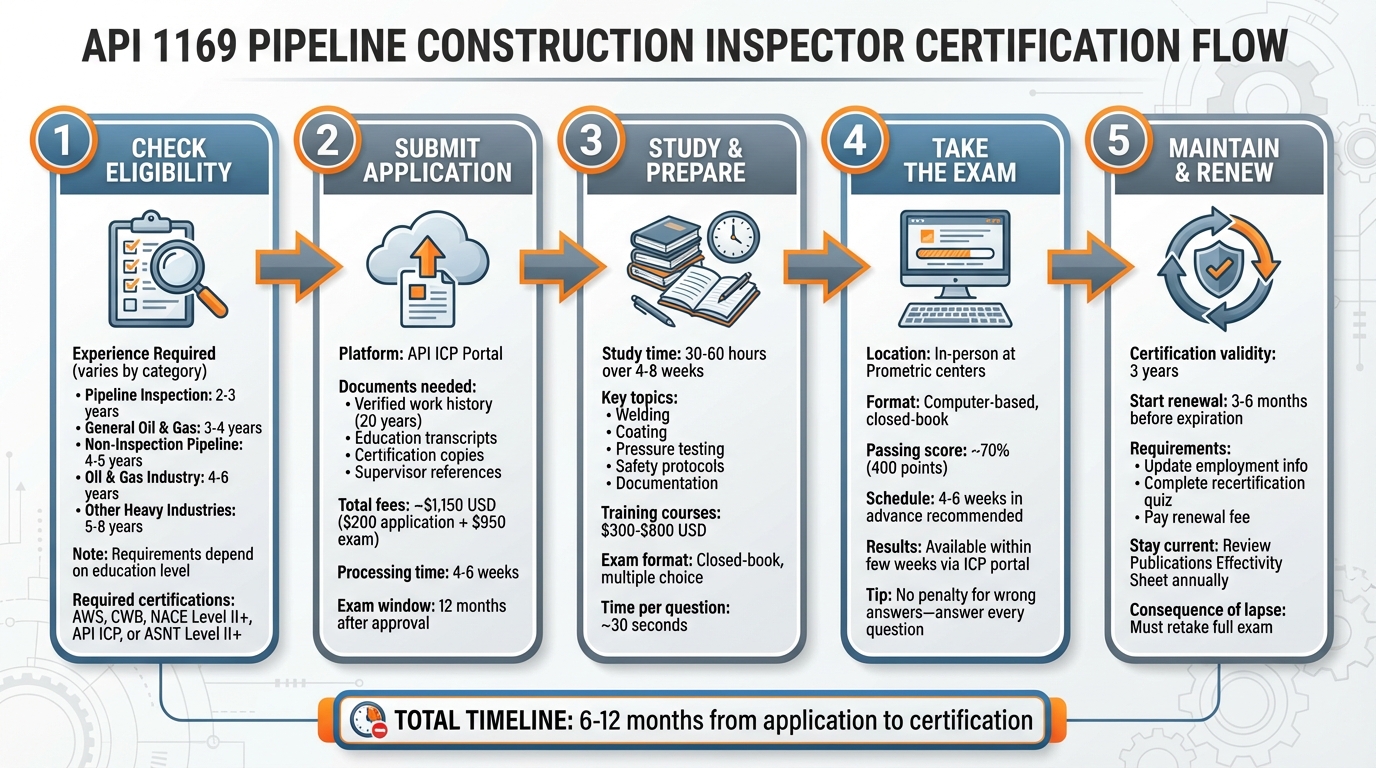
API 1169 Certification Process: 5 Steps from Application to Renewal
Who Can Apply for API 1169 Certification
Work and Education Requirements
To be eligible for API 1169 certification, you need relevant industry experience from the last 20 years and appropriate educational qualifications. This certification targets professionals involved in onshore pipeline construction and inspection, including roles like pipeline construction inspectors, welding inspectors, coating inspectors, pressure and leak test personnel, safety inspectors, and utility inspectors.
Experience is categorized into five areas: Pipeline Inspection, General Oil & Gas Inspection, Non-Inspection Pipeline Experience, Oil & Gas Industry Experience (e.g., petrochemical refineries), and Other Heavy Industries (e.g., construction, mining, logging, power generation, shipbuilding). The number of years required depends on your specific background and education.
- Pipeline Inspection: Requires 3 years of experience, or 2 years if you hold a bachelor’s degree or a 2-year technical degree.
- General Oil & Gas Inspection: Includes roles like equipment inspection, nondestructive testing, in-service inspection, or tank and pressure vessel work. Requires 4 years with a high school diploma or GED, or 3 years with a technical degree.
- Non-Inspection Pipeline Roles: Positions such as foreman, welder, fitter, survey party chief, or heavy equipment operator require 5 years of experience with a high school diploma, or 4 years with a technical degree.
- Oil & Gas Industry Experience: For those working in petrochemical facilities, 4 years of experience is needed, including at least 1 year of pipeline-specific work, if you have a recognized third-party certification. If pipeline-specific experience is less defined, 6 years is required.
- Other Heavy Industries: Requires 8 years of experience with any level of education plus a certification, or 5 years with a technical degree and certification.
If your experience is verified, holding additional certifications can help streamline the eligibility process.
Certification Prerequisites
Applicants in the General Oil & Gas Industry Experience or Other Heavy Industries categories must hold recognized certifications. Acceptable credentials include:
- American Welding Society (AWS) certifications
- Canadian Welding Bureau (CWB) certifications
- NACE (Level II or higher) for corrosion and coating work
- Other API ICP certifications
- ASNT (Level II or higher) for nondestructive testing
Military veterans with technical service experience may also qualify. For example, 2 years of technical military service in areas like mechanical systems or heavy equipment can count as a 2-year or 4-year technical degree. This can reduce the required pipeline inspection experience – for instance, a veteran with 2 years of military technical service might only need 2 years of pipeline inspection experience instead of 3.
To apply, you’ll need to submit a supervisor-verified employment history. This should include job titles, employers, locations, dates (MM/DD/YYYY), and detailed descriptions of duties that align with API categories. Be sure to keep accurate records, as API may contact your supervisors directly to confirm your employment and responsibilities.
How to Apply for API 1169
Gathering Required Documentation
To avoid delays or rejection, make sure you have all the necessary documents ready. You’ll need to provide work history from the past 20 years that aligns with one of API 1169’s five categories. This includes employer verification letters written on company letterhead, detailing your roles, employment dates, and specific responsibilities. For example, a letter confirming three years of pipeline coating inspection with 1,200 field hours is a good reference.
If you’re relying on education to reduce the required experience, include official transcripts or certificates. Any documents in a language other than English must have certified translations.
For those applying under the general oil & gas or heavy industry categories, include copies of additional certifications like AWS, CWB, NACE Level II (or higher), other API credentials, or ASNT Level II (or higher). These certificates should clearly show expiration dates, if applicable. Employer reference letters must include supervisor contact details, as API may contact them to verify your employment and job duties. Typically, one reference per qualifying experience period is required. Keep well-organized personnel records to back up your application.
Submitting the Application
Submit your application through the API Individual Certification Programs (ICP) portal at https://api.org/certification. If you don’t already have an account, you’ll need to create one. Once logged in, select your qualifying category and upload scanned copies of all required documents. The portal’s ability to save your progress reduces the risk of errors compared to using paper forms.
Double-check your application using API’s checklist to catch common mistakes like incomplete work history, missing signatures, blurry scans, or mismatched credentials. Be prepared to pay nonrefundable fees totaling about $1,150.00 USD ($200.00 for the application review and $950.00 for the exam) via credit card.
After submitting, you can track your application status through the ICP portal. Approval usually takes 4 to 6 weeks. If your application is incomplete, it could extend the process by an additional 4 to 8 weeks, so submitting early is a good idea. Once approved, you’ll have 12 months to take the exam.
How to Study for the API 1169 Exam
Key Topics and References
Once your application is complete, the next step toward earning your API 1169 certification is diving into exam preparation.
The exam covers a range of topics, including utility inspection, welding, coating, documentation, and safety protocols. To guide your studies, refer to the API 1169 Publications Effectivity Sheet, available on API’s Exam Info page. This sheet outlines all the standards, codes, and regulations that could appear on the test. Keep in mind, the exam is closed-book, so you’ll need to thoroughly understand the material before test day.
For utility inspection, focus on areas like right-of-way clearing, stringing, trenching, line locating, and protecting existing buried utilities. In pressure and leak testing, study topics such as selecting test media, determining minimum test durations, calculating pressures, documenting tests, and understanding acceptance criteria. The welding section includes procedure and welder qualifications, essential variables, visual weld acceptance criteria, and repair limits. For coating, be familiar with surface preparation standards, application techniques, holiday detection, and repair methods. Additionally, brush up on inspection ethics, documentation practices, and effective communication with crews.
While the exam is technical, it also evaluates your overall competency as an inspector, covering a broad spectrum of responsibilities.
Once you’ve reviewed these core topics, it’s time to structure your study plan with the right tools.
Study Resources and Tools
With the key topics identified, you can now focus on using the right resources to prepare.
Plan to dedicate 30–60 focused hours over 4–8 weeks for your studies, depending on your prior experience with pipelines and familiarity with the reference materials. If you’re working full-time, a practical schedule might include 1–1.5 hours of study on weekday evenings and 3–4 hours on one weekend day.
Start by reviewing the Body of Knowledge and all references listed in the Effectivity Sheet to get a clear understanding of the exam’s scope. Create a glossary of important terms like MAOP, MOP, HDD, and NDE. Then, prioritize high-weight topics such as welding, pressure testing, coating, and safety measures.
Consider enrolling in specialized API 1169 training courses from providers like Atlas API Training, Jiva Consulting, or Wilkinson Coutts. These courses, which typically cost between $300–$800 USD, provide guided lectures, worked examples, and exam-style question banks. They also break down each Body of Knowledge section, offer study checklists, and include timed practice exams. A well-rounded study approach combines reading the primary standards, taking a focused course to highlight frequently tested areas, and practicing with timed exams to reinforce your understanding.
Since the exam is known for being time-sensitive – allowing about 30 seconds per question – timed practice is crucial. Simulate test conditions by taking full-length exams under a timer. Review your mistakes by referencing the relevant clauses and use educated guessing when necessary (there’s no penalty for incorrect answers). The passing score is around 70% (about 400 points), so aim to consistently score above this threshold during practice to build confidence for the actual exam.
Taking the API 1169 Exam
Scheduling the Exam
Once API approves your application through the ICP portal, you’ll receive an authorization to schedule (ATS) email with your exam window and instructions for booking through Prometric. It’s important to schedule your exam as soon as possible to secure your preferred date. Keep in mind, the API 1169 exam is only available at in-person Prometric testing centers – there’s no remote or online option.
To book your exam, log into the Prometric scheduling site using your API program ID and candidate details. Enter your ZIP code to find nearby test centers and compare available dates and times. Since seating is first-come, first-served, it’s a good idea to schedule your exam 4–6 weeks in advance to get your preferred slot. This is especially important in busy areas like Texas energy corridors, the Gulf Coast, North Dakota, and Pennsylvania, where demand for test slots is higher due to concentrated oil and gas activity.
The API application and exam fee typically ranges from $300–$800 USD, depending on whether you’re an API member and if your registration includes training courses. Be aware that Prometric may charge additional fees if you need to reschedule or cancel your appointment.
When selecting your test center and time, think about convenience and comfort. Consider factors like proximity, parking, local traffic, and your personal peak performance time – some people do better in the morning, while others prefer afternoon slots. Also, account for weather and commute time, especially if you’re traveling from a remote job site.
Once your exam is scheduled, it’s time to prepare by reviewing the format and strategies for success.
Exam Format and Tips for Success
The API 1169 exam is a computer-based, closed-book test administered at Prometric centers. You won’t be allowed to bring any publications, notes, or personal materials into the exam room – everything you need must be committed to memory. The test consists of multiple-choice questions based on the API 1169 Body of Knowledge and standards listed in the Publications Effectivity Sheet. For OSHA-related questions, relevant regulations will be displayed on-screen.
Every question carries equal weight, and there’s no penalty for wrong answers, but unanswered questions will lower your score. The passing score is approximately 70%, or about 400 points. Since you’ll have roughly 30 seconds per question, managing your time effectively is crucial.
Start with a quick first pass, answering the easier questions right away. Flag any challenging ones and avoid spending more than 90 seconds on a single question. Reserve the last 10–15 minutes to review flagged items. If you’re unsure about a question, make an educated guess – leaving questions blank will hurt your score.
Pay close attention to the wording of each question, especially qualifiers like "most appropriate", "initial action", or "according to OSHA." Eliminate obviously incorrect options and compare the remaining choices against the language of the relevant standard. Be cautious with extreme or absolute answers unless they match the specific wording of the code. Questions often focus on applying U.S. and Canadian standards (such as API recommended practices and OSHA 29 CFR 1910/1926) in practical scenarios, rather than simple fact recall.
On exam day, plan to arrive 30–45 minutes early to allow time for check-in, biometric or photo capture, and locker assignment. Bring a government-issued photo ID that matches the name on your API registration. Personal items like phones, smartwatches, and notes are not allowed in the testing room. Prometric centers are typically kept cool, so wear layers to stay comfortable during the multi-hour exam. Allow extra time for transportation and parking to avoid unnecessary stress.
After finishing the test, you may see a brief on-screen confirmation that your submission was successful. Detailed pass/fail results will be emailed to you and posted in the ICP portal within a few weeks. Keep your Prometric receipt for your records. If you don’t pass, review the performance breakdown by topic (if provided), adjust your study plan, and reapply for a future exam window through the API portal. This will include paying any re-examination fees. Use the first attempt as a learning experience, focusing on targeted training, question banks, and practice exams from API 1169 training providers to address any weak areas.
sbb-itb-aa28329
Maintaining and Renewing Your API 1169 Certification
Recertification Process
Your API 1169 certification is valid for three years. To avoid any interruptions, start the recertification process 3 to 6 months before your certification expires.
Recertification is straightforward and completed online. Here’s what you’ll need to do: log into the ICP portal, check and confirm your personal and employment details, update your supervisor’s contact information, complete the recertification quiz (based on the current Publications Effectivity Sheet), and pay the renewal fee.
To make the process smoother, keep an organized record of your professional activities. A simple spreadsheet can help – list project names, dates (MM/DD/YYYY), locations (state and county), and the percentage of time spent on inspection duties. Additionally, save digital copies of training certificates, supervisor contact details (name, title, company, phone, and email), and any correspondence from API. Not only does this streamline recertification, but it also demonstrates your attention to detail and professionalism to potential employers.
If your certification expires, your status becomes inactive, which could disqualify you from projects requiring active credentials. In most cases, API will require you to reapply and retake the full exam, rather than simply completing the online quiz.
By staying organized and proactive, you can ensure your certification remains valid and align yourself with industry expectations.
Staying Current with Industry Standards
Keeping your certification active also means staying informed about changes in industry standards. The Publications Effectivity Sheet, updated regularly, lists the standards and documents relevant to the API 1169 exam and recertification. Reviewing this sheet annually – and especially before your recertification – is a great way to stay in the loop on evolving regulations and best practices.
Between recertification cycles, take a proactive approach to learning. Enroll in training courses related to API 1169 or pipeline construction, attend employer-led safety sessions or procedural updates, and participate in industry events like conferences, webinars, or workshops hosted by pipeline associations and standards organizations. Reviewing key standards and incident reports quarterly can also sharpen your field expertise, improve your documentation practices, and enhance your credibility with operators and regulators.
Staying updated not only helps with recertification but also ensures you’re always prepared for the demands of the industry.
How ABLEMKR Supports API 1169-Certified Professionals

Compliance and Deployment
ABLEMKR takes the hassle out of managing your API 1169 certification by maintaining a digital compliance profile for each pipeline inspector. This profile securely stores your certificate number, issue date, and expiration date. Once you upload your API certificate, the system verifies it directly against API public records. This automated process ensures that only inspectors with valid credentials show up in employer searches, safeguarding your professional reputation while helping operators stay compliant.
The platform’s mobile matching system goes a step further, filtering candidates based on API 1169 certification, relevant experience, safety training, availability, and location. For example, if a midstream operator needs an inspector for a two-month mainline project in West Texas, they can search specifically for an "API 1169-certified pipeline construction inspector" with hydrotest experience. ABLEMKR then identifies pre-vetted professionals within driving distance, cutting lead times from weeks to just days – or even hours in urgent situations like shutdowns.
Onboarding and site-readiness are also handled digitally. When a project manager sends you a digital onboarding packet, you can complete and sign all necessary documents straight from your smartphone. Managers can then track the progress in real time, eliminating the back-and-forth emails that often slow down U.S. pipeline projects. By the time you arrive on-site, all paperwork is done, and you’re ready to start inspecting on day one.
This seamless approach not only simplifies compliance but also unlocks broader advantages for both workers and employers.
Benefits for Workers and Employers
ABLEMKR offers more than just compliance tools – it provides real, practical benefits for both inspectors and the companies hiring them.
For API 1169-certified inspectors, the platform opens doors to a steady stream of well-paid, project-based jobs with multiple operators and contractors. By pooling demand across different regions, ABLEMKR helps you line up back-to-back assignments, smoothing out income between projects. Integrated timekeeping ensures you’re paid on time, with clear records of earnings. Over time, building a documented work history – complete with client ratings and a track record of continuous assignments – can lead to better rates and more selective job opportunities.
For employers, ABLEMKR speeds up mobilization, reduces compliance risks, and cuts down on administrative work. Real-time dashboards provide a clear view of which field personnel hold API 1169 certification, when credentials are set to expire, and how staffing aligns with company standards. For example, supervisors can quickly identify gaps, such as a spread operating with only one certified inspector across several crews, and adjust staffing as needed. Automated expiration alerts and centralized records help avoid audit issues, while consolidated invoicing and payroll tools streamline cost tracking. Plus, because ABLEMKR logs your project roles and dates, it’s easy to export your inspection history when it’s time to renew your certification after three years.
API 1169 Pipeline Construction Inspector; Exam Tips
Conclusion
Earning your API 1169 certification takes careful preparation. Start by verifying your qualifications – whether that’s 3 years in pipeline inspection, 4 years in general oil and gas inspection, or up to 8 years in heavy industry, supported by certifications like AWS or NACE Level II. Make sure to gather supervisor-verified documentation, submit your application through API’s ICP portal, review the API effectivity sheet, and prepare for the exam, which focuses on U.S. and Canadian standards. These steps provide a clear roadmap to achieving certification.
Once certified, the credential remains valid for three years, with renewal required to stay aligned with evolving industry standards.
This certification isn’t just about meeting compliance requirements – it’s about staying competitive in a demanding field. Industry regulations have made certification a must for ensuring safe pipeline construction. For inspectors, it opens doors to in-demand job opportunities. For employers, it minimizes risks, streamlines crew mobilization, and ensures inspectors meet rigorous standards.
In fast-paced sectors like energy transition and industrial development, certified professionals have a clear advantage. Operators increasingly seek pre-qualified workers with verified credentials for critical projects, whether it’s remote pipeline repairs or scheduled maintenance shutdowns. By earning and maintaining API 1169 certification, you position yourself for a career that emphasizes expertise, safety, and reliability – qualities the industry values now more than ever.
FAQs
What topics should I focus on to prepare for the API 1169 certification exam?
To get ready for the API 1169 exam, concentrate on essential areas such as OSHA regulations, pipeline safety standards, excavation and trenching practices, pipeline construction and repair processes, safety protocols, and environmental compliance requirements. A solid grasp of industry standards, proper documentation methods, and effective safety and compliance practices in pipeline operations is crucial.
Make sure to allocate sufficient time to study these topics and review applicable guidelines to feel confident and prepared on exam day.
Can military veterans apply their service experience toward API 1169 certification eligibility?
Yes, military veterans can use their service experience to meet the eligibility requirements for API 1169 certification, especially if their roles included construction, safety, or similar skills. Such experience may count toward the certification’s work history or training prerequisites. Veterans should carefully review the eligibility guidelines and gather documentation to verify their relevant experience. This will help show how their military background aligns with the standards of the certification.
What should I do if my API 1169 certification has expired?
If your API 1169 certification has lapsed, you’ll need to go through the renewal process by reapplying and passing the exam again. Begin by ensuring you still meet the eligibility criteria and take the time to familiarize yourself with the updated exam guidelines.
When you’re prepared, schedule your exam through the certifying authority or an authorized testing provider. Make sure to set aside ample time for studying and preparation to give yourself the best chance of passing on your renewal attempt.


