
Downtime in energy projects is expensive and disruptive. A single turbine failure can cost hundreds of thousands of dollars per hour, with global manufacturers losing $50 billion annually. But real-time data is changing the game. By using IoT sensors and predictive analytics, energy operators can monitor equipment health, prevent failures, and avoid costly shutdowns.
Key Insights:
- Cost Savings: Predictive maintenance reduces downtime by up to 75% and maintenance costs by 20–30%.
- Early Detection: Sensors identify issues weeks before failure, allowing for targeted, data-driven repairs.
- Workforce Efficiency: Real-time alerts and workforce platforms ensure qualified technicians are deployed quickly.
- Improved Asset Lifespan: Continuous monitoring extends equipment life by 20–40%.
Switching to real-time systems is essential for reducing delays, improving safety, and cutting costs. The future of energy management lies in integrating live data, predictive tools, and workforce solutions to maintain uptime and efficiency.
Introducing Live Outage | GE Vernova
sbb-itb-aa28329
The Downtime Problem in Energy Projects
Unplanned downtime doesn’t just slow energy operations – it brings them to a standstill. When a turbine breaks down or a power plant unexpectedly goes offline, the consequences ripple across the entire operation, leading to immediate revenue losses and heightened safety risks. The challenge lies in the fact that energy infrastructure operates under intense conditions. For example, combined cycle power plants endure extreme temperatures and pressures, which place immense strain on components like bearings, blades, and valves. On top of that, aging equipment forces maintenance teams to make tough choices between risking catastrophic failures or scheduling costly inspections.
The reasons behind downtime are numerous. Equipment failures dominate, whether it’s turbine breakdowns, bearing fatigue, or tube leaks in steam plants. But that’s not all – grid disturbances, operator errors, and outdated systems, such as aging UPS infrastructure, make matters worse. For renewable energy projects, unpredictable weather adds another layer of difficulty. Fluctuations in wind speeds and temperature changes directly affect output, requiring advanced modeling to maintain grid stability. These challenges make it clear why downtime is such a critical issue, both financially and operationally.
What Downtime Costs in Dollars
In the power generation industry, a single unplanned turbine failure can result in losses of hundreds of thousands of dollars in production.
Take the example of a fossil power plant in Utah: a neglected air heater performance issue reduced capacity by over 5%, leading to tens of millions of dollars in lost generation. Even minor inefficiencies, if left unresolved, can snowball into significant financial setbacks.
But the costs aren’t just monetary. Downtime also disrupts operations, creating a domino effect of delays and inefficiencies that ripple through the entire system.
Operational Problems and Safety Concerns
The financial hit is just one part of the story. Downtime causes major operational disruptions, delaying project timelines, making production output inconsistent, and throwing planned maintenance schedules into chaos. And then there’s the safety aspect – sudden mechanical failures like tube leaks in steam plants or overheating wind turbine components can create dangerous situations for workers. Addressing these issues often requires quick deployment of skilled personnel, and real-time workforce analytics can play a crucial role in minimizing these risks.
"The biggest customer challenges – or more accurately, perceived challenges – are usually their own available resources and trust. Most customers feel they don’t have the personnel and the time to support development of a predictive maintenance program." – Jake Tuttle, CEO, Taber International
The workforce challenge adds another layer of complexity. Many operators feel overburdened, stuck relying on “gut-feel” maintenance methods instead of transitioning to data-driven approaches that could prevent most failures. This lack of resources keeps energy companies in a reactive mode, constantly addressing emergencies instead of proactively avoiding them. These hurdles highlight the pressing need to adopt predictive, data-focused maintenance strategies to reduce risks and improve efficiency.
How Real-Time Data Cuts Downtime
Switching from reactive maintenance to a data-driven approach starts with real-time monitoring. Instead of reacting to breakdowns, energy operators now rely on IoT sensors, predictive analytics, and workforce tracking systems to address issues before they escalate. This proactive approach allows operators to anticipate failures long before they happen.
Predicting Equipment Failures Before They Happen
Real-time IoT sensors are key to spotting what experts call "early mechanical signals" – subtle changes in vibration, temperature, pressure, and flow that hint at potential problems weeks or even months ahead of a major failure. This method shifts maintenance from costly emergency repairs to condition-based fixes, performed only when data shows a component is nearing its limit.
Take the example of a regional pipeline operator managing 310 miles of gathering lines. In December 2025, they adopted IoTKinect‘s industrial IoT sensors, which use LoRaWAN and Cellular connectivity to track pressure, flow, and vibration. Within a year, they slashed unplanned downtime by 67%, saved $340,000 in emergency repairs, and avoided $1.2 million in potential damages by detecting three major issues early.
Edge computing enhances this process by analyzing data locally at the equipment level, enabling fast decisions even in remote areas with limited connectivity. Digital twins – virtual replicas of physical assets – allow operators to simulate performance and test maintenance strategies without risking actual downtime. Combined with machine learning, these tools can predict equipment failures with up to 90% accuracy.
"We’ve had success in recognizing condenser and heat exchanger fouling throughout the fouling process, keying into subtle performance degradation during the early stages of formation, allowing for minor corrective actions to be taken at much lower cost." – Jake Tuttle, CEO, Taber International
Tracking Workforce Performance in Real Time
Spotting issues early is only part of the equation. Ensuring the right personnel are available to address them is equally important. Automated alerts from Computerized Maintenance Management Systems (CMMS) notify maintenance teams via SMS, email, or mobile apps as soon as equipment thresholds are breached.
ABLEMKR’s platform simplifies this process by matching pre-vetted workers to job sites based on certifications, safety training, availability, and location. This ensures that when emergencies like shutdowns or remote repairs arise, operators can quickly deploy qualified teams instead of scrambling to cover staffing gaps. This real-time visibility into workforce readiness helps prevent minor issues from spiraling into costly delays.
Augmented Reality (AR) tools further streamline repairs. Off-site experts can guide on-site technicians through complex procedures in real time. Predictive maintenance also optimizes workforce allocation by identifying actual equipment health, reducing unnecessary inspections, and focusing resources on high-priority tasks. On top of that, AI in industrial settings can increase workforce productivity by about 30%, while predictive maintenance can cut total maintenance budgets by 15–25%.
Making Faster Decisions with Live Data
When equipment starts showing signs of trouble, speed is critical. Real-time dashboards provide a clear view of key performance indicators and asset health, enabling immediate action when sensor data crosses critical thresholds. Centralized CMMS platforms consolidate sensor data and logs, giving managers a comprehensive overview to identify trends and address risks quickly. For energy facilities, even one hour of unplanned downtime can cost over $260,000.
Digital twins add another layer of efficiency by allowing teams to simulate "what-if" scenarios for maintenance, helping them choose the best course of action without risking actual downtime. Predictive maintenance not only reduces overall maintenance costs by 20–30% but also cuts unplanned downtime by up to 75% through advanced monitoring and proactive strategies. These tools and techniques enhance equipment reliability and workforce efficiency, tackling the downtime challenges that often disrupt energy operations.
Measurable Results from Real-Time Data
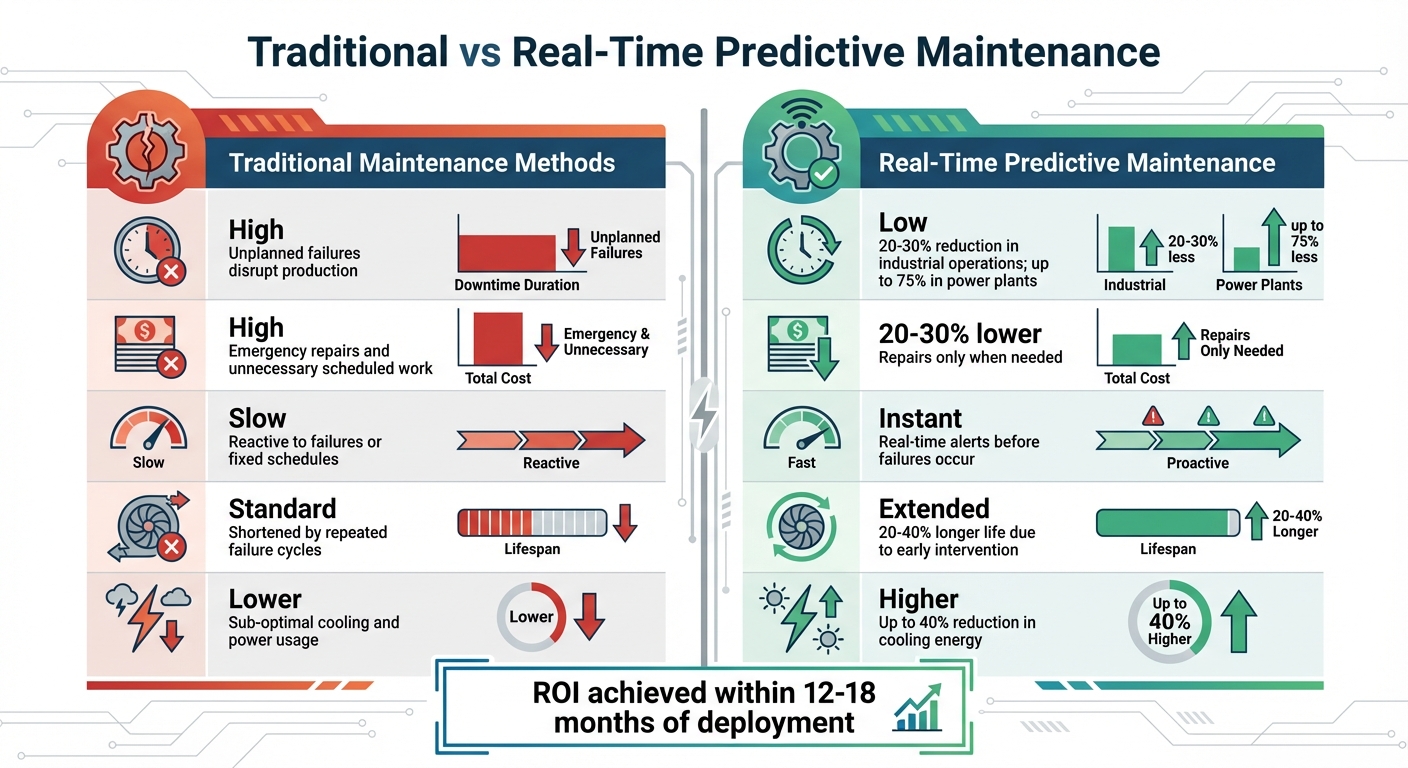
Traditional vs Real-Time Predictive Maintenance in Energy Projects
Lower Downtime and Operating Costs
Real-time data has a direct impact on reducing downtime and cutting operating expenses. This works hand-in-hand with workforce analytics, which optimize staffing and improve project outcomes. For example, companies using predictive maintenance have seen unplanned downtime drop by as much as 75% in power plant operations, while overall maintenance costs have decreased by 20–30%.
Take the case of a renewable energy provider managing a vast wind turbine fleet. In 2025, they partnered with Timspark to implement an IoT and machine learning–powered monitoring system. This setup tracked critical metrics like wind speed, rotation, and vibration across their turbines. The results? A 6% boost in energy production efficiency, an 18% cut in maintenance and repair costs, and the prevention of 26 major failures. Most companies adopting similar systems experience a return on investment (ROI) within 12 to 18 months of deployment.
"Maintenance costs for an organization can be reduced 20% to 30%, basically shaving off the big maintenance costs due to failure, and stretching the preventative maintenance windows to lower the average." – Jake Tuttle, CEO, Taber International
Better Project Performance
Real-time data doesn’t just prevent equipment failures – it also extends the lifespan of critical assets. Continuous monitoring can increase asset longevity by 20–40%, which helps reduce the need for costly replacements. Predictive models, with an accuracy rate of 85–90%, enable operators to plan targeted repairs during scheduled maintenance, avoiding the chaos of emergency shutdowns.
Google’s data centers are a prime example of this approach at scale. By using machine learning for real-time cooling management, they reduced energy consumption for cooling systems by 40%. Similarly, Microsoft’s Wyoming data center achieved a 35% cost reduction within 18 months after transitioning to 100% renewable energy and implementing real-time efficiency tracking. These advancements in energy management and resource allocation directly enhance project timelines and budget adherence.
Here’s how real-time predictive measures stack up against traditional methods:
Comparison: Traditional Methods vs. Real-Time Data
| Metric | Traditional (Reactive/Preventive) | Real-Time (Predictive) |
|---|---|---|
| Downtime Impact | High: Unplanned failures disrupt production | Low: 20–30% downtime reduction in industrial operations; up to 75% in power plants |
| Maintenance Costs | High: Emergency repairs and unnecessary scheduled work | 20–30% lower: Repairs only when needed |
| Response Speed | Slow: Reactive to failures or fixed schedules | Instant: Real-time alerts before failures occur |
| Asset Lifespan | Standard: Shortened by repeated failure cycles | Extended: 20–40% longer life due to early intervention |
| Energy Efficiency | Lower: Sub-optimal cooling and power usage | Higher: Up to 40% reduction in cooling energy |
Switching from traditional approaches to real-time systems is more than just an upgrade – it’s a game-changer. These systems allow energy operators to manage risks more effectively, allocate resources with precision, and maintain uptime. When combined with workforce deployment tools like those offered by ABLEMKR, which ensure skilled personnel are mobilized exactly when and where they’re needed, the result is a powerful strategy to minimize delays and maximize efficiency.
Expanding Real-Time Solutions Across Energy Projects
Real-time data is transforming how energy projects operate, adapting to everything from solar farms in Arizona to offshore oil rigs in the Gulf. By leveraging sensors, on-site edge computing, and instant alerts, energy systems can respond immediately to changing conditions. For remote sites like wind farms or rural drilling locations, edge AI processes data directly on devices. This eliminates the need for constant cloud connectivity, enabling quick decisions even in areas with limited bandwidth.
But it’s not just about monitoring equipment. Energy managers often face challenges in maintaining complex systems due to limited time and personnel. This is where deployment platforms step in, combining real-time asset data with labor management tools. These platforms enable condition-based interventions, ensuring technicians are sent out only when sensor data flags an actual issue. This approach allows for faster, smarter workforce deployment, driven entirely by data.
Deploying Workers with Real-Time Matching
A platform like ABLEMKR bridges the gap between operational needs and skilled labor in the U.S. energy sector. Using mobile-first technology, it matches workers to job sites based on factors like certifications, safety training, availability, and location. This ensures that operators can respond quickly, whether it’s for an emergency shutdown, a pipeline repair in a remote area, or routine maintenance at a solar facility.
For example, if a sensor detects abnormal vibration in a wind turbine or a transformer overheating, the system sends an immediate alert via SMS or a mobile app. Simultaneously, ABLEMKR identifies qualified technicians nearby who are ready to respond. Employers can see real-time updates on worker status, streamline payroll through integrated workflows, and track compliance automatically. This eliminates the need for manual processes and drastically reduces the time between identifying a problem and having a technician on-site.
This real-time matching not only speeds up repairs but also boosts maintenance efficiency. By cutting down on unnecessary inspections, it frees up labor for more critical tasks. It also helps prevent what Jake Tuttle, CEO of Taber International, refers to as "invisible victories" – like avoiding a turbine failure during peak demand by deploying the right technician before a breakdown occurs. For energy projects in remote or high-risk areas, combining real-time asset monitoring with instant workforce deployment delivers measurable operational gains.
What’s Next for Real-Time Data in Energy
The future of real-time data in energy is expanding even further. Tools like digital twins are being used to simulate maintenance scenarios and optimize workforce schedules before technicians even reach the site. Meanwhile, Augmented Reality (AR) is giving on-site workers access to critical schematics and data through wearable devices, allowing remote experts to guide them through repairs in real time. These advancements reduce the need for large on-site teams, enabling a smaller group of highly skilled experts to manage multiple projects efficiently.
Real-time data is also becoming a cornerstone of ESG compliance and decarbonization efforts. With over 40 countries requiring greenhouse gas emissions reporting and ESG regulations growing by 155% over the last decade, energy operators are under increasing pressure to adapt. Real-time monitoring helps optimize energy use, cut waste, and meet these stricter sustainability mandates. This shift turns compliance into an operational advantage rather than just a reporting requirement. As the energy sector moves toward renewables, modernized grids, and decommissioned legacy systems, platforms that integrate workforce deployment with real-time asset data will become critical for managing this growing complexity.
Conclusion
Real-time data is changing the way energy projects function, turning downtime from an inevitable expense into something manageable. By transitioning from reactive repairs to predictive, condition-based maintenance, operators can cut unplanned downtime by up to 75% and lower maintenance expenses by 20% to 30%. For power plants, where an hour of unplanned turbine downtime can mean a loss of hundreds of thousands of dollars, this shift is more than operational – it’s a critical competitive edge.
The foundation of this transformation is centralized visibility. When sensor data, workforce availability, and equipment health are integrated into a single platform, teams can act instantly instead of reacting after delays. Maintenance happens only when real-time data highlights an actual issue, extending asset life, reducing unnecessary work, and ensuring technicians are deployed exactly where they’re needed. This centralized approach also streamlines workforce mobilization.
Platforms like ABLEMKR take this a step further by combining real-time asset monitoring with on-demand workforce deployment. By matching pre-vetted workers based on certifications, safety training, availability, and location, ABLEMKR enables operators to mobilize teams quickly – whether for emergency shutdowns, remote pipeline repairs, or scheduled mine work. Employers also gain real-time insights into worker status, integrated payroll, and compliance tracking, eliminating delays in labor deployment. This seamless integration strengthens the strategy of minimizing downtime while improving operational efficiency.
Looking ahead, the energy industry’s future depends on even greater technological integration. With ESG regulations growing by 155% over the last decade and rising energy demands, real-time data will play an increasingly important role. Operators who combine tools like digital twins, edge AI, and AR with real-time workforce platforms will be better equipped to navigate these challenges. For energy projects tackling this complexity, merging real-time asset monitoring with instant workforce deployment is no longer optional – it’s the foundation of modern industrial operations.
FAQs
What sensors matter most for predicting energy asset failures?
The key sensors for spotting potential energy asset failures focus on vibration, temperature, and electrical signatures. These tools help catch issues early, making it easier to address them before they turn into major problems, ensuring smoother operations through predictive maintenance.
How do you roll out real-time monitoring at remote sites with limited connectivity?
To set up real-time monitoring in remote areas with limited connectivity, consider using rugged IoT sensors paired with edge computing solutions. These devices handle data collection and processing right at the source, cutting down the need for high-bandwidth networks. By focusing on sending only essential alerts and insights, you can ensure quick and effective responses. Adding predictive maintenance systems can further refine the process, prioritizing key data and helping to maintain smooth operations, even in locations with challenging connectivity.
How does ABLEMKR speed up getting qualified technicians on-site during an alert?
ABLEMKR speeds up technician deployment during alerts by providing real-time updates on worker status. It connects pre-screened workers to job sites by considering factors like certifications, safety training, availability, and proximity. This ensures crews are assembled quickly, whether for emergencies or planned projects, reducing delays and keeping operations on track.


