
AI is revolutionizing construction by optimizing resource allocation. It helps manage labor, equipment, materials, and finances more efficiently, reducing delays, cutting costs, and improving project outcomes. Here’s how AI makes a difference:
- Labor Optimization: Matches workers to tasks based on skills and real-time data, boosting productivity by up to 20%.
- Predictive Maintenance: Reduces equipment downtime by 50% and extends machine lifespan by 40%.
- Material Management: Forecasts demand and ensures just-in-time delivery, cutting material waste by up to 20%.
- Safety Enhancements: Lowers workplace accidents by 25% through risk analysis.
- Cost Control: AI systems improve budgeting accuracy, saving 10–20% on project costs.
The Rise of AI in Construction: Transforming the Industry
Main Uses of AI in Construction Resource Allocation
AI is transforming how construction projects manage resources like labor, equipment, and materials. By addressing delays and cost overruns, it helps improve scheduling and budget control, making projects more efficient and predictable.
AI for Labor Allocation
Managing a construction workforce has always been a balancing act, but AI is making it much easier. By analyzing worker skills and project needs, AI matches the right people to the right tasks. It also adjusts staffing levels based on real-time data. For example, AI platforms automate repetitive tasks, freeing up skilled workers to focus on specialized jobs, which can boost productivity by as much as 20%.
Real-time monitoring is another game-changer. AI tools allow managers to track project demands and assign tasks automatically based on worker availability and skills. They can even factor in external conditions like weather to keep things on schedule. A great example is Spot the Dog, a robotic system that monitors job progress and worker locations to improve on-site labor allocation. AI also plays a critical role in off-site construction, where robots assemble building components, speeding up processes and reducing errors.
But AI’s contributions don’t stop with labor – it’s also reshaping how construction teams manage their equipment.
Predictive Maintenance for Equipment
AI is revolutionizing equipment management through predictive maintenance. By analyzing sensor data, performance metrics, and historical records, AI can spot potential problems before they escalate. This proactive approach allows teams to schedule maintenance at the best times, reducing disruptions and keeping projects on track.
"Predictive maintenance reduces breakdowns by 70% and increases productivity by 25%." – Deloitte
Gone are the days of static maintenance schedules. AI systems now use condition-based monitoring to continuously assess machinery health and flag issues early. They also predict when parts will need replacing, helping teams avoid last-minute scrambles. For instance, a construction firm using HVI‘s AI Agent cut downtime by 50% in just one year, saving thousands on emergency repairs. Similarly, Hitachi Construction Machinery Europe employs AI-driven predictive maintenance, using machine learning and telematics to analyze data and prevent failures before they occur.
These tools extend the life of equipment, lower maintenance costs, and reduce unexpected delays. The same kind of data-driven efficiency applies to managing materials.
AI Material Delivery Optimization
AI is making material delivery smarter and more efficient. By tracking inventory in real time and forecasting demand, it ensures supplies are ordered based on actual needs instead of outdated estimates. This leads to just-in-time delivery, which cuts down on on-site storage costs and prevents shortages.
AI also integrates with ERP systems to adjust material deliveries as project needs change. It analyzes factors like delivery costs and lead times to choose the most cost-effective suppliers. Additionally, AI tools process historical sales data and market trends to predict shortages, helping managers secure materials before they run out. Platforms like Datagrid connect with systems such as Procore, PlanGrid, and Autodesk BIM 360 to automate material tracking, submittals, and change orders, eliminating manual work and reducing communication gaps.
The global AI in construction market is expected to hit $8.6 billion by 2031, growing at an annual rate of 34.1%. This rapid growth highlights the increasing reliance on AI-driven logistics, which offer features like real-time GPS tracking, predictive delay alerts, and automated updates for project managers.
How to Implement AI Resource Allocation
Getting AI up and running in construction takes careful planning and a step-by-step approach to ensure success.
Assess Project Needs and Data Readiness
Start by analyzing your current processes. Pinpoint recurring tasks or bottlenecks – whether in scheduling, equipment use, or material management. Set clear, measurable goals. For instance, aim to reduce labor costs by 15% or cut equipment downtime in half. Then, take a close look at your data. Is it complete, structured, accurate, and easy to access? Without reliable data, AI can’t deliver meaningful results.
"AI is a force multiplier, but if your operational foundation is broken, AI is just going to make things worse." – Russ Kliman, Board Member at Cecilian Partners
Your data infrastructure is just as critical as your goals. For example, if you’re looking to optimize labor allocation, you’ll need up-to-date records on worker skills, project timelines, and task requirements.
"Before a builder even thinks about AI, they need to get their data structured, accurate, and integrated." – Jessica Kerrigan, VP of Strategic Marketing at Cecilian Partners
It’s also essential to establish data privacy and security policies, especially when handling sensitive information like worker details or project budgets.
To minimize risks, begin with high-impact areas where AI can demonstrate its value without causing major disruptions if issues arise.
Choose and Configure AI Tools
Selecting the right AI platform means finding one that aligns with your specific priorities. For example, if controlling costs is your main goal, look for tools that specialize in budget tracking and expense forecasting.
Scalability and integration are key factors. Choose a platform that can grow with your projects and works seamlessly with your existing systems, such as project management or accounting software. Tools with real-time insights and easy-to-use interfaces make it simpler for field managers to act on AI recommendations.
Start small – implement AI on one project first. This lets you test and refine configurations based on real-world results before scaling up.
Keep your workflow needs and team skills in mind. Generic AI solutions may overlook construction-specific details, while specialized platforms are built to handle industry-specific contracts, regulations, and processes.
Don’t overlook data security and compliance. Construction projects often involve sensitive information, so ensure your chosen platform includes strong encryption, access controls, and meets data protection standards.
Once the tools are in place, focus on team training and maintaining data quality.
Train Teams and Maintain Data Quality
Equip your teams with practical training on how AI works in their daily tasks. Show them how to use AI-generated recommendations for scheduling or interpreting reports and forecasts. Tailor training sessions to match each team member’s role to make the learning process more relevant.
Data quality management is an ongoing effort. Set clear standards for data entry, perform regular audits, and use validation rules to catch errors before they affect AI outputs. With companies losing up to 20-30% of their revenue due to data inefficiencies, maintaining high-quality data is a worthwhile investment.
Encourage a culture of data stewardship by helping everyone understand the importance of accurate information. For example, incomplete timesheets or incorrect equipment logs can disrupt project schedules, so it’s crucial to emphasize diligence in data entry.
Address concerns early by explaining that AI is there to support – not replace – human roles.
Finally, establish clear data ownership protocols. When everyone knows who is responsible for specific data sets, it ensures accountability and smooth sharing of information across systems.
As your AI integration progresses, continue refining your processes to improve outcomes.
sbb-itb-aa28329
Measuring AI Impact on Resource Allocation
Once you’ve implemented AI tools, it’s essential to measure both their technical performance and the business outcomes they drive. This helps justify the investment and identify areas for improvement. Below, we’ll break down how to evaluate these benefits using clear and actionable metrics.
Key Metrics for Evaluating AI Performance
Tracking AI’s performance requires a mix of business, technical, and financial metrics. Unlike traditional KPIs, which mainly focus on past performance, AI metrics offer forward-looking insights, helping you anticipate challenges and validate operational efficiencies.
- Budget performance metrics: These are crucial for evaluating AI’s role in managing project finances. Keep an eye on cost variance, budget adherence ratios, resource allocation efficiency, and spend forecasting accuracy. These metrics reveal whether AI is delivering on its promise to cut costs and enhance financial control.
- Timeline metrics: To understand how AI impacts scheduling, monitor project phase durations, compare planned versus actual completion times, and track timeline variance. These measurements highlight how AI improves scheduling accuracy.
- Productivity and efficiency metrics: AI’s influence on operations can be seen in labor productivity rates, equipment utilization, material usage efficiency, and overall equipment effectiveness. For example, companies using AI in resource management have reported productivity boosts of up to 30% in sectors like construction and utilities.
- Quality and safety metrics: AI’s broader benefits include better quality control and safer workplaces. Track defect rates, safety incident frequency, inspection pass rates, and compliance with industry standards. Firms using AI for safety management have seen a 25% reduction in workplace accidents.
It’s important to regularly review and adjust these KPIs to align with current project realities and evolving business needs.
Standard vs AI-Driven Allocation Comparison
The advantages of AI-driven resource allocation become evident when compared to traditional methods. Here’s how key performance areas stack up:
| Metric | Traditional Methods | AI-Driven Allocation | Improvement |
|---|---|---|---|
| Cost Management | Manual estimation with 10–15% variance | Real-time cost optimization | 10–20% cost savings |
| Equipment Downtime | Reactive maintenance approach | Predictive maintenance | 40–50% reduction in downtime |
| Labor Efficiency | Static scheduling and allocation | Dynamic workforce optimization | 15–25% efficiency improvement |
| Material Waste | Experience-based ordering | AI-powered demand forecasting | Up to 20% material cost reduction |
| Project Delays | Manual schedule adjustments | Automated timeline optimization | 20% reduction in delays |
Traditional approaches often rely on guesswork and outdated processes, while AI brings a more dynamic and predictive approach. AI systems continuously learn and adapt, making budgeting and resource management more accurate and reliable over time.
Real Examples of AI Benefits
Metrics are one thing, but real-world examples highlight the tangible benefits of AI in action. Here are a few success stories:
- AF Gruppen: For a $560 million high-rise project in Oslo, AI was used to optimize scheduling workflows. The system analyzed materials and workforce combinations, producing seven schedules that outperformed the original plan, cutting project costs by 15%.
- Build Group: This company applied AI to generate alternative schedules for a $5 million project. By choosing the most profitable path, they saved millions of dollars and shaved weeks off the construction timeline.
- Juneau Construction: Using drones and AI, they analyzed data for concrete pours on a 31-floor high-rise. This reduced processing time from 10 man-hours to just 2–4 hours, saving $40,000 in labor costs.
- Ananda Development: For a high-rise project in Bangkok, Thailand, they used an AI scheduler from ALICE Technologies. The AI ran multiple scheduling scenarios, cutting the total project timeline by 208 days.
These examples reflect broader industry trends. Deloitte estimates that AI and advanced analytics can reduce project costs by 10–15%, cut budget and timeline deviations by 10–20%, and lower engineering hours by 10–30%.
"We are at an interesting crossroads in the industry where a lot of wasteful processes could be automated using these technologies. In the next five years, AI and machine learning are going to be mainstreamed into the products that we are currently using. In turn, we are going to see both productivity and project outcomes improve." – Atul Khanzode, Chief Technology Officer, DPR
The construction sector is embracing AI at a rapid pace. The global AI in construction market is projected to grow from $3.93 billion in 2024 to $22.68 billion by 2032, with an annual growth rate of 24.6%.
Improving Resource Allocation with Workforce Platforms
AI can fine-tune schedules, but platforms like ABLEMKR take it a step further by connecting you with the right workers quickly and efficiently. These modern workforce platforms combine AI’s planning capabilities with on-the-ground labor deployment, bridging the gap between strategy and execution. This collaboration allows platforms like ABLEMKR to bring AI-driven insights to life.
How ABLEMKR Supports Workforce Management
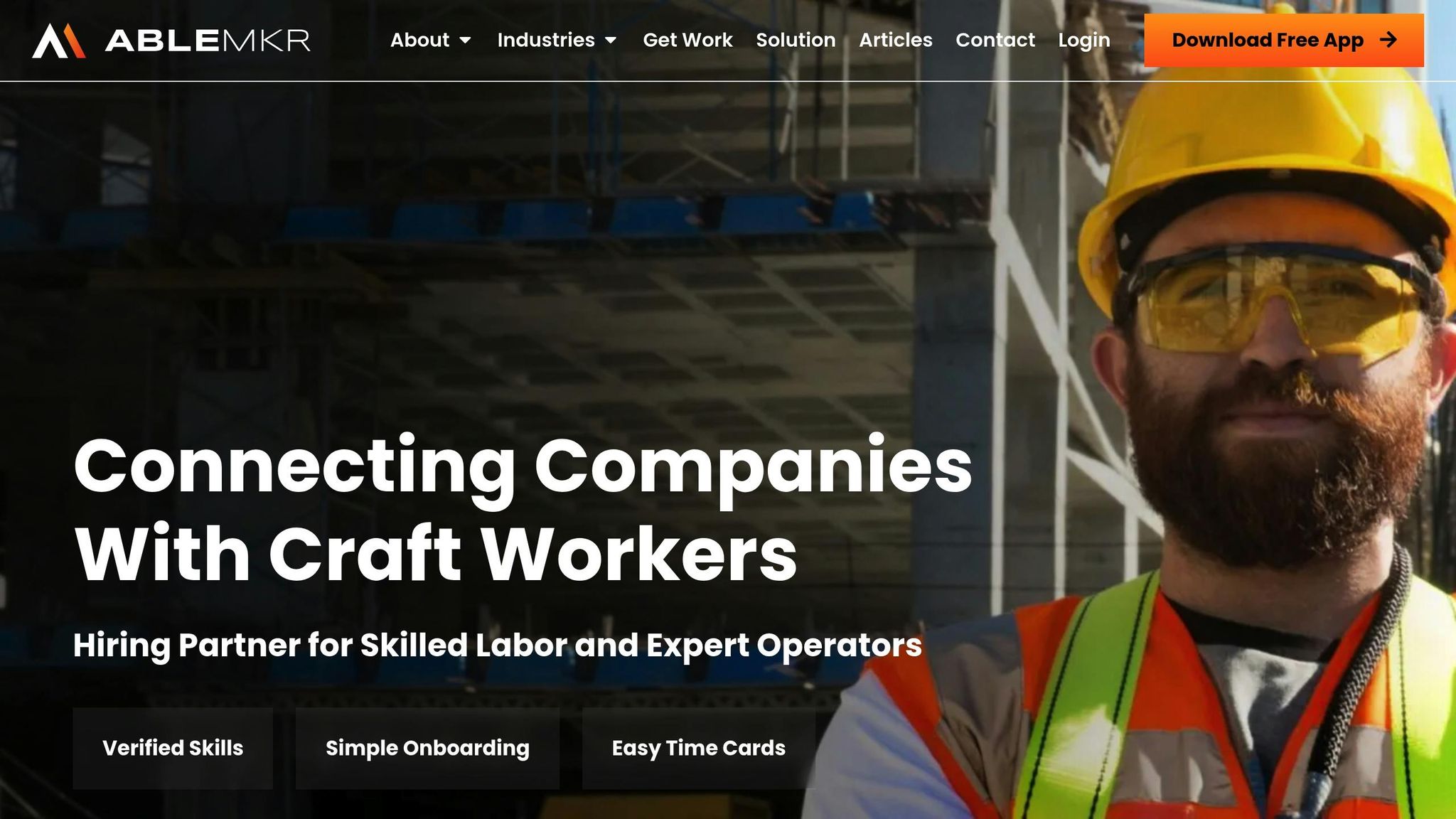
ABLEMKR specializes in linking companies with skilled and unskilled labor across industries like construction, oil & gas, and mining. It simplifies the logistics of workforce management, ensuring that when your AI system identifies the need for, say, three certified welders on a specific day, you’re not left scrambling to fill the gap. With thousands of verified workers already enrolled and new ones joining daily, ABLEMKR ensures a steady supply of talent to meet AI-driven workforce demands.
The platform doesn’t just stop at connecting you with workers. ABLEMKR takes care of the heavy lifting, handling onboarding, insurance, payroll, and benefits. This allows businesses to focus on executing their AI-optimized plans without getting bogged down by administrative tasks.
To meet the varying needs of projects, ABLEMKR offers flexible hiring options. These include flex workers, flex-to-hire arrangements, fractional hiring, and direct placements. This adaptability helps businesses adjust quickly to changing project phases or unexpected labor demands.
Integrating ABLEMKR with AI Tools
When paired with AI, ABLEMKR transforms workforce planning into immediate action. AI can analyze historical data to predict the most efficient workforce configurations, while ABLEMKR ensures you can deploy the right people at the right time.
"AI doesn’t replace people – it helps construction managers make better, faster decisions about who to hire and when." – Christopher Birli
AI-powered platforms can scan resumes and profiles to match candidates with specific projects, speeding up recruitment. When combined with ABLEMKR’s database of verified workers, this process becomes even more accurate.
For instance, a mid-size construction company used AI-WorkForceSync to manage a multi-site housing project, cutting scheduling conflicts by 35% and completing the project two weeks ahead of schedule. Similarly, a commercial construction firm leveraged predictive analytics to address resource shortages early, reducing material delays by 50%.
ABLEMKR also helps address workforce gaps flagged by AI systems. If predictive models identify potential shortages or mismatches in skills, ABLEMKR can quickly source replacements. Its instant communication tools make it easier for managers to find and deploy workers on short notice.
AI can also monitor employee satisfaction, helping companies tackle potential turnover issues before they escalate. When paired with ABLEMKR’s feedback tools, this creates a proactive approach to workforce retention, ensuring that AI-optimized schedules stay on track. This combination of AI and workforce management tools paves the way for mobile solutions that enhance real-time data sharing and cost visibility.
Mobile Access and Cost Transparency Benefits
ABLEMKR’s mobile app brings AI-driven workforce decisions directly to the field. Workers can log their hours in real time, giving managers up-to-date insights. This real-time data is essential for AI systems to adjust resource allocation accurately and respond quickly to workforce needs.
When an AI system identifies a need for additional workers or a new skill mix, managers can post requirements and connect with available talent through the app. With over 500 downloads, the app has become a go-to tool for streamlining workforce management.
Cost transparency is another key advantage. ABLEMKR provides real-time market guidance on labor costs, allowing customers to set rates. This clarity supports AI systems focused on cost efficiency by delivering accurate, up-to-date labor pricing.
"We pride ourselves on full transparency with no surprises when you work with us." – ABLEMKR
This transparent pricing helps AI tools create more precise financial forecasts, improving budget management and overall project control. Real-time workforce data also feeds back into AI models, sharpening predictions about labor costs, availability, and productivity. In one case, an AI-powered scheduling system reduced project timelines by 15% by analyzing historical data and cutting down idle time.
The Future of AI in Construction Resource Management
AI is reshaping how construction projects are planned, managed, and executed. From streamlining resource allocation to improving workforce management, the industry is undergoing a significant transformation. And as technology continues to advance, the changes on the horizon promise to be even more impactful.
Key Takeaways
AI is already delivering tangible benefits that are redefining project economics. By automating repetitive tasks like drawing reviews, change detection, and resource management, it allows managers to focus on strategic decisions. In fact, experts predict that up to 30% of construction tasks could be automated by 2025.
The financial implications are massive. AI is projected to contribute a staggering $19.9 trillion to the global economy by 2030, illustrating its potential to drive growth far beyond individual projects.
Workforce management is another area seeing significant improvements. Platforms like ABLEMKR, when paired with AI, use real-time data from mobile apps to predict labor needs and costs more accurately. This ensures the right workers with the right skills are available precisely when needed, reducing inefficiencies.
Safety is also getting a boost. AI systems can identify risks early, track compliance, and monitor site conditions continuously. Considering that human error accounts for over 20% of project delay costs, these predictive capabilities are becoming indispensable for keeping projects on time and within budget.
What’s Next for AI and Workforce Platforms
The next big leap in AI for construction lies in creating seamless integrations between technologies. The market for AI in construction is set to grow from $3.99 billion in 2024 to $11.85 billion by 2029, with a compound annual growth rate of 24.31%. This growth reflects not only the technology’s value but also its increasing adoption across the industry.
"Over the next five to 10 years, AI and construction is going to be all about augmenting people, making people more efficient, making them smarter, and making their lives better."
– Pat Keaney, Director of Product Management, Intelligence at Autodesk Construction R&D
Looking ahead, 66% of industry leaders expect AI to become a core part of their operations, with 76% planning to increase AI investments by 2025. Instead of relying solely on in-house development, companies are turning to third-party solutions that integrate seamlessly with existing systems and data.
Future AI tools will also become more spatially aware, working alongside extended reality (XR) technologies to improve collaboration and optimize material procurement. These advancements aim to enhance cash flow management and overall efficiency.
Platforms like ABLEMKR are evolving alongside these changes, leveraging AI’s predictive capabilities to refine workforce deployment. By combining AI’s analytical strength with ABLEMKR’s execution tools, companies gain a competitive edge that traditional methods simply can’t match.
"AI won’t take a worker’s job, but the person who uses AI will. The same, he said, is true of companies, in that a builder that uses AI will disrupt the business of a builder that doesn’t."
– Jim Barrett, Chief Innovation Officer for Turner Construction
The pace of change in the construction industry is accelerating. Companies that embrace AI-powered resource management and workforce platforms are positioning themselves to lead, while those that hesitate risk falling behind. The choice is clear – adapt or get left in the dust.
FAQs
How does AI enhance budgeting and cost management in construction projects?
AI is transforming budgeting and cost management in construction by using historical and real-time data to create precise cost estimates. This minimizes the risk of budget overruns and gives project managers the tools to plan with more certainty.
Through machine learning models, AI uncovers patterns and improves cost predictions over time. It can also detect potential financial risks early, enabling teams to adjust budgets before issues escalate. These tools help optimize resource allocation, boost profitability, and reduce expensive mistakes in construction projects.
What are the steps to effectively use AI for resource allocation in construction projects?
To make the most of AI for resource allocation in construction, begin by creating reliable and well-organized data repositories. This ensures that the inputs driving AI decisions are accurate and trustworthy. Then, connect AI tools to your current project management systems to enable efficient workflows and real-time updates that enhance decision-making.
Start small by applying AI to low-risk tasks, allowing your team to build confidence and gather valuable insights before expanding its use to more complex processes.
Focusing on data precision and encouraging teamwork between AI systems and your staff will make the transition smoother while helping you get the most out of AI’s potential to streamline resource management.
How does AI-driven predictive maintenance improve the lifespan and efficiency of construction equipment?
AI-powered predictive maintenance is a game-changer for keeping construction equipment running smoothly and efficiently. By leveraging advanced sensors and machine learning algorithms, it monitors equipment performance in real time, flagging potential problems before they turn into major breakdowns. This means repairs can be handled promptly, avoiding expensive disruptions and downtime.
Taking care of issues early doesn’t just cut repair costs – it also ensures machinery operates at its best. Over time, this approach reduces wear and tear, makes better use of resources, and helps construction projects stay productive and cost-efficient.


