
Battery storage systems are essential for energy infrastructure but pose serious risks like fires, chemical exposure, and high-voltage hazards. To ensure safety and compliance, workers need specialized training programs. Here’s a quick overview of key training options:
- OSHA Lithium Battery Safety Online Course: Focuses on federal safety standards, PPE use, and emergency response. Cost: $150–$300.
- Hazmat University Training: Covers lithium battery transportation by air and ground. Certification valid for 3 years. Cost: $400–$800.
- NFPA Battery Energy Storage Systems Training: Addresses fire risks specific to energy storage systems. Cost: $600–$1,200.
- On-Site Apprenticeship Programs: Combines classroom learning with hands-on training at facilities. Employer-funded.
- ABLEMKR Platform: Tracks worker certifications and ensures compliance via a cloud-based system. Subscription-based pricing.
Each program caters to different needs, from online courses to practical, on-site training. Proper certification not only ensures safety but also protects businesses from fines, operational disruptions, and legal issues.
Battery Energy Storage Systems Fire Safety Symposium
1. OSHA Lithium Battery Safety Online Course

OSHA offers an online course designed to teach the essentials of federal safety standards and highlight the primary risks associated with lithium-ion battery systems. Participants will learn to identify dangers like thermal runaway, electrical shock, and chemical exposure. The course is built around federal regulations and focuses on practical safety measures critical for working with battery storage systems. It’s a solid starting point for anyone involved in this field.
Key Topics Covered
The course dives into several crucial areas, including:
- Proper use of personal protective equipment (PPE)
- Emergency response protocols for battery-related incidents
- Identifying hazards like damaged batteries or overheating
- Safe handling practices for lithium-ion batteries
Additionally, it covers OSHA’s electrical safety standards, with a focus on lockout/tagout procedures and working safely around high-voltage equipment.
Delivery Format
This online course features interactive modules, video demonstrations, and quizzes to reinforce learning. It also includes downloadable materials and is mobile-friendly, making it accessible anytime, anywhere.
Certification
Upon completing the course, participants earn a certificate, which can serve as proof of training. Be sure to check local requirements to see if additional or refresher training is necessary.
2. Hazmat University‘s Lithium Batteries Training (Initial and Recurrent)
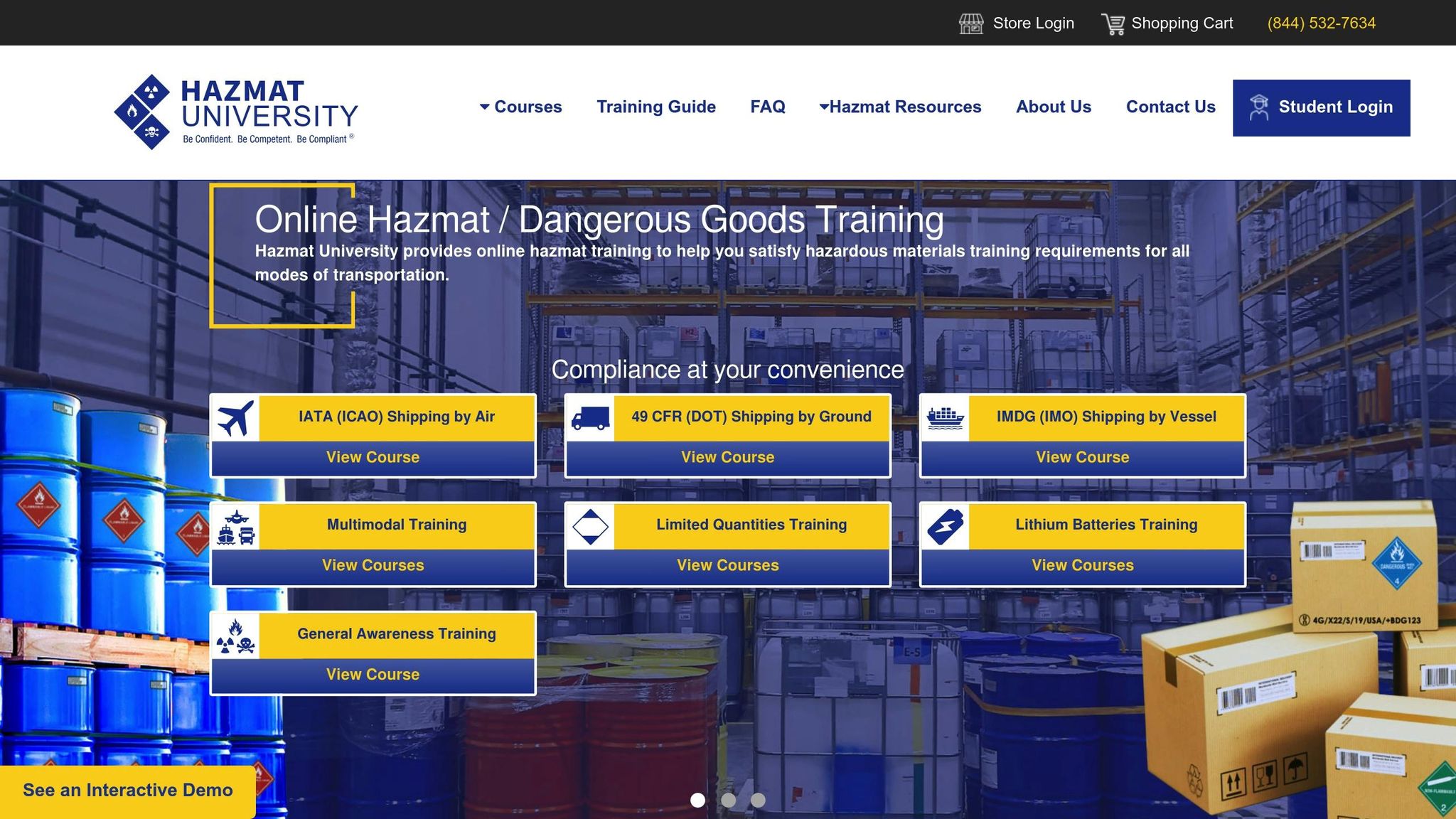
After completing OSHA’s foundational training, Hazmat University offers specialized courses tailored to the specific hazards of transporting lithium batteries. These online programs cater to battery storage workers, providing both initial certification and recurrent training to help them stay compliant with federal regulations throughout their careers. This training complements OSHA’s guidelines by addressing the unique challenges of hazardous material transportation.
Hazmat University offers two courses: Lithium Batteries Training by Air, for those handling air transport, and Lithium Batteries Training by Ground, designed for ground transportation workers. Both courses meet the training standards outlined in 49 CFR Part 172, Subpart H, Section 172.704, making them ideal for workers needing hazmat certification.
Delivery Format
The training is delivered entirely online, eliminating the need for in-person attendance. This flexible format is perfect for professionals in the battery storage industry who need to fit training into their busy schedules.
Key Topics Covered
The courses cover essential aspects of lithium battery handling and transportation, including:
- Proper classification and identification of various lithium battery types
- Packaging requirements and documentation procedures
- Emergency response protocols for incidents like thermal runaway and chemical exposure
Participants are also trained on regulatory compliance, learning to navigate the detailed requirements of hazmat transportation. Topics include shipping papers, marking and labeling guidelines, and the specific rules for transporting lithium batteries by air or ground.
Cost
Each course is priced at $209.00, which includes all course materials and certification upon successful completion.
Certification Validity Period
Certification is valid for three years, after which workers must recertify. The courses take approximately 4–5 hours to complete and are designed to meet both initial and recurrent training needs, ensuring workers remain compliant and confident in their roles within battery storage operations.
3. National Fire Protection Association (NFPA) Battery Energy Storage Systems Training
Building on essential safety principles, the National Fire Protection Association (NFPA) offers training specifically tailored to address fire hazards in battery energy storage systems. This training is particularly relevant for workers in battery storage facilities and solar installations, where fire risks are a significant concern.
Unlike general hazardous materials courses, NFPA’s program zeroes in on the unique fire and safety challenges tied to energy storage systems. Topics include thermal runaway events, risks from residual energy, the release of toxic and flammable gases, and deep-seated fires that can smolder for hours or even days after being detected.
Key Topics Covered
The training dives into various battery failure modes that workers might encounter, such as:
- Mechanical failures: Damage caused by mishandling or structural issues.
- Thermal failures: Overheating that can trigger chain reactions and cascading failures.
- Electrical failures: Hazards like overcharging, short circuits, or voltage irregularities.
Emergency protocols are a major focus, including guidance on safely using water to cool energy storage system (ESS) fires, even when electrical sources are involved. This approach is supported by research from UL, though workers are also cautioned about the conductivity risks posed by pooling water. The program emphasizes strict compliance with NFPA codes, including NFPA 855, 1, 70, 110, and 111, to ensure safety and regulatory adherence.
Delivery Format
NFPA’s training is available online, making it accessible to workers regardless of their location or shift schedules. One example is the "Energy Storage and Solar Safety for Emergency Responders Online Training", which provides participants with immediate access to essential safety knowledge.
Cost
The cost of training depends on the course and provider. For example, Solar Energy International (SEI) offers a 2-hour online course titled "CE538: 2020 NFPA 855 and Fire Codes for Energy Storage Systems" for $250. SEI also provides limited partial scholarships for international and low-income participants, as well as work/trade programs for those enrolled in workshops lasting eight weeks or more.
This training is designed with practical applications in mind, teaching workers how to identify and address reignition risks that may arise hours or even days after an initial fire is extinguished. This knowledge is especially critical for battery storage facilities, where thermal events can have delayed effects, requiring ongoing vigilance and specialized response strategies. By focusing on these real-world challenges, NFPA’s training supports a comprehensive approach to safety in energy storage operations.
sbb-itb-aa28329
4. On-site Hazardous Material Worker Apprenticeship Programs
Online courses may lay the groundwork, but on-site apprenticeships provide the hands-on experience workers need to tackle the specific challenges of battery storage facilities. These programs combine classroom learning with real-world training, offering workers the chance to develop skills directly within the environment they’ll be working. Unlike shorter certification courses, apprenticeships often span a longer period, giving participants the opportunity to build expertise gradually while earning a paycheck.
Utility companies and energy storage operators frequently create custom apprenticeship programs to address the unique demands of their facilities.
Delivery Format
On-site apprenticeship programs take a blended approach. Workers start with classroom sessions to learn the theory, then transition to supervised, practical training at the job site. This structure ensures workers can apply hazardous material protocols in real-world scenarios – covering everything from proper PPE usage to effective emergency responses.
The hands-on portion of the program is especially valuable. Workers familiarize themselves with the physical layout of battery storage facilities, including the locations of safety equipment, ventilation systems, and emergency shutdown mechanisms. They also learn to navigate site-specific risks like confined spaces and electrical hazards. This immersive approach bridges the gap between theory and practice, preparing workers to handle the dynamic and often unpredictable challenges of battery storage operations.
Key Topics Covered
The curriculum in these programs focuses on practical, facility-specific applications. Emergency response training is a major component, covering evacuation routes, communication systems, and coordination with local emergency services. Workers also learn to recognize early warning signs of potential battery malfunctions and understand how thermal events progress.
Advanced PPE training is another critical area. Workers are trained in the maintenance, inspection, and replacement of specialized gear, such as respiratory protection for gas leaks and high-voltage safety equipment. Compliance training ensures workers understand both federal OSHA standards and state-specific regulations, including proper documentation, incident reporting, and guidelines for hazardous waste disposal and spill management.
Cost
Most apprenticeship programs are funded by employers, which means participants can earn wages while they train. In some cases, these programs also benefit from shared resources within the industry, reducing costs for both workers and employers.
Certification Validity Period
Graduates receive credentials recognized across the industry. While these certifications are permanent, periodic refresher courses are required to keep workers up to date with the latest safety practices, regulatory changes, and new industry developments. This ongoing education ensures workers are always prepared for evolving workplace challenges.
5. ABLEMKR Workforce Deployment and Compliance Platform

ABLEMKR takes a different approach to workforce deployment and compliance in battery storage operations. Unlike traditional training programs, this mobile-first platform connects pre-vetted workers – those with up-to-date hazardous material certifications – to energy projects across the country. The result? Only properly trained personnel are deployed, minimizing risks and ensuring safety.
What sets ABLEMKR apart is its real-time compliance tracking. Instead of relying on manual checks for worker credentials, the platform automatically tracks certification expiration dates and sends alerts when refresher training is needed. For battery storage operators, this reduces the risk of deploying workers with expired certifications – a crucial factor in maintaining safety and adhering to regulations in hazardous environments.
Take, for example, a Texas utility company that recently used ABLEMKR to staff a new grid-scale battery storage facility. The platform matched workers with current lithium battery safety and emergency response training to the project. By tracking compliance status in real time and ensuring all onboarding documentation was completed before site access, the company met regulatory standards without costly delays.
Delivery Format
ABLEMKR is a cloud-based, mobile-first platform that’s accessible from virtually anywhere. While it doesn’t directly offer training courses, it integrates seamlessly with third-party providers to track the completion of both online and in-person certifications. This creates a streamlined compliance management system where employers can upload or sync worker training records from programs like OSHA, NFPA, Hazmat University, and more.
The platform centralizes these records, making audit-ready documentation available for regulatory inspections. Workers can use the mobile app to check their compliance status, view job assignments, and stay on top of training requirements. Employers, on the other hand, gain real-time insights into workforce readiness across multiple projects.
Key Topics Covered
The platform’s compliance engine tracks certifications essential for battery storage operations, including:
- OSHA-required lithium battery safety
- Emergency response procedures
- PPE usage protocols
- DOT hazmat shipping requirements
Additionally, it manages site-specific safety protocols to ensure workers meet the unique training needs of each facility. Beyond basic certification tracking, ABLEMKR schedules and monitors refresher training. Automated reminders notify workers and employers when renewals are due, and the platform can even assist with enrolling in approved training programs. This proactive system ensures compliance with the U.S. Department of Transportation’s three-year retraining requirement for hazmat employees, helping operators save time and reduce costs.
Cost
ABLEMKR is available through a subscription or per-project fee model, priced in U.S. dollars. Employers can choose between a monthly platform fee or a per-worker deployment fee, which covers compliance tracking, onboarding, and payroll.
Training Program Comparison Table
Here’s a breakdown of the key details for various hazardous material training programs tailored to battery storage workers:
| Program Name | Delivery Format | Certification Validity | Key Topics Covered | Cost |
|---|---|---|---|---|
| OSHA Lithium Battery Safety Online Course | Online, self-paced | About 3 years | Lithium battery hazards, proper PPE use, emergency response, workplace safety standards | $150–$300 per worker |
| Hazmat University’s Lithium Batteries Training | Online and hybrid options | 3 years (initial), 2 years (refresher) | Battery chemistry, thermal runaway prevention, shipping regulations, incident management | $400–$800 per worker |
| NFPA Battery Energy Storage Systems Training | Instructor-led workshops and online modules | About 3 years | Fire suppression systems, code compliance, installation safety, inspection protocols | $600–$1,200 per worker |
| On-site Hazardous Material Worker Apprenticeship Programs | Hands-on, facility-specific | Varies by program (typically 2–4 years) | Site-specific procedures, equipment operation, maintenance protocols, regulatory compliance | $2,000–$8,000 per apprentice |
| ABLEMKR Workforce Deployment Platform | Cloud-based, mobile-first platform | Continuous certification tracking | Certification management, automated renewals, real-time compliance monitoring, audit documentation | Subscription or per-project fees |
The table highlights how these programs differ in cost, format, and certification validity. Most certifications are valid for approximately three years, though some programs require periodic refreshers. For employers, tools like ABLEMKR simplify managing these certifications by automating renewal tracking and ensuring compliance across the workforce.
Training formats cater to a range of needs, from flexible online courses to in-depth, hands-on apprenticeships. For businesses, ABLEMKR offers a streamlined way to oversee site-specific requirements and certification deadlines efficiently.
Conclusion
The training programs discussed earlier emphasize the importance of thorough hazardous material training, especially as the battery storage industry continues its rapid growth. With the market expanding and incident rates climbing, ensuring worker safety and uninterrupted operations has never been more critical.
Insufficient training can cost U.S. businesses billions in lost productivity and medical expenses, creating significant operational challenges. This highlights the pressing need for effective training programs that not only reduce risks but also keep operations running smoothly.
This article explored various training methods, such as online courses and on-site apprenticeships, each playing a key role in upholding safety standards in battery storage facilities. Comprehensive training programs focus on essential topics like safe handling procedures, emergency response protocols, proper use of personal protective equipment (PPE), and hazard identification. These measures are especially crucial since lithium-ion batteries are classified as Class 9 hazardous materials. Beyond meeting DOT and OSHA requirements, such training equips workers to act decisively during emergencies, minimizing downtime and preventing costly disruptions.
Platforms like ABLEMKR simplify compliance management by tracking certifications and automating renewals, ensuring only qualified workers are assigned to battery storage projects.
Investing in proper training and certification management not only reduces insurance costs and legal risks but also helps retain employees. In fact, recent data shows that 86% of professionals would consider switching jobs for better training and career development opportunities. As the energy transition gains momentum, tools like ABLEMKR are essential for maintaining safety standards and scaling operations effectively in the growing battery storage sector.
FAQs
What safety risks should workers be aware of when handling battery storage systems?
Battery storage systems present several safety concerns that workers need to address. A key risk is thermal runaway – a dangerous chain reaction that can result in fires or explosions. This process may also release toxic or flammable gases, creating serious health and safety threats for workers and surrounding areas.
Another concern comes from chemical hazards associated with materials like lithium-ion batteries. Improper handling can lead to exposure to toxic substances or corrosive injuries. To minimize these dangers, it’s crucial for workers to undergo comprehensive training and follow strict safety protocols, ensuring a safer workplace for everyone involved.
How does ABLEMKR simplify compliance and training management for battery storage workers?
ABLEMKR simplifies managing compliance and training for battery storage workers through its mobile-first platform. It helps organize certifications, keep track of compliance, and monitor safety training in real-time, ensuring workers consistently meet industry standards and safety protocols.
For employers, it offers an easy way to verify worker qualifications, maintain accurate compliance records, and deploy skilled teams efficiently. The result? Less downtime and a safer, more productive work environment.
What are the advantages of on-site apprenticeships over online training for handling hazardous materials in battery storage facilities?
On-site apprenticeship programs offer hands-on experience in actual work settings, which is crucial for safely managing hazardous materials in battery storage facilities. These programs allow workers to practice safety protocols in real time while building essential skills. This not only helps minimize the likelihood of accidents but also ensures workers adhere to safety regulations effectively.
On the other hand, online training often leans heavily on theoretical knowledge, which might fall short in preparing workers for the practical challenges of dealing with real-world hazards. On-site training stands out by promoting better engagement, as participants can work directly with equipment, collaborate with supervisors, and connect with peers. This immersive approach creates a learning environment tailored to the specific demands of their roles.


