
Ensuring compliance with H-2B visa regulations hinges on accurate hour tracking. Employers and their office staff must document both hours offered and hours worked to meet legal obligations, including the three-fourths guarantee rule. This rule requires offering at least 75% of workdays in a 12-week period (or 6 weeks for shorter contracts). Failure to comply can lead to penalties, back wages, or even petition denials for up to three years.
Key Points:
- Three-Fourths Guarantee: Employers must offer work for at least 75% of the contract period.
- Recordkeeping: Payroll and hour records must be retained for three years and provided within 72 hours if requested.
- Accurate Documentation: Include hours worked, hours offered, and any refusals, alongside pay stubs with detailed wage information.
- Timely Reporting: Notify the Department of Labor and Homeland Security within 2 days of worker departures to avoid liability.
- Timekeeping Systems: Use tools that track a fixed 168-hour workweek, calculate guarantees, and ensure compliance with wage laws.
Proper hour tracking not only avoids penalties but also ensures fair treatment of workers. Digital systems can simplify the process, reducing errors and preparing records for audits.
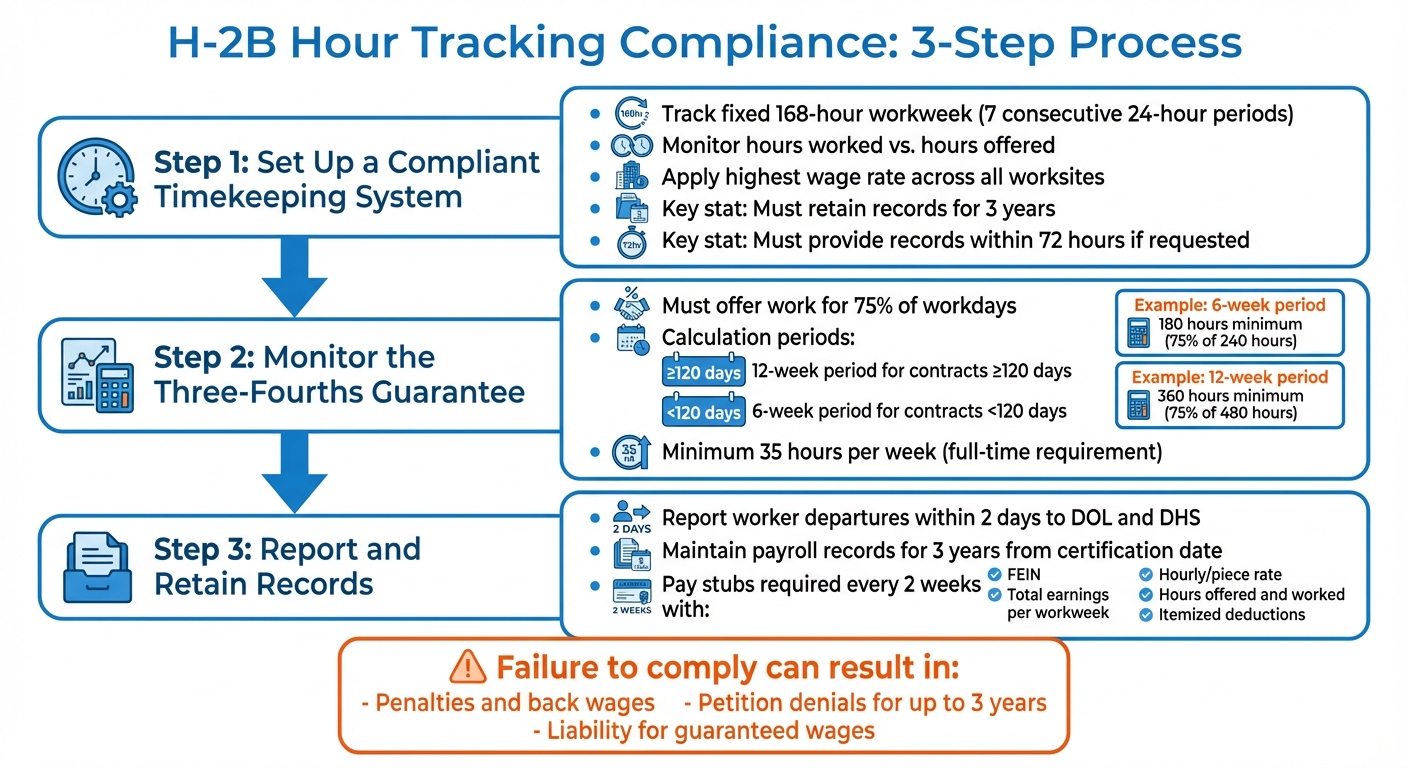
H-2B Hour Tracking Compliance: 3-Step Process for Employers
Legal Requirements for Tracking H-2B Worker Hours
Keeping accurate records is essential for complying with U.S. labor laws and ensuring fair treatment of H-2B workers. Employers must carefully track and document worker hours as part of their legal obligations. These records are crucial for protecting workers and verifying that employers fulfill their contractual commitments. Employers should also note that records must be made available to the Wage and Hour Division within 72 hours if requested.
How to Document Work Hours Accurately
Employers are required to maintain detailed payroll records for at least three years from the date of certification. These records must include both the hours workers actually perform and the hours of employment offered to them. Pay stubs must be provided at least every two weeks and include key details such as:
- The employer’s Federal Employer Identification Number (FEIN)
- Total earnings for each workweek
- Hourly or piece rate
- Hours offered and hours worked
- Any itemized deductions
The standard workweek is defined as 168 consecutive hours, or seven 24-hour periods, which provides a consistent timeframe for wage calculations. For workers paid by piece rate, employers should also document the daily number of units produced. Missing any required information in these records could lead to penalties.
Accurate documentation ensures compliance and prepares employers for additional requirements, such as guarantees and reporting.
Understanding the Three-Fourths Guarantee Rule
Under the three-fourths guarantee rule, employers must offer work for at least 75% of the workdays in each 12-week period (or 6-week period for jobs lasting fewer than 120 days). Since H-2B roles are considered full-time, workers must be offered a minimum of 35 hours per week. Employers need to track hours offered separately from hours worked because even hours refused by the worker count toward meeting the 75% guarantee. If the employer falls short of this requirement, they must pay workers for the guaranteed hours as if they had worked them.
This rule underscores the importance of precise hour tracking to avoid potential disputes or penalties.
Reporting Worker Departures on Time
If an H-2B worker leaves early, employers must notify both the Department of Labor and the Department of Homeland Security in writing within two days. Timely reporting releases employers from the three-fourths guarantee for that worker. However, failing to report the departure on time means the employer remains responsible for paying guaranteed wages through the end of the applicable 12-week period.
Staying on top of these requirements ensures compliance and protects employers from unnecessary liabilities.
sbb-itb-aa28329
Step 1: Set Up a Compliant Timekeeping System
Select a timekeeping system that does more than just track clock-in and clock-out times. It should also monitor a fixed 168-hour workweek (seven 24-hour periods) and distinguish between hours worked and hours offered. Even when workers decline offered hours, those hours still count toward the three-fourths guarantee, provided they don’t exceed the daily maximum.
Your system should also ensure that the highest wage rate is applied across all worksites. This means it needs to automatically select the highest Prevailing Wage Determination (PWD) among the locations where work is being performed. For workers paid on a piece-rate basis, the system must calculate average hourly earnings and apply the higher required rate between the piece-rate earnings and the applicable wage.
Manual vs. Digital Timekeeping Tools
When it comes to timekeeping, manual logs and digital systems each have their pros and cons – but digital tools often provide greater accuracy and efficiency. Here’s a breakdown of the key differences:
| Feature | Manual Logs | Digital Timekeeping Systems |
|---|---|---|
| 3/4 Guarantee Calculation | Prone to errors in calculating 12-week pro-rata requirements | Automatically tracks hours and sends alerts for potential shortfalls |
| Rounding Compliance | Hard to ensure rounding "averages out" over time | Programmed to follow FLSA-compliant rounding rules |
| Record Retention | Risk of physical loss; difficult to retrieve during audits | Secure cloud storage with easy retrieval; meets retention standards |
| Multi-Site Wage Logic | Requires manual adjustments for different PWDs | Automatically applies the highest applicable wage rate across locations |
If you use digital time clocks with rounding features, make sure they comply with FLSA rules. Rounding should be to the nearest five minutes, one-tenth, or quarter-hour and must balance out over time so employees are fully compensated. Regular audits of these systems can help ensure compliance and identify any issues.
Connect Timekeeping with Wage Calculations
For seamless compliance, integrate your timekeeping system with payroll. This allows the system to automatically compare the Prevailing Wage Determination, federal or state minimum wage, and the wages paid to similar U.S. workers – ensuring the highest applicable rate is used.
Additionally, the system should flag missed offered hours and require supervisors to document any refusals. This ensures that declined hours are still counted toward meeting the three-fourths guarantee. By connecting timekeeping and payroll, you can simplify wage calculations and maintain compliance in real time.
Step 2: Monitor the Three-Fourths Guarantee
Once you’ve set up a reliable timekeeping system, the next step is keeping a close eye on the three-fourths guarantee. Accurately calculating and tracking guaranteed hours is essential – not just to meet legal requirements but also to protect your business from potential liability. By leveraging your timekeeping system, you can ensure compliance and avoid surprises during each work period.
How to Calculate Guaranteed Hours
The three-fourths guarantee means you must provide work hours equivalent to at least 75% of the total hours in a standard work schedule. For contracts lasting 120 days or more, use a 12-week calculation period. For shorter contracts, use a 6-week period.
Here’s how it works:
- For a 40-hour workweek, a 6-week period requires offering at least 180 hours (75% of 240 hours).
- For a 12-week period, the required hours jump to 360 hours (75% of 480 hours).
If workers join mid-week or leave early, adjust calculations proportionally based on full-day equivalents. Keep in mind that hours offered but declined by workers still count toward the total, as long as they stay within daily maximum limits.
Track Hours in Real-Time Across Workers
Once you’ve calculated the required hours, establish weekly checkpoints to track progress against the 75% threshold. Regular reviews are just as important as your timekeeping system – they allow you to make timely adjustments to schedules before any shortfall becomes a problem.
Your tracking efforts should cover all workers, including both H-2B visa holders and U.S. workers performing similar tasks during the contract period. If your offered hours begin to fall below the required threshold, adjust schedules promptly and document any refusals from workers. If, despite your efforts, you fail to meet the guarantee by the end of the 6- or 12-week period, you’ll need to compensate workers for the shortfall – paying them for the hours they should have been able to work.
Step 3: Report and Retain Records for Compliance
Once you’ve established reliable timekeeping and monitoring systems, the next step is maintaining accurate records to ensure compliance. Under the Fair Labor Standards Act (FLSA), employers are required to keep detailed records of wages, hours, and other relevant information as outlined by the U.S. Department of Labor (DOL) regulations. These records must cover a fixed 168-hour workweek, providing a consistent framework for wage calculations and simplifying the process during labor audits.
The documentation should include key details like payroll data, departure notifications, and signed certification forms. The DOL emphasizes the importance of accuracy, stating, "Major discrepancies should be discouraged, however, since doubt is raised as to the accuracy of the record of actual hours worked".
How to Avoid Unlawful Deductions
Accurate recordkeeping also plays a critical role in preventing unlawful wage deductions. Deductions that reduce wages below the required levels can lead to compliance violations. For example, if deductions are made for housing, meals, or utilities, it’s crucial to review state-specific wage laws to ensure employee compensation remains above the minimum threshold. In states like New York, employers must provide a written Pay Notice and Work Agreement (Form LS 54) at the time of hire, as well as wage statements (Form FL 447) for each pay period. Clear documentation of overtime rates and any non-discretionary bonuses is essential to avoid wage theft claims.
Additionally, employers must report a worker’s departure to the OFLC and DHS within two workdays. Timely reporting releases the employer from the three-fourths guarantee for that worker. It’s also important to document any instances where workers refuse offered hours, as these hours still count toward meeting the guarantee.
Using ABLEMKR for Hour Tracking

The ABLEMKR platform simplifies compliance by automating key recordkeeping and reporting tasks. It integrates payroll workflows with compliance tracking, offering real-time visibility into worker status. The system automatically tracks the 168-hour workweek standard and monitors the three-fourths guarantee over 6-week or 12-week periods. This automation ensures accurate hour calculations and creates audit-ready records. By combining timekeeping, payroll, and compliance documentation in one platform, ABLEMKR makes it easier to generate reports for labor audits and avoid discrepancies that could raise concerns during inspections.
Common Hour Tracking Mistakes and How to Avoid Them
Employers often stumble when tracking H-2B worker hours, leading to compliance issues, wage disputes, and even financial penalties. Knowing where these mistakes typically happen can help you establish a better system that avoids these pitfalls. Below, we’ll break down some of the most common errors and how to address them effectively.
Inaccurate or Incomplete Records
One major misstep is mishandling the three-fourths guarantee. Many employers think they’re in the clear if they offer work on 75% of the workdays, but they overlook the importance of hours worked each day. According to the U.S. Department of Labor:
An employer has not met the work guarantee if the employer has merely offered work on three-fourths of the workdays if each workday did not consist of a full number of hours of work time as specified in the job order.
To stay compliant, only count refused hours up to the daily maximum outlined in the job order. This ensures you’re meeting the guarantee without overestimating offered hours.
For piece-rate workers, errors often arise when calculating guarantee payments. Employers must use the higher of these two rates: the average hourly piece rate earnings or the required hourly wage rate. Another common oversight? Forgetting to adjust for partial periods, like the first and last weeks of a job order. These periods require pro-rata adjustments to the guaranteed hours based on the actual days worked.
Accuracy is key, but so is clear and timely communication.
Failure to Report Worker Departures
When an H-2B worker is terminated for cause or voluntarily leaves the job, you’re required to notify both the Office of Foreign Labor Certification and DHS within 2 days. Missing this deadline can leave you on the hook for the three-fourths guarantee, even if the worker is no longer employed.
To avoid this, set up a system that automatically flags worker departures and triggers notifications. Be sure to document everything: the departure date, reason, and when notifications were sent. This kind of record-keeping can protect you during audits and ensure compliance.
Wage Shortfalls and Non-Compliance
Wage miscalculations are another frequent issue. Employers sometimes fail to include all compensation details in the job order, such as overtime rates or non-discretionary bonuses. Even if you don’t expect overtime, the rate must still be listed upfront.
When using time clock systems, discrepancies between recorded and actual hours worked can also raise red flags during audits. While rounding time to the nearest five minutes, tenth, or quarter-hour is allowed, it must balance out over time to ensure workers are paid for all hours worked.
Platforms like ABLEMKR can simplify this process. Their automated tools handle wage calculations, verify worker profiles, and cross-check hours worked against job order requirements. By flagging potential issues in real time, the system ensures workers are paid accurately and that your documentation is audit-ready. This level of automation not only reduces errors but also keeps your compliance efforts on track throughout the entire work period.
Conclusion
Keeping precise track of H-2B hours is essential for staying compliant with regulations and safeguarding both your business and your workforce. Adhering to the required guarantees, minimum hours, and reporting deadlines isn’t optional – it’s critical. Falling short on these standards can result in serious consequences like wage discrepancies, audit issues, or even being barred from the program.
Stick to the 168-hour workweek rule and monitor offered and worked hours over each 12-week period. Make sure to document any worker refusals, as these still count toward meeting compliance requirements.
Using digital tools can make these tasks much easier. Platforms like ABLEMKR simplify the process by automating hour tracking, integrating timekeeping with wage calculations, and keeping tabs on the three-fourths guarantee in real time. With built-in alerts for potential compliance risks, these tools ensure your records are ready for audits and your workers are paid correctly throughout their employment.
Take a moment to evaluate your current system. Upgrading to a tool that handles the complexities of hour tracking and guarantee calculations automatically can minimize errors, resolve disputes before they escalate, and keep your H-2B program running without hiccups.
FAQs
How do I count ‘hours offered’ vs. ‘hours worked’ for the 75% guarantee?
Hours offered refer to the total hours an employer makes available for a worker to perform their job. On the other hand, hours worked are the actual hours the worker spends fulfilling their duties. Employers are required to ensure that workers are offered at least 75% of the hours they were promised. To meet this obligation, it’s crucial to track both the hours offered and the hours worked. Keeping accurate records helps confirm compliance with the 75% guarantee.
What do I need to report if an H-2B worker quits or is terminated within 2 days?
If an H-2B worker quits or is terminated, you’re required to inform the Department of Labor within 2 days of the separation. This step is crucial to stay compliant with the rules of the H-2B program and labor laws.
What records do I need if the DOL audits my H-2B time and payroll?
Keeping precise records for each employee is essential. This includes details like their full name, Social Security number, address, and birth date (if they’re under 19). You’ll also need to document their sex, occupation, daily and weekly work hours, wage basis, regular pay rate, total earnings, deductions, total wages paid, and the payment date. These requirements align with the regulations set by the FLSA and the H-2B program.


