
If you’re pursuing a career in wind energy, understanding the difference between GWO (Global Wind Organisation) and WTT-I (Wind Turbine Technician-I) certifications is critical. Here’s a quick breakdown to help you decide:
- GWO Certification: Focuses on safety training and is globally recognized. It’s often required for site access, especially for offshore projects. Key modules include Basic Safety Training (BST) and Basic Technical Training (BTT). Safety certifications need renewal every 2 years, but technical certifications like BTT don’t expire.
- WTT-I Certification: Centers on technical skills specific to the U.S. market, covering electrical, mechanical, and hydraulic systems. It’s tailored for entry-level roles like Installation or Field Service Technicians and aligns with U.S. regulations like OSHA.
Quick Comparison
| Feature | GWO Certification | WTT-I Certification |
|---|---|---|
| Scope | Global safety and technical standards | U.S.-focused technical expertise |
| Key Focus | Safety compliance, site access | Technical skills for turbine maintenance |
| Modules | BST (safety), BTT (technical), ART (rescue) | Electrical, mechanical, hydraulics, safety |
| Validity | 2 years (BST), no expiration (BTT) | Determined by issuing organization |
| Cost | Varies by region and provider | $580–$1,750 |
| Target Audience | Global technicians, offshore workers | U.S.-based technicians |
Both certifications complement each other. GWO is ideal if you want international mobility and safety credentials, while WTT-I is better suited for U.S.-specific technical roles. Many employers prefer candidates with both certifications to ensure they’re fully prepared for the job.
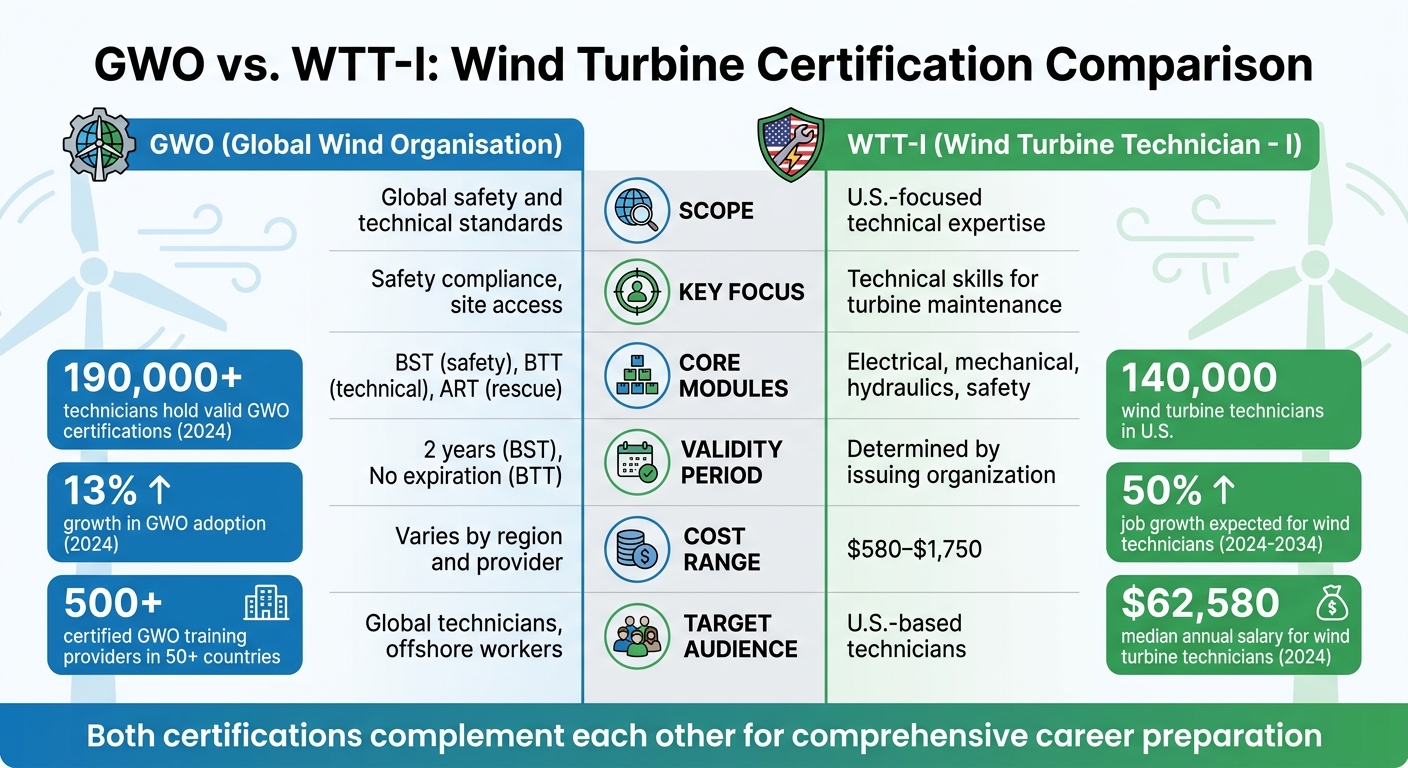
GWO vs WTT-I Wind Turbine Certification Comparison Chart
GWO-certified Basic Safety Training and Basic Technical Training
What is GWO Certification?
GWO certification is a globally recognized credential that focuses on safety and skills for professionals working in or near wind turbines. Developed by top wind energy manufacturers, it sets a universal standard for what technicians must know before they can access a site.
This certification is often a mandatory requirement imposed by insurers, contractors, and project owners, especially for offshore projects where risks are higher. All certifications are logged in WINDA (Wind Industry Database), a global registry that assigns each technician a unique WINDA ID. This ID acts as a digital training passport, allowing employers to verify qualifications instantly and enabling technicians to move between projects and regions without unnecessary hurdles. In essence, it provides the essential safety foundation needed for roles in the wind energy sector.
By 2024, the global adoption of GWO certification has grown by 13% compared to the previous year. Training is offered by over 500 certified providers across more than 50 countries. The Global Wind Organisation itself doesn’t conduct the training but accredits independent providers who must pass rigorous audits to deliver the standardized curriculum.
Core Modules and Training Requirements
GWO certification includes several training programs tailored to specific roles and skills. The most common is Basic Safety Training (BST), which is required for most technician and operational roles. BST includes five key modules: First Aid, Manual Handling, Fire Awareness, Working at Heights, and Sea Survival (the last being mandatory for offshore work).
Another program, Basic Technical Training (BTT), focuses on practical skills in mechanical, electrical, and hydraulic systems, with additional training on hubs, blades, and generators. BTT is crucial for entry-level technicians, commissioning roles, or those working with original equipment manufacturers (OEMs). Unlike safety modules, BTT certifications do not expire, as they cover fundamental technical knowledge rather than time-sensitive emergency skills.
For those with more experience or in leadership roles, Advanced Rescue Training (ART) focuses on rescue techniques for confined spaces like the hub, spinner, and blade interior. Additional specialized courses include Enhanced First Aid (EFA), Blade Repair, and Control of Hazardous Energies (CoHE), catering to those seeking advanced expertise.
| Training Category | Core Modules / Topics | Validity Period |
|---|---|---|
| Basic Safety Training (BST) | First Aid, Manual Handling, Fire Awareness, Working at Heights, Sea Survival | 2 Years |
| Basic Technical Training (BTT) | Mechanical, Electrical, Hydraulic, Hub, Blade, Generator | Does Not Expire |
| Advanced Rescue (ART) | Hub Rescue, Spinner Rescue, Inside Blade Rescue, Rescue from Heights | 2 Years |
This structured approach prioritizes safety while complementing the technical focus of other certifications like WTT-I.
Before starting any training, individuals must create a free account on winda.globalwindsafety.org to obtain their unique WINDA ID. Many providers offer bundled BST courses, which can save time and money for new entrants.
Validity and Renewal Process
GWO safety certifications are valid for 24 months. To stay compliant, technicians must complete refresher courses before their certification expires. These refresher sessions ensure workers stay up-to-date on the latest safety protocols, equipment updates, and procedural changes.
Technicians should carefully track their certification expiration dates, as expired credentials can lead to immediate loss of site access – a major issue for those scheduled to work on wind farms. The WINDA platform simplifies this process by providing reminders and allowing employers to verify worker credentials.
It’s worth noting that while BST certifications expire after two years, BTT certifications remain valid indefinitely. This makes BTT training a one-time investment in core technical skills without the need for ongoing renewals.
What is WTT-I Certification?
WTT-I (Wind Turbine Technician I) is an entry-level certification tailored specifically for the U.S. wind energy industry. Unlike the globally oriented safety standards established by GWO (Global Wind Organization), WTT-I zeroes in on the technical expertise required to inspect, service, and maintain wind turbine towers and their components. While GWO addresses worldwide safety protocols, WTT-I adapts training to meet U.S. regulatory and technical demands.
The certification aligns with ANSI/ACP 5000-2-2022 standards, ensuring compliance with North American regulations. It incorporates elements of GWO standards but modifies them for U.S.-specific requirements, such as 50/60 Hz electrical transmission systems and adherence to OSHA regulations, including 29 CFR 1910.269 for Qualified Electrical Workers.
With wind turbine technician jobs expected to grow by 50% from 2024 to 2034 and a median annual salary of $62,580 in 2024, WTT-I certification positions candidates for one of the fastest-expanding career fields in the U.S.. Currently, over 140,000 wind turbine technicians maintain more than 75,000 turbines across the country.
Exam Structure and Coverage Areas
The WTT-I certification focuses on four core technical areas crucial for turbine maintenance:
- Electrical systems: Training covers troubleshooting, wiring, AC/DC circuits, and control devices, all essential for diagnosing power generation issues .
- Mechanical systems: Modules include component maintenance, repair techniques, and using precision measuring tools .
- Hydraulics: This section emphasizes maintaining and safely operating hydraulic systems that manage blade pitch and braking functions.
- Operations: Topics include hoisting, rigging, and understanding how weather conditions affect turbine performance.
To ensure technicians are fully prepared, WTT-I integrates key safety modules, often paired with GWO BST (Basic Safety Training). This combination equips technicians with both the technical know-how and safety awareness needed for work on turbine sites .
Prerequisites and Training Path
The training path for WTT-I certification is designed to accommodate a wide range of candidates, from beginners to those with relevant experience. Most programs in the U.S. do not require prior experience, making them accessible to individuals from diverse backgrounds. However, having experience in fields like automotive mechanics, hydraulics, electrical systems, or military service can be an advantage.
Physical fitness is a key requirement, as technicians must climb towers over 250 feet while carrying more than 25 lbs of gear. Additionally, weight restrictions – typically between 264–275 lbs – are in place to ensure the safe use of climbing equipment .
Training programs blend theoretical learning with practical, hands-on experiences, including 3D simulations and real-world practice. Campus-based programs typically take 7 to 8 months to complete, while online certificate options span about 32 weeks . Costs range from $580 to $1,750, depending on the program’s structure and institution. It’s important for prospective students to confirm they’re enrolling in a certification program – which includes formal testing – rather than a course that only offers a certificate of completion. This emphasis on technical training and safety serves as a stepping stone to broader opportunities in the wind energy sector.
GWO vs. WTT-I: Direct Comparison
Comparison Table
| Feature | GWO Certification | WTT-I Certification |
|---|---|---|
| Scope | Recognized globally for safety and technical standards, backed by major OEMs like Vestas and Siemens Gamesa. | Focused on U.S. technical certification standards. |
| Target Audience | Designed for wind turbine technicians, operators, and offshore workers worldwide. | Geared toward professionals in the U.S. wind industry. |
| Duration | Modular training: Basic Safety Training (BST) takes 4–5 days, Basic Technical Training (BTT) varies, and Advanced Rescue Training (ART) is updated to 2 days starting March 2026. | Depends on the specific program. |
| Costs | Costs vary by region and provider, ranging from subsidized public programs to private training centers. | Pricing depends on the program. |
| Validity | Safety modules like BST, ART, and Enhanced First Aid are valid for 24 months; technical modules (BTT) have no expiration. | Certification validity is determined by the issuing organization. |
| Delivery Methods | Available through accredited providers offering mobile units, simulation centers, and real-world training. | Delivered through campus-based or online programs. |
| Key Content | Covers safety topics (working at heights, fire awareness, first aid, sea survival) and technical areas (mechanical, electrical, hydraulics). | Focused on technical skills tailored to U.S. industry needs. |
| Verification | Digital records are stored in the WINDA global database. | Relies on documentation specific to the program. |
The WTT-I certification is designed to meet U.S. industry standards, offering training aligned with domestic needs. On the other hand, GWO certification provides a globally recognized framework, supported by over 500 certified training providers across more than 50 countries. As of 2024, over 190,000 technicians held valid GWO certifications, reflecting a 13% increase from the prior year.
Each certification serves a distinct purpose: GWO caters to an international audience with a focus on safety and technical consistency, while WTT-I is tailored to U.S.-specific requirements. Both address their respective markets effectively, offering valuable credentials for professionals in the wind energy sector.
sbb-itb-aa28329
Benefits and Career Applications
GWO: Global Mobility and Safety Compliance
Earning a GWO certification can unlock international career paths within the wind energy sector. Many leading turbine manufacturers and operators now require GWO credentials, ensuring technicians meet global safety and operational standards. The WINDA database serves as a digital training passport, enabling employers to verify certifications instantly.
"Technicians with certifications in all three GWO standards (BST, BTT and ART) can save employers approximately three weeks of entry level training, allowing them to perform safely and effectively on wind turbines".
This streamlined training process not only enhances the technician’s value during hiring but also allows for faster deployment on critical projects.
For offshore positions, GWO’s Basic Safety Training (BST) is a must-have, particularly with the updated Sea Survival module, which now includes a Walk-to-Work (W2W) lesson for motion-compensated gangway systems. Advanced certifications like Advanced Rescue Training (ART) and Enhanced First Aid (EFA) further prepare technicians for specialized emergency response roles and leadership opportunities. Between 2019 and 2020, the number of completed ART courses in North America surged by 600%.
While GWO focuses on international mobility and safety, other certifications cater to region-specific technical needs.
WTT-I: U.S.-Focused Technical Skills
Unlike GWO, which emphasizes global standards, WTT-I certification is tailored to meet the technical demands of the U.S. wind energy industry. It equips entry-level technicians with mechanical, electrical, and hydraulic skills aligned with domestic regulatory requirements. Though it lacks the international portability of GWO, WTT-I provides a direct route into U.S.-based wind energy careers.
For those focused solely on onshore projects within the U.S., WTT-I offers a targeted approach without requiring the broader safety modules included in GWO certification. However, the growing preference for GWO standards is evident, with a 30% increase in completed GWO training modules in North America in 2020. This trend highlights the demand for globally recognized qualifications, even for technicians working on domestic projects.
For U.S.-based wind energy initiatives, ABLEMKR plays a pivotal role by connecting WTT-I-certified professionals to key projects. Through integrated compliance tracking, it ensures crews are mobilized quickly for installations and emergency repairs across the country’s energy corridors, making WTT-I a practical choice for domestic technicians.
Choosing Between GWO and WTT-I
Key Decision Factors
Your career aspirations heavily influence which certification to pursue. One of the main factors is geographic scope. For instance, if you’re aiming to work with major turbine manufacturers like Vestas or Siemens Gamesa, a GWO certification is often a must. The GWO North America Committee also ensures that its training standards align with U.S. OSHA regulations, making this certification particularly relevant for professionals working domestically.
Different roles also call for specific certifications. For example, offshore safety roles typically require GWO’s Basic Safety Training (BST), while technical positions benefit from the updated standalone Mechanical and Electrical Basic Technical Training (BTT) modules, which will be available starting March 2026.
The numbers tell the story as well. By 2024, over 190,000 technicians worldwide held valid GWO certifications – a 13% jump from the previous year. Additionally, more than 530,000 training records were uploaded to the WINDA database in 2024. These statistics highlight how widely employers and insurers require these certifications for site access. For professionals, these factors are critical when deciding on training and aligning with the right career opportunities.
How ABLEMKR Supports Certified Professionals

ABLEMKR simplifies the process of leveraging your certifications to land the right roles. Their platform is designed to connect pre-vetted, certified professionals with essential energy projects across key U.S. energy corridors. Whether your expertise lies in Advanced Rescue Training (ART) for emergency scenarios or the updated Mechanical and Electrical BTT modules for specialized installation tasks, ABLEMKR matches technicians to roles that align with their training.
The platform also keeps track of certification validity, sending alerts for renewals to ensure workers don’t face site access issues. Its mobile-first approach uses geo-location to deploy certified crews quickly for urgent repairs or shutdowns. Plus, integrated payroll workflows ensure technicians are paid on time. For those registered in the WINDA database, ABLEMKR syncs seamlessly with their digital training passport, enabling employers to verify credentials instantly and mobilize qualified workers in a matter of hours instead of weeks.
Conclusion
Deciding between GWO and WTT-I certifications comes down to your career aspirations. A GWO certification is widely recognized by major global manufacturers like Vestas, Siemens Gamesa, and GE. It’s an established standard for professionals seeking international opportunities and strong safety credentials. On the other hand, WTT-I is tailored to U.S.-specific technical skills and regulations, making it a better fit for domestic roles within the United States. This distinction highlights the need to match your certification choice with your career goals.
The updates to GWO standards in March 2026 aim to improve training efficiency. If you’re targeting offshore safety roles or international projects, GWO’s training – covering modules like Basic Safety Training and Advanced Rescue Training – offers essential preparation. For those focused on U.S.-based technical positions, WTT-I’s exam structure might align better with your professional path.
FAQs
Do I need GWO to work on U.S. wind farms?
No, GWO certification isn’t an absolute requirement for working on U.S. wind farms. While it’s highly regarded for its focus on safety and technical skills – particularly for offshore projects – it’s not mandatory for every role.
Many positions accept alternative certifications, such as OSHA training or safety programs provided directly by employers. However, having GWO certification can give you an edge, especially if you’re aiming for offshore or high-risk roles, as many employers tend to favor candidates with this credential.
Which certification do employers prefer: GWO, WTT-I, or both?
Employers tend to favor certifications that are well-known and align with industry safety standards. In the wind energy sector, GWO certification stands out as particularly important. It’s often required for offshore roles because of its global reputation and thorough safety training programs, such as Basic Safety Training (BST) and Advanced Rescue Training (ART). While WTT-I might be applicable in certain situations, GWO is usually the go-to option for environments involving higher risks.
How do I renew GWO BST without losing site access?
To maintain your GWO Basic Safety Training (BST) certification and avoid losing site access, make sure to complete the refresher course within the two months leading up to your certification’s expiration date. This ensures your original certification date remains unchanged. If you renew earlier than two months before it expires, your renewal date might shift, which could impact site access schedules. Let your certification lapse? Unfortunately, you’ll have to retake the full course. For detailed guidance, reach out to your nearest GWO training provider.


