
Relocating oil and gas workers to remote or international locations is a complex process that requires careful planning, compliance with legal requirements, and logistical coordination. Here’s what you need to know:
- Why Relocation Matters: Relocating experienced workers ensures safety, operational continuity, and project success. It’s often quicker than hiring and training new staff.
- Challenges: Companies must handle visa processes, housing in remote areas, medical clearances, and family support. Delays can disrupt multi-million-dollar projects.
- Key Steps:
- Understand Legal Requirements: Ensure visas, certifications (like BOSIET or IWCF), and credential legalization are completed early.
- Plan the Move: Coordinate medical tests, travel, and temporary housing. Family needs like schools and spousal employment should also be addressed.
- Ensure Compliance: Maintain valid safety certifications, medical clearances, and adhere to local labor laws.
- Provide Housing and Support: For remote locations, build or arrange housing with necessary amenities. Support families with schools, healthcare, and local services.
- Leverage Technology: Use workforce management platforms to streamline onboarding, compliance tracking, and logistics.
Relocation isn’t just about moving workers – it’s about ensuring their readiness, safety, and well-being while minimizing disruptions to operations. Early planning and modern tools can simplify the process while improving retention and efficiency.
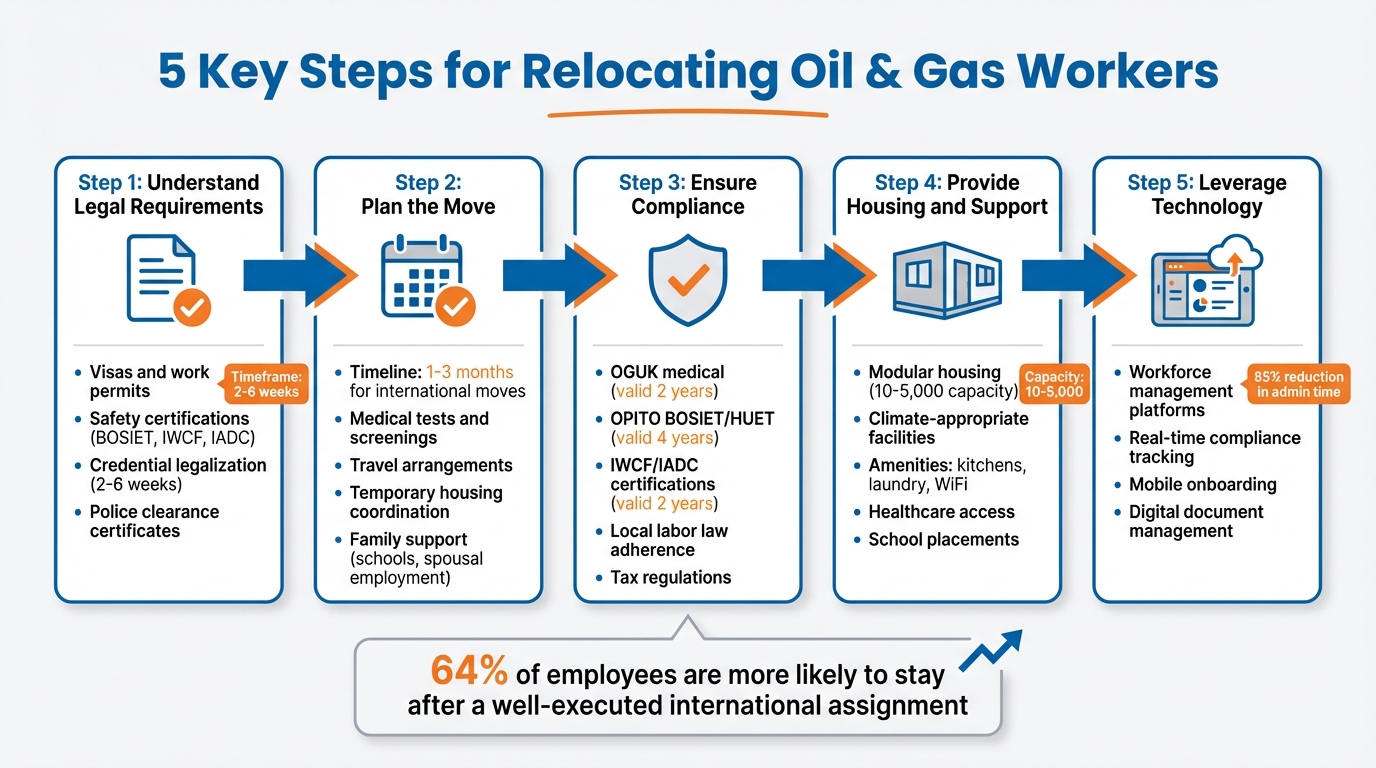
5-Step Process for Relocating Oil and Gas Workers Internationally
Steps for Managing Worker Relocation
Relocating oil and gas workers is no small task. It takes months of coordination between HR, finance, and operations to ensure everything aligns with project deadlines and compliance requirements. Rushing through this process can lead to costly delays, failed medicals, or visa rejections – any of which could throw a project off track.
Identifying Relocation Requirements
The first step is understanding the legal and operational requirements before workers can even begin their journey. For example, in major oil and gas hubs like Qatar and the UAE, workers can’t apply for visas on their own. Employers must kick off the process with the Ministry of Labour. This means HR needs to verify job offers, confirm project timelines, and gather critical documents such as verified qualifications, police clearance certificates, and signed contracts.
Credential legalization is another crucial step that shouldn’t be left to the last minute. Degrees and certificates often need notarization, attestation, or an apostille, which can take anywhere from two to six weeks. Workers should keep a "credential pack" ready – this includes notarized copies of passports, degrees, and safety cards – to streamline future relocations.
Different roles come with unique certification needs. For instance, offshore workers may need BOSIET training, while drilling roles often require IWCF or IADC certifications. Specialized technical positions, like electrical technicians in hazardous areas, might require COMPEX certification, and inspectors may need API or NDT credentials. To manage costs, it’s smart to invest early in lower-cost essentials like OGUK medicals ($150–$300) and H2S awareness training ($100–$200). Higher-cost certifications like OPITO BOSIET ($900–$1,600) can be deferred until a candidate is confirmed.
Once the requirements are clear, the focus shifts to planning the logistics and timelines for the move.
Planning and Preparing for the Move
A well-structured timeline is key. It should cover medical tests, biometric registrations, travel arrangements, and temporary housing. International relocations typically take one to three months, though some regions may require even more time.
During this phase, companies need to handle several moving parts: medical testing, safety certifications, insurance, and travel logistics. Workers must pass drug and alcohol screenings, fit-for-respirator tests, and any required region-specific vaccinations, such as Yellow Fever.
For remote sites with limited infrastructure, companies may need to build housing compounds or work with logistics providers experienced in managing operations in isolated areas. Supporting workers’ families is just as important. Assistance with school placements, spousal employment, and adjustment programs can help families settle in, giving them time to plan and organize their affairs.
Meeting Industry Compliance Standards
Once the move is planned, maintaining compliance becomes the priority. Most offshore roles require an OGUK (or equivalent) medical certificate, which is usually valid for two years. Safety certifications like OPITO BOSIET or HUET are typically valid for four years, while IWCF or IADC Well Control certifications need renewal every two years.
To stay compliant, companies must ensure workers hold valid medical and safety certifications and adhere to local labor and tax regulations. Lease agreements should include mobility-friendly clauses, such as transfer provisions, to accommodate relocation needs. Depending on the destination, additional compliance measures may include "permit-to-work" systems, SIMOPS protocols, or professional registrations with local engineering councils.
Managing worker relocation successfully requires balancing logistical planning with strict adherence to compliance standards.
sbb-itb-aa28329
Visa and Immigration Requirements
Getting the right visa is often the most time-sensitive part of moving oil and gas workers to the U.S. The process is petition-based, meaning you need to file with USCIS in advance, which can add weeks or even months to the timeline. Since the oil and gas industry works on tight schedules, starting the visa process early is essential.
U.S. Visa Options for Oil and Gas Workers
For engineers, geologists, and technical specialists, the H-1B visa is the most common option. Each year, 65,000 H-1B visas are available, with an extra 20,000 set aside for those holding advanced U.S. degrees. The standard application fee for this visa is $205.
If you’re transferring employees within the same company, the L-1 visa is the go-to option. The L-1A is for managers and executives, while the L-1B applies to employees with specialized knowledge. To qualify, the worker must have been with the company abroad for at least one of the past three years. Canadian and Mexican professionals can use the TN visa under the USMCA agreement, which covers many roles in engineering and science that are common in the energy sector. Australian nationals can apply for the E-3 visa, which has an annual limit of 10,500 visas. Additionally, the E-1/E-2 visas are available for treaty countries, allowing foreign businesses to bring in essential employees or managers.
Here’s a quick breakdown of visa options and their main requirements:
| Visa Type | Best For | Key Requirement |
|---|---|---|
| H-1B | Engineers, geologists, technical specialists | Bachelor’s degree in a specialty field |
| L-1A/B | Managers or staff with specialized knowledge | 1 year of employment abroad within the last 3 years |
| TN | Canadian or Mexican professionals | Citizenship and qualifying professional role |
| E-3 | Australian professionals | Australian citizenship and specialty occupation |
After choosing the right visa, employers need to address local immigration requirements to finalize the process.
Meeting Local Immigration Laws
Once the appropriate visa is selected, employers must handle local immigration steps. For H-1B, H-1B1, or E-3 visas, employers need to submit a Labor Condition Application (LCA) to the Department of Labor before filing the visa petition. This form ensures that hiring the worker won’t negatively impact U.S. workers and that wages meet required standards. LCAs are typically processed within seven working days and can be filed up to six months before the job’s start date.
After USCIS approves the petition, workers must complete the online DS-160 form and schedule an interview at a U.S. Consulate. They’ll need to bring their petition receipt, supporting documents, and may have to pay reciprocity fees depending on their home country. However, even with a visa, entry into the U.S. isn’t guaranteed – Customs and Border Protection officials at the port of entry make the final call.
Employers also need to ensure workers meet U.S. tax obligations through the IRS and help them get a Social Security number, which requires work authorization from the Department of Homeland Security. For family members, spouses and children can often apply for derivative visas (like H-4 or L-2) to accompany the worker. Some dependents on E and L visas can even work without filing a separate application. Handling these legalities is just as important as managing the technical aspects of relocation.
Housing and Support Services in Remote Locations
Once the move is planned and compliance is addressed, the next big step is tackling housing and on-site support.
Solving Housing Challenges in Remote Areas
Housing in remote oil and gas locations requires careful planning. The size of the crew and the length of the project dictate whether temporary mobile units or more permanent modular setups are needed. Modular housing can accommodate anywhere from 10 to 5,000 people and is designed for easy transport and setup [18,21].
Climate and safety considerations are key. Housing must be built to handle extreme conditions – whether it’s freezing arctic tundra, scorching desert heat, or humid offshore environments [18,21]. Near industrial sites like refineries, blast-resistant buildings rated for 3 psi to 5 psi are common, with some capable of withstanding blasts up to 200 MS. Fabric structures offer a quick solution, with some taking just 10 minutes to set up.
Remote worksites often double as small, self-sufficient communities. Amenities like commercial kitchens, laundry facilities, and recreation areas are essential for keeping morale high [20,22]. Connectivity is also a priority – WiFi and smart TVs help workers stay in touch with family and unwind after long shifts [18,23]. In urban hubs like Houston, corporate apartments with full kitchens provide a more comfortable and personal alternative to hotels.
"Our project schedule and details changed countless times and you and your personnel adapted and performed above expectations in all aspects of the planning, manufacturing, delivery, and set up of our project."
– Kevin Northcutt, Energy Services Director, Endeavor Energy Resources
Planning ahead is crucial for remote site housing logistics. This gives time for site evaluation and coordinating delivery. Prefabricated modular units, built in controlled environments, reduce the risk of weather delays [8,19]. A staggered approach often works best: start with temporary housing for the first 2–4 weeks while workers handle essentials like residency IDs and bank accounts, then transition to long-term accommodations.
Another essential consideration is the well-being of workers’ families, which is explored in the next section.
Supporting Workers and Their Families
Relocating workers for the long term involves more than just housing – it’s about making sure their families can settle comfortably. One of the biggest priorities is finding schools, especially in international or remote areas where international or boarding schools might be the only options. Start early by gathering educational certificates and transcripts, as schools in energy hubs often fill up fast.
In 2019, ExxonMobil rolled out a U.S. relocation program that included a Miscellaneous Expense Allowance and up to $2,500 for spousal employment support. They partnered with Cartus Corporation to manage tasks like shipping household goods and assisting with home purchases. These types of structured programs make transitions smoother and ensure work continues without disruption.
Healthcare access is another major factor. Before arrival, confirm local in-network healthcare options and establish emergency evacuation protocols [1,8]. Larger camps often include on-site health and dental clinics staffed by visiting professionals to reduce downtime for workers [20,21]. Some camps even have general stores or convenience centers for basic needs.
For international assignments, language and cultural training programs help families adapt to their new surroundings. Financial support, like assistance with setting up local bank accounts, obtaining SIM cards, and managing tax requirements, is especially helpful during the critical first 90 days. Including a transfer clause in lease agreements can also protect workers from penalties if they’re relocated again by the company [1,8,10].
"Successful relocations aren’t just about moving people – they’re about helping employees and their families thrive in new locations while maintaining business continuity."
– ARC Relocation
Using Technology to Simplify Relocation
Digital platforms are transforming how oil and gas companies handle worker relocations. By automating compliance, logistics, and communication, these tools help minimize delays and cut down on administrative costs. For instance, one major oil and gas company reported an 85% reduction in administrative time after adopting a mobile-first onboarding solution in February 2024.
Workforce Management Platforms
Modern workforce management platforms bring hiring, onboarding, and compliance into a single system. Take ABLEMKR’s mobile-first platform as an example. It connects pre-vetted workers to essential projects across the U.S. by matching their certifications, safety training, availability, and location. Workers can complete onboarding tasks before even stepping on-site, while employers gain real-time insights into worker status, payroll workflows, and compliance tracking.
AI-driven compliance tools also play a crucial role, automating tasks like safety permits, operator rounds, and incident reporting. This ensures 100% compliance with local regulations, reducing the risk of fines. For companies managing workers across multiple countries, automation eliminates the headaches of manual tracking, which often leads to errors and delays.
"The Augmentir platform is a core technology in our digital transformation strategy… We’ve seen significant improvements in quality and standardization, as well as improved productivity through reduced downtime."
– Sr. Director, Advanced Technology
Another key feature of these platforms is centralized communication. Instant access to worker directories and multimedia messaging keeps relocated workers connected, even in remote or unfamiliar locations. Poor communication costs businesses an estimated $1.2 trillion annually, but effective platforms can boost productivity by 25%. Beyond these platforms, specialized digital tools address specific challenges faced during worker relocations.
Digital Tools for Remote Relocation
Digital tools are enhancing the relocation process in practical ways. Virtual tours and digital document management make housing searches in remote areas easier, allowing families to explore options without physically traveling. Real-time expense tracking adds transparency to relocation costs, covering both "hard costs" like airfare and shipping, and "soft costs" such as visa fees and tax briefings.
Mobile applications further streamline relocations. GPS tracking and geofencing monitor worker locations and safety in real-time. One company reported an 85% reduction in administrative time, while another saw a 90% drop in equipment shrinkage and a 25% boost in operational efficiency using mobile tracking tools. Additionally, integrating mobile timekeeping with payroll systems like ADP enables accurate, real-time reporting. For example, a drilling company used this system to flag and address unapproved overtime before payroll processing, cutting payroll costs directly.
Augmented reality (AR) and wearable devices are also making a big impact. Smart headsets and glasses allow relocated workers to connect with remote experts for real-time troubleshooting, reducing the need for costly travel. These tools have delivered 33% faster maintenance and 89% faster audits, while providing instant access to work instructions and safety alerts. With private 5G networks expanding to offshore rigs and remote sites, AR and wearable technology are becoming essential for high-risk operations.
Conclusion
Successfully relocating oil and gas workers hinges on three key factors: early planning, strict compliance, and smart technology use. Companies that start the relocation process months in advance – allowing time for document legalization, family arrangements, and certification coordination – experience far smoother transitions and better results.
Meeting critical safety and immigration requirements is non-negotiable. From OGUK medicals (costing between $150 and $300) to OPITO BOSIET certifications (ranging from $900 to $1,600), compliance ensures both worker safety and legal protection for employers. The benefits are clear: 64% of employees are more likely to remain with their employer after a well-executed international assignment.
Technology is a game-changer in addressing relocation challenges. Platforms like ABLEMKR streamline compliance tracking, match workers to roles based on certifications and locations, and offer real-time updates on worker status and payroll. By reducing manual errors and cutting administrative workloads, these tools make the process more efficient and reliable.
With projections showing nearly 1.9 million direct oil and gas jobs globally by 2035, companies that invest in efficient relocation processes gain a competitive edge. Comprehensive support – such as visa sponsorship, housing assistance, and spousal career services – doesn’t just make relocation smoother; it strengthens worker loyalty and operational success in the long run. These thoughtful strategies turn relocation into a driver of sustained excellence.
FAQs
How early should a relocation start to avoid visa and certification delays?
Relocating to a new country takes careful preparation, and it’s best to start planning several months in advance. This gives you enough time to handle crucial steps like visa applications and certification processes. Since processing times can vary depending on the destination and its specific requirements, getting an early start minimizes potential delays and makes the transition much easier.
What documents should workers have ready for quick international moves?
When planning an international move for work, it’s crucial to have all essential documents in order. This includes your passport, visa, and work permit. Depending on your destination, you might also need to complete specific entry paperwork required by that country.
Being organized with these documents can save you a lot of time and stress, ensuring a smoother transition to your new location.
How does ABLEMKR reduce onboarding and compliance delays during mobilization?
ABLEMKR uses a mobile-first platform to simplify hiring, onboarding, and compliance processes in real time. It connects pre-vetted workers to job sites by considering factors like certifications, safety training, availability, and location. Employers benefit from real-time updates on worker status and compliance tracking, making it easier to address issues quickly and ensure workers are ready to step into high-demand projects without delays.


