
Managing fringe benefits for W-2 construction employees is essential for tax compliance and fair compensation, especially when working on federally funded projects under Davis-Bacon requirements. Key takeaways:
- Fringe benefits include health insurance, retirement contributions, and paid time off. Employers must calculate their value by December 31 and report taxable portions on W-2 forms by January 31, 2026.
- Davis-Bacon Projects: Prevailing wages include a base rate and fringe benefits. If benefits fall short, the difference must be paid as taxable cash wages.
- Common Benefits: Health insurance, transportation subsidies, and educational assistance have specific tax rules. For example, parking and transit benefits are tax-free up to $315/month each in 2025.
- Certified Payroll: Weekly reporting is mandatory for federally funded projects, requiring detailed documentation of wages, benefits, and hours worked.
- Avoid Errors: Misreporting or failing to meet compliance can lead to IRS penalties, audits, and additional wage liabilities.
Accurate records, proper benefit valuation, and modern tools like ABLEMKR can simplify compliance and ensure timely reporting.
How To Calculate Fringe Benefits For Prevailing Wage? – CountyOffice.org
Types of Fringe Benefits and Compliance Rules
W‑2 construction staff often receive various fringe benefits, including health insurance, retirement contributions, parking subsidies, and reimbursements for training. IRS Publication 15‑B outlines which of these benefits are taxable, partially taxable, or fully excluded from taxation.
In the construction industry, common fringe benefits include health and accident coverage, group life insurance, retirement plans, transportation benefits (like parking and transit), education assistance, achievement or service awards, housing or meal allowances, and reimbursements for safety-related expenses. Each type of benefit comes with its own set of compliance requirements, reporting guidelines, and tax rules. Let’s break down some of the key categories and their specific compliance considerations.
Health and Accident Benefits
Group health insurance premiums provided under a qualified plan are generally tax-free. These premiums don’t impact Box 1 wages, but for large employers, the total cost must be reported in Box 12 with code DD. For field workers in construction, accident and health plans that cover on-site injuries are also tax-free, provided they meet the IRS’s bona fide plan standards. However, cash payments in place of health coverage are fully taxable and must be included in W‑2 Boxes 1, 3, and 5.
Employer contributions to Health Savings Accounts (HSAs) are excluded from taxable income if the employee is eligible for an HSA and the contributions stay within the IRS’s annual limits. These contributions are reported in Box 12 with code W but are not included in Box 1 wages. Similarly, employer-paid disability insurance premiums may be tax-free while being paid, but the taxability of disability benefits depends on whether the premiums were paid with pre-tax or after-tax dollars. Accurate documentation is critical, as errors in reporting health coverage can result in penalties. For instance, W‑2 forms for the 2025 tax year must be filed by January 31, 2026.
Transportation Benefits
The IRS allows certain transportation-related fringe benefits to be excluded from taxable income, up to monthly limits. In 2025, employees can receive up to $315 per month for parking and up to $315 for transit passes or vanpooling (a combined maximum of $630 per month) tax-free. Any amount exceeding these limits must be added to W‑2 wages in Boxes 1, 3, and 5.
For construction workers, employer-provided parking at remote job sites or transit subsidies for urban commuters can qualify as tax-free, provided proper documentation is kept. Employers need to clearly track pre-tax salary reductions versus employer-paid portions, especially for teams commuting to multiple job sites. Additionally, mileage reimbursements for personal vehicle use are tax-free if reimbursed at or below the 2025 IRS standard mileage rate of 70 cents per mile under an accountable plan. To qualify, employees must maintain accurate logs of miles driven between job sites.
Education Assistance and Achievement Awards
Employers can offer up to $5,250 annually in tax-free educational assistance under Section 127. This can cover tuition, books, and supplies for job-related training programs. For construction workers, this might include OSHA certifications, NCCER training, CDL courses, or heavy equipment training. To qualify, the program must be in writing and available to all employees without discrimination. Any amount above the $5,250 limit is considered taxable income and must be reported on the employee’s W‑2.
Non-cash achievement awards, such as tools, safety gear, or engraved plaques, can be tax-free up to $1,600 annually (or $400 for non-qualified plans) when awarded for safety milestones or length-of-service achievements. These awards must not include a cash alternative to remain tax-free. For example, a plaque recognizing a zero-incident milestone in a construction project fits within these guidelines. Employers need to document the fair market value of such awards and exclude them from W‑2 wages if they fall within the tax-free limits. However, cash equivalents or gift cards are fully taxable.
Davis-Bacon Act Compliance for Fringe Benefits
If your construction company takes on federally funded projects, the Davis-Bacon and Related Acts (DBRA) require you to pay workers a prevailing wage. This wage includes two parts: a basic hourly rate and a fringe benefit component. You must ensure every laborer and mechanic receives the full prevailing wage for their job classification. The fringe portion can be covered through cash wages, compliant benefit plans (like health insurance or pensions), or a mix of both.
Fringe benefits must meet or exceed the amounts specified in the wage determination and must be paid "to or on behalf of" the employee. For example, if the prevailing wage is $40 per hour – split into a $30 base rate and a $10 fringe benefit – you can allocate the $10 through eligible benefit plans. If the benefits provided fall short, the difference must be paid in cash wages. Any cash shortfall is taxable and should be reported on the employee’s W‑2, while contributions to compliant benefit plans remain non-taxable.
It’s important to note that not all benefits qualify for Davis-Bacon fringe credits. Mandatory costs like Social Security, workers’ compensation, and unemployment insurance do not count toward your fringe obligations. Only benefits that comply with Department of Labor standards are eligible. If your benefits total less than the required fringe amount (e.g., $7 per hour when $10 is required), you must make up the difference in cash wages to stay compliant. This underscores the need for accurate reporting, which is covered in the next section.
Recording and Reporting Requirements
Weekly certified payroll reports are critical for compliance. These reports need to include details such as worker classification, daily and project hours, basic hourly rate, fringe rate, and total compensation. They must also specify whether fringe benefits are paid entirely in cash, through benefit plans, or as a combination of both. To back up your claims, retain all relevant records, including benefit plan documents, contribution schedules, provider invoices, and cost breakdowns.
Calculating the hourly fringe credit involves dividing the annual employer cost of a compliant benefit by the total hours the employee is expected to work that year. For instance, if health insurance costs $7,800 annually and the employee is expected to work 2,000 hours, the fringe credit for health coverage would be $7,800 ÷ 2,000, or $3.90 per hour. The same method applies to other benefits like pensions or vacation pay. Be consistent in your calculations and avoid artificially inflating hourly credits by using unrealistically low hour estimates.
Common mistakes include misclassifying workers, claiming credits for ineligible benefits, failing to document fringe payments on certified payrolls, and treating fringe benefits inconsistently across projects or workers in the same classification. To prevent these issues, update fringe allocations whenever benefit plans change or during open enrollment periods. Regularly reconcile certified payroll reports against internal payroll and benefits records. Combining diligent recordkeeping with modern tools can help ensure compliance.
Using Technology for Compliance Tracking
Modern workforce management platforms simplify Davis-Bacon compliance by centralizing worker data and integrating timekeeping with payroll. These systems automatically apply the correct Davis-Bacon wage and fringe rates to each worker and project. For example, ABLEMKR assigns pre-vetted W‑2 workers to federally funded projects while providing real-time worker status updates, integrated payroll, and built-in compliance tracking. This type of technology can significantly reduce errors and streamline the entire process.
sbb-itb-aa28329
Common Errors and Valuation Methods
Construction Fringe Benefits Tax Treatment and 2025 Limits Guide
How to Value Fringe Benefits
Getting fringe benefit valuations right is crucial for meeting compliance standards, especially when it comes to W-2 construction staffing. To calculate the value of these benefits, use the fair market value (FMV) approach. This involves converting the annual cost of each benefit into an hourly rate. For instance, if health insurance costs $7,800 annually and an employee works 2,000 hours a year, the fringe credit works out to $3.90 per hour ($7,800 ÷ 2,000).
Make sure to complete these valuations by December 31 to ensure proper tax withholding and timely W-2 reporting. Keep in mind that W-2 forms for the 2025 tax year must be filed no later than January 31, 2026. For specific benefits, the IRS provides detailed valuation rules in Publication 15-B. For example, the 2025 business mileage rate is set at 70 cents per mile, and reimbursements up to this rate are generally tax-exempt if properly documented.
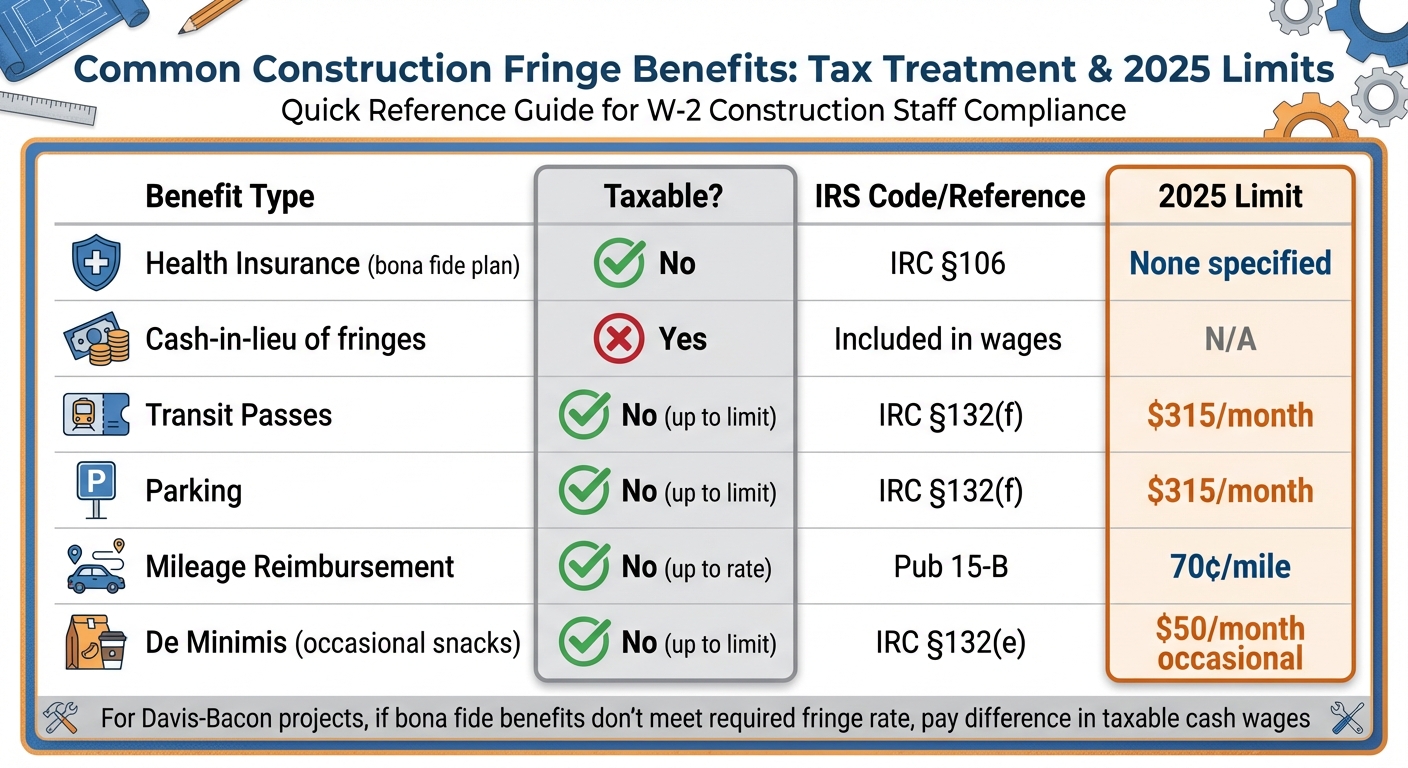
Below is a quick reference table summarizing common construction benefits and their tax treatment:
| Benefit Type | Taxable? | IRS Code/Reference | 2025 Limit |
|---|---|---|---|
| Health Insurance (bona fide plan) | No | IRC §106 | None specified |
| Cash-in-lieu of fringes | Yes | Included in wages | N/A |
| Transit Passes | No (up to limit) | IRC §132(f) | $315/month |
| Parking | No (up to limit) | IRC §132(f) | $315/month |
| Mileage Reimbursement | No (up to rate) | Pub 15‑B | 70¢/mile |
| De Minimis (occasional snacks) | No (up to limit) | IRC §132(e) | $50/month occasional |
For Davis-Bacon projects, if the value of bona fide benefits doesn’t meet the required fringe rate, employers must pay the difference in taxable cash wages. This adjustment must also be reflected in certified payroll reports.
Accurate valuation and clear reporting practices are essential to prevent compliance missteps.
Preventing Common Mistakes
Once fringe benefits are properly valued, the next step is ensuring accurate reporting and classification. Late or missed W-2 reporting can result in IRS penalties. Employers are required to include the value of taxable fringe benefits in wages and report them by January 31, 2026. Misclassifying employees or incorrectly allocating benefits can lead to tax discrepancies, back pay issues, and even audits. For example, treating W-2 employees as 1099 independent contractors denies them fringe benefits required under Davis-Bacon. This misclassification can result in back pay, additional taxes (including 50% of the employer’s FICA share), and Department of Labor audits.
Another common pitfall is using incorrect valuation methods. Failing to apply FMV, overlooking IRS valuation rules, or misallocating benefit costs per hour or per employee can create major problems. On certified payroll reports, contractors sometimes fail to separate the base hourly wage from fringe benefits. For instance, reporting a combined $57 instead of breaking it into a $45 base wage and $12 in fringes violates Davis-Bacon requirements.
To stay compliant and avoid these issues, employers should adopt a consistent valuation process. Here are some practical steps:
- Set up a year-round fringe valuation calendar and document all taxable and excludable benefits monthly.
- Recalculate fringe credits after open enrollment periods when benefit costs change.
- Use payroll software to automatically track bona fide contributions versus cash payments.
- Train payroll staff on IRS Publication 15-B valuation rules.
- Keep thorough documentation, such as plan details, contribution records, and allocation worksheets, to demonstrate compliance during audits.
Year-End Compliance Checklist for 2025
Review and Update Benefits Records
Ensure all fringe benefit valuations are completed and payroll records updated by December 31, 2025, to meet the W-2 deadline on January 31, 2026. This includes gathering and reconciling payroll and benefit records, such as health insurance premiums, pension contributions, and vacation pay accruals. Cross-check these details with Davis-Bacon prevailing wage requirements for each project. If there are any shortfalls in required fringe benefits, make sure they are covered through taxable cash wages.
Verify that employee-specific fringe values align with project wage determinations, ensuring total amounts meet or exceed the required hourly rates. Pay special attention to mid-year adjustments, as the 2025 WH-347 form now requires more detailed fringe benefit information – like plan numbers, hourly credits, and funding status – making accurate year-end reconciliation even more critical.
Reconcile fringe expense and liability accounts with recorded contributions for each employee and benefit type. For Davis-Bacon projects, ensure the total hourly fringe credits reported on certified payrolls match contributions made to bona fide benefit plans or cash paid in lieu of benefits. Keep documentation, such as trust fund statements or invoices, readily available, as these are often requested during audits. Additionally, maintain written fringe benefit policies, plan documents, union agreements, and prevailing wage determinations on file to support your compliance during IRS or DOL reviews.
By streamlining these manual tasks, you can reduce the risk of errors and delays.
Simplifying Year-End Processes with ABLEMKR

Modern technology can help ease the burden of manual year-end compliance tasks. ABLEMKR’s platform is designed to tackle the challenges of managing fringe benefits across multiple projects. Its integrated payroll workflows and real-time compliance tracking automate calculations, certified payroll generation, and W-2 preparation. The system ensures that workers’ certifications align with Davis-Bacon requirements, while automatically tracking benefit hours – like health insurance and pension contributions – and applying geo-location-based wage adjustments for different project sites.
This mobile-first platform provides real-time insights into worker status and contribution records, eliminating common manual errors during year-end reviews. With embedded compliance tracking, the system generates audit-ready reports that break down hourly fringe benefits – for instance, $3 per hour for health insurance and $2.50 per hour for pension contributions – ensuring totals align with prevailing wage rates. By centralizing fringe benefit management, ABLEMKR helps construction companies meet the December 31 valuation deadline and produce accurate W-2 forms, avoiding the usual last-minute stress.
Conclusion
Managing fringe benefits for W2 construction staff requires careful and ongoing documentation. Employers must determine the exact value of all fringe benefits by December 31 to ensure proper tax withholding and accurate W-2 reporting by January 31. For contractors involved in Davis–Bacon or prevailing wage projects, certified payroll reports now need to include specific fringe benefit details – such as plan numbers, hourly credit values, and funding status – under the updated 2025 WH-347 form. This adds another layer of complexity to an already intricate process.
Tracking benefits like health insurance, pensions, and vacation pay across various job sites and wage determinations can be a logistical challenge, often introducing compliance risks. Missteps in fringe allocations are a common cause of audit failures. To stay compliant, contractors must maintain thorough, audit-ready records that prove fringe contributions were deposited accurately, on time, and at the correct rates. Each certified payroll hour must also be clearly linked to the corresponding benefit deposits.
Technology offers a way to simplify these challenges, transforming compliance into an operational strength. Automated systems can handle fringe credit calculations, certified payroll generation, record reconciliation, and W-2 preparation, reducing the risk of manual errors. Real-time tracking of worker certifications and benefit hours ensures consistency and accuracy across projects.
ABLEMKR’s mobile-first platform streamlines these processes by automating fringe benefit calculations and producing compliant certified payrolls. By integrating hiring, onboarding, payroll workflows, and compliance tracking into a single system, construction companies gain real-time insights into worker statuses and contribution records. The platform also automatically tracks benefit allocations and generates audit-ready reports that meet prevailing wage requirements, helping contractors meet December 31 deadlines without unnecessary stress.
Managing fringe benefits effectively not only safeguards your business but also ensures fair compensation for employees and positions your company as a strong competitor on federally funded projects.
FAQs
What happens if fringe benefits for construction employees are reported incorrectly?
Misreporting fringe benefits for construction employees can lead to some hefty consequences for employers. These include financial penalties, back taxes, and even the risk of legal action. On top of that, mistakes in reporting can attract attention from tax authorities, potentially resulting in audits and more compliance headaches.
But it’s not just about the money. Missteps in reporting can damage a company’s reputation and weaken trust – both with employees and regulatory bodies. Getting the details right is crucial to sidestep these issues and keep operations running smoothly.
What steps can construction companies take to comply with the Davis-Bacon Act’s fringe benefits requirements?
Construction companies can meet the requirements of the Davis-Bacon Act by properly managing and documenting fringe benefits like health insurance, retirement contributions, vacation pay, and holiday pay. These benefits must at least match the prevailing wage rates outlined by the Act.
To ensure compliance, employers should:
- Accurately track wages and benefits to verify they meet federal standards.
- Keep thorough records of all employee wages and benefits.
- Stay updated on federal regulations to adapt to any changes in requirements.
Leveraging workforce management tools can make this process easier. These tools can automate payroll, monitor certifications, and ensure benefits are distributed correctly, helping companies comply with legal obligations more efficiently.
How can technology help ensure compliance with fringe benefits for construction employees?
Technology platforms like ABLEMKR simplify fringe benefits compliance for construction projects by providing tools such as real-time worker status tracking, integrated payroll workflows, and built-in compliance monitoring. These features not only help employers meet legal obligations but also streamline workforce management.
With ABLEMKR, employers can easily onboard workers, keep track of certifications, and manage benefits with precision. This minimizes administrative headaches while ensuring compliance and timely payments for employees.


