
Temp agencies in Florida must follow strict workers’ compensation laws to avoid legal and financial risks. Here’s what you need to know:
- Who Needs Coverage: Non-construction businesses with 4+ employees (including temps) must carry workers’ comp. Construction businesses need coverage for 1+ worker.
- Misclassification Penalties: Misclassifying workers as independent contractors can result in fines up to $25,000 per worker, plus back taxes and penalties.
- Premium Rates: Insurance costs vary by job risk. High-risk construction roles can cost $80 per $100 of payroll, while clerical jobs are far cheaper.
- Compliance Challenges: Agencies must manage coverage gaps, correctly classify workers, and handle disputes with client companies.
Failing to comply can lead to hefty fines, lawsuits, and stop-work orders. Proper classification, accurate payroll records, and verifying subcontractor insurance are key steps to staying compliant.
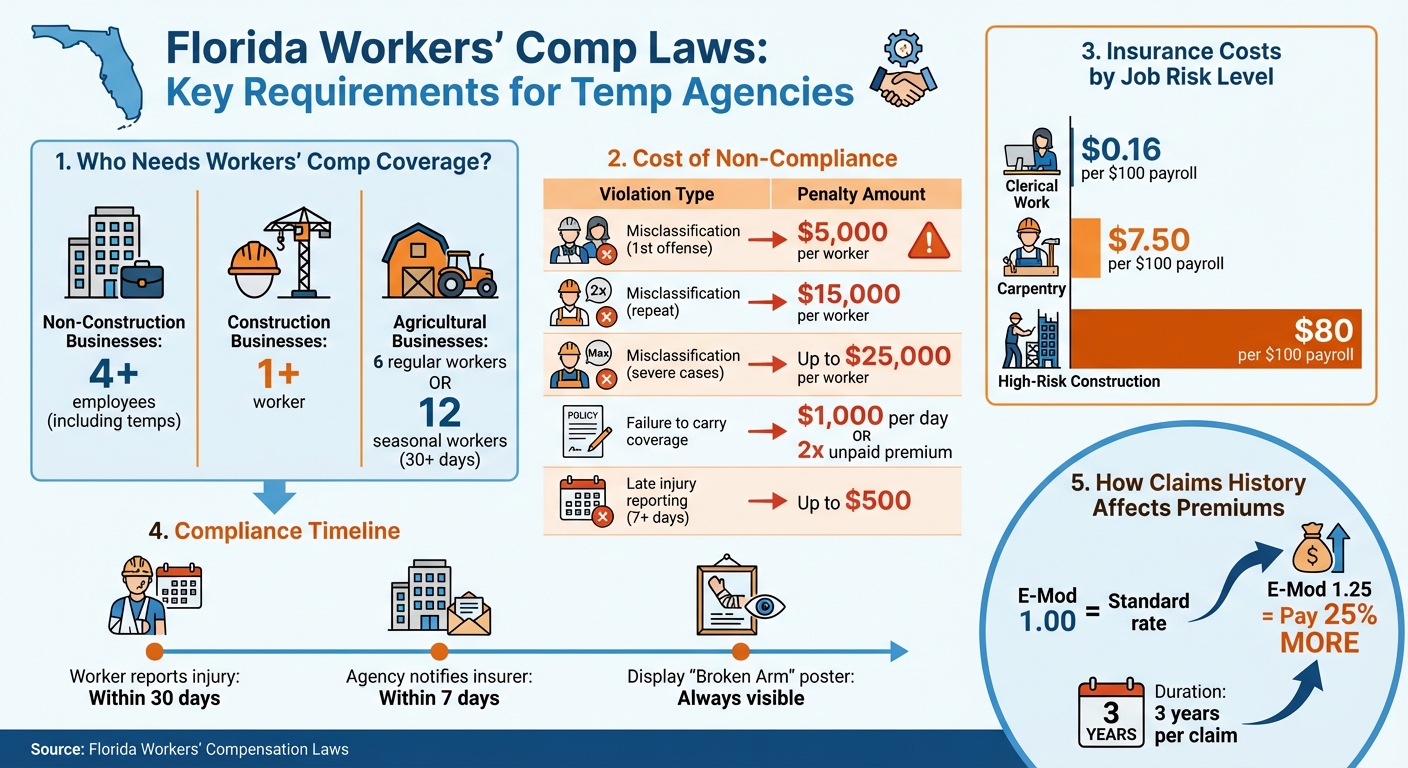
Florida Workers’ Comp Coverage Requirements and Penalty Costs for Temp Agencies
Common Workers’ Comp Compliance Problems for Florida Temp Agencies
Here’s a closer look at the common compliance challenges Florida temp agencies face when it comes to workers’ compensation.
Required Coverage Based on Employee Numbers
Florida law requires non-construction businesses with four or more employees – including temp workers and corporate officers – to carry workers’ comp coverage, unless exemptions apply. For example, having three permanent staff members and one temp worker would trigger the coverage requirement. The rules are even stricter for construction-related placements: agencies placing just one worker at a construction site must secure coverage. Ignoring these rules can be costly, with penalties starting at $1,000 per day or twice the unpaid premium, along with potential stop-work orders.
Incorrect Classification of Temporary Workers
Misclassifying temp workers as independent contractors is a major compliance issue. Under Florida law, temp workers are considered employees – not independent contractors. This distinction is especially critical in construction, where workers are classified only as employees or business owners, with no room for independent contractor status.
Misclassification can lead to serious consequences during payroll audits. If an insurer finds that a worker was misclassified or uninsured, they may retroactively add the worker’s entire pay to your payroll and charge back premiums. Beyond financial penalties, you could lose the "exclusive remedy" protection that shields employers from lawsuits. This means an injured misclassified worker could sue in civil court for damages, including pain and suffering. Getting worker classifications right is essential to avoid financial and legal pitfalls.
Correct Job Classification and Risk-Based Premium Rates
Assigning the correct NCCI code to each worker is another crucial step in managing compliance. Insurance premiums are based on the actual tasks a worker performs – not their job title. For instance, a Project Manager who spends time on a construction site might be reclassified from a clerical code to a higher-risk construction code. If duties are mixed in worklogs, insurers often apply the highest-rated classification to all pay, which can significantly increase costs.
The difference in rates can be staggering. Clerical work might cost around $0.16 per $100 of payroll, while carpentry could cost roughly $7.50 per $100. On top of this, your claims history plays a role through the Experience Modification Rate (E-Mod). An E-Mod above 1.00 raises premiums (e.g., a score of 1.25 means paying 25% more). Since this multiplier stays in effect for three years, a single serious claim can drive up costs for an extended period. Proper job classification and managing claims are key to keeping premiums under control.
How to Fix Workers’ Comp Compliance Problems
Now that you’ve pinpointed potential compliance challenges, it’s time to tackle them with practical solutions. Here’s how to stay aligned with Florida law and avoid costly issues.
Tracking Coverage Requirements and Getting Insurance
Keep a close eye on your employee count. In Florida, non-construction businesses need workers’ comp coverage once they reach four employees (including temps), while construction companies require coverage for even a single worker.
For businesses with fluctuating staff levels, pay-as-you-go insurance can be a smart option. Instead of estimating annual payroll, premiums are based on actual payroll figures, which helps manage cash flow and reduces the risk of surprise audit bills. Jeff Sandy, Vice-President of Workers’ Compensation Brokerage at Jencap Insurance Services, advises:
"As a business, you are still able to purchase workers’ compensation coverage for your employees. It can be through the State Fund or private insurers that don’t have minimum employee requirements".
To avoid fines, report any offsite-treatment injury within seven days – failure to do so can result in penalties of up to $500. Also, make sure the required "Broken Arm" poster is displayed in a visible area, including your insurance provider’s contact information.
Once your insurance is in place, focus on correctly classifying your workforce.
Using Compliance Tools to Classify Workers Correctly
Proper worker classification is crucial for staying compliant and managing costs. Use NCCI four-digit class codes to match job duties accurately. Detailed records that separate hours by job function can prevent insurers from applying higher-rated classifications across your entire payroll during audits.
If you’re unsure about a classification code, reach out to the National Council on Compensation Insurance (NCCI) at 1-800-622-4123 for guidance. Florida also provides free resources like the Proof of Coverage database to confirm subcontractor insurance and the Exemption Search tool to verify valid exemptions for business owners.
Before work begins, always review Certificates of Insurance (COIs) for subcontractors. If a subcontractor lacks coverage, their workers could become your responsibility during an audit. For agencies based outside Florida, ensure that "Florida" is explicitly listed in Section 3A of the workers’ compensation policy to cover employees working in the state.
Using ABLEMKR for Compliance Management

Platforms like ABLEMKR simplify compliance management, reducing risks tied to worker misclassification. ABLEMKR automates processes like identity verification, background checks, and I-9 compliance. By using a W-2 employment model, the platform eliminates the risk of misclassifying workers as independent contractors, which can lead to fines of up to $5,000 per worker.
Additionally, ABLEMKR tracks site-specific certifications, such as OSHA 10/30 or trade licenses, and flags expiring credentials. GPS-verified time tracking ensures workers are present on-site, providing an accurate audit trail for payroll and compliance reporting.
The platform’s all-in bill rates – typically 30% to 70% above the worker’s gross wage – cover payroll taxes, workers’ compensation insurance, and general liability. This helps agencies avoid unexpected costs from misclassifications or lapses in coverage.
sbb-itb-aa28329
Florida Temp Agency Compliance Checklist
Here’s a streamlined checklist to help your agency meet Florida’s workers’ compensation requirements.
- Verify Your Coverage Thresholds
If you’re a non-construction agency with four or more employees (including temps), workers’ compensation insurance is mandatory. For construction agencies, coverage is required even if you employ just one person. Agricultural businesses need coverage if they employ six regular workers or 12 seasonal workers for 30 days or more. - Classify Workers Correctly
Temporary workers should always be classified as employees of your agency, not independent contractors. They must meet the three-prong test: being free from agency control, working outside your core business, and engaging in an independent trade. Misclassification can lead to fines – $5,000 per worker for a first offense and $15,000 for repeat violations. - Match Coverage to Job Risk
Assign the correct NCCI four-digit class codes to each worker based on their job. Higher-risk roles, like those in construction, typically come with higher premiums than office positions. If your agency operates out of state, ensure that "Florida" is explicitly listed in Section 3A of your policy, and use Florida-approved classification codes and rates. - Set Up Dual Reporting for Injuries
Create a system where injured workers report incidents to both your agency and the client site supervisor immediately. Keep in mind, workers must report injuries within 30 days, and your agency must notify your insurance carrier within seven days. Missing these deadlines could result in claim denials and penalties of up to $500. - Confirm Subcontractor Coverage
Before subcontractors begin work, verify their workers’ compensation coverage. Use Florida’s Proof of Coverage database or review their Certificates of Insurance. Ensuring their coverage is current protects your agency from potential liability.
This checklist is a practical tool for staying compliant and reducing legal risks tied to workers’ compensation.
Conclusion
For temp agencies in Florida, staying on top of workers’ comp compliance isn’t just about following the rules – it’s a cornerstone of running a successful business. Meeting coverage thresholds and avoiding penalties is non-negotiable, and getting worker classifications right is equally critical. Missteps here can lead to hefty fines and unexpected costs. This makes it clear: handling both coverage and classification with care is essential.
As Candace Jenkins, a Licensed Insurance Advisor, explains:
"Knowing the laws and requirements surrounding workers’ compensation is essential to running a smooth operation".
Being proactive in compliance doesn’t just keep you out of trouble – it also shields your agency from lawsuits, work stoppages, and unforeseen liabilities. For example, verifying subcontractor coverage through Florida’s official database and keeping payroll records accurate aren’t just formalities – they’re steps toward building a stronger, more resilient operation. Additionally, the exclusive remedy rule ensures that proper coverage protects your business from personal injury lawsuits, offering an extra layer of security.
Tools like ABLEMKR take the hassle out of compliance by automating W-2 employment verification, payroll tax management, and credential tracking. Features like GPS-verified timesheets and automated credential tracking ensure that only qualified and insured workers are on the job, reducing errors and saving time. This allows you to focus on growth rather than scrambling to meet compliance deadlines.
The takeaway: workers’ comp isn’t just a regulatory requirement – it’s how Florida temp agencies safeguard their teams, their projects, and their bottom line. By staying ahead of the rules and using the right tools, you can keep your agency running smoothly and successfully.
FAQs
Who pays workers’ comp when a temp is injured – the agency or the client?
In Florida, staffing agencies are generally responsible for providing workers’ compensation benefits if a temporary worker gets injured on the job. This is because, under state law, the agency is recognized as the official employer of record.
How can a temp agency prove the correct NCCI class codes during an audit?
To ensure the correct NCCI class codes are used during an audit, a temp agency must keep accurate and detailed payroll records, along with proper employee classifications and documentation. These records should clearly reflect the company’s primary business activities, as class codes are determined by the main operations of the business – not by individual employee tasks. Well-organized and transparent documentation helps maintain compliance and makes the audit process smoother.
What records should we keep to avoid coverage gaps and penalty disputes?
Employers need to keep detailed and accurate records of worker classifications, employment agreements, payroll data, safety training, certifications, and their expiration dates. It’s crucial to hold onto these records for a minimum of three years. Doing so helps avoid potential coverage gaps and disputes over penalties.


