
When hiring in Florida, classifying workers as 1099 contractors or W2 employees has serious tax and legal implications. Misclassification can lead to fines, back taxes, and even felony charges. Here’s the core difference:
- W2 Employees: Employers handle tax withholdings (e.g., Social Security, Medicare), pay unemployment taxes (FUTA, SUTA), and provide benefits like workers’ compensation. Employees receive a W-2 form for tax filing.
- 1099 Contractors: Independent workers manage their own taxes, including the 15.3% self-employment tax, and file quarterly estimated payments. They typically receive a 1099-NEC form.
Florida has no state income tax, but compliance with federal tax laws and state-specific rules like reemployment tax and workers’ compensation is mandatory. Employers must also report all workers earning $600+ annually to the state within 20 days. Missteps can lead to audits, penalties, and legal disputes.
Quick Comparison:
| Aspect | W2 Employee | 1099 Contractor |
|---|---|---|
| Tax Withholding | Employer handles | Worker handles |
| Social Security/Medicare | 7.65% (matched by employer) | 15.3% (self-employment tax) |
| Unemployment Tax (SUTA) | Paid by employer | Not applicable |
| Workers’ Compensation | Provided by employer | Worker secures own coverage |
| Tax Forms | W-2 | 1099-NEC (if paid $600+) |
Proper classification ensures compliance, avoids penalties, and aligns with both state and federal laws. Misclassification risks include back taxes, fines, and legal challenges.
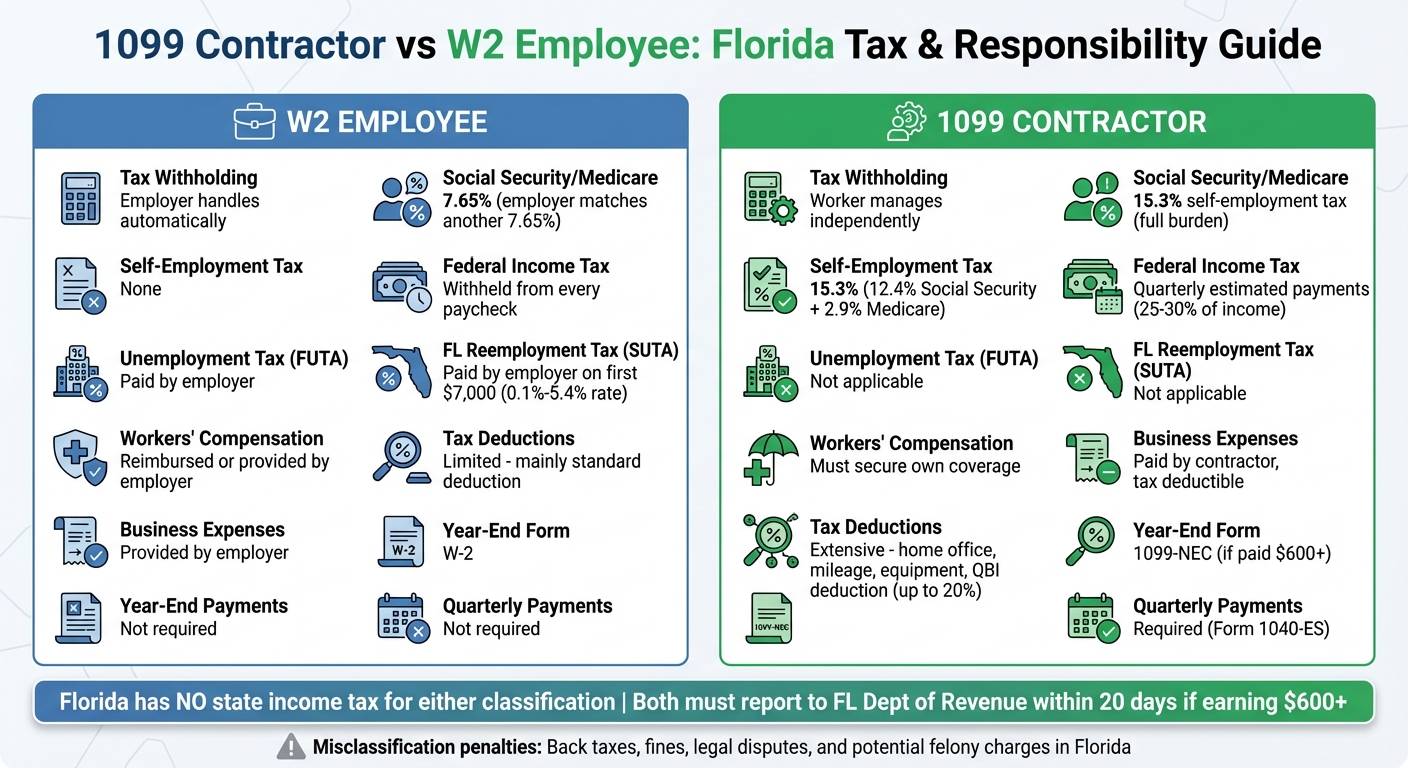
1099 Contractor vs W2 Employee Tax Comparison in Florida
1099 vs W2
sbb-itb-aa28329
Tax Responsibilities: 1099 Contractors vs W2 Employees
When it comes to taxes, 1099 contractors and W2 employees in Florida have distinct responsibilities. While neither group pays state income tax, the way federal taxes are handled – and who takes care of them – varies significantly. Let’s break it down.
1099 Contractor Tax Requirements
If you’re an independent contractor in Florida, you’re in charge of managing your own federal taxes. This includes paying the 15.3% Self-Employment Tax (SECA), which covers both the employer and employee portions of Social Security (12.4%) and Medicare (2.9%). And that’s on top of your regular federal income tax.
"Independent contractors are responsible for their own taxes, therefore employers are not required to pay employment taxes or to withhold state, federal, or local taxes from paychecks to independent contractors." – Ayo and Iken
Contractors must also make quarterly estimated tax payments using Form 1040-ES, setting aside about 25–30% of their gross income to cover federal taxes. Missing these quarterly deadlines can lead to IRS penalties for underpayment. If you earn $600 or more from a client in a tax year, they’ll send you a Form 1099-NEC by January 31. It’s essential to classify your work correctly to avoid potential IRS penalties and compliance issues.
W2 Employee Tax Requirements
For W2 employees, the employer takes care of most tax-related tasks. Federal income tax, along with the employee’s 7.65% FICA share (6.2% for Social Security and 1.45% for Medicare), is automatically withheld from each paycheck. Employers match this amount, contributing an additional 7.65%.
Employers also pay Federal Unemployment Tax (FUTA) and Florida Reemployment Tax (SUTA) on behalf of their employees. In Florida, SUTA applies to the first $7,000 of an employee’s wages, with rates ranging from 0.1% to 5.4% for experienced employers, while new employers pay 2.7%. By January 31, employees receive a Form W-2 summarizing their wages and withholdings for the tax year.
Tax Responsibilities Comparison Table
| Tax/Obligation | W2 Employee | 1099 Contractor |
|---|---|---|
| Federal Income Tax | Withheld from every paycheck by employer | Paid via quarterly estimated payments |
| Florida State Income Tax | None | None |
| Social Security & Medicare | 7.65% paid by employee; 7.65% matched by employer | 15.3% paid by contractor (Self-Employment Tax) |
| Unemployment Tax (FUTA) | Paid by employer | Not applicable |
| FL Reemployment Tax (SUTA) | Paid by employer on first $7,000 of wages | Not applicable |
| Business Expenses | Usually reimbursed or provided by employer | Paid and deducted by contractor |
| Year-End Reporting | Form W-2 | Form 1099-NEC (if paid ≥$600) |
This table highlights the key differences in tax responsibilities, showing why proper worker classification is so important. Missteps can lead to serious tax and legal consequences for both workers and employers.
Tax Deductions and Credits by Worker Type
When it comes to reducing taxable income, the options available to workers vary greatly depending on whether they are classified as 1099 contractors or W2 employees. Each group navigates a distinct set of rules and opportunities for deductions.
Deductions for 1099 Contractors
Independent contractors have the advantage of deducting a wide range of business-related expenses using Schedule C. These deductions can significantly lower taxable income and include costs like home office expenses, business mileage, equipment purchases, professional development, and advertising expenses. Additionally, many contractors qualify for the Qualified Business Income (QBI) deduction, which allows eligible self-employed individuals to deduct up to 20% of their qualified business income.
Another key tax break for contractors is the ability to deduct the employer-equivalent portion of the self-employment tax (7.65%) when calculating adjusted gross income. This helps offset the burden of paying the full 15.3% self-employment tax.
"As a 1099 contractor, you receive more tax deductions like business mileage, meal deductions, home office expenses, and work phone and internet costs… Therefore, contractors might end up paying fewer taxes than a traditional employee would." – Coworking Resources
However, despite these opportunities, many freelancers miss out on potential savings. Roughly 77% fail to claim available deductions, often because they aren’t sure which expenses qualify. To maximize deductions, meticulous record-keeping is essential – think mileage logs, receipts, utility bills, and measurements for home office space. This highlights the importance of proper classification to ensure workers can take advantage of the deductions they’re entitled to.
Deductions for W2 Employees
For W2 employees, the options for deductions are much more limited. Most rely primarily on the standard deduction, as the majority of unreimbursed work-related expenses are no longer deductible under current federal tax laws.
However, the 2025 "One Big Beautiful Bill" introduced Schedule 1-A, which offers some additional deductions for W2 employees. These include deductions for qualified tips, overtime pay, car loan interest, and a special deduction for seniors aged 65 and older. While these additions provide some relief, they pale in comparison to the variety of deductions available to contractors. For this reason, W2 employees are often encouraged to seek direct reimbursement from their employers for work-related expenses, as these reimbursements are typically tax-free.
Deductions and Credits Comparison Table
| Deduction/Credit | 1099 Contractor | W2 Employee |
|---|---|---|
| Business Expenses | Deductible (e.g., home office, tools, travel, equipment) | Generally not deductible (unless reimbursed by employer) |
| Self-Employment Tax Deduction | Can deduct 7.65% (employer-equivalent portion) | Not applicable |
| QBI Deduction | Up to 20% of qualified business income | Not applicable |
| Health Insurance Premiums | Deductible as a business expense | Typically provided pre-tax by the employer |
| Retirement Contributions | Higher limits via SEP-IRA or Solo 401(k) | Limited to employer 401(k) or IRA limits |
| Standard Deduction | Available | Available |
| Schedule 1-A Deductions (2025) | Not applicable | Qualified tips, overtime pay, car loan interest, seniors 65+ |
Since Florida does not impose a state income tax, these deductions only impact federal taxable income. However, correctly classifying workers is still essential for other state-level obligations like workers’ compensation and reemployment tax. These differences in deductions further underline the importance of accurate worker classification, especially when addressing compliance requirements at the state level.
Florida Tax Rules and Requirements
No State Income Tax in Florida
Florida’s tax structure is unique because it does not impose a state income tax on W2 employees or 1099 contractors. This absence of state income tax is a significant benefit for workers, but it doesn’t eliminate federal tax responsibilities. Both W2 employees and 1099 contractors are still required to adhere to federal tax laws.
For W2 employees, federal taxes – including income tax, Social Security, and Medicare – are automatically deducted from their paychecks. On the other hand, 1099 contractors are responsible for managing their federal tax obligations independently. This includes making quarterly estimated tax payments and covering the 15.3% self-employment tax. To avoid financial surprises, experts often recommend that contractors set aside 25% to 30% of their earnings to cover federal income and self-employment taxes, as their clients do not withhold any taxes on their behalf.
Additionally, independent contractors who provide taxable services in Florida must collect a 6% state sales tax, along with any applicable local surcharges. They are required to report and remit these taxes using Form DR-15. These tax-related responsibilities highlight the distinct differences between W2 employees and 1099 contractors, which also extend to employment protections.
Workers’ Compensation and Employment Laws
Florida’s employment laws further differentiate the obligations of employers toward W2 employees and independent contractors. Employers are required to provide workers’ compensation coverage for their W2 employees, ensuring protection in case of workplace injuries while also shielding employers from lawsuits. Independent contractors, however, typically need to secure their own coverage. The rules are stricter in the construction industry, where all workers must be covered regardless of their classification. Misclassifying workers intentionally is treated as a felony in Florida and can result in severe penalties, including fines and back taxes.
Another employer responsibility is the Florida Reemployment Tax (formerly unemployment tax), which applies to W2 employees. The tax rate ranges from 0.1% to 5.4% on the first $7,000 of wages, with new employers generally paying a rate of 2.7%. This tax does not apply to 1099 contractors, as they are not eligible for unemployment insurance. Worker classification in Florida is determined using the "right to control" test, as outlined in Florida Statute 440.02. This test evaluates whether the employer controls the methods used to achieve results rather than just the outcome itself.
"The main test that Florida uses to determine whether or not an individual is an independent contractor is the ‘right to control’ test." – Travis Peeler, Attorney & LegalMatch Legal Writer
Since October 1, 2021, Florida businesses have been required to report all new workers – both W2 employees and independent contractors earning $600 or more annually – to the Florida Department of Revenue. This must be done within 20 days of the worker’s start date or first payment. Failing to meet this deadline can result in penalties ranging from $25 to $500 per worker. For industries like construction, where proper workforce management is crucial, these regulations underscore the importance of accurate worker classification and compliance with employment laws.
Worker Misclassification: IRS Standards and Penalties
IRS Classification Criteria
The IRS applies Common Law Rules to decide whether a worker qualifies as a 1099 contractor or a W2 employee. This determination hinges on three key areas: behavioral control, financial control, and the type of relationship between the worker and the business.
- Behavioral Control focuses on how much direction the business has over the worker’s tasks. This includes instructions about when and where to work, the tools or equipment to use, specific procedures to follow, and any training provided.
- Financial Control examines whether the business manages the financial aspects of the worker’s role, such as reimbursed expenses, investment in tools or facilities, and whether the worker can experience profits or losses.
- Type of Relationship evaluates how the business and worker perceive their arrangement. Factors include written agreements, benefits like insurance or vacation pay, the duration of the relationship, and whether the worker’s services are integral to the business.
"In determining whether the person providing service is an employee or an independent contractor, all information that provides evidence of the degree of control and independence must be considered." – Internal Revenue Service
For example, in March 2024, the Department of Labor illustrated this with a skilled welder in the construction industry. In one situation, the welder, who followed assigned tasks without making independent business decisions, was classified as an employee. In another, the welder operated independently, bidding on projects and working with multiple clients, which indicated contractor status. This highlights that having specialized skills doesn’t automatically make someone a contractor. Independence in business decisions is key.
No single factor determines a worker’s status. Instead, the IRS looks at the overall nature of the relationship. Employers are encouraged to document their decisions carefully. If there’s uncertainty, they can file Form SS-8 with the IRS to request an official ruling, though this process typically takes six months or more. These criteria are not just guidelines – they directly impact the penalties businesses face for misclassification.
Misclassification Penalties and Risks
Misclassifying workers isn’t just a technical error – it comes with serious financial and legal consequences. Beyond tax issues, it can affect compliance with safety and labor laws.
If the IRS finds that a worker was wrongly classified as a contractor, the employer may owe unpaid federal income tax withholding, both shares of Social Security and Medicare taxes (FICA), and Federal Unemployment Tax (FUTA). In Florida, this also triggers audits for the Florida Reemployment Tax, potentially resulting in large back payments plus interest.
The risks don’t end there. Misclassification can lead to workers’ compensation issues. Florida employers are required to provide workers’ comp for employees. A misclassified contractor who gets injured could sue for personal injury or lead to state penalties for failing to provide coverage. Additionally, misclassified workers often miss out on minimum wage and overtime pay, which can result in back-wage claims and liquidated damages under the Fair Labor Standards Act (FLSA).
| Risk Category | Consequences |
|---|---|
| Tax Liability | Unpaid Social Security, Medicare, and federal income tax withholding |
| Unemployment Tax | Liability for unpaid Federal Unemployment Tax (FUTA) on wages |
| Legal Penalties | Fines and penalties under Internal Revenue Code section 3509 |
| FLSA Violations | Failure to pay minimum wage or overtime under DOL standards |
| Workers’ Comp | Personal injury lawsuits and state fines for lack of coverage |
It’s important to note that a signed contract cannot override the actual nature of the working relationship. Workers cannot "agree" to be classified as 1099 contractors if their role meets the criteria for employee status. However, employers can take advantage of the Voluntary Classification Settlement Program (VCSP) to reclassify workers as employees moving forward. This program offers partial relief from federal employment taxes for those who qualify.
Conclusion
Knowing the difference between 1099 contractors and W2 employees is crucial for both employers and workers in Florida. This classification determines tax responsibilities, eligibility for benefits, legal protections, and overall financial planning. While Florida’s lack of state income tax simplifies certain aspects, federal regulations and state-specific rules – like those covering workers’ compensation and unemployment – still require close attention. These distinctions impact not just individual tax obligations but also an employer’s legal duties.
For employers, correctly classifying workers isn’t optional. Missteps can lead to audits, back taxes, significant penalties, and even legal disputes over unpaid wages or benefits. The IRS bases classification on factors like task control and financial arrangements. To avoid issues, businesses should regularly review worker roles and keep thorough documentation of classification criteria.
Worker classification also affects day-to-day flexibility and benefit access. 1099 contractors gain independence and control over their work but must manage quarterly estimated tax payments and shoulder the full 15.3% self-employment tax burden. They typically don’t receive employer-provided benefits like health insurance, retirement plans, or workers’ compensation coverage. Meanwhile, W2 employees benefit from tax withholding, access to employer-sponsored benefits, and protections under wage and hour laws. However, they usually have less freedom in how they perform their work.
In industries like construction and energy, where misclassification is a common issue, compliance can be especially challenging across multiple job sites. Tools like ABLEMKR simplify this process by offering integrated payroll, real-time worker status tracking, and compliance features. This includes meeting Florida’s 20-day reporting requirement for contractors paid $600 or more, helping businesses deploy skilled labor efficiently while staying within legal boundaries.
Proper classification isn’t just about avoiding penalties – it ensures fair treatment for workers and smooth operations for employers. Whether you’re hiring your first contractor or managing teams across states, understanding these rules and leveraging compliance tools can save time, money, and headaches in the long run.
FAQs
How can I tell if someone should be W-2 or 1099 in Florida?
In Florida, deciding whether a worker falls under the W-2 or 1099 classification hinges on the degree of control and independence within the working relationship. The primary considerations include how much the employer dictates the work process and whether the worker provides services to other businesses. Florida’s guidelines emphasize these factors to accurately assess the relationship and determine the appropriate classification.
What taxes do I need to set aside as a 1099 contractor?
As a 1099 contractor, you’re responsible for handling federal taxes, including self-employment tax (which covers Social Security and Medicare). The good news? If you’re in Florida, there’s no state income tax, so that’s one less thing to worry about. Make sure to calculate and set aside enough for these federal taxes to stay on top of your tax responsibilities.
When do Florida businesses have to report new hires and contractors?
Florida businesses are required to report new hires and independent contractors within 20 days of either making the first payment or signing the agreement. This rule has been in place since October 1, 2021.


