
Renewable energy is growing fast, but it comes with fire risks that can harm infrastructure, workers, and communities. Here are the main hazards and ways to address them:
- Battery Thermal Runaway: Overheating in lithium-ion batteries can cause fires that are hard to extinguish and release toxic gases. Solutions include early detection sensors, modular designs, and proper cooling systems.
- Electrical Faults in Solar Systems: Faulty wiring, design flaws, and arcs in DC components can ignite fires. Regular inspections, proper installation, and shutdown mechanisms help prevent these issues.
- Transformer Failures: Overloading and environmental stress can lead to fires in power systems. Maintenance, thermal imaging, and protective barriers are key to reducing risks.
- Combustible Materials and Poor Installation: Flammable materials in solar panels and improper setups increase fire risks. Use non-flammable materials and ensure installations meet safety standards.
- Poor Maintenance and Vegetation: Overgrown plants and loose connections can fuel fires. Regular maintenance, vegetation control, and debris removal are essential.
Key Takeaway: Fire safety in renewable energy facilities requires thorough inspections, proper installation, and adherence to safety codes like NFPA 70 and NFPA 855. These steps protect assets and ensure safer operations.
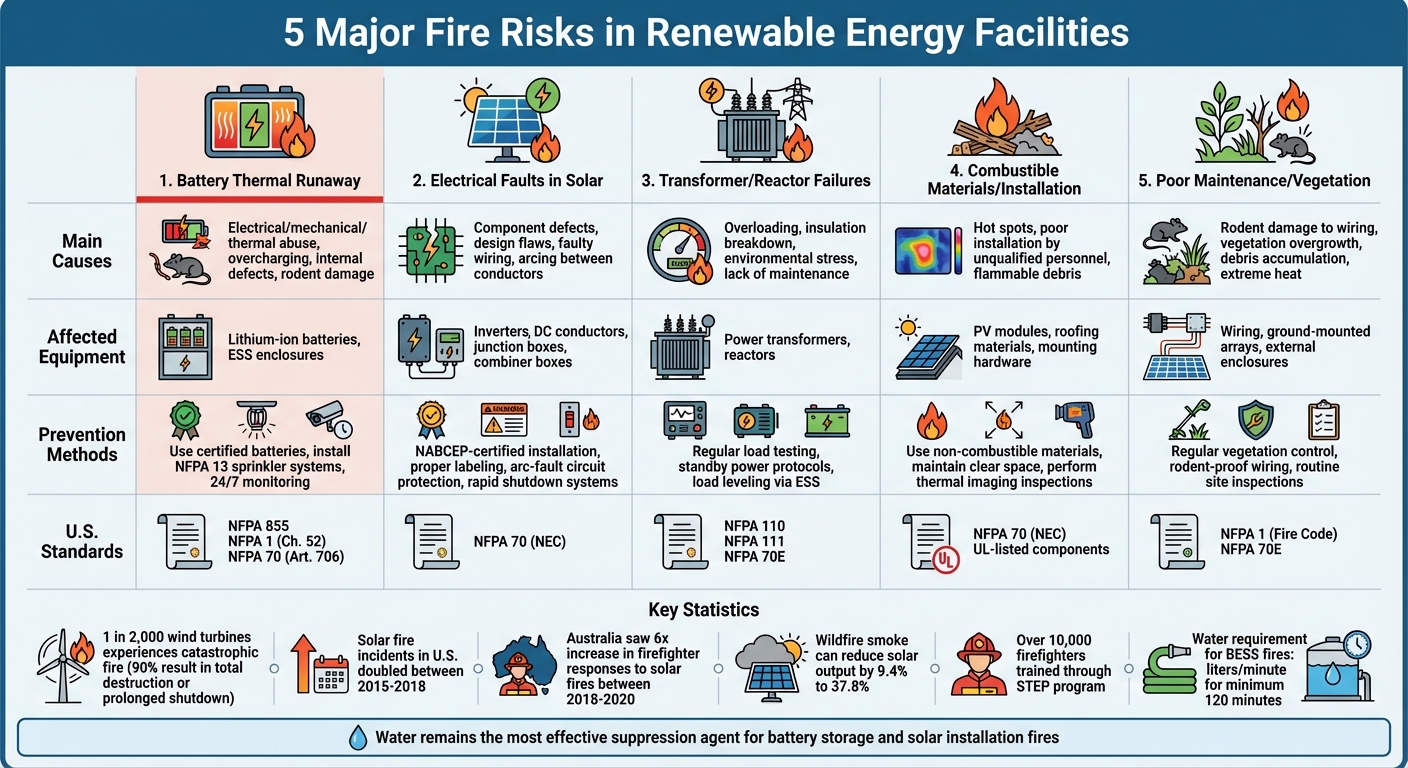
5 Major Fire Risks in Renewable Energy Facilities: Causes, Prevention, and Safety Standards
1. Battery Thermal Runaway in Energy Storage Systems
Fire Risk Severity
Battery thermal runaway is one of the most serious fire hazards in renewable energy facilities. It happens when a lithium-ion cell overheats to the point where it triggers a self-sustaining fire. What makes this particularly dangerous is that traditional firefighting methods, like using water, often fall short. Water can’t penetrate the internal layers of the battery cells, meaning the chemical reactions driving the fire continue unchecked.
These fires are tough to deal with – they can burn for days and even reignite after appearing to be out. On top of that, thermal runaway releases toxic substances such as hydrogen fluoride, carbon monoxide, and metal particulates, creating significant risks for both emergency responders and nearby communities.
Primary Causes
Water intrusion is one of the key culprits behind thermal runaway in battery storage systems. A striking example occurred in December 2025 at a facility in Warwick, New York. Heavy rainfall led to water seeping into the system, resulting in its third fire in just two years.
Electrical faults and short circuits in lithium-ion cells are another major trigger. When a single cell fails, the heat it generates can quickly spread to neighboring cells, creating a domino effect that impacts entire battery racks or containers. High ambient temperatures and poor ventilation make things worse by preventing proper heat dissipation.
These risks underline the importance of careful design and operational safeguards.
Affected Renewable Components
Thermal runaway primarily affects lithium-ion battery cells, the racks that hold them, and DC components within Battery Energy Storage System (BESS) containers. As battery storage systems continue to grow across the U.S. to support renewable energy and stabilize the grid, ensuring the safety of these components becomes increasingly important.
Recommended Mitigation Strategies
To address these risks, several strategies can be implemented:
- Install aspirating smoke and carbon monoxide sensors inside BESS containers to detect issues early.
- Opt for modular cabinet designs rather than large walk-in containers. This approach not only improves firefighting access but also helps limit the spread of thermal runaway.
- Ensure adequate spacing between battery containers and add thermal barriers between batteries and switchgear to prevent fire spread. Watertight construction is also essential.
- Provide dedicated air conditioning or ventilation systems to regulate internal temperatures and reduce the buildup of flammable gases.
- Equip facilities with a water supply capable of delivering at least 1,900 liters per minute for a minimum of 120 minutes.
Fire departments are increasingly turning to controlled burn techniques when dealing with BESS fires. The National Fire Chiefs Council explains:
"The prevailing view when it comes to firefighting tactics is to adopt a ‘controlled burn’ to minimise runoff whilst protecting the surrounding area from flame and heat impingement."
This approach aims to manage the fire while minimizing environmental and safety risks.
2. Electrical Faults in Solar Farm Inverters and DC Components
Fire Risk Severity
After battery thermal runaway, electrical faults in solar systems rank as another major fire hazard.
The primary risk comes from electrical arcs. These arcs, occurring between conductors or to the ground, generate intense heat capable of igniting flammable materials. DC arrays, in particular, carry a unique arc-flash risk.
The U.S. Department of Energy highlights the issue:
"Design flaws, component defects, and faulty installation can cause a rooftop solar system to start a fire. As with all electrical systems, these problems can cause arcs between conductors or to the ground, as well as hot spots, which can ignite nearby flammable material."
Primary Causes
Human error is the leading cause of fire risks in solar systems. Mistakes like design flaws, poorly manufactured components, and improper installation practices are more common culprits than outright equipment failure. Faulty wiring and weak connections can lead to hot spots, increasing the likelihood of fires. Environmental factors such as extreme heat and intense sunlight further add stress to electrical components. Additionally, the glass surfaces of PV modules are prone to mechanical and thermal wear over time. These risks directly impact several critical system components.
Affected Renewable Components
Key components like inverters, DC arrays, wiring, conductors, and PV modules are particularly vulnerable to electrical faults. Prolonged exposure to environmental conditions can degrade these parts. On the DC side, the challenge is even greater, as these systems often remain energized even when they are not actively generating electricity.
Recommended Mitigation Strategies
To minimize risks, installations should be handled by NABCEP-certified professionals and adhere to NEC standards.
Preventive actions include:
- Regular thermal imaging inspections to detect hot spots before they escalate into fire hazards.
- Clear labeling of power lines to enable first responders to shut down systems quickly.
- Installation of functional shutdown mechanisms that comply with NEC requirements.
- Periodic testing and commissioning of DC arrays to identify potential arc-flash risks.
The Solar Training and Education for Professionals (STEP) program has trained over 10,000 firefighters and fire code officials to handle solar equipment safely. The U.S. Department of Energy emphasizes:
"Shutting down PV systems in accordance with the National Electric Code requirements will protect consumers and first responders".
3. Transformer and Reactor Failures in Power Systems
Fire Risk Severity
Failures in transformers and reactors present a serious fire hazard. They can ignite nearby flammable materials and create dangerous situations if water is used for fire suppression, as it can conduct electricity and pose a shock risk. Hot spots within these components can reach ignition temperatures, further increasing fire risks. Additionally, live electrical parts heighten the danger to personnel, especially during firefighting efforts.
Primary Causes
Several factors can lead to transformer and reactor failures. Overcharging, discharging, and exceeding voltage ratings place enormous stress on these components, often leading to breakdowns. Environmental conditions, including extreme heat, flooding, seismic events, and even rodent damage, can weaken their electrical integrity. Faulty installation, manufacturing defects, and poor maintenance schedules also contribute to the development of dangerous hot spots. Misuse of power systems further accelerates wear and tear, increasing the likelihood of failure and compounding risks across interconnected systems.
Affected Renewable Components
Key components in renewable energy systems, such as power transformers, reactors, high-voltage switchgear, and associated wiring, are particularly vulnerable. These elements are critical in wind farms, solar installations, and battery storage facilities, where they handle large electrical loads and operate continuously. The combination of electrical and environmental stressors makes them prone to failure, adding to the fire risks already associated with battery and solar systems.
Recommended Mitigation Strategies
To reduce risks, several measures are recommended:
- Certified Installation: Ensure installations are performed by NABCEP-certified professionals and comply with NFPA 70 (National Electrical Code) and NFPA 1 (Fire Code) standards.
- Thermal Imaging Inspections: Conduct regular thermal imaging to detect hot spots early, preventing potential fires.
- Proper Labeling: Clearly label all power lines to help first responders quickly isolate hazards during emergencies.
- External Risk Mitigation: Install flood barriers, seismic reinforcements, and rodent-proofing to protect against environmental threats.
- Safe Firefighting Practices: When using water on electrical sources up to 1,000 volts DC, maintain a distance of at least 5 feet and use an adjustable nozzle set to a 10° fog pattern to minimize shock risks.
These strategies not only address immediate risks but also contribute to the long-term safety and reliability of power systems.
4. Combustible Materials and Poor Installation in Solar Panels
Fire Risk Severity
Solar panels are made with materials like plastics and polymers that can fuel fires and release harmful byproducts. For example, crystalline-silicon, cadmium telluride, and copper indium selenide modules can emit lead, cadmium, and selenium when burning. Beyond the panels, components like cabling and inverters can also catch fire. Fires involving these systems not only worsen due to material degradation but also create debris, which poses risks to first responders. The high voltages in these systems – up to 1,000V for residential setups and 1,500V for industrial ones – further increase the danger. Many of these risks arise from improper installation, which is explored next.
Primary Causes
Faulty installation practices, such as loose wiring and improper integration of components like inverters, cabling, and meter cupboards, significantly raise fire risks. When industry safety standards like NFPA 855 or UL 9540 are ignored, critical fire prevention measures are often missing. Additionally, solar panels integrated into roofs or building façades can influence how fires spread across a structure, making precise installation techniques essential. These oversights highlight the importance of adhering to strict safety protocols when setting up renewable energy systems.
Affected Renewable Components
While all types of solar panels are susceptible to fire risks, the hazards vary depending on the technology. Crystalline-silicon panels, thin-film cadmium telluride modules, and copper indium selenide modules release different toxic substances when exposed to flames. Other system components, such as inverters, cabling, meter cupboards, and roof-mounted hardware, can also contribute to fire risks if not installed or maintained properly. Since these systems are interconnected, a failure in one part can lead to issues across the entire setup.
Recommended Mitigation Strategies
To minimize risks, regular inspections should focus on securing loose wiring near inverters and roof components to prevent electrical malfunctions. In the event of a fire, the system should be isolated by shutting off the meter cupboard, though residual voltage remains a hazard. The CTIF emphasizes:
"Assume that there is always voltage on the solar panels."
Firefighters should maintain a safe distance of at least 1.6 feet (0.5 meters) when spraying live solar components and 3.3 feet (1 meter) when working within a bound radius. Compliance with standards like NFPA 855 and UL 9540 is essential, and facilities should consider using thermal infrared cameras for real-time heat monitoring to catch potential issues before they escalate. Due to the release of harmful metals and toxic gases like hydrogen fluoride and hydrogen cyanide during fires, responders should wear self-contained breathing apparatuses and monitor for these substances.
sbb-itb-aa28329
5. Poor Maintenance and Vegetation Management
Fire Risk Severity
Neglecting maintenance and allowing vegetation to grow unchecked can create a hazardous situation for renewable energy sites. Dry grass, fallen branches, and debris around solar panels and wind turbines act as fuel, turning minor electrical faults into devastating wildfires. Statistically, one in every 2,000 wind turbines experiences a catastrophic fire, with 90% of these incidents either destroying the turbine entirely or causing prolonged shutdowns, resulting in major financial losses. Solar facilities face similar challenges. In the U.S., solar-related fire incidents more than doubled between 2015 and 2018, and in Australia, firefighter responses to solar fires increased sixfold between 2018 and 2020. Poor maintenance only amplifies these risks, making fire hazards even more severe.
Primary Causes
One major issue is loose electrical connections, which can lead to dangerous overheating. For example, in 2023, a fire broke out at the Lem Kaer Wind Park in Denmark. A Vestas V112 3.0 MW turbine caught fire after a circuit breaker overheated due to a connection that wasn’t properly tightened or had loosened from vibration. Similarly, at the West Union Rexville wind farm in New York, a lightning strike ignited hydraulic oil residue on turbine blades. Investigators found that poor maintenance of a bolted connection in the lightning protection system caused an arc, resulting in 150 days of downtime and $2.2 million in losses.
Other causes include mechanical wear from inadequate lubrication, which can create friction sparks. Overgrown vegetation also adds to the danger by accumulating conductive dust and debris that can infiltrate electrical components like inverters, leading to electrical arcing and thermal runaway.
Affected Renewable Components
Certain components in renewable energy systems are particularly vulnerable to maintenance lapses. For wind turbines, nacelles, circuit breakers, and lightning protection systems are at high risk. In solar facilities, inverter housings can fail when moisture and debris compromise insulation and safety distances. Aging infrastructure often lacks modern fire suppression or lightning protection systems, making it even more susceptible as components deteriorate. This is especially concerning for areas like Canada, where 80% of Indigenous communities are located in fire-prone forests, and in 2023, 42% of wildfire evacuations occurred in these communities.
Recommended Mitigation Strategies
To reduce these risks, rigorous maintenance and vegetation management are essential. For smaller sites, clear vegetation around the perimeter and use non-combustible materials like concrete or gravel. Larger solar farms can benefit from creative solutions, such as employing livestock like sheep to manage grass growth, which not only reduces fuel loads but also cuts maintenance costs.
Thermal imaging inspections can help identify hot spots in electrical connections before they ignite. Lightning protection systems should be regularly inspected to ensure bolted connections are secure and free from hydraulic oil residue. For solar inverters, choosing models with appropriate "pollution degree" ratings (ranging from Degree 1 to 4) ensures they can handle environmental contaminants. Regular maintenance checks should also focus on preventing water ingress and removing conductive dust from factory-sealed power heads.
After nearby wildfires, cleaning solar modules of ash and debris is critical to maintaining efficiency. Wildfire smoke alone can reduce solar power output by 9.4% to 37.8%, even if the facility itself isn’t physically damaged.
Solar+Battery Storage Fire Safety Part 1: Residential and Commercial Solar+Storage (6.4.25)
Fire Risk Comparison Table
The table below outlines five major fire risks associated with renewable energy facilities. It highlights the causes, affected equipment, prevention strategies, and relevant U.S. standards. These details aim to help prioritize fire safety measures and ensure compliance with established guidelines.
Water remains the most effective suppression agent for fires in both battery storage systems and solar installations. For lithium-ion battery fires, NFPA 855 mandates the use of automatic sprinkler systems designed in accordance with NFPA 13, capable of delivering large volumes of water for effective cooling.
Proper installation is another key factor in fire prevention. Installers certified by the North American Board of Certified Energy Practitioners (NABCEP) are trained to meet wiring, grounding, and arc-fault protection standards outlined in NFPA 70 (National Electrical Code). Additionally, the Solar Training and Education for Professionals (STEP) program has trained over 10,000 firefighters across the U.S., equipping them with the knowledge to handle solar equipment emergencies.
| Fire Risk | Main Cause | Affected Equipment | Prevention Methods | U.S. Standards & Suppression |
|---|---|---|---|---|
| Battery Thermal Runaway | Electrical, mechanical, or thermal abuse; overcharging; internal defects; rodent damage | Lithium-ion batteries, ESS enclosures | Use certified batteries; install NFPA 13 sprinkler systems; 24/7 monitoring | NFPA 855, NFPA 1 (Ch. 52), NFPA 70 (Art. 706); water cooling via automatic sprinklers |
| Electrical Faults in Solar | Component defects; design flaws; faulty wiring; arcing between conductors | Inverters, DC conductors, junction boxes, combiner boxes | NABCEP-certified installation; proper labeling; arc-fault circuit protection; rapid shutdown systems | NFPA 70 (NEC); water application per NEC/NFPA guidelines |
| Transformer/Reactor Failures | Overloading; insulation breakdown; environmental stress; lack of maintenance | Power transformers, reactors | Regular load testing; standby power protocols; load leveling via ESS | NFPA 110, NFPA 111, NFPA 70E; standard industrial fire suppression |
| Combustible Materials/Installation | Hot spots; poor installation by unqualified personnel; flammable debris near panels | PV modules, roofing materials, mounting hardware | Use non-combustible materials; maintain clear space around equipment; perform thermal imaging inspections | NFPA 70 (NEC); UL-listed components; minimum firefighting access distances |
| Poor Maintenance/Vegetation | Rodent damage to wiring; vegetation overgrowth; debris accumulation; extreme heat | Wiring, ground-mounted arrays, external enclosures | Regular vegetation control; rodent-proof wiring; routine site inspections | NFPA 1 (Fire Code), NFPA 70E; vegetation management and post-wildfire cleaning |
A unique challenge with battery storage systems is stranded energy – a condition where damaged batteries remain energized even after a fire is extinguished. This creates ongoing risks of electric shock and potential reignition, which can occur hours, days, or even weeks later. To address this, damaged cells require continued cooling and secure storage in non-combustible containers during post-incident recovery.
These insights emphasize the importance of consistent safety measures across all renewable energy facilities to mitigate fire risks effectively.
Conclusion
Renewable energy facilities face five major fire risks: battery thermal runaway, electrical faults in solar components, transformer failures, combustible installation materials, and inadequate maintenance. These hazards can result in severe damage, injuries, and operational downtime, making robust safety protocols and vigilant monitoring absolutely critical.
Regular inspections and strict compliance with fire safety codes are the cornerstones of effective fire prevention. As the U.S. Department of Energy points out, "A PV system that is properly installed by a qualified vendor should not introduce any significant risk to your home". Proper installation, combined with ongoing monitoring, significantly reduces the likelihood of fire incidents while ensuring adherence to OSHA and NFPA standards.
Fires in renewable energy systems demand specialized responses. Lithium-ion batteries, for example, can reignite long after the initial fire is extinguished. Damaged systems may retain stranded energy, creating persistent shock hazards. In addition, wind turbine nacelles can release toxic gases during a fire, underscoring the need for emergency evacuation plans and comprehensive worker training.
Timely workforce support is another key to addressing these challenges. ABLEMKR provides a solution by enabling the rapid deployment of pre-vetted, certified professionals. By matching personnel based on credentials like NABCEP certification, location, and availability, facilities can ensure installations, inspections, and emergency responses are handled by qualified experts. This targeted approach helps mitigate the risks of improper installation – one of the leading causes of solar-related fires – while maintaining compliance with safety standards.
As the renewable energy industry continues to grow, prioritizing fire safety becomes increasingly important. Water remains the most effective suppression method for battery and solar fires, and ongoing firefighter training enhances preparedness. Long-term fire safety in renewable energy facilities ultimately depends on a combination of strict safety code adherence, regular maintenance, and immediate access to certified professionals.
FAQs
How can renewable energy facilities prevent battery thermal runaway?
Preventing battery thermal runaway in renewable energy facilities demands thoughtful preparation and proactive strategies. Start by using certified lithium-ion battery packs and maintaining a minimum of 2 feet of separation between batteries and any flammable materials. This spacing minimizes the risk of fire spreading.
Incorporate active battery-management systems to keep a constant eye on temperature and charge levels. Pair these systems with proper cooling and ventilation to prevent overheating.
It’s also crucial to install fire-suppression systems specifically designed for battery storage. Regularly inspecting and maintaining electrical components ensures everything stays in working order. Together, these measures significantly reduce risks and promote the safe operation of energy storage systems.
What steps can solar farm operators take to reduce the risk of electrical faults causing fires?
Solar farm operators can minimize fire risks caused by electrical faults by focusing on routine inspections and preventive maintenance of wiring, connections, and equipment. It’s crucial to ensure that every component adheres to the latest National Electrical Code (NEC) standards to maintain both safety and compliance.
Incorporating advanced fault detection systems – like ground-fault and arc-fault detectors – combined with proper grounding and protective devices, can greatly reduce the likelihood of electrical issues leading to fires. Taking these proactive steps not only improves safety but also safeguards valuable infrastructure and the well-being of personnel.
What are the key maintenance practices to prevent fire risks in renewable energy facilities?
Regular maintenance plays a crucial role in reducing fire risks at renewable energy facilities. Key steps include inspecting photovoltaic (PV) modules, wiring, and junction boxes for any signs of loose connections, corrosion, or damaged insulation. It’s equally important to confirm proper grounding and bonding. For battery energy storage systems (BESS), teams should test the battery management system (BMS), keep an eye on cell voltages and temperatures, and ensure fire suppression systems and ventilation pathways are working as intended. Additionally, removing dust from panels and heat sinks, tightening fasteners, and using infrared scans to spot potential hot spots can significantly lower fire hazards.
Having trained personnel is essential to meet fire safety standards like NFPA 855 and OSHA guidelines. Maintaining detailed logs, scheduling regular inspections, and relying on certified technicians for repairs are all critical measures. Platforms such as ABLEMKR can simplify this process by helping companies quickly deploy skilled workers, track certifications, and ensure compliance, even in high-risk or remote areas.


