
Root Cause Analysis (RCA) workshops are structured sessions aimed at identifying and addressing the underlying reasons behind problems or incidents. The goal is not just to fix immediate issues but to prevent them from recurring by resolving system-level flaws. Here’s a quick breakdown of what makes an RCA workshop effective:
- Clear Focus: Define the problem with a precise problem statement.
- Right Team: Include frontline staff, subject matter experts, and data analysts.
- Neutral Facilitation: Focus on facts, not blame, to encourage open discussions.
- Systematic Tools: Use methods like Fishbone diagrams, 5 Whys, and Barrier Analysis to identify root causes.
- Action-Oriented: Assign specific tasks to address root causes and track progress.
The process involves gathering evidence, brainstorming causes, analyzing findings, and implementing solutions. Skilled facilitation and the use of appropriate tools ensure the workshop leads to meaningful, long-term improvements. By focusing on systems rather than individuals, RCA workshops help organizations improve safety, efficiency, and overall processes.
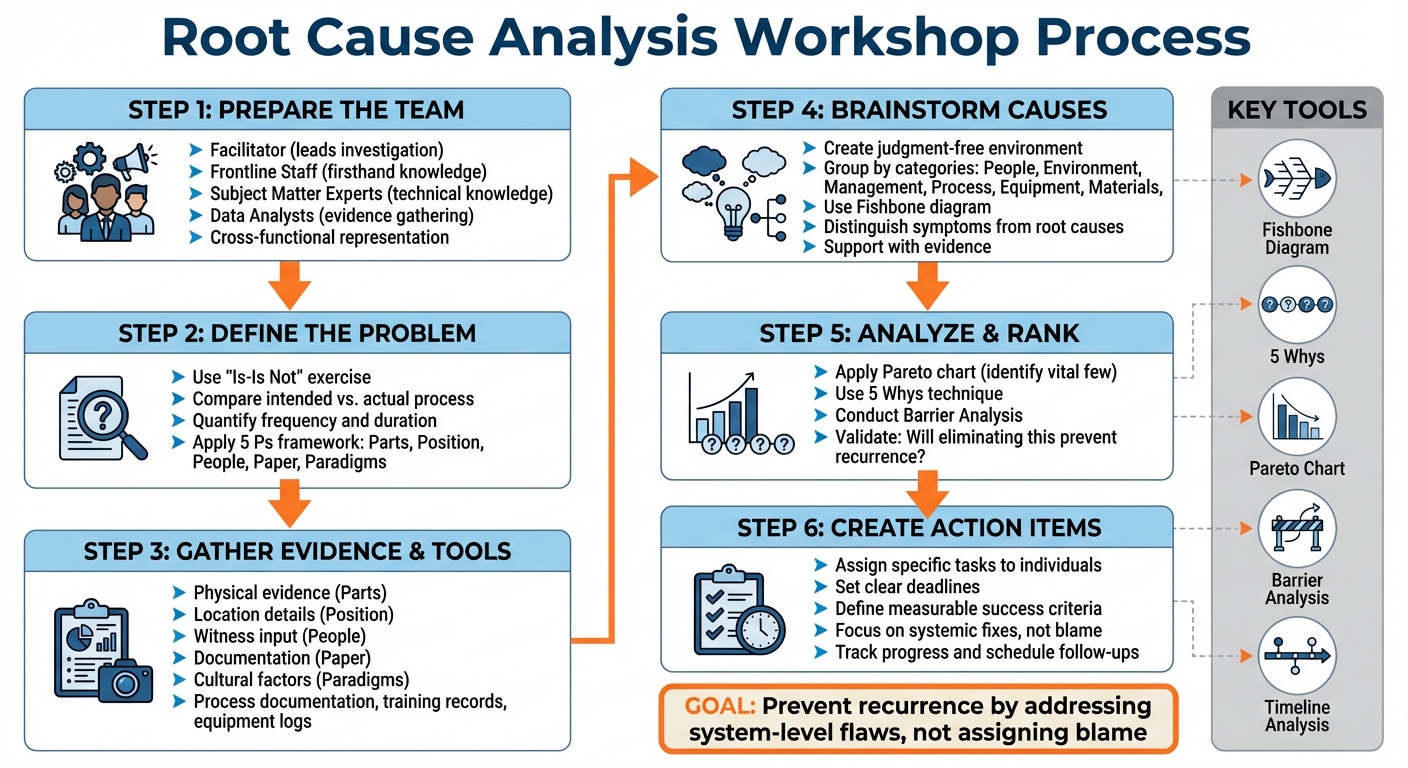
Root Cause Analysis Workshop Process: 6-Step Framework
Preparing for a Root Cause Analysis Workshop
Selecting the Right Team Members
The success of a Root Cause Analysis (RCA) workshop depends heavily on assembling the right team. A facilitator is essential to lead the group and oversee the investigation process. Beyond the facilitator, your team should include three key roles: frontline staff who are directly involved with the issue, subject matter experts with technical knowledge, and data analysts skilled in gathering and interpreting evidence.
Frontline staff bring firsthand knowledge of how processes actually work compared to how they are intended to function. As Coursera Staff highlights:
Without involving team members who have direct experience and expertise related to the problem you are trying to solve, you may miss out on key context
Subject matter experts contribute their specialized understanding of the systems or processes involved. Meanwhile, data analysts focus on identifying contributing factors and evaluating the effectiveness of potential solutions.
It’s also important to build a cross-functional team. Including both management and frontline staff ensures the focus stays on systemic issues rather than placing blame on individuals. Striking a balance between technical skills – like data analysis – and interpersonal skills – such as communication and problem-solving – can help avoid pitfalls like confirmation bias, where people only seek evidence that supports their preexisting beliefs. To ensure comprehensive representation, consider categories such as People, Environment, Management, Process, and Equipment when forming your team.
Once your team is in place, the next step is to create a solid foundation by drafting a clear problem statement.
Writing a Clear Problem Statement
A clear problem statement is the backbone of a productive RCA workshop. It provides a shared understanding of the issue and keeps the team focused on identifying root causes. According to OSHA:
a fundamental, underlying, system-related reason why an incident occurred that identifies one or more correctable system errors
To develop this statement, start with an "Is-Is Not" exercise. This helps the team agree on what aspects of the issue will be included in the investigation and what will not. Compare the intended process – what policies or protocols dictate – with what actually happened, identifying where things diverged. Quantify the problem by gathering data on its frequency, duration, and specific challenges it creates. Using the "5 Ps" framework – Parts, Position, People, Paper, and Paradigms – ensures the statement is based on evidence rather than assumptions.
With the team and problem statement in place, the next step is to gather the tools and data needed for the analysis.
Gathering Tools and Resources
For a thorough analysis, collect evidence and tools that align with the "5 Ps" framework:
- Parts: Physical evidence related to the issue.
- Position: Details about the location and environmental factors.
- People: Input from witnesses and participants.
- Paper: Relevant documentation, such as policies and protocols.
- Paradigms: Organizational norms or cultural factors that may have influenced the situation.
You’ll also need detailed process documentation, including the policies and procedures in effect at the time of the incident. For human and environmental factors, gather data on staff competency, training records, staffing ratios, and conditions like lighting or workspace setup. Technical details, such as equipment maintenance logs and calibration settings, can provide critical context. Additionally, building a timeline of events leading up to the incident can help pinpoint where things went wrong.
Choosing the right analysis tools is equally important. For complex problems with multiple potential causes, tools like fishbone diagrams are effective. For simpler, recurring issues, the Five Whys technique can quickly identify root causes. If your team is working remotely or dealing with a particularly intricate incident, RCA software can facilitate real-time collaboration and link findings to actionable solutions. However, manual tools like whiteboards and sticky notes remain effective for brainstorming in the early stages. The key is selecting tools that fit both the problem’s complexity and your team’s workflow.
sbb-itb-aa28329
Workshop: Root Cause Analysis | Commited
Running the Workshop: Step-by-Step Process
Now that you’ve clearly defined the problem and gathered the necessary tools, it’s time to dive into the step-by-step process of running the Root Cause Analysis (RCA) workshop.
Brainstorming Possible Causes
Start by creating a judgment-free atmosphere where participants feel comfortable discussing what happened and why. The goal is to encourage open, honest dialogue without fear of blame.
Group potential causes into categories like People, Environment, Management, Process, Equipment, Materials, and Measurement. This structured approach ensures no major area is overlooked. To visualize these causes, use a Fishbone diagram, which helps map out the contributing factors in an organized way.
It’s essential to distinguish between symptoms and root causes. As noted by Baker Hughes:
The immediate or obvious cause of an incident is often a symptom of underlying causes.
For example, if equipment fails, ask deeper questions: Why did it fail? Was maintenance skipped? Did the process allow the failure to escalate? Avoid jumping to conclusions – carefully explore all potential factors. Most incidents stem from a sequence of events rather than a single issue.
Support every identified cause with solid evidence, such as documentation, witness statements, or physical data. Once you’ve outlined the potential causes, analyze and rank them to focus on the most critical systemic failures.
Analyzing and Ranking Root Causes
A Pareto chart can be a powerful tool here. It visually highlights the "vital few" causes that contribute most to the problem, helping the team prioritize what to address first.
Use the 5 Whys technique to dig deeper into systemic issues. For instance, if a worker is injured, ask why the hazard existed, why it wasn’t identified, why the safety protocol failed, and so on. Continue this process until you identify whether the root cause has been resolved or lies beyond your control.
A root cause is only legitimate if eliminating it prevents the problem from recurring. While multiple factors may play a role, focus on the ones that, when addressed, will fully resolve the issue.
Incorporate Barrier Analysis to assess existing controls, identify where they failed, and uncover performance gaps. Organize findings by their impact to isolate the factors most likely to be the true root causes. Once you’ve prioritized these root causes, the next step is to develop actionable solutions.
Creating and Assigning Action Items
For each identified root cause, create specific action items and assign them to responsible individuals. Clearly define deadlines, allocate resources, and set measurable success criteria. The emphasis should be on fixing systemic issues rather than assigning blame. Document all tasks and track progress using software or a formal monitoring system.
As ASQ wisely points out:
Root cause analysis in itself will not produce any results; it must be made part of a larger problem-solving effort for quality improvement.
Since most incidents involve multiple root causes, ensure that action items address each one rather than focusing on just a single factor. Include team members responsible for implementing the solutions in the planning process to improve the chances of success.
Put an escalation system in place to address overdue tasks and maintain momentum. Schedule follow-up reviews to evaluate the effectiveness of corrective actions using specific metrics. If the solutions fall short, reopen the RCA and adjust your approach as needed. While the ultimate goal is to address root causes, remember to resolve the immediate issue to provide relief while implementing long-term fixes.
Facilitation Techniques for Better Results
Keeping Participants Engaged and On Track
Visual tools help maintain focus. Tools like Fishbone diagrams, mind maps, and Pareto charts are excellent for presenting data and illustrating relationships in a way that keeps the entire group engaged and on the same page. Displaying key points visually not only encourages participation but also helps reduce distractions. Additionally, writing down contributions on a visible board keeps discussions targeted and minimizes off-topic chatter.
The "5 Whys" method digs deeper. This technique encourages participants to keep questioning and exploring root causes, preventing them from settling for surface-level answers.
Stick to a timed agenda. A well-structured schedule ensures the session stays productive. For instance, allocate time blocks like 5 minutes for introductions, 10 minutes for defining the problem, 10 minutes for identifying causes, 15 minutes for gathering facts, 15 minutes for narrowing focus, and 10 minutes for action planning. This approach keeps everyone aligned and ensures no step is rushed.
Managing Disruptions and Challenges
Set ground rules upfront. Begin by clarifying the purpose of the Root Cause Analysis (RCA): "to prevent recurrence, not to assign blame". As highlighted by Apollo RCA:
Purpose: To prevent recurrence, not place blame
This helps establish a supportive and constructive environment.
Address disruptions with a "parking lot." When off-topic or contentious issues arise, jot them down on a separate board or digital space for later discussion. This ensures all concerns are acknowledged without derailing the current focus. If the group fixates too quickly on a single cause, introducing a "takeaway question" can redirect the conversation toward a more comprehensive analysis.
Balance participation to avoid dominance. Structured methods, like going around the room in order, ensure everyone has a chance to contribute. Incorporating breaks at key intervals also helps maintain energy levels and prevents any one individual from monopolizing the discussion.
Challenge ideas with logic. Use "IF/Then" reasoning to test assumptions (e.g., "If Cause A and Condition B are true, then Effect C should always occur"). This encourages participants to move beyond opinions and focus on evidence-based conclusions. A group "brain dump", where all ideas are listed visually, can then help weed out theories that don’t align with the data.
Digital collaboration tools can further enhance these facilitation methods, making it easier to manage disruptions and maintain focus.
Using Technology to Improve Collaboration
Building on these strategies, technology offers powerful ways to streamline collaboration and analysis.
Move past traditional tools. While whiteboards and sticky notes are great for brainstorming, they can be hard to archive and inaccessible for remote participants. Dedicated RCA software solves these issues by providing real-time updates, remote access, and better version control. Many platforms integrate tools like Fishbone Diagrams, 5 Whys, and Logic Trees into a single digital workspace, ensuring consistency throughout the analysis.
Connect findings to actionable steps. Look for tools that allow you to assign responsibilities for specific root causes and corrective actions directly within the platform. This not only ensures accountability but also reduces the risk of overlooking critical follow-ups. Automated report generation can save time and make documentation more efficient.
For industries like construction, energy, and extractives, platforms like ABLEMKR (https://ablemkr.com) are particularly useful. When RCA identifies gaps in areas like worker certifications, safety training, or crew deployment, ABLEMKR’s mobile-first technology provides real-time visibility into worker statuses and compliance tracking. This ensures corrective actions are implemented quickly and effectively across distributed job sites, turning workshop findings into tangible improvements.
Conclusion
Summary of the RCA Workshop Process
RCA workshops follow a structured process designed to uncover the root causes behind problems: gathering the right team, clearly defining the issue, collecting evidence, identifying and validating causes, and assigning corrective actions. The ultimate aim is to dig deeper than surface-level symptoms and address the underlying system-level flaws that allowed the issue to arise.
As OSHA puts it:
A root cause analysis (RCA) is a process for finding the ultimate source of a problem (the root cause). It goes beyond the readily apparent cause and effect to pinpoint the flaws in a process or system that contributed the issue.
- OSHA
This definition highlights the importance of focusing on systemic issues rather than quick fixes. The emphasis on evidence-based discussions and avoiding blame fosters an open environment where honest dialogue thrives, paving the way for effective and trackable solutions. However, the job isn’t done until those solutions are fully implemented – this means assigning responsibility, setting deadlines, and monitoring progress to ensure the issue is resolved for good.
With the workshop process outlined, the next step is to ensure these efforts lead to lasting, meaningful change through a commitment to continuous improvement.
Building a Culture of Continuous Improvement
To sustain the benefits of RCA workshops, organizations must weave continuous improvement into their daily operations. These workshops are not just reactive tools – they can also proactively enhance safety and operational efficiency. By standardizing processes and establishing clear benchmarks, you can ensure consistent handling of critical issues and prevent them from slipping through the cracks.
Shifting the focus from "who is at fault" to "what system allowed this to happen" is key. This approach not only prevents recurring problems but also strengthens processes and reduces inefficiencies, driving long-term improvements.
For industries like construction, energy, and extractives – where safety and compliance are non-negotiable – tools such as ABLEMKR (https://ablemkr.com) can play a vital role. These platforms provide real-time tracking of worker certifications, safety training, and compliance, helping translate workshop insights into measurable improvements across multiple job sites. By leveraging such tools, organizations can turn systematic analysis into actionable, lasting progress.
FAQs
What roles are essential for a successful root cause analysis (RCA) workshop?
A successful RCA workshop brings together a small, cross-functional team equipped with the right mix of skills, authority, and practical experience. Here’s a look at the key roles that make it work:
- Facilitator: Keeps the workshop organized and on track, ensuring discussions remain focused while guiding the team through the RCA process.
- Subject Matter Expert (SME): Provides specialized technical or process-specific knowledge to help pinpoint and analyze the issue.
- Front-line Practitioner: Offers firsthand insights based on daily work, adding practical context to the problem at hand.
- Data Analyst: Translates and visualizes relevant data to support the team’s findings and decisions.
- Recorder: Captures the group’s discussions, decisions, and action items, ensuring no detail is missed.
- Decision-Maker: A manager or process owner with the authority to approve solutions and allocate resources for corrective actions.
By combining strategic oversight, technical know-how, and real-world experience, this team works together to uncover root causes and develop meaningful solutions.
How can we make root cause analysis (RCA) workshops lead to lasting improvements?
To make RCA workshops truly impactful, think of them as the launching point for an ongoing improvement journey, not just a one-off event. Start by clearly defining the issue at hand and gathering objective data beforehand to ensure everyone is aligned. Assemble a team that blends frontline workers with individuals skilled in analysis, creating a balance of practical insight and technical expertise. During the workshop, rely on proven tools like the Five Whys or Ishikawa diagrams to dig into root causes. Use a shared visual board to document findings, keeping everything transparent and organized. Then, for every root cause identified, develop corrective actions that are specific, measurable, and have clear ownership.
Once the workshop wraps up, the real work begins. Incorporate these actions into your standard operating procedures and set regular check-ins to monitor progress and tweak strategies as needed. A centralized system can be a game-changer here – tools like ABLEMKR help track timelines, assign responsibilities, and measure outcomes in real time, making it easier to stay on top of corrective actions and maintain accountability.
Don’t stop there. Share the results with everyone involved, recognize successes, and update your organization’s improvement playbook to reflect what you’ve learned. This kind of approach doesn’t just solve problems – it builds a culture of continuous learning and ensures that RCA workshops drive meaningful, lasting change.
What are the key tools and techniques for running an effective root cause analysis (RCA) workshop?
Running an effective RCA workshop means using structured tools and collaborative techniques to pinpoint and address the root causes of an issue. Some of the most commonly used tools include the 5 Whys, which helps dig deeper into problems by repeatedly asking "why" until the core issue is found, and the Ishikawa (fishbone) diagram, which organizes potential factors into categories for better analysis. Another valuable tool is the Root-Cause Map, which provides a visual breakdown of the events leading up to the problem. To prioritize causes and focus on practical solutions, facilitators often rely on methods like multivoting and the Importance-Difficulty matrix.
Facilitation techniques play a big role in keeping the workshop productive. Guided brainstorming sessions, team voting to reach consensus, and verifying findings with evidence all help maintain focus and accuracy. Digital collaboration tools can also simplify the process by allowing real-time input and documentation, making it easier to turn findings into actionable improvements. When these approaches are combined, teams can uncover overlooked factors and create solutions that are both practical and lasting.


