
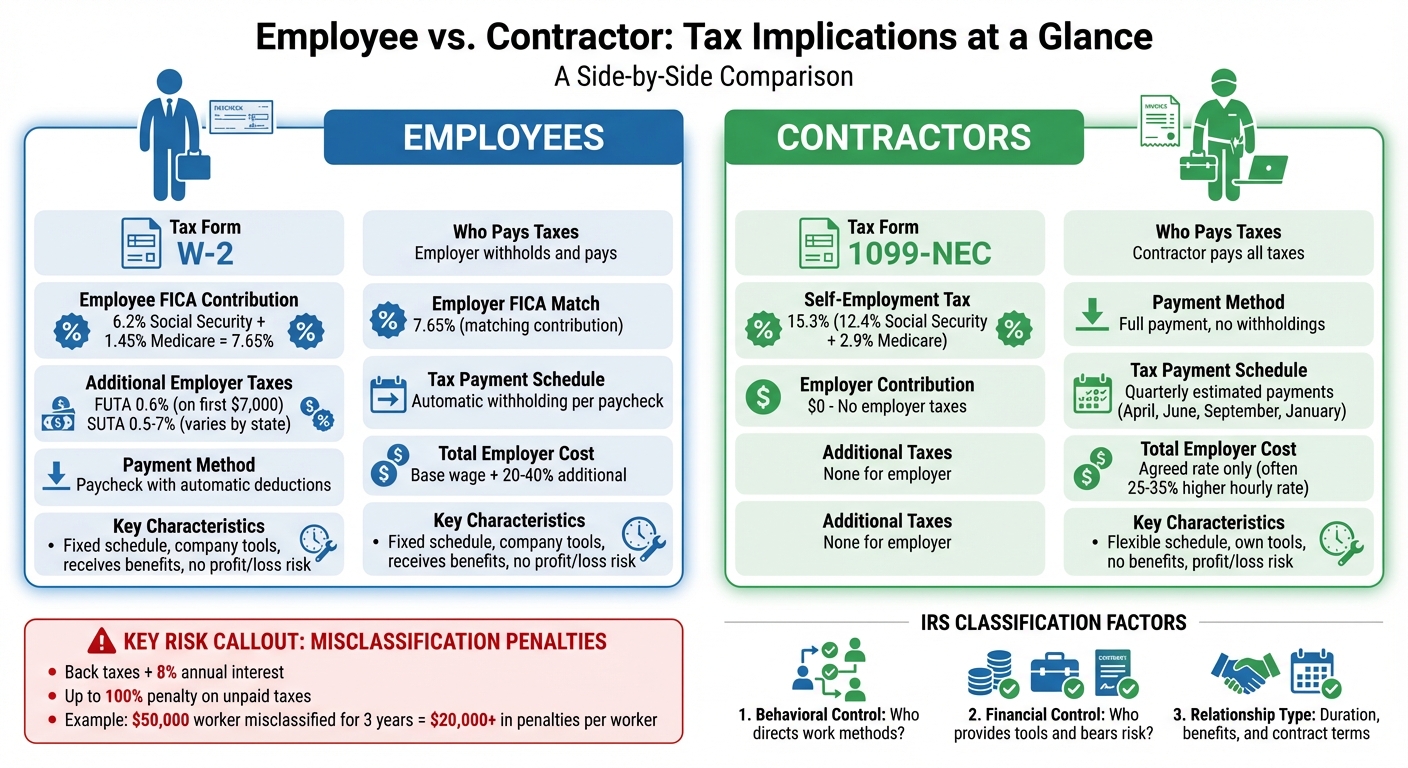
Choosing between employees and contractors impacts taxes, costs, and compliance. Here’s a quick breakdown:
- Employees: Employers are responsible for withholding income taxes, matching Social Security (6.2%) and Medicare (1.45%), and paying unemployment taxes. Employees receive a W-2 and have taxes automatically deducted.
- Contractors: Paid in full with no withholdings, contractors handle their own taxes, including a 15.3% self-employment tax. They report income using 1099-NEC forms and manage quarterly tax payments.
Key Risks: Misclassifying workers can lead to penalties, back taxes, and interest. The IRS evaluates classification based on behavioral control, financial control, and the nature of the relationship. For example:
- Employees: Follow set schedules, use company tools, and receive benefits.
- Contractors: Set their own hours, use personal tools, and work independently.
Cost Differences: Employers typically spend 20–40% more on employees due to taxes and benefits, while contractors often charge higher rates to offset self-employment taxes and lack of benefits.
Accurate classification is critical, especially in industries like construction and energy, where workforce needs shift rapidly. Missteps can result in audits and significant financial consequences.
Employee vs Contractor Tax Comparison Chart
Tax Responsibilities for Employees
What Employers Must Pay and Report
When you classify someone as an employee, you’re taking on a range of tax responsibilities that go beyond just paying their wages. For starters, employers are required to withhold federal income tax based on the employee’s W-4 form. On top of that, 6.2% of the employee’s pay is deducted for Social Security, along with 1.45% for Medicare. Employers must match these amounts from their own funds.
There are also other taxes employers need to handle. For example, the Federal Unemployment Tax Act (FUTA) requires a payment of 6% on the first $7,000 of an employee’s wages, though this rate is often reduced to an effective 0.6%. State Unemployment Tax Act (SUTA) rates vary widely, ranging from 0.5% to 7%, and apply to wages between $7,000 and $40,000, depending on state regulations and the employer’s history with unemployment claims.
Reporting is another critical part of the process. Employers must deposit withheld taxes using the Electronic Federal Tax Payment System (EFTPS). They’re also responsible for filing Form 941 every quarter, submitting Form 940 annually, and providing employees with Form W-2 by January 31. Missing deposit deadlines can lead to penalties of 0.5% per month, and late W-2 filings can result in fines as high as $630 per form.
While employers manage these behind-the-scenes tasks, employees will see these tax deductions reflected directly in their paychecks.
What Employees Pay Through Withholding
For employees, the tax process feels straightforward because employers handle the heavy lifting. Federal income tax is withheld based on the details the employee provides on their W-4 form, which factors in income and personal circumstances. Employees also contribute their share of FICA taxes – 6.2% for Social Security and 1.45% for Medicare. If an employee earns more than $200,000 as a single filer, an additional 0.9% Medicare tax is withheld. Depending on where the employee lives, state and local income taxes might also be deducted from their paycheck.
In short, while employers manage the logistics, employees see these deductions automatically applied, simplifying their tax obligations.
Employee vs Independent Contractor Tax Differences | W-2 vs 1099
Tax Responsibilities for Contractors
Unlike employees, contractors handle their own tax obligations, which requires a different approach to managing income and expenses.
Self-Employment Tax and Quarterly Payments
As an independent contractor, you’re paid the full amount for your work with no taxes withheld. This means you’re responsible for covering all your tax liabilities, including self-employment tax – a 15.3% rate that combines both the employee and employer portions of Social Security (12.4%) and Medicare (2.9%).
Self-employment tax is calculated on your net earnings, which is your gross income minus allowable business expenses. To figure this out, you’ll use Schedule SE when filing your Form 1040. If your net earnings exceed $400 in a year, the IRS requires you to pay this tax. To ease the burden, you can deduct the employer-equivalent portion (7.65%) when determining your adjusted gross income.
Since there’s no automatic withholding, you’ll need to make quarterly estimated tax payments if your total tax liability is over $1,000 for the year. These are submitted using Form 1040-ES and are generally due in April, June, September, and January. To avoid penalties for underpayment, aim to pay at least 90% of your current year’s taxes or 100% of the previous year’s taxes (110% if you’re a higher earner). A good rule of thumb is to set aside 25–30% of each payment for taxes to ensure you’re covered.
These responsibilities tie into annual and quarterly reporting, which we’ll delve into in the next section about Form 1099 requirements.
Form 1099 Requirements
If you earn $600 or more from a business in a calendar year, they’re required to send you a Form 1099-NEC by January 31. This form shows the total amount they paid you for services, with no tax withheld. To prepare for this, businesses will typically ask you to fill out a W-9 form when you start working with them, ensuring they have the necessary tax information.
When tax season rolls around, you’ll use all the 1099-NECs you’ve received to calculate your total gross income. This is reported on Schedule C of your Form 1040, where you’ll also deduct legitimate business expenses. These might include costs for tools, safety gear, mileage, home office expenses, travel to job sites, liability insurance, and professional licenses. After subtracting these expenses, the remaining amount – your net profit – is what’s subject to both income tax and self-employment tax.
It’s also crucial to report any additional income that isn’t documented on a 1099-NEC. The IRS closely monitors sectors where cash payments are common, so accurate reporting is key to avoiding any issues.
How the IRS Determines Worker Classification

The IRS uses common-law rules to classify workers, focusing on three key areas: behavioral control, financial control, and the type of relationship. Getting this classification right is critical because employers handle tax withholding and payments for employees, while independent contractors take care of their own taxes.
To make a determination, the IRS examines all aspects of the working relationship. If there’s any doubt, employers can file IRS Form SS-8 to request an official decision. Here’s how the IRS distinguishes between employees and independent contractors based on these factors:
Behavioral Control
This factor looks at how much control a business has over how, when, and where work is performed. For example, if a worker is required to follow detailed instructions, attend mandatory training, or adhere to fixed hours and specific locations, they are likely considered an employee. On the other hand, independent contractors typically decide their own methods, schedules, and work processes with little to no direct oversight.
Financial Control
Financial control examines who provides tools, handles expenses, and assumes financial risks. Employees typically rely on their employer to supply equipment, reimburse expenses, and shield them from profit or loss risks. Independent contractors, however, bring their own tools, pay their own expenses, and have the potential to profit – or lose – based on how they manage costs. For instance, in the energy industry, a contractor repairing pipelines might use their own diagnostic tools, cover travel expenses, and even subcontract work to increase their earnings. If the company provides all tools and covers expenses, that suggests an employee relationship.
Type of Relationship
The nature and length of the working relationship also play a role. The IRS looks at factors like written contracts, employee benefits (e.g., health insurance or paid leave), the expected duration of the relationship, and whether the work is central to the company’s main operations. A contract that specifies contractor status supports that classification, but if the worker receives ongoing benefits or their role is integral to the business, they are more likely an employee. Courts may also consider other elements, such as the permanency of the relationship or whether the worker can be dismissed at will.
| Factor | For Employees | For Contractors |
|---|---|---|
| Behavioral Control | Follows instructions, mandatory training, fixed hours and locations | Sets own methods and schedule, minimal oversight |
| Financial Control | Tools provided, expenses reimbursed, no risk of profit/loss | Supplies own tools, manages expenses, opportunity for profit/loss |
| Type of Relationship | Ongoing relationship, benefits provided, work is central to business | Short-term contracts, no benefits, work is non-core |
Tax Cost Comparison: Employees vs. Contractors
When comparing the costs of employees versus contractors, it’s not just about the hourly rate. Employers hiring employees take on additional expenses beyond base wages, including payroll taxes, unemployment insurance, workers’ compensation, and often benefits. On the other hand, contractors are typically paid only their agreed rate, without these extra obligations.
For employees, employers contribute 7.65% for FICA, 6% for FUTA on the first $7,000 of wages (often reduced to 0.6%), plus varying amounts for SUTA, workers’ compensation, and benefits. These added expenses generally increase employer costs by 20–40% over base wages. Contractors, however, shoulder the full 15.3% self-employment tax themselves, which often leads them to charge higher rates to offset this burden. These distinctions have a major impact on overall costs, especially in industries with fluctuating workforce needs.
Cost Breakdown with Construction and Energy Examples
To illustrate how these tax and cost differences play out, let’s look at two examples – one in construction and another in energy.
Take a construction laborer earning $30/hour for 2,000 hours per year. As an employee, their base wages total $60,000 annually. Employers then add about $4,590 for FICA (7.65%), $1,800–$3,600 for unemployment insurance and workers’ comp (depending on state and job risk), and possibly $6,000–$12,000 for health insurance and retirement benefits. This brings the total employer cost to somewhere between $72,000 and $80,000 annually. If the same worker becomes a contractor, they might charge $40/hour to account for self-employment taxes and lack of benefits. In this case, the company pays $80,000 for 2,000 hours, with no additional payroll taxes or benefits.
Now consider a pipeline inspector in the energy sector earning $70/hour as an employee. Over 2,000 hours, their annual wages amount to $140,000. The employer adds $10,710 for FICA, a few thousand more for unemployment insurance and workers’ comp, and potentially $20,000 or more in benefits for high-skill roles. This pushes the total employer cost to between $175,000 and $185,000 annually. As a contractor, the inspector might charge $95–$110/hour. At $100/hour, the company would pay $200,000 for 2,000 hours but avoid payroll taxes and benefits entirely. While the hourly contractor rate is higher, it offers flexibility and eliminates the long-term commitment of adding headcount.
Strategic Workforce Decisions
The choice between hiring employees or contractors often depends on project length and workforce utilization. For instance, a six-month commercial construction project with consistent work may favor hiring employees for key roles. In contrast, a three-week refinery shutdown justifies paying premium contractor rates, as it avoids the ongoing payroll costs between projects.
Efficient workforce management is critical in industries like construction and energy, where demands can shift rapidly. Tools such as ABLEMKR help operators make informed decisions by centralizing data on bill rates, hours worked, and compliance. This kind of real-time insight is especially valuable for high-risk, high-demand projects, enabling better planning around taxes and labor costs across a blended workforce.
sbb-itb-aa28329
Risks of Misclassifying Workers
Misclassifying workers can hit your business hard, with costs reaching tens of thousands of dollars per worker. If the IRS or Department of Labor (DOL) finds that you’ve incorrectly classified employees as independent contractors, you’ll be on the hook for unpaid employment taxes – plus interest, which typically runs around 8% annually. For instance, a worker earning $50,000 annually and misclassified for three years could cost you more than $20,000 in back taxes and penalties per worker. And that doesn’t even include potential state-level liabilities.
The financial fallout doesn’t stop there. Misclassification means you’re responsible for the full 15.3% FICA tax and 6% FUTA tax on initial wages. If you fail to withhold taxes, penalties can reach 100% of the unpaid amount. For example, one construction firm misclassified 50 laborers as contractors and ended up owing over $1 million in back taxes and penalties. In another case, an energy company faced $500,000 in DOL fines for Fair Labor Standards Act (FLSA) violations after misclassifying pipeline repair crews. These examples highlight the serious financial risks of getting worker classifications wrong.
IRS and DOL Penalties
Both the IRS and DOL impose steep penalties for misclassification. These include repayment of all owed taxes with interest, and in cases of intentional disregard, civil penalties can reach 100% of the unpaid taxes. The DOL might also require back wages, overtime, and liquidated damages, with fines of up to $1,000 per worker.
Reclassification doesn’t just mean paying penalties – it can trigger ongoing obligations. You may need to provide workers’ compensation, unemployment insurance, and even health or retirement benefits. State agencies might add penalties for unpaid state income taxes or disability insurance. On top of that, misclassified workers could sue for denied benefits, and an audit could lead to broader scrutiny of your workforce practices.
How to Stay Compliant
To avoid these risks, keep detailed records showing how your workers meet the IRS criteria for behavioral control, financial control, and the nature of the relationship. Use written agreements that clearly define contractor status, including project-based work, payment by deliverables, and the worker’s responsibility for their own tools and insurance. Conduct regular audits, especially in industries like construction or energy, where on-site control could suggest employee status. If you’re unsure about a worker’s classification, file IRS Form SS-8 for guidance and consult with CPAs or employment attorneys.
Tools like ABLEMKR can help reduce misclassification risks. By providing real-time insights into worker status, streamlining payroll, and integrating compliance tracking, ABLEMKR simplifies record-keeping and ensures certifications, project assignments, and geo-location data are documented properly.
Construction and Energy Sector Examples
Examples from the construction and energy industries clearly demonstrate how tax implications vary based on worker classification.
On-Site Laborers as Employees
In construction and energy settings, on-site workers such as laborers or rig hands are typically classified as employees. This is because employers maintain substantial control over their work. For instance, if your company sets their shift schedules, assigns specific tasks, provides safety training, and supplies the necessary equipment, these workers are considered employees rather than contractors. They usually work at a single job site, follow instructions from supervisors, and are paid hourly wages without facing risks of profit or loss.
Take, for example, a construction laborer earning $60,000 annually. Employers are responsible for withholding 6.2% for Social Security and 1.45% for Medicare, along with applicable income taxes. Additionally, the employer pays a matching 7.65% FICA contribution, plus unemployment taxes – resulting in approximately $9,180 in extra costs each year. Similarly, in the energy sector, an on-site worker like a roughneck earning $80,000 incurs employer costs of about $6,120 in FICA match, $420 in FUTA, and roughly $2,160 in state unemployment insurance, totaling over $9,000 annually.
However, not all roles in these industries fall under the employee category.
Specialized Consultants as Contractors
Specialized roles, such as energy engineers or construction safety inspectors, are often classified as independent contractors. These professionals operate autonomously, deciding how and when to complete their work. They use their own tools and software, carry their own insurance, and typically work for multiple clients on a project-by-project basis. These contracts have clear end dates, exclude employee benefits, and place the risk of profit or loss on the consultant.
For instance, a construction safety consultant earning $50,000 for a project receives the full payment without tax withholdings and is issued a Form 1099-NEC if the payment exceeds $600. After deducting $5,000 for tools and travel, their taxable income drops to $45,000, lowering their tax liability. Similarly, an energy engineer contracted for a $100,000 project deducts $20,000 in expenses, a tax benefit employees cannot access. These consultants function as independent businesses, separate from the company’s day-to-day operations.
These examples underscore the importance of accurate worker classification to effectively manage tax obligations in industries like construction and energy.
How ABLEMKR Simplifies Worker Management

Navigating worker classification in the construction and energy industries can be a real headache, especially when managing both employees and contractors. ABLEMKR takes the hassle out of this process by streamlining workforce management and ensuring tax compliance. By handling classification efficiently, it also makes hiring and payroll much smoother.
Streamlined Hiring and Onboarding
ABLEMKR’s mobile platform connects pre-vetted workers to job sites based on certifications, safety training, availability, and location. This means companies can quickly assemble crews for urgent projects – whether it’s a last-minute shutdown, a remote pipeline repair, or scheduled mine development – without the delays of lengthy vetting. Since worker qualifications are verified upfront, the platform significantly reduces the risk of misclassification.
For construction projects needing infrastructure specialists or energy operations requiring skilled workers across U.S. energy corridors, ABLEMKR ensures the right talent gets to the right job site. Its straightforward onboarding system eliminates paperwork bottlenecks, allowing workers to get started quickly while ensuring all necessary documentation is collected for tax purposes.
And it doesn’t stop there – ABLEMKR also simplifies compliance and payroll processes to keep everything running smoothly.
Automated Compliance and Payroll Tracking
Worker classification comes with its fair share of tax complexities, but ABLEMKR automates compliance and payroll tracking to make it easier. Employers gain real-time visibility into worker status through integrated payroll workflows and built-in compliance tools, helping them avoid costly IRS penalties for misclassification. The platform also simplifies time card management, making it easy to track hours worked – critical for calculating proper tax withholdings or issuing accurate Form 1099-NEC documents to contractors earning $600 or more.
The payroll system clearly separates contractor and employee tax responsibilities, ensuring workers get paid promptly while reducing administrative headaches. By automating these workflows, ABLEMKR acts as a staffing and HR partner, allowing businesses to focus on their core projects instead of drowning in tax paperwork. This all-in-one solution supports accurate classification and efficient workforce management for the construction and energy sectors.
Conclusion
Grasping the tax differences between employees and contractors is crucial, especially in industries like construction and energy, where workforce models often mix the two. Employees have taxes withheld and share FICA contributions with their employer – 6.2% for Social Security and 1.45% for Medicare – while receiving a Form W-2. On the other hand, contractors are responsible for paying the full 15.3% self-employment tax, managing quarterly tax payments, and receive a Form 1099-NEC for earnings over $600.
Misclassifying workers can lead to serious consequences. Labeling employees as contractors incorrectly may result in IRS penalties, including back taxes, interest, and fines. There are also potential Department of Labor penalties and wage-and-hour claims. The IRS examines worker relationships through specific criteria, with proper classification depending on the role and the level of oversight involved.
For businesses operating across U.S. energy corridors or large construction sites, accurate worker classification and documentation are vital. ABLEMKR offers a solution to this challenge by integrating compliance tracking, automated payroll workflows, and real-time visibility into worker status. Its mobile-first platform connects pre-vetted workers based on certifications and location, minimizing the risk of misclassification while enabling quick crew deployment for tasks like shutdowns, pipeline repairs, or mine development.
Instead of getting overwhelmed by tax paperwork and audits, construction and energy firms can rely on ABLEMKR to scale their workforce efficiently. With features like payroll separation for W-2 employees and 1099 contractors, ABLEMKR serves as both a staffing tool and a fractional HR partner. By simplifying classification and payroll compliance, the platform allows these businesses to focus on their core operations while staying on top of evolving tax requirements.
FAQs
What are the risks of incorrectly classifying an employee as an independent contractor?
Misclassifying an employee as an independent contractor can spell trouble for employers. The financial fallout alone can be steep – think unpaid payroll taxes like Social Security, Medicare, and unemployment insurance, all paired with penalties and interest. On top of that, employers could face lawsuits or fines for breaking labor laws.
But it doesn’t stop at financial headaches. Misclassification can tarnish a company’s reputation, attract audits, and invite extra scrutiny from tax authorities. These challenges can disrupt daily operations and create ongoing compliance hurdles. Getting worker classification right is not just about avoiding penalties – it’s about maintaining trust with your team and staying on the right side of regulators.
How does the IRS decide if someone is an employee or an independent contractor?
The IRS determines whether a worker is classified as an employee or an independent contractor by examining the control and relationship between the worker and the business. This includes evaluating who oversees how tasks are performed, whether the worker’s role is integral to the company’s operations, and how payments are structured.
Employees typically operate under closer supervision, follow company guidelines, and may receive benefits such as overtime pay. In contrast, independent contractors work with greater autonomy, deciding their schedules and methods. Misclassifying workers can result in serious tax and compliance problems, making it essential for businesses to carefully evaluate these distinctions.
What are the key tax differences between contractors and employees?
When it comes to taxes, the key distinction is who handles the responsibility. Contractors are in charge of managing their own taxes. This includes paying self-employment taxes, which cover Social Security and Medicare, and making estimated payments directly to the IRS. The upside? They can deduct certain business expenses, which can help offset their tax burden.
Employees, however, have it a bit easier in this area. Their taxes are automatically withheld by their employer, who also contributes to Social Security and Medicare on their behalf. While this simplifies the process for employees, it also means they have fewer opportunities to claim deductions for work-related expenses.


