
Workplace safety is a shared responsibility. Under OSHA, employers must provide safe working conditions, while employees have the right to report hazards, access safety information, and participate in inspections without fear of retaliation. Here’s the key takeaway:
- Employers are required to eliminate hazards, provide safety training, supply protective equipment (PPE), and maintain accurate records of incidents.
- Employees have the right to a safe workplace, report unsafe conditions, review safety records, and refuse dangerous tasks.
OSHA enforces these rules through inspections, requiring employers to report fatalities within 8 hours and serious injuries within 24 hours. For employees, whistleblower protections ensure they can speak up about safety concerns without retaliation. Both parties must work together to reduce risks and prevent accidents.
Modern tools can simplify compliance, making it easier to track training, report incidents, and manage safety records. A safer workplace starts with understanding and fulfilling these responsibilities.
OSHA Explained: Your Rights, Employer Duties & Top Safety Violations #osha
sbb-itb-aa28329
Employer Obligations Under OSHA
OSHA outlines specific responsibilities for employers to ensure worker safety. These duties include addressing workplace hazards, providing necessary training, and maintaining accurate records of incidents. Failing to meet these responsibilities can lead to fines, citations, and, most importantly, preventable injuries or fatalities.
The General Duty Clause
The cornerstone of OSHA compliance is Section 5(a)(1) of the OSH Act, better known as the General Duty Clause. This provision requires employers to maintain a workplace that is "free from recognized hazards that are causing or are likely to cause death or serious physical harm". It acts as a safety net for situations where no specific OSHA standard applies.
"Each employer shall furnish to each of his employees employment and a place of employment which are free from recognized hazards that are causing or are likely to cause death or serious physical harm to his employees." – 29 USC 654
A hazard qualifies as "recognized" if the employer knows about it, if it is widely acknowledged in the industry, or if it is blatantly obvious [5,7]. Employers are required to take practical steps to eliminate or minimize such risks [5,7].
Training, PPE, and Hazard Communication
Employers must provide safety training in a language that workers can understand. This training should address the specific risks employees might encounter and explain the measures needed to reduce these risks.
Additionally, employers are responsible for supplying workers with properly maintained personal protective equipment (PPE) and implementing hazard communication systems. These systems must include accessible Safety Data Sheets (SDS) and clear, accurate labeling of hazardous materials.
Recordkeeping and Reporting
Employers are obligated to document and report workplace injuries and illnesses within specific deadlines. Fatalities must be reported to OSHA within 8 hours, while serious injuries – like inpatient hospitalizations, amputations, or eye losses – must be reported within 24 hours.
For businesses with more than 10 employees (excluding certain low-risk industries), maintaining OSHA Form 300, the Log of Work-Related Injuries and Illnesses, is mandatory. Each year, the annual summary (Form 300A) must be displayed prominently from February 1 to April 30. Employees and their representatives have the right to review these records, promoting transparency in workplace safety [2,3].
| Incident Type | Reporting Deadline to OSHA |
|---|---|
| Work-related fatality | Within 8 hours |
| Inpatient hospitalization | Within 24 hours |
| Amputation | Within 24 hours |
| Loss of an eye | Within 24 hours |
These rules provide a clear framework for employers to meet their obligations while ensuring workers’ safety and rights are upheld.
Employee Rights Under OSHA
While employers are responsible for creating safe work environments, employees also have critical rights to protect themselves from hazards and report issues without fear of retaliation. These rights ensure that workers not only benefit from established safety protocols but also play an active role in upholding them.
The Right to a Safe Workplace
Every worker in the United States has the right to a workplace that is free from serious, recognized hazards and complies with OSHA standards. Employers are required to provide safety training in a language employees can understand, ensuring that all workers can grasp the measures designed to protect them. This is especially vital in industries like construction, energy, and mining, where risks are higher.
Additionally, employees must have access to Safety Data Sheets (SDS) for any hazardous chemicals they handle, as well as a written hazard communication program. These resources help workers understand the risks they face and how to mitigate them.
Reporting Hazards and Whistleblower Protections
Workers have the right to report unsafe conditions either to their employer or directly to OSHA. Under Section 11(c) of the OSH Act, employers are prohibited from retaliating against employees who exercise their safety rights. This protection is essential for fostering a transparent and balanced safety culture.
Retaliation can include actions like termination, demotion, reduced hours, harassment, or reassignment. If you experience retaliation after reporting a safety issue, you can file a complaint with OSHA – but you must act quickly. Retaliation complaints under the OSH Act must be filed within 30 days of the adverse action. To strengthen your case, document everything – keep copies of complaints, emails, performance reviews, and notes from conversations. Record the dates of both your safety report and any negative actions you face.
Access to Safety Information and Participation
Transparency is key to empowering workers under OSHA. Employees and their representatives have the right to access the Log of Work-Related Injuries and Illnesses (OSHA Form 300). This log helps workers identify patterns or recurring issues that might require attention.
When OSHA issues a citation for a violation, it must be posted near the site of the issue for at least three working days or until the problem is resolved. This ensures employees are informed about violations and their resolution status. During OSHA inspections, an authorized employee representative has the right to accompany the compliance officer, providing valuable input on workplace conditions. Employees can also review their own medical records and any documentation related to exposure to toxic substances or harmful physical agents.
Employee Rights vs. Employer Obligations: A Comparison
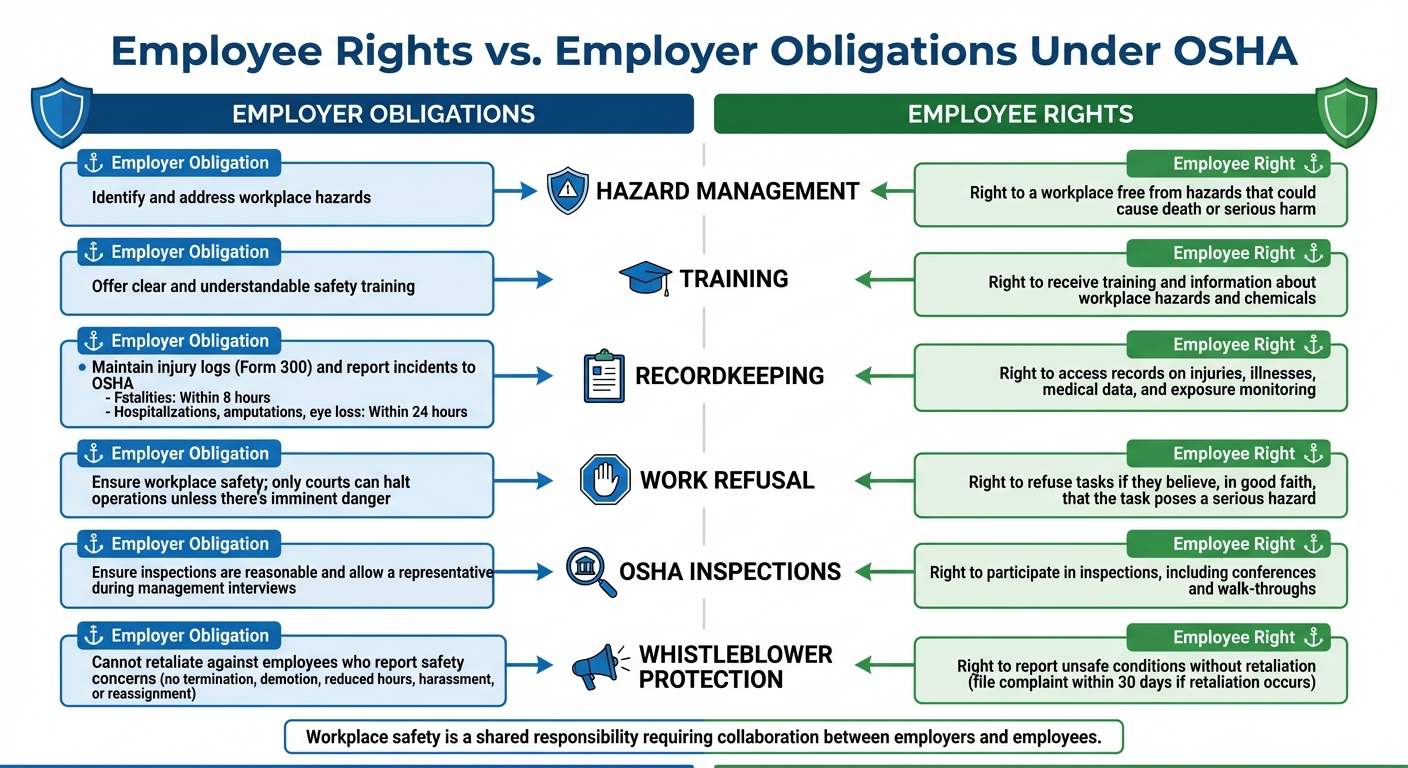
OSHA Employee Rights vs Employer Obligations Comparison Chart
Employer responsibilities and employee protections are designed to work hand in hand to reduce workplace injuries and fatalities. By understanding these roles – both their differences and where they align – employers and employees can create safer environments together. Recognizing these shared duties highlights that safety is a collective effort.
Hazard Management, Training, and Reporting: Key Comparisons
Here’s a breakdown of how safety roles are divided:
| Area | Employer Obligation | Employee Right |
|---|---|---|
| Hazard Management | Identify and address workplace hazards | Right to a workplace free from hazards that could cause death or serious harm |
| Training | Offer clear and understandable safety training | Right to receive training and information about workplace hazards and chemicals |
| Recordkeeping | Maintain injury logs (Form 300) and report incidents to OSHA | Right to access records on injuries, illnesses, medical data, and exposure monitoring |
| Work Refusal | Ensure workplace safety; only the courts can halt operations unless there’s imminent danger | Right to refuse tasks if they believe, in good faith, that the task poses a serious hazard |
| OSHA Inspections | Ensure inspections are reasonable and allow a representative during management interviews | Right to participate in inspections, including conferences and walk-throughs |
This table highlights how safety responsibilities are shared between employers and employees.
Shared Responsibilities for Workplace Safety
While specific duties are divided, workplace safety thrives on collaboration. OSHA outlines clear distinctions between employer obligations and employee rights, but achieving a safe work environment requires both parties to work in unison. Employers must create and enforce safety protocols, but these measures are only effective when employees actively follow them.
"Most successful safety and health programs are based on a common set of key elements. These include management leadership, worker participation, and a systematic approach to finding and fixing hazards." – OSHA
Transparency also plays a key role in maintaining safety. Employers are required to maintain Safety Data Sheets and hazard communication programs, which directly support employees’ "right to know" about chemical exposures . Additionally, when employers display OSHA citations for at least three working days or until the issue is resolved, employees stay informed about ongoing safety concerns in their workplace.
Using Technology for OSHA Compliance
Technology has opened up new ways to simplify compliance with OSHA regulations while promoting safety and transparency. In industries like construction, energy, and mining, where risks and regulatory requirements are high, manual processes often fall short. Digital platforms now provide tools to manage these challenges effectively, benefiting both employers and employees.
How Workforce Technology Simplifies Compliance
Modern workforce platforms tackle key compliance hurdles by:
- Automating worker qualification checks: Ensuring employees meet industry standards, such as 29 CFR Part 1926 for construction or Parts 1915–1918 for maritime operations.
- Centralizing recordkeeping: Digitally managing injury logs and incident data in one place.
- Supporting legal defenses: Providing documentation for the unpreventable employee misconduct defense, which is used to counter OSHA citations for unforeseeable violations.
For recordkeeping, digital systems are a game-changer. Starting January 2024, high-hazard industries with 20–249 employees must submit Form 300A data electronically each year. Larger establishments with 250 or more employees are required to submit Forms 300, 301, and 300A. Platforms like ABLEMKR simplify this process, helping employers meet deadlines with ease.
To use the unpreventable employee misconduct defense, companies must show they’ve established work rules, communicated them effectively, and monitored compliance. With real-time safety training documentation and worker status tracking, digital platforms create the necessary paper trail to prove these efforts during inspections.
On multi-employer worksites – common in construction – OSHA’s Multi-Employer Citation Policy can hold various parties accountable for hazards, even if they don’t directly employ the affected worker. Digital platforms help clarify roles and responsibilities through detailed documentation, reducing confusion over hazard ownership and worker qualifications.
Supporting Workers Through Transparency and Flexibility
Technology doesn’t just help employers – it also empowers workers by giving them access to vital safety information. Under OSHA, employees have the right to view injury logs, exposure data, and hazard communication. ABLEMKR’s mobile-first platform ensures workers can access these details, including safety credentials and job site hazard information, before stepping onto a high-risk site.
The platform also supports whistleblower protections under Section 11(c) by providing clear, documented channels for reporting hazards without fear of retaliation. Workers can also use these tools to verify safety training requirements and assess workplace conditions, enabling them to refuse work that poses serious risks.
Conclusion
OSHA compliance brings together employer responsibilities and employee rights to create safer workplaces, prevent injuries, and save lives. Employers are tasked with providing safe equipment, eliminating hazards, and maintaining transparent records. Meanwhile, employees have the right to participate in inspections, report unsafe conditions without fear of retaliation, and access essential safety information. When both sides actively engage, it fosters a culture of accountability that helps reduce workplace injuries.
As OSHA highlights, "Most successful safety and health programs are based on a common set of key elements. These include management leadership, worker participation, and a systematic approach to finding and fixing hazards". This collaborative approach forms the backbone of effective safety management. For instance, employers are required to report any work-related fatalities within 8 hours. On the other hand, workers who get involved in safety programs and use whistleblower protections play a critical role in identifying and addressing risks before they lead to harm.
Modern technology further strengthens these safety efforts. Tools like ABLEMKR simplify compliance by automating worker qualification checks, centralizing injury logs, and offering mobile access to safety credentials and hazard details. For industries like construction, energy, and mining – where risks are higher – these digital platforms help both employers and employees meet OSHA requirements with greater ease and precision.
Ultimately, workplace safety is a shared responsibility. Employers must set the tone with clear policies and proper training, while employees need to stay informed and speak up when they identify risks. With the support of modern technology, this partnership becomes even more effective, aligning everyone toward the common goal of a safer work environment.
FAQs
What is a “recognized hazard” under OSHA’s General Duty Clause?
A "recognized hazard" under OSHA’s General Duty Clause refers to any workplace condition or practice that is widely acknowledged to pose a risk of death or serious physical harm. This includes risks that are commonly understood as dangerous within a specific industry or work setting. Essentially, if a hazard is known to experts or professionals in the field, it falls under this definition.
When can I legally refuse unsafe work without getting fired?
If you believe your work conditions pose a real danger of death or serious injury, you have the legal right to refuse unsafe work. However, certain steps must be followed to ensure your actions are protected. First, the situation must meet OSHA’s criteria for an imminent danger. This means the hazard is immediate and severe.
Before refusing, you need to report the hazard to your employer and give them a chance to address the issue. If they fail to take corrective action, you can then refuse the work while adhering to OSHA guidelines. Following these steps is crucial to safeguard your rights in such situations.
How do OSHA inspections work, and what should employees and employers expect?
OSHA inspections are designed to ensure safe and healthy working conditions, and they usually happen without any prior warning. Here’s what typically occurs during an inspection:
- Inspector Arrival: The OSHA inspector will present their official credentials upon arrival and explain the purpose and scope of the inspection.
- Workplace Examination: Inspectors assess the workplace for potential hazards, review safety records, and may interview employees about safety practices and concerns.
Employer Rights and Responsibilities
Employers have specific rights and responsibilities during an OSHA inspection:
- Representation: Employers can appoint a representative to accompany the inspector during the walkthrough.
- Clarification: They can ask for clarification on any findings or concerns raised during the inspection.
- Contesting Citations: If citations are issued, employers have the right to contest them through the appropriate channels.
Employee Rights and Protections
Employees also play a key role in the inspection process and have important protections:
- Filing Complaints: Workers can file complaints with OSHA if they believe there are unsafe conditions.
- Participation: Employees may participate in the inspection process, including interviews with the inspector.
- Protection from Retaliation: OSHA safeguards employees from any form of retaliation for reporting hazards or participating in inspections.
Follow-Up and Corrective Actions
If the inspection identifies hazards, employers are required to address them promptly. Follow-up inspections may be conducted to ensure compliance. Additionally, employers must submit a written response to OSHA within five days, detailing how the identified issues will be corrected.
By understanding this process, both employers and employees can better navigate OSHA inspections and contribute to a safer workplace.


