
The U.S. construction industry is struggling to meet the growing demand for green construction skills. By 2030, green job vacancies are expected to jump from 67 million in 2025 to 241 million, but the workforce isn’t keeping up. Key challenges include:
- Skills Gap: Only 1 in 8 workers have the green expertise needed, especially in areas like solar installation, energy-efficient retrofits, and geothermal systems.
- Lack of Certifications: Many workers lack industry-recognized credentials, slowing hiring and project progress.
- Hands-On Experience: Training often focuses on theory, leaving workers unprepared for practical applications.
- Uneven Access: Training programs are not evenly distributed, leaving some regions without adequate opportunities.
Solutions include targeted training programs, technology platforms like ABLEMKR to connect workers with projects, and partnerships between governments and industries to standardize certifications. Addressing these gaps is critical to achieving sustainability goals and keeping up with the rapid pace of innovation in construction.
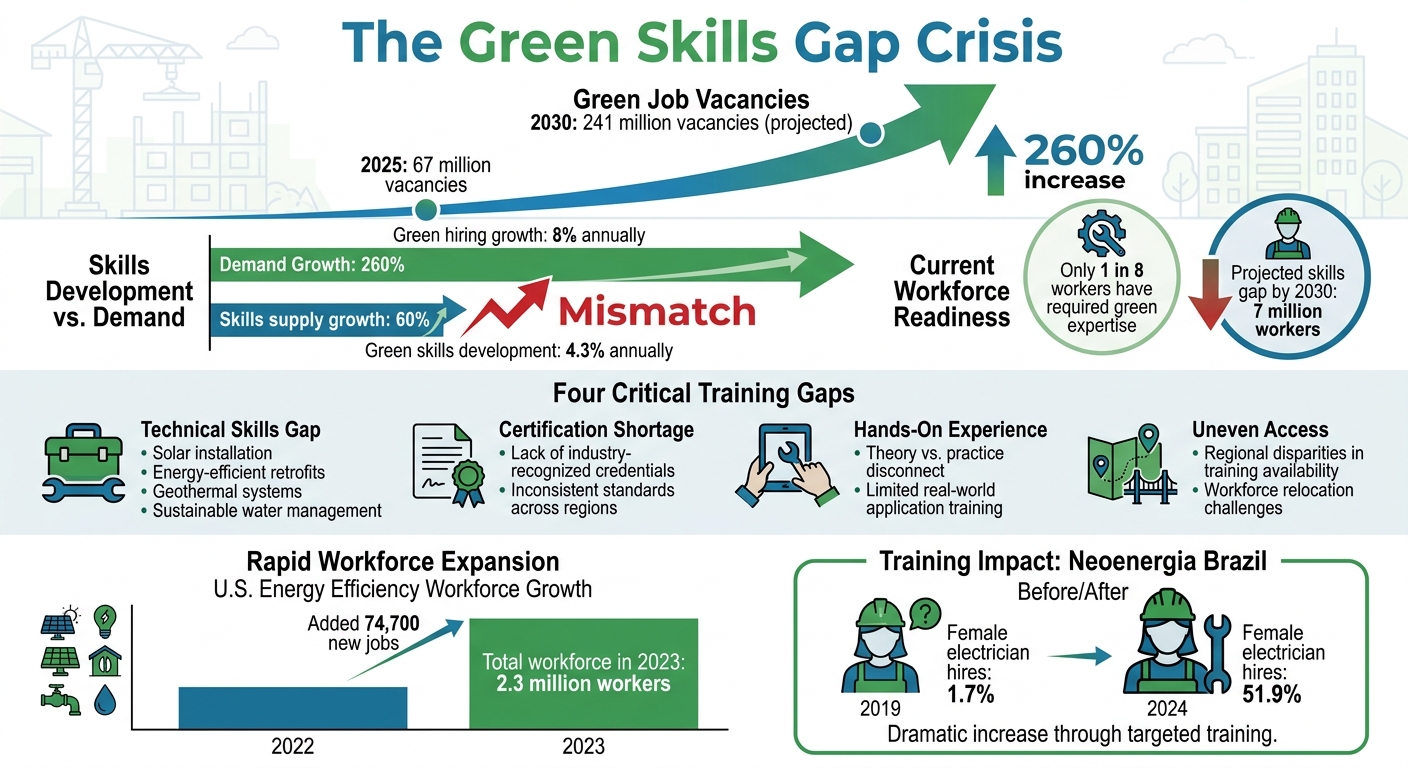
Green Construction Skills Gap: Key Statistics and Training Challenges 2025-2030
Master Green Building & Sustainable Construction Course with CDG Training Private Limited |
sbb-itb-aa28329
Key Training Gaps in Green Construction
The shortage of green skills highlights a critical issue: only one in eight workers worldwide possesses the expertise needed for green construction roles. The construction industry, in particular, faces pressing deficits in areas like solar energy installation, sustainable water management, energy-efficient upgrades, and geothermal systems. These shortages create bottlenecks that slow down projects and impede progress toward climate goals.
But the problem isn’t limited to technical trades. Workers often lack analytical skills such as performing life-cycle assessments (LCA), measuring embodied carbon, and preparing environmental product declarations (EPDs).
"The current demand for green skills is greater than the supply of green talent. This is what is referred to as the green skills gap." – Billy Lusk, One Click LCA
Lack of Hands-On Experience with Green Technologies
One of the biggest hurdles is the gap between classroom learning and real-world application. Workers might understand the theory behind systems like heat pumps or smart building controls but often lack the practical experience to install, troubleshoot, or maintain them effectively.
"There is so much innovation happening in construction right now that is not captured in training." – Mohammad Haque, Sustainability Manager at Mattamy Homes
The rapid pace of technological change – like advancements in Building Information Modeling (BIM) and carbon modeling software – means that training programs often struggle to keep up.
Programs like the United Way of Long Island’s "POWERUP!" initiative are helping bridge this gap. In May 2026, this program provided 50 hours of hands-on training over 17 days, giving participants real-world experience with clean heating and cooling technologies, solar arrays, and EV charging stations. This approach directly connects classroom learning with field application, targeting youth and veterans.
Another issue is the lack of industry-recognized credentials that validate expertise in green construction.
Shortage of Workers with Green Certifications
Green hiring is growing at nearly 8% annually, but the development of green skills is increasing at a slower rate of 4.3%. This mismatch is creating a global shortage of skilled workers, with a gap projected to reach seven million by 2030. Compounding the problem, construction now competes with industries like technology and media, which also require sustainability expertise for managing AI and data centers.
Certifications are essential for verifying skills, but too few workers hold credentials for renewable energy projects or energy efficiency upgrades. For example, Neoenergia in Brazil tackled this issue by launching targeted training programs. By 2024, these efforts increased female representation among their electrician hires from just 1.7% in 2019 to 51.9%. Programs like this demonstrate how focused certification efforts can quickly expand the talent pool.
Gap Between Classroom Learning and Field Application
While hands-on training is limited, many standardized curricula fail to meet industry needs. Programs often emphasize environmental science but neglect the technical skills required on job sites. As a result, workers might understand sustainability concepts but struggle to apply them using tools like integrated project delivery methods or real-time carbon tracking. Without standardized, industry-aligned curricula, workers face challenges in meeting employer expectations.
In March 2026, Mattamy Homes took a proactive approach by incorporating sustainability principles into job descriptions across all departments, including sales and customer care. This ensured staff could effectively communicate the benefits of geothermal systems and other green features to buyers. This highlights a broader issue: sustainability isn’t just a technical concern. Teams in procurement, finance, and project management also need green skills to deliver successful projects. Without these competencies, even skilled technical workers may struggle to execute projects efficiently. Modern platforms are now revolutionizing construction staffing to help contractors find the right talent for these evolving roles.
| Skill Category | Specific Gaps |
|---|---|
| Technical/Trades | Solar installation, geothermal systems, water management, energy-efficient retrofitting |
| Digital/Tech | Building Information Modeling (BIM), smart building controls, carbon modeling software |
| Compliance/Reporting | Life-cycle assessment (LCA), embodied carbon analysis, EPD reporting |
| Strategic/Soft Skills | Circular economy principles, systems thinking, sustainable procurement |
What’s Causing the Green Training Gap
The green training gap stems from the rapid pace of technological advancements, shifting regulatory landscapes, and uneven access to training opportunities across different regions.
Fast-Changing Green Construction Technologies
The speed of technological innovation is outstripping the ability of training programs to keep up. Federal and local decarbonization goals are driving demand for specialized roles like heat pump installers, energy auditors, and HVAC technicians. In just one year, from 2022 to 2023, the U.S. added 74,700 new energy efficiency jobs, pushing the total workforce in this sector to 2.3 million.
However, there’s a glaring mismatch: while demand for green jobs has surged by 260%, the development of green skills is only growing at 60%.
To address this, organizations like the Pacific Northwest National Laboratory (PNNL) have stepped in. In February 2025, PNNL introduced centralized training materials for heat pump installation and maintenance, aiming to create a standardized knowledge base for the industry. But even with these efforts, training programs often lag behind. For example, by the time educational institutions integrate tools like Building Information Modeling (BIM) into their curricula, the industry has often moved on to even newer technologies.
The rapid pace of technological evolution is further complicated by the challenges posed by changing regulations.
New Regulations and Industry Standards
As technology evolves, so do the skills required to meet updated regulations and industry standards. U.S. net-zero goals and stricter building codes demand expertise in areas many workers are not yet trained for. Adding to the complexity, state and local standards vary widely, making it difficult for workers to navigate these requirements.
Contractor licensing requirements differ significantly by region, creating barriers for those trying to enter the green construction field. While health and safety certifications are well-defined, green credentials for retrofitting and energy efficiency remain underdeveloped and inconsistent, making it harder to verify workers’ qualifications. Modern industry standards now call for advanced capabilities like Building Information Modeling (BIM) and integrated project delivery, which go beyond traditional trade skills. On top of that, the financial and administrative burdens associated with licensing and compliance often discourage contractors from pursuing the training needed to meet these new standards.
"Without strategies to overcome these challenges, workforce shortages will hinder progress on decarbonization efforts." – ACEEE
Uneven Access to Training Programs Across Regions
The challenges of adapting to new technologies and regulations are even more pronounced in areas with limited access to training programs. Across the country, the availability of green training programs is uneven, leaving some regions struggling to transition away from fossil fuels. This disparity often leads skilled workers to relocate to areas with better opportunities, exacerbating talent shortages in underserved regions.
To address such gaps, some states are taking action. For instance, in February 2025, West Virginia launched a pre-apprenticeship program for energy auditors. This initiative aims to combat negative perceptions of clean energy careers by offering hands-on experience and real-world job exposure, helping workers transition from traditional energy roles to green construction. However, many programs still fail to align with the specific technical needs of their regions, resulting in a mismatch between training and local demands. This misalignment leaves a significant gap, especially in roles like heat pump installation and energy auditing, where demand far exceeds the supply of qualified workers, particularly in underserved areas.
How to Close the Green Training Gap
Addressing the gaps in green workforce training requires a well-rounded approach that combines education, technology, and collaboration. The construction industry can’t afford to wait for workers with the right skills – it needs to actively develop them.
Building Skills Through Focused Training Programs
Taking a skills-based approach is key. The LinkedIn Green Skills Report 2023 highlights that focusing on specific skills, rather than job titles, is the best way to prepare the global workforce for green jobs.
Entry-level certifications lay the groundwork. Programs like BPI‘s Building Science Principles (BSP) and Healthy Home Evaluator (HHP) provide foundational knowledge in areas like energy efficiency and building science. For those needing to earn while they learn, Registered Apprenticeship Programs combine classroom learning with paid, hands-on fieldwork and mentorship.
Short-term programs and online academies are also making a difference. For example, the United Way of Long Island’s POWERUP! program offers intensive training to quickly prepare workers for roles in solar, wind, and high-efficiency HVAC systems. For more specialized areas like embodied carbon analysis, Life-Cycle Assessment (LCA), and Building Information Modeling (BIM), free online platforms such as the One Click LCA Academy and Willdan Clean Energy Academy provide flexible, on-demand courses [3,7].
Financial support can further accelerate training efforts. The NYSERDA Clean Energy Internship Program funds 75% to 90% of an intern’s salary for eligible green businesses, helping to bridge the gap between training and employment. These programs create a steady stream of skilled workers ready to meet the growing demand.
Using Technology to Match Workers with Green Projects
Technology platforms are bridging the gap between skilled workers and green projects. Many professionals hesitate to showcase their green certifications due to fears of being accused of greenwashing or not realizing their market value. This hesitation, combined with the shortage of qualified workers, makes efficient matching tools essential.
Platforms like ABLEMKR address this need. Designed for mobile use, ABLEMKR connects pre-vetted workers to projects based on their certifications, safety training, availability, and location. For tasks like retrofitting, heat pump installation, or energy audits, the platform ensures operators can quickly mobilize qualified crews. It also acts as a central hub for verifying certifications from organizations like BPI and the U.S. Green Building Council (USGBC) [3,7].
With green job vacancies expected to skyrocket from 67 million today to 241 million by 2030, and demand for green skills outpacing supply growth by over 4:1, streamlined tech solutions are vital. Efficient matching prevents project delays and ensures compliance with regulations like the EU’s Energy Performance of Buildings Directive (EPBD) [2,3].
By integrating directly with training and certification programs, platforms can create a seamless transition from completing credentials to starting jobs – cutting down the time between learning and working [3,7].
Government and Industry Partnerships for Training
Collaboration between governments and industries is essential to scaling green training efforts. Such partnerships provide the funding and reach necessary to address regional training gaps. For instance, the EU’s Energy Performance of Buildings Directive (EPBD) has allocated over €100 billion for building renovations between 2023 and 2030.
Standardized credentials are another priority. The LinkedIn Green Skills Report stresses the need for governments, educational institutions, and private companies to work together to create certifications that are widely accepted across regions. This would replace the current fragmented system and improve worker mobility [2,3].
Accessible training is also crucial. Online platforms and tools like interactive career maps from the Interstate Renewable Energy Council (IREC) help workers in remote or underserved areas identify local certification requirements and job opportunities without needing to relocate [3,7]. Programs like the Long Island Clean Energy Hub show how regional initiatives can connect residents to training, internships, and clean energy jobs.
Equity is another focus. Outreach efforts should prioritize underserved communities, veterans, and young people, ensuring the green transition benefits everyone. Partnerships between platforms like ABLEMKR and government-funded training initiatives can create a comprehensive ecosystem that supports education, certification, and job placement at scale.
Tracking and Expanding Green Construction Training
How to Measure Training Program Success
When evaluating the success of green training programs, it’s important to go beyond just counting enrollment numbers. A more telling metric is the rate of certification completions, which indicates whether workers are gaining the skills they need. The green building sector supports hundreds of thousands of jobs and makes a substantial contribution to the GDP. Certification tracking becomes especially crucial as many buildings require extensive retrofits to achieve net-zero targets.
Another valuable measure is worker feedback. Instead of focusing solely on completed projects, successful programs assess how well workers apply their training on job sites. Feedback should also gauge whether training keeps up with the latest innovations. In this way, evaluating real-world application becomes as essential as monitoring certification rates.
Apprenticeship mandates provide another concrete way to measure workforce development. Requiring 5–10% of project teams to include apprentices ensures that new workers gain critical hands-on experience. Monitoring whether projects meet these apprenticeship goals not only fosters accountability but also ensures the next generation of workers is well-prepared. Together, these metrics create a strong foundation for scaling green training initiatives across the country.
Expanding Training Programs Through Technology
Technology is a game-changer when it comes to scaling and managing the growing workforce in green construction. Effective tracking of training outcomes helps guide deployment strategies, and platforms like ABLEMKR are stepping in to bridge the gap between skilled workers and projects. Between 2022 and 2023, the energy efficiency sector added 74,700 jobs, bringing the workforce to 2.3 million. Managing this rapid growth requires systems that can quickly and efficiently match workers to the right projects.
ABLEMKR’s platform tackles this challenge by connecting pre-vetted workers with green construction projects based on their certifications, safety training, location, and availability. The mobile platform provides real-time visibility into worker credentials, making it simpler for contractors to verify qualifications from organizations like the U.S. Green Building Council. With built-in compliance tracking and payroll management, the platform minimizes deployment delays – an essential feature for projects requiring specialized skills such as heat pump installations or energy audits. This streamlined approach ensures that as training programs produce more certified workers, they can be efficiently assigned to projects in key U.S. cities and energy hubs where green construction is booming.
Conclusion
Green construction is at a crossroads. The surge in job openings, paired with a lack of green skills, threatens to derail progress toward net-zero targets. With the construction industry contributing about 21% of global greenhouse gas emissions, addressing this skills gap is not just important – it’s urgent.
One key step is standardizing green certifications, much like health and safety qualifications. This would make it easier for employers to identify workers skilled in areas like retrofitting and energy efficiency. Additionally, training programs need to keep up with the rapid pace of innovation in the construction industry, as current curricula often fail to reflect these advancements. Amanda Williams, Head of Environmental Sustainability at CIOB, highlighted this challenge:
"A global and regional shortfall of trained workers with a wide range of green skills has the potential to be a major barrier to achieving sustainable construction".
Technology also offers a practical solution. Platforms like ABLEMKR connect certified workers with green projects, ensuring that talent is deployed efficiently. These platforms provide real-time insights into worker credentials, track compliance, and match workers to projects based on their qualifications, safety training, and location. This streamlined approach ensures that skilled labor reaches the growing number of green initiatives across U.S. cities and energy hubs.
The path forward involves investing in targeted training, standardizing credentials, and leveraging technology to close the skills gap. This green transition also creates an opportunity for workers in carbon-intensive industries to retrain and apply their expertise in sustainable construction. As Marybeth Collins, Environment+Energy Leader, put it:
"With net-zero deadlines fast approaching, bridging the green skills gap is no longer optional – it is a necessity".
FAQs
Which green construction skills are most in demand right now?
The construction industry is seeing a surge in demand for skills related to green building practices. Some of the top areas include solar installation, energy-efficient systems like heat pumps and air sealing, and energy retrofitting for existing structures. Professionals such as sustainability engineers, energy-efficiency consultants, and green project managers are in high demand to lead these initiatives. These roles and skills are key to driving progress in sustainable construction and achieving energy efficiency targets.
What certifications should I get to qualify for green construction jobs?
To step into green construction jobs, earning certifications such as LEED (Leadership in Energy and Environmental Design) can be a game-changer. These credentials are highly regarded in the industry, showcasing your knowledge and skills in sustainable building practices and green standards.
How can ABLEMKR help certified workers get placed on green projects faster?
ABLEMKR speeds up staffing for green projects by simplifying hiring, onboarding, and compliance tasks. The platform quickly matches workers to roles by considering their certifications, safety training, and availability. Plus, it offers real-time updates on worker status, helping to cut delays and make deployment easier.


