
LEED-certified professionals face a growing demand for advanced skills as green building standards evolve. With over 110,000 certified projects globally and stricter regulations on energy and carbon emissions, expertise in areas like whole-life carbon assessments, energy modeling, and performance monitoring is now essential. Key highlights include:
- LEED v5 (2024-2025) emphasizes whole-life carbon tracking and ongoing performance validation, shifting focus from initial design to long-term results.
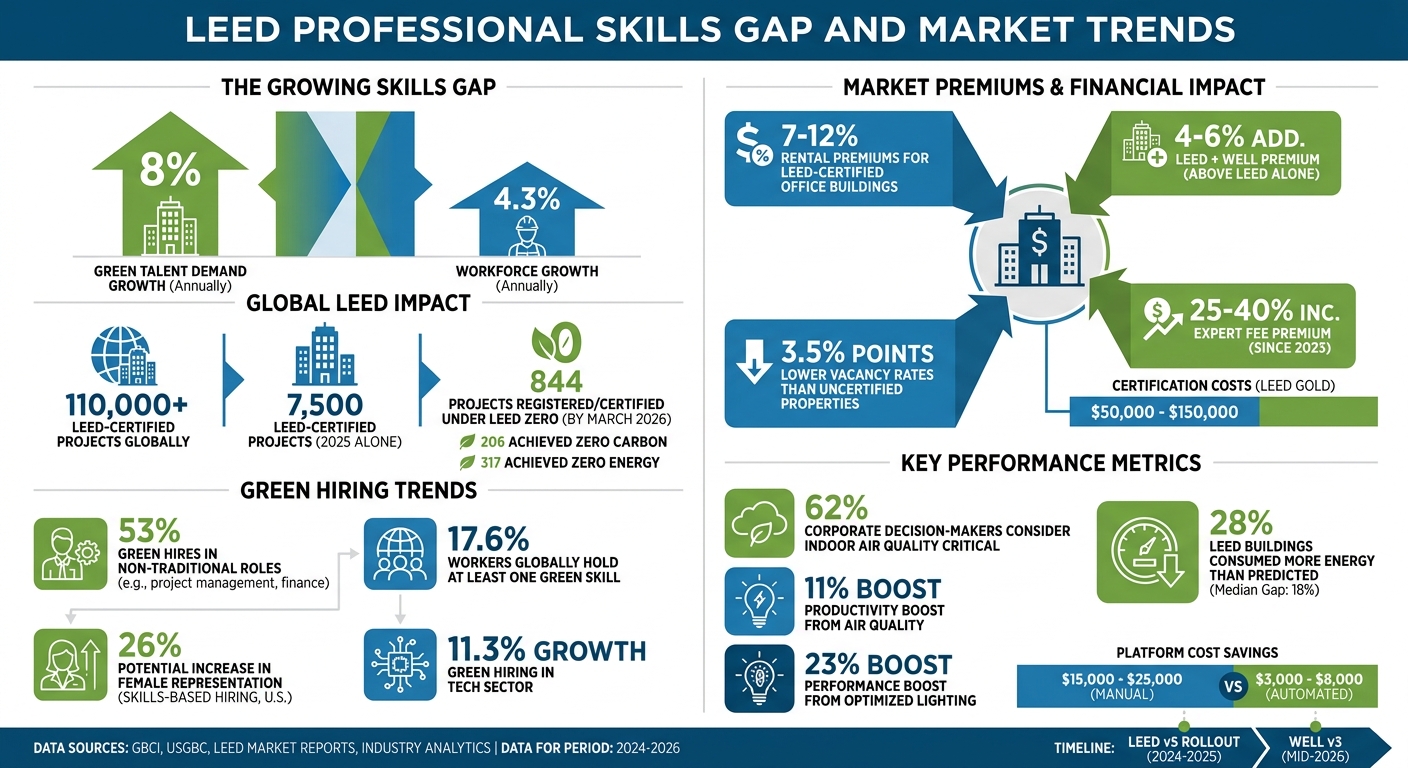
- Green skills gap: Demand for green talent is growing at 8% annually, but workforce growth is lagging at 4.3%.
- Cross-industry competition: 53% of green hires now occupy roles in project management, procurement, and finance.
- New tools and methods: Proficiency in LEED Online, energy modeling (ASHRAE 90.1), and Life Cycle Assessments (LCA) is critical.
- LEED Zero program: Projects must now achieve net-zero emissions, covering operational and embodied carbon.
The challenge? Staying updated with technical and regulatory changes while integrating skills like BIM and advanced mechanical system coordination. Platforms like ABLEMKR are addressing workforce gaps by matching certified professionals to projects and supporting ongoing training. As LEED standards evolve, professionals who invest in continuous learning will remain competitive in this rapidly shifting landscape.
LEED Professional Skills Gap and Market Trends 2024-2026
Core Technical Skills for LEED Professionals
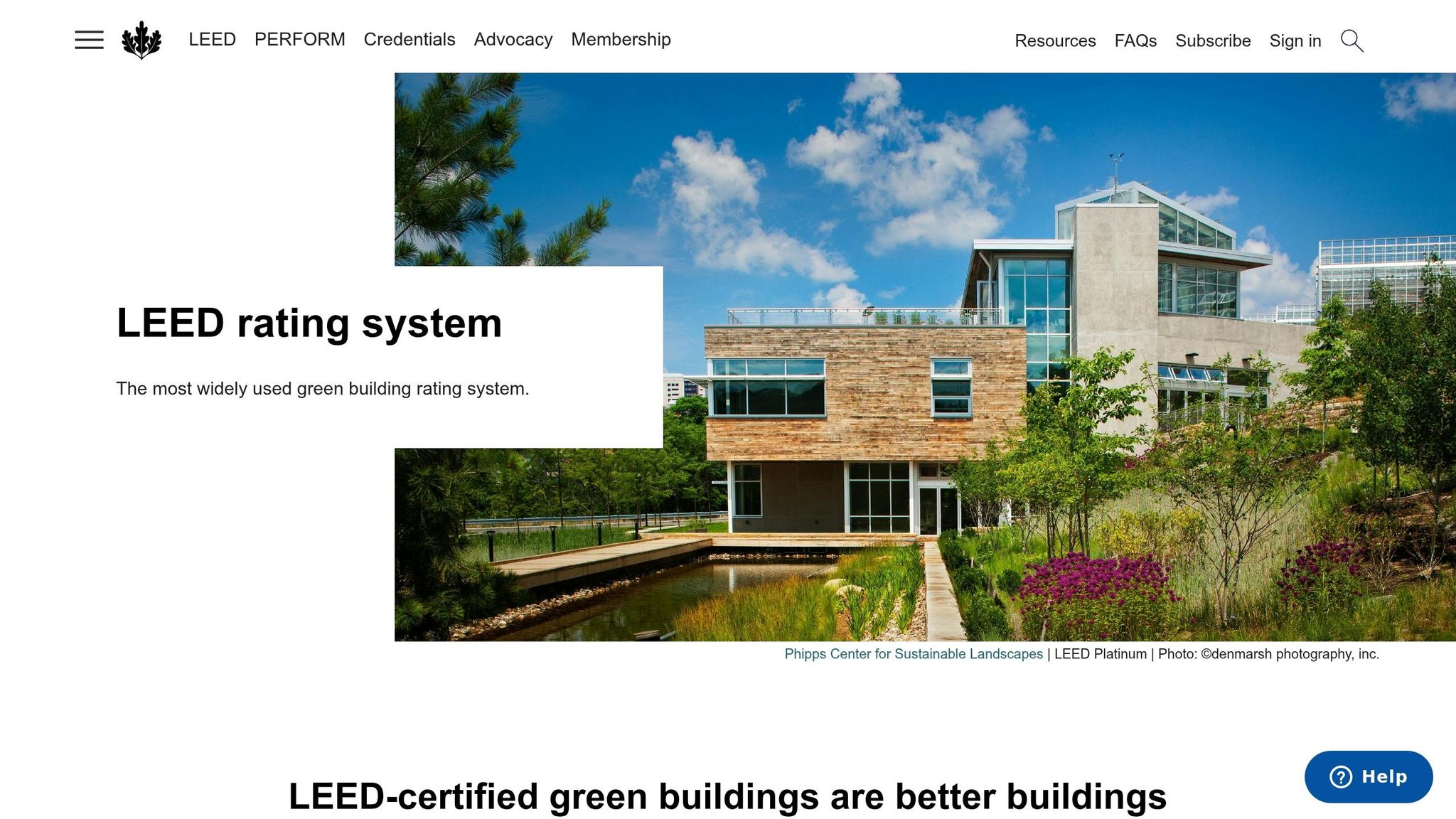
To excel as a LEED professional, it’s crucial to dive deep into the platforms and methodologies that underpin green building certifications. These skills go far beyond basic administrative tasks – they’re the backbone of achieving various certification levels, each with its own technical demands. Developing expertise in these tools is key to meeting the performance targets outlined by LEED protocols.
LEED Online and Certification Tools
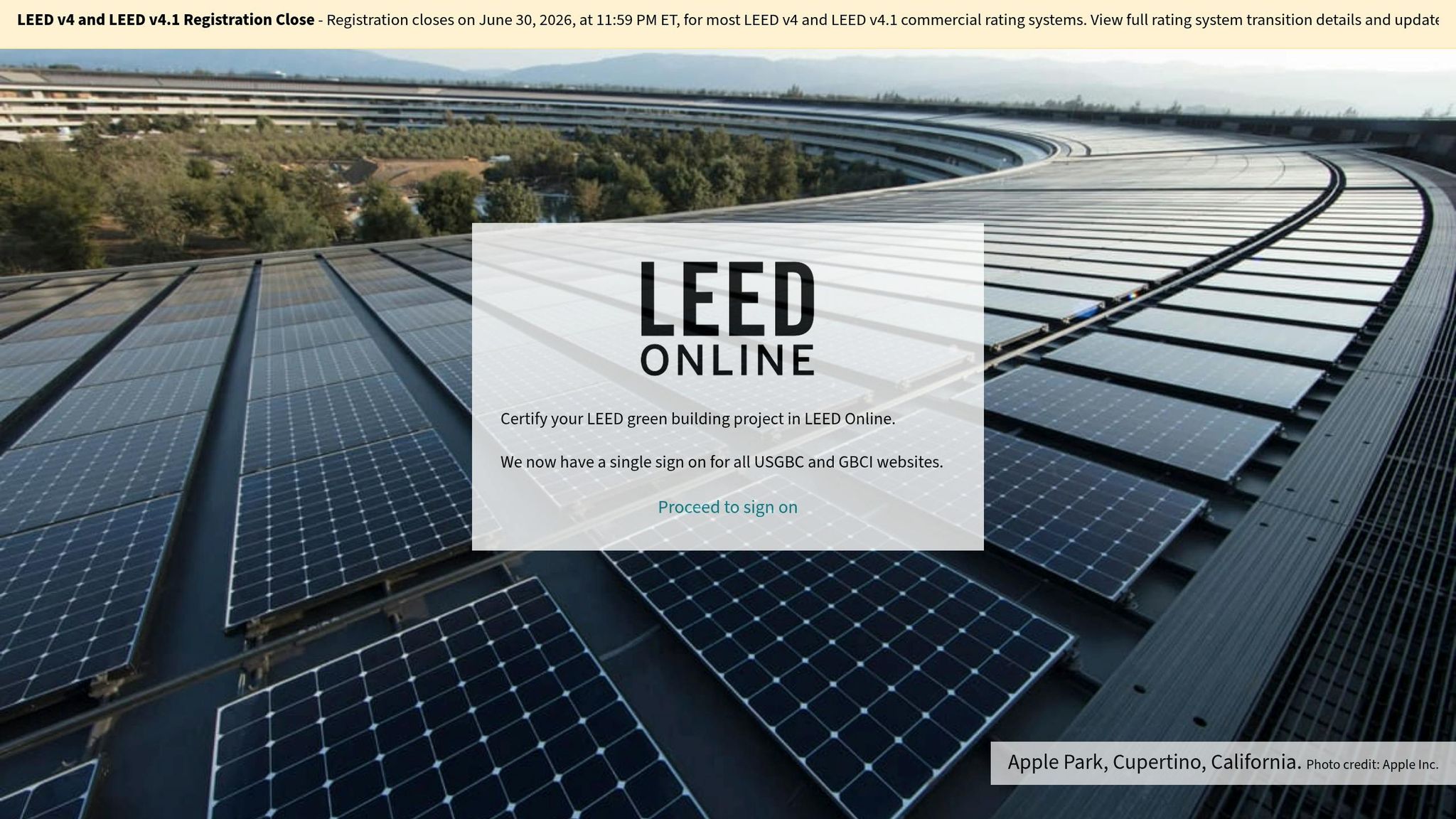
Using LEED Online effectively isn’t just about uploading files. It starts with accurately registering projects by entering details like building types, locations, and sustainability goals. One of the more demanding aspects is managing the "Analyses Required for LEED Credits", which makes up roughly 32% to 35% of the certification workload. This includes gathering evidence such as energy analyses, materials reports, and development plans, while also tracking credit compliance throughout the project. Another critical task is evaluating materials to ensure they meet LEED standards.
Sustainable Materials Analysis
Assessing materials for LEED compliance involves a structured approach using the LEED Credit Library. Before earning points toward higher certification levels, professionals must meet all prerequisites in the materials category. This process includes consulting LEED Reference Guides for criteria, using Sample Forms for standardized documentation, and staying updated through the Addenda database to ensure compliance with USGBC standards. Additionally, identifying "Regional Priority" credits, which address environmental issues specific to a project’s location, can provide extra points. Once materials are evaluated, the next step is precise energy modeling to confirm performance improvements.
Energy Modeling and Efficiency Optimization
Energy modeling has become more rigorous, especially under LEED v4.1 and the 2024 energy update. Projects must now follow ASHRAE 90.1 Appendix G to guide design decisions and demonstrate compliance, achieving at least a 5% reduction from the baseline to meet the Minimum Energy Performance prerequisite. For jurisdictions using ASHRAE 90.1-2016 or later, the same model can be used for both local code compliance and LEED documentation. Marcus Sheffer, a LEED Fellow at 7group, explains the process:
"A preliminary model is one created during design and used to help design decision-making. The required energy model is a final model of the project as designed after the design is complete."
In cases where unregulated energy exceeds 50% of the total proposed building energy, teams can opt for the less demanding Core and Shell thresholds instead of New Construction thresholds. To ensure accuracy, professionals must use the updated LEED Minimum Energy Performance Calculator (released in July 2024) and correctly model on-site renewables by applying a source-to-site factor of zero, as specified in ASHRAE 90.1-2010 Section G2.4.
sbb-itb-aa28329
Advanced Skills in Sustainable Practices
With the introduction of LEED v5 in late 2025, the landscape of sustainable building practices has shifted dramatically. One of the standout changes is the mandatory inclusion of whole-life carbon assessments for all new construction projects. What was once considered advanced expertise is now the baseline for staying competitive in the industry.
Life Cycle Assessment (LCA) Expertise
Life Cycle Assessment (LCA) has become a cornerstone of sustainability. Professionals are no longer focused solely on operational energy; tracking embodied carbon – the emissions tied to material extraction, manufacturing, transportation, and disposal – is now essential. This shift requires a deep understanding of Environmental Product Declarations (EPDs), which provide critical data for evaluating embodied carbon.
However, there’s a challenge: as of January 2026, only 38% of U.S. cement plants had published EPDs. This lack of transparency can cause supply chain bottlenecks. Companies like Holcim are stepping up by publishing EPDs for their entire product line and introducing "ECOPact" concrete, which reduces carbon intensity by 30% to 100% compared to traditional materials. Similarly, Nucor’s facility-specific EPDs highlight carbon intensities that are 75% below the global average, thanks to their electric arc furnace production methods.
Conducting LCAs during the design phase is critical. It allows professionals to choose materials and methods that meet Gold or Platinum LEED thresholds while adhering to regulations like New York City’s Local Law 97, which penalizes high-carbon buildings. The key is addressing supply chain issues early – delays caused by missing carbon data can derail projects if left until construction begins.
Mastering LCA is just one part of the equation. Professionals must also adopt robust carbon reduction strategies.
Carbon Reduction and Net-Zero Strategies
The LEED Zero program has raised the bar, requiring projects to verify absolute zero emissions over a 12-month period. This includes emissions from onsite combustion, refrigerants, embodied carbon, and transportation. By March 2026, 844 projects were either registered or certified under LEED Zero, with 206 achieving Zero Carbon and 317 achieving Zero Energy.
A standout example is MONTONI‘s Espace Montmorency project in Laval, which targeted LEED Platinum certification by cutting water consumption by 73% through a rainwater recovery system and reducing greenhouse gas emissions by 91%. Patrick Côté, Director of Sustainable Development, explained:
"LEED is an incentive to rethink every detail of construction: a roof becomes an opportunity to integrate solar panels; a façade becomes a place to maximize thermal insulation; an outdoor space becomes a community garden."
The financial benefits of these strategies are clear. In 2024, the Abipa building combined heat wheels, solar pre-heating, and reinforced insulation to cut annual energy costs by $50,276, achieving a return on investment in just over two years. To replicate such results, professionals need expertise in managing advanced mechanical systems and ensuring airtight building envelopes.
While cutting emissions is critical, creating optimal indoor environments is equally important.
Indoor Environmental Quality (IEQ) Optimization
Indoor Environmental Quality (IEQ) now goes beyond air quality to include acoustics, lighting, and thermal comfort – key factors that drive value. 62% of corporate real estate decision-makers now consider indoor air quality and wellness features as "critical" or "very important" when negotiating leases. Buildings with both LEED and WELL certifications command 4% to 6% higher rental premiums.
The trend toward measured-performance verification means buildings must incorporate continuous monitoring systems. WELL v3, expected in mid-2026, will require real-time air quality sensors and occupant satisfaction surveys for certification. Platforms like Arc and Measurabl simplify this process by offering real-time scoring, cutting administrative costs by up to 70%.
The benefits extend beyond compliance. Improved air quality can boost productivity by 11%, while optimized lighting can enhance performance by 23%. Patrick Côté highlights the importance of designing with occupants in mind:
"The goal is to design buildings that focus on the needs of their occupants. This means generous natural light, ergonomic work stations, views of the outdoors, optimum air quality and temperature control."
Commissioning IEQ systems early ensures compliance and enhances the overall comfort and satisfaction of building occupants.
Soft Skills and LEED Project Management
Technical know-how alone won’t cut it when it comes to managing LEED projects. Success often hinges on how well project managers can navigate the human side of green building. This means fostering strong collaboration among architects, engineers, contractors, and suppliers to align everyone with the project’s sustainability goals.
Communication and Collaboration
While advanced tools and methodologies are critical for earning LEED certification, they’re only as effective as the communication and teamwork behind them. LEED projects rely heavily on integrative strategies – early planning sessions where all stakeholders come together to define sustainability goals before construction begins. These sessions establish a shared understanding of key objectives like energy efficiency, water conservation, and sustainable material use. When everyone – from developers to site foremen – speaks the same language, it’s easier to stay on track.
But the stakes are high. A 2025 study of 500 LEED-certified buildings revealed that 28% consumed more energy than predicted by their design models, with a median performance gap of 18%. Often, these issues stem from poor communication between design teams and operations staff. For instance, if a mechanical engineer’s specifications aren’t clearly conveyed to the facilities manager, energy performance can take a hit.
The best project managers tackle this head-on. They assign LEED credits to the right team members early on and maintain regular check-ins to ensure everyone stays aligned with sustainability goals. They also know how to frame green building decisions in terms of ESG initiatives and risk management – concepts that resonate with developers and boardroom decision-makers.
LEED Documentation and Compliance Management
LEED documentation is a common stumbling block for many projects. It’s a process that demands meticulous record-keeping, from accurately reporting project areas to ensuring calculators are used correctly. Even small missteps – like uploading PDFs instead of Excel files – can create hurdles for reviewers trying to verify formulas.
The administrative workload isn’t trivial. Managing certification manually can cost between $15,000 and $25,000 per building, while using platform-based systems like Arc or Measurabl can slash that to $3,000 to $8,000. For portfolios with more than 10 buildings, automation becomes essential to maintain consistency and reduce errors.
Patrick Côté, Director of Sustainable Development at MONTONI, highlights the lasting impact of thorough documentation:
"LEED certification stays with the building throughout its life, guaranteeing recognition of the strategic choices that have been made to achieve the desired objectives."
Starting early helps. Hiring certified consultants and commissioning agents 6 to 12 months before the project kicks off ensures you have the expertise needed to navigate documentation challenges. With demand for these services driving up costs, setting aside budget contingencies of 15% to 20% above initial estimates can cover verification and commissioning fees. This level of preparation not only smooths the documentation process but also strengthens performance verification once the building is operational.
Site Verification and Performance Tracking
The industry is moving beyond design-intent certification to focus on measured-performance verification. This shift requires buildings to prove they meet sustainability goals through continuous monitoring. Tools like air quality sensors, thermal comfort monitors, and submeters now track real operational data. By mid-2026, WELL v3 certification will make these systems mandatory for ongoing compliance.
On-site audits are also critical. Verifying acoustics, air quality, and thermal comfort ensures the building performs as designed. Mobile tools are making this process easier – site teams can instantly capture and upload photographic evidence, material receipts, and disposal records, reducing the risk of inconsistent documentation.
The financial benefits of getting this right are hard to ignore. In 2025, LEED-certified office buildings in major U.S. markets commanded rental premiums of 7% to 12% and had vacancy rates 3.5 percentage points lower than uncertified properties. Buildings with both LEED and WELL certifications saw even higher premiums – 4% to 6% above LEED alone. By implementing post-occupancy monitoring plans early, project managers can spot and address performance gaps before they jeopardize certification or tenant satisfaction.
Addressing Skills Gaps and Training Pathways
Even with LEED credentials, many professionals find themselves underprepared for the demands of modern green construction. While LEED training does a great job of covering sustainability principles and material selection, it often overlooks the digital construction tools – like clash detection, 3D modeling, and interdisciplinary collaboration – that are essential for keeping projects on time and within budget. These skills are critical for integrating mechanical, electrical, and plumbing (MEP) systems effectively, as explored below.
Gaps in MEP Engineering and BIM for Sustainability
One of the biggest challenges lies in integrating complex MEP systems. For example, in facilities like hospitals, where MEP networks are particularly intricate, professionals need more than theoretical knowledge. They require practical expertise in Building Information Modeling (BIM) to coordinate designs seamlessly. Without strong BIM skills, design errors increase, cost estimates become unreliable, and construction schedules are disrupted. It’s no surprise that the U.S. General Services Administration mandates the use of BIM to manage its 336 million square feet of federal space.
This focus on digital tools has led many professionals to prioritize a BIM-first approach in their careers. Mastering platforms like Revit and understanding shared data environments often takes precedence over pursuing LEED accreditation. For renovation projects, in particular, BIM proves indispensable for accurately modeling existing conditions and mitigating risks – areas not directly addressed in traditional LEED training.
Certification Progression: Green Associate to LEED AP
The standard certification path starts with the LEED Green Associate, which covers basic sustainability concepts. From there, professionals can advance to LEED AP specialties like Building Design and Construction (BD+C) or Operations and Maintenance (O+M). Pairing LEED credentials with expertise in digital construction tools bridges the gap between environmental goals and practical project execution. This progression highlights the growing need to combine certification with evolving technical skills.
Staying Updated with Regulatory and Industry Changes
Green building standards are constantly evolving, and staying informed requires a proactive approach. Structured continuing education – through live sessions and capstone projects – helps professionals keep up with both technical advancements and regulatory updates. This ongoing training not only sharpens technical skills but also addresses the coordination challenges inherent in digital construction workflows. Adhering to international standards like ISO 19650 for BIM processes ensures alignment with global best practices.
Additionally, professionals stay informed by subscribing to industry newsletters, attending webinars, and exploring resource pages from training platforms. Certifications from organizations like Autodesk, the National Skill Development Corporation, and the Royal Institute of British Architects provide a solid foundation for navigating the ever-changing demands of the industry.
ABLEMKR‘s Role in Supporting LEED Professionals

The construction industry is grappling with a growing gap between the demand for green skills and the available workforce. ABLEMKR steps in to address this challenge by offering staffing solutions specifically designed for green construction projects, focusing on certifications and expertise.
Automated Job Matching for Certified Professionals
ABLEMKR’s platform takes a unique approach to staffing by matching professionals to projects based on their certifications and skills rather than traditional job titles. This is crucial because 53% of green hires now occur in roles without explicitly "green" job titles. By filtering candidates through criteria like LEED credentials, BIM expertise, and sustainability qualifications, the platform connects professionals to over 7,500 LEED-certified projects worldwide in 2025.
The platform’s mobile-first design leverages geo-location, availability, and certification data to find the perfect fit. For LEED professionals, this means being matched to projects that align with their specific credentials, whether it’s LEED AP BD+C for new builds or O+M for ongoing operations. Research shows that skills-based hiring can expand the representation of women in construction talent pools by 26% in the U.S., contributing to a more diverse workforce in green building.
On-Demand Staffing for Green Construction
To meet the urgent need for certified professionals, ABLEMKR offers an on-demand staffing model that accelerates workforce deployment. Since 2023, demand for LEED Accredited Professionals has caused fees to rise by 25–40%. ABLEMKR’s approach ensures companies can access this in-demand talent pool quickly, avoiding the delays that often come with traditional hiring methods.
Whether it’s retrofitting warehouses for LEED O+M certification or constructing commercial properties aiming for net-zero emissions, the platform ensures rapid mobilization. Real-time updates on worker availability allow project managers to confirm the readiness of certified professionals instantly. With green hiring in the technology sector growing by 11.3%, competition for LEED experts is fierce, making ABLEMKR’s quick deployment capabilities indispensable.
Compliance Tracking and Training Support
ABLEMKR also simplifies compliance tracking by verifying certifications and project eligibility directly through its platform. This automated system eliminates the need for manual management, which can cost between $15,000 and $25,000 per building. With 17.6% of workers globally holding at least one green skill, ABLEMKR’s tracking tools ensure the right professionals are identified and deployed efficiently.
Additionally, the platform supports ongoing professional development by guiding workers toward training opportunities. This helps them maintain and upgrade their certifications, keeping pace with evolving LEED standards and advancements in digital construction tools. By doing so, ABLEMKR not only supports individual career growth but also helps ensure that LEED project goals are consistently met.
Conclusion
The green building industry is growing at a pace that the workforce struggles to match. While green hiring is climbing at 8% annually, the pool of skilled workers is only increasing by 4.3%. This gap puts pressure on LEED-certified professionals to continually upgrade their expertise. The rollout of LEED v5 in late 2025, which mandates whole-life carbon assessments and Environmental Product Declarations (EPDs), has shifted the competitive landscape.
The shift from focusing on design intent to verifying performance means professionals must become adept with new tools, such as air quality sensors and building management systems, while staying current with updates to LEED, WELL, and regional standards. This ongoing technical evolution highlights the importance of continuous professional development.
This shortage of green skills presents a unique chance for those who commit to ongoing learning. LEED credential maintenance already requires continuing education, reinforcing the need to stay informed about emerging practices in sustainable construction. Platforms like ABLEMKR are stepping in to address this challenge by matching professionals to projects based on their specific credentials, rather than generic job titles. This approach not only accelerates the deployment of skilled workers for critical green projects but also promotes diversity. In fact, research suggests that such strategies could boost female representation in the U.S. construction workforce by 26%.
With LEED Gold certification costs ranging from $50,000 to $150,000, having the right expertise at the right time is essential for both project success and cost efficiency. The gap between industry needs and available talent won’t close on its own. Professionals who focus on mastering whole-life carbon assessments, performance monitoring, and digital certification tools will lead the way in shaping the next generation of sustainable buildings. And with specialized expertise, they can command fee premiums of 25–40%.
FAQs
What new skills does LEED v5 require?
LEED v5 focuses heavily on decarbonization, promoting the use of environmentally conscious materials such as certified wood, and aligning with updated green building standards. To stay current, professionals need a solid grasp of the revised prerequisites and credits, ensuring projects meet the latest sustainability benchmarks.
How do I start doing whole-life carbon and LCA work?
To get started, dive into the fundamentals of whole-life carbon and life cycle assessment (LCA). These concepts focus on two main areas: embodied carbon (the emissions tied to materials and construction processes) and operational carbon (the emissions from building use over time). Understanding these is key to assessing a building’s total environmental impact.
Next, explore methodologies highlighted in LEED v5, such as circularity (designing for material reuse and minimizing waste) and climate resilience (ensuring buildings can withstand climate-related challenges). These approaches align with modern sustainability goals and are becoming increasingly important in green building practices.
To put this knowledge into action, use tools designed to support LCA processes. Additionally, consider pursuing training or certifications in green building standards. These credentials not only enhance your expertise but also help you stay aligned with the latest industry requirements and best practices.
What tools help close the gap between modeled and actual building performance?
Tools like LEED, BREEAM, and WELL certification systems play a crucial role in aligning design goals with actual outcomes. These frameworks provide clear benchmarks and key performance indicators (KPIs) to evaluate how well a building’s performance matches its original sustainability and efficiency objectives. They ensure that projects not only aim for but also achieve measurable results in environmental and operational performance.


