
The renewable energy consulting market in the U.S. is growing rapidly, driven by corporate sustainability goals, regulatory changes, and advancements in clean energy technology. Key insights include:
- Market Growth: The U.S. renewable energy consulting market is projected to reach $310 million by 2025, representing 63% of North American activity.
- Challenges: Nearly half of renewable projects face delays due to permitting hurdles (49%) and grid interconnection issues (34%).
- Job Growth: Clean energy jobs grew 7.2% in 2025, with energy storage roles increasing by 29%.
- Specialized Roles: Solar, wind, energy storage, and energy efficiency consultants are in high demand, requiring technical expertise and certifications.
- Cost Trends: Solar energy costs are expected to drop to $31.73/MWh by 2029, making it a competitive energy source.
Emerging roles focus on technical skills, regulatory knowledge, and financial modeling to manage complex projects. Certifications like NABCEP, GWO, and CEM are critical for credibility. Tools like ABLEMKR are helping connect skilled consultants to projects faster, addressing hiring gaps in this expanding sector.
How to Become a Successful Energy Consultant | 4 Steps to Land Your Dream Job (Career Roadmap No. 1)
sbb-itb-aa28329
New Consulting Roles in Renewable Energy
The renewable energy sector is expanding into roles that require specialized technical skills in areas like solar, wind, energy storage, and energy efficiency. These positions are tailored to address specific challenges in the shift to cleaner energy, such as managing offshore wind farms or designing battery systems to stabilize the grid during peak demand. Below, we’ll explore how these consulting roles are adapting to meet the needs of this evolving industry.
Market changes are driving the demand for consultants with hands-on, technical expertise. Today’s renewable energy consultants work with advanced tools like SCADA systems, AI-driven forecasting models, and navigate complex policies like the Inflation Reduction Act. Corporate sustainability goals are also reshaping these roles – over 70% of Fortune 500 companies now have renewable energy targets as part of their ESG strategies. This requires consultants who understand Power Purchase Agreements and Net-Zero planning.
The numbers tell the story. Renewable energy jobs in the U.S. grew by 7.2% year-over-year in 2025, with energy storage roles alone increasing by 29% between 2024 and 2025. By 2030, clean energy jobs are expected to make up over 60% of the energy sector’s workforce. This growth is creating opportunities for professionals skilled in technical, regulatory, and data-driven solutions.
Solar Energy Consultant
Solar energy consultants oversee the technical and financial feasibility of photovoltaic (PV) projects, from initial assessments to ongoing operations. Their work involves conducting site analyses, designing PV layouts using tools like PVsyst and AutoCAD, and ensuring both regulatory compliance and financial soundness through ROI calculations and tax credit navigation. Many also assist clients in securing Corporate Power Purchase Agreements to meet net-zero goals.
Solar installations are expected to grow by 35% in 2025, driven by utility-scale and commercial projects. California leads the way, accounting for 25% of all solar-related job postings in the U.S.. The steep decline in solar panel costs – an 80% drop since 2010 – has made solar one of the most affordable energy sources, but realizing these savings requires consultants adept in system optimization and financial modeling.
Key certifications like NABCEP (North American Board of Certified Energy Practitioners) establish technical credibility, while tools like RETScreen aid in energy modeling. Consultants must also stay informed about federal incentives and varying state-level permitting processes.
Wind Energy Consultant
Wind energy consultants focus on site assessments, turbine selection, and environmental permitting for both onshore and offshore projects. They evaluate wind resources, conduct hydrology studies, and oversee construction. They also integrate SCADA systems for real-time monitoring and use AI to build predictive models.
Wind energy jobs grew by 11% year-over-year in 2025, with offshore projects along the East Coast and land-based developments in the Midwest driving demand. Texas alone accounts for 20% of wind job postings nationwide. Employment for Wind Turbine Technicians is expected to rise by 60% by 2033, increasing the need for consultants to manage these specialized teams.
In 2024, the U.S. Department of Energy used the FLORIS model to optimize wind farm performance, highlighting the growing demand for Offshore Tech Support Analysts and AI Specialists. Consultants in this space must be skilled in environmental impact assessments, remote monitoring, and logistics for offshore operations.
Energy Storage Consultant
Energy storage consultants specialize in battery system optimization, microgrid design, and grid stability analysis. They work with technologies like lithium-ion and flow batteries, advising on strategies like energy arbitrage and demand-side management. Their expertise is vital for integrating storage with variable renewable sources like solar and wind to ensure continuous clean energy supply.
The U.S. energy storage market saw record installations of over 12 GW in 2024, marking a 33% year-over-year increase. This growth stems from the need for grid resilience and the expansion of Distributed Energy Resources (DERs). For example, Toyota’s battery manufacturing plant in Liberty, North Carolina, created significant demand for Project Managers and Maintenance Experts in 2025.
Consultants in this field use tools like PowerFactory, PSS/E, and HOMER for hybrid system modeling. They must understand battery lifecycle management, thermal regulation, and the economics of grid-scale storage. By 2032, the battery manufacturing sector is expected to generate between 84,000 and 125,000 new jobs, ensuring sustained demand for experts in this area.
Energy Efficiency Consultant
Energy efficiency consultants focus on identifying cost-saving measures through energy audits for residential, commercial, and industrial facilities. They recommend upgrades to HVAC systems, lighting, and other infrastructure, often managing utility rebate programs. Their role has become increasingly data-driven, using AI and IoT sensors to optimize energy use in real-time.
These consultants also help organizations meet SEC climate disclosure requirements by developing greenhouse gas (GHG) inventory protocols and tracking emissions reductions. They work with facility managers to implement building automation systems and measure the impact of efficiency upgrades. Skills in Python, SQL, and energy modeling platforms are becoming essential as the field becomes more reliant on data.
The Certified Energy Manager (CEM) credential is a key qualification for this role, signaling expertise in energy systems and project implementation. As companies ramp up decarbonization efforts, energy efficiency consultants are playing a central role in bridging technical operations with strategic ESG objectives.
Required Skills and Certifications
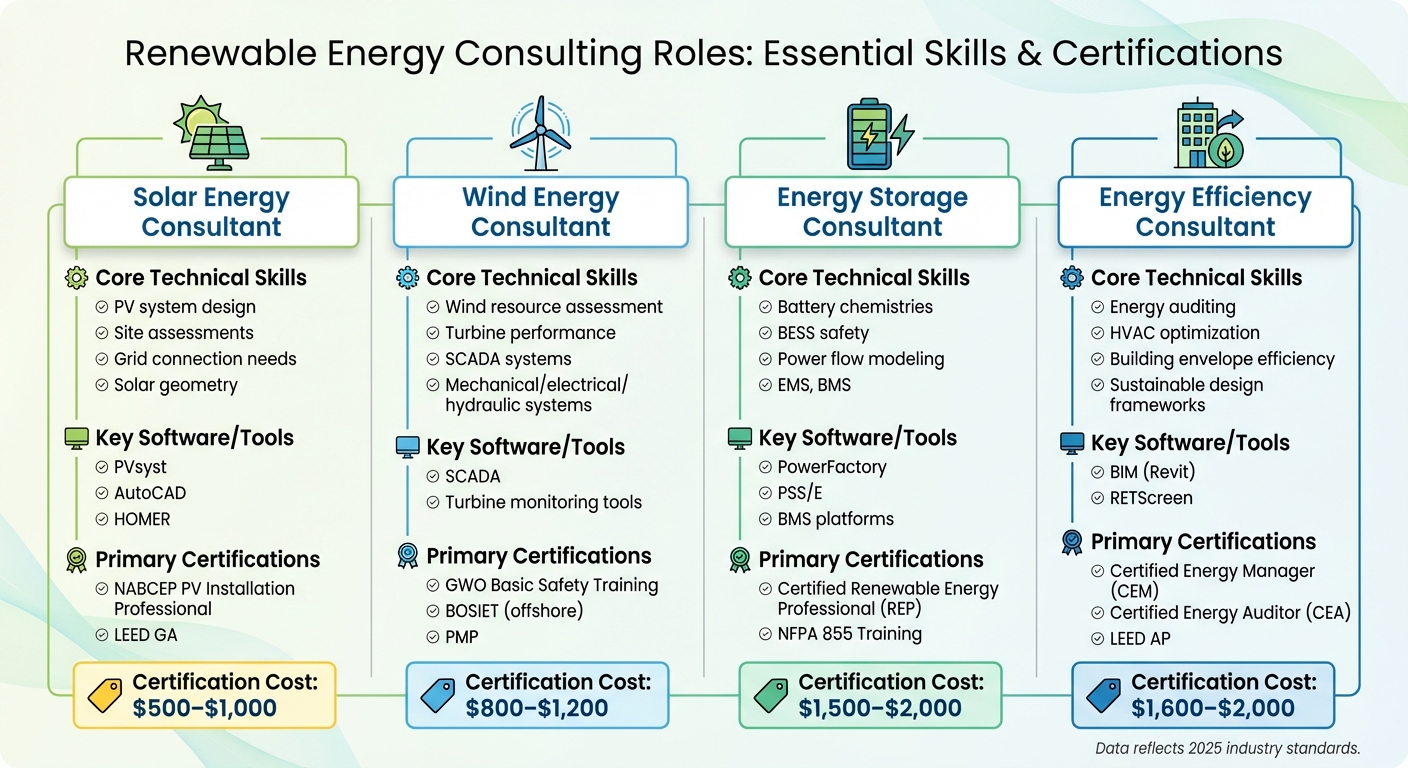
Renewable Energy Consulting Roles: Skills, Tools, and Certifications Comparison
Renewable energy consultants need a mix of technical know-how, financial expertise, and excellent communication skills. The technical requirements differ by specialization, with each role depending on specific software tools, as shown in the table below. Financial skills are equally crucial – consultants must calculate metrics like Net Present Value (NPV), Internal Rate of Return (IRR), and Levelized Cost of Energy (LCOE) to assess project feasibility.
In addition to technical and financial skills, data analytics is a must. Proficiency in tools like Python, SQL, or R is essential for analyzing and optimizing energy production [17, 22]. Energy storage consultants, for example, need a deep understanding of Battery Energy Storage Systems (BESS), battery chemistries, and compliance with safety standards like NFPA 855. On the other hand, energy efficiency consultants focus on energy audits, HVAC system improvements, and using Building Information Modeling (BIM) software [10, 19]. Knowledge of grid interconnection rules from NERC and FERC is also critical, especially as the interconnection queue now exceeds 2,600 GW of waiting capacity.
The ability to interpret technical data and present it in a clear, actionable way is what sets top consultants apart. Whether addressing policymakers, corporate leaders, or local communities, this skill is invaluable [10, 29]. Strong project management capabilities are just as important, helping consultants manage cross-functional teams and navigate delays that can stretch permitting timelines to an average of 4.5 to 6.5 years. Interestingly, job seekers with "green skills" in the U.S. have an 80.3% higher hiring rate compared to the broader workforce, even though up to 20% of green jobs may remain unfilled by 2030 due to skill shortages.
The table below outlines the essential technical skills, software tools, and certifications needed for various consulting roles.
Skills and Certifications by Role
| Role | Core Technical Skills | Key Software/Tools | Primary Certifications | Certification Cost |
|---|---|---|---|---|
| Solar Consultant | PV system design, site assessments, grid connection needs, solar geometry | PVsyst, AutoCAD, HOMER | NABCEP PV Installation Professional, LEED GA | $500–$1,000 |
| Wind Consultant | Wind resource assessment, turbine performance, SCADA systems, mechanical/electrical/hydraulic systems | SCADA, turbine monitoring tools | GWO Basic Safety Training, BOSIET (offshore), PMP | $800–$1,200 |
| Energy Storage Consultant | Battery chemistries, BESS safety, power flow modeling, EMS, BMS | PowerFactory, PSS/E, BMS platforms | Certified Renewable Energy Professional (REP), NFPA 855 Training | $1,500–$2,000 |
| Energy Efficiency Consultant | Energy auditing, HVAC optimization, building envelope efficiency, sustainable design frameworks | BIM (Revit), RETScreen | Certified Energy Manager (CEM), Certified Energy Auditor (CEA), LEED AP | $1,600–$2,000 |
Certifications play a key role in establishing credibility. For example, the NABCEP PV Installation Professional is widely regarded as a benchmark for solar consultants, while the GWO Basic Safety Training is essential for wind professionals. Energy efficiency specialists often pursue the Certified Energy Manager (CEM) credential to validate their expertise in energy auditing and renewable technologies [19, 23]. For those managing major projects, the Project Management Professional (PMP) certification signals the ability to handle large-scale infrastructure timelines and budgets.
"The speakers on the course were very experienced and knowledgeable. I’ve improved my skills in Project Finance on the course".
Education and Training Pathways
Breaking into renewable energy consulting starts with a solid educational background, but the exact path depends on the role you’re aiming for. A Bachelor’s degree in Environmental Science, Energy Engineering, Renewable Energy, or Sustainable Development is a great starting point for many consulting positions. For technical roles, especially in solar or wind energy, degrees in fields like Electrical, Mechanical, Civil, Industrial, or Aerospace Engineering are key. These programs prepare you to handle tasks like designing systems, assessing energy resources, and managing large infrastructure projects. Advanced degrees take this a step further, honing the technical and analytical expertise needed for leadership or research-heavy roles.
Pursuing a Master’s in Energy Systems Engineering or even a Ph.D. in Atmospheric Science opens doors to senior positions or research-focused opportunities. Employment for environmental scientists and specialists, which includes many renewable energy consultants, is expected to grow 7% between 2023 and 2033, according to projections as of May 2024.
While a four-year degree is often the standard, there are alternative routes into the field. Associate degrees or vocational training in areas like electrical work, welding, or wind technology can lead to entry-level technical roles. For those aiming to earn the Certified Renewable Energy Professional (REP) credential, the requirements vary: a four-year degree requires at least two years of experience, a two-year degree requires five years, and individuals with no degree need at least ten years of experience. The REP certification costs $400 to apply and take the exam, with a $300 renewal fee every three years.
Tools like IREC‘s Solar Career Map offer a helpful guide to career paths in the solar industry, showing how professionals can transition from technical roles to consulting positions. Additionally, IREC provides a free, self-paced course called "Exploring Careers in the Solar Industry," which helps participants craft personalized training and networking strategies.
To stand out in this competitive field, hands-on experience is invaluable. Seek internships with corporate sustainability teams, public utilities, or grassroots nonprofits. Joining student organizations focused on energy or sustainability can help you lead projects and stay engaged with current policy debates. Build a portfolio showcasing your coursework, technical reports, or research projects to highlight your problem-solving skills. Familiarity with tools like Excel, GIS (Geographic Information Systems), Python, or SQL is increasingly important as the industry adopts more digital approaches. Combining formal education with practical experience and technical skills is essential for thriving in the dynamic world of renewable energy consulting.
Using ABLEMKR for Renewable Energy Staffing

As the demand for renewable energy consulting roles continues to rise, finding efficient solutions for staffing has become increasingly important. The industry faces a significant challenge: hiring qualified consultants quickly enough to meet project needs. On average, it takes over six months to fill these roles, with approximately 1.7 job openings for every unemployed energy technician in top markets. ABLEMKR steps in to close this gap, linking expert consultants to critical renewable energy projects.
How ABLEMKR Connects Consultants to Projects
ABLEMKR’s mobile-first platform is designed to match pre-screened consultants with renewable energy projects. The matching process considers factors like certifications, safety training, availability, and location. Credentials such as NABCEP (Solar), OSHA Safety, and Wind Turbine Technician certifications are prioritized to ensure only qualified professionals are assigned to infrastructure projects.
The platform also offers real-time tracking, giving project managers visibility into worker status and project progress. This feature is especially useful for remote projects or situations requiring rapid crew mobilization, whether for installations, maintenance, or emergency repairs. By utilizing geo-location data, ABLEMKR significantly reduces the time it takes to hire and deploy skilled workers.
Benefits for Employers and Workers
ABLEMKR provides clear advantages for both employers and consultants. Employers benefit from streamlined hiring, onboarding, and compliance processes. The platform integrates payroll workflows and tracks compliance with labor laws, safety regulations, and environmental standards – key considerations since 94% of energy jobs between 2024 and 2025 were contract-based rather than direct hires. Additionally, ABLEMKR grants access to exclusive talent pools that aren’t publicly listed.
For consultants, the platform offers flexibility and access to well-paying opportunities in solar, wind, and energy storage. It ensures timely payments and supports various work arrangements, from short-term contracts to potential full-time roles. This flexibility allows professionals to manage their schedules while gaining valuable experience across diverse projects. With renewable energy employment projected to hit 16.6 million globally by 2025 and clean energy jobs expected to make up over 60% of the energy sector workforce by 2030, platforms like ABLEMKR are becoming essential tools for connecting skilled workers to the growing needs of the industry.
Conclusion
The renewable energy consulting field is expanding rapidly, with clean energy jobs projected to make up over 60% of the sector by 2030. Emerging roles in solar, wind, energy storage, and energy efficiency are reshaping the industry, demanding professionals with specialized technical expertise, regulatory knowledge, and digital skills. As one expert put it, "The rapid growth of renewables depends on the industry finding enough employees with the right skills and experience".
Success in these roles hinges on a combination of key certifications and skills. Certifications like NABCEP, GWO Basic Safety Training, and OSHA 30-Hour are indispensable. Beyond these, consultants must grasp project finance, Power Purchase Agreements, and federal policies such as the Inflation Reduction Act to deliver comprehensive solutions to clients. These qualifications are redefining how renewable energy projects are staffed and executed.
By 2030, the global renewable energy sector will require an additional 1.3 million white-collar professionals, including project managers and finance specialists. However, traditional hiring processes, often taking six months or more to fill specialized roles, are too slow to meet the pace of project demands. Addressing this challenge, ABLEMKR offers a mobile-first platform that connects pre-vetted consultants to renewable energy projects. The platform matches professionals based on certifications, location, and availability, while also simplifying compliance and payroll processes.
For businesses, having qualified consultants is critical to project success. For professionals, the growing renewable energy sector provides flexible, well-paid opportunities across a variety of projects. These range from utility-scale solar installations – expected to grow by 35% in 2025 – to the booming energy storage market. The combination of environmental priorities, supportive policies, and technological advancements has created a thriving career landscape for those with the right expertise. Platforms like ABLEMKR play a key role in ensuring that skilled professionals are matched to the projects that need them most.
FAQs
Which renewable energy consulting role fits my background?
The ideal renewable energy consulting role for you will align with your unique skills and experience. If your expertise lies in technical fields, positions such as solar energy consultant, wind turbine technician, or energy engineer could be a great fit, as they emphasize system design and technical evaluations. On the other hand, if your strengths are more strategic or analytical, roles like energy analyst or feasibility study consultant might be more appealing, focusing on assessing project potential and refining energy solutions.
What certifications matter most to get hired faster?
Certifications can play a big role in speeding up your hiring process in the renewable energy sector. Industry-recognized credentials like the AEE Certified Renewable Energy Professional (REP) and NABCEP Board Certifications for solar professionals are excellent examples. These certifications confirm your skills in key areas such as system design, project management, and technical installation.
Focusing on certifications that align with your specific area of interest – whether it’s solar, wind, or energy storage – can showcase both your expertise and your dedication to the field. This not only enhances your skill set but also makes you stand out as a strong candidate in a competitive job market.
How can ABLEMKR help me find renewable energy consulting projects?
ABLEMKR bridges the gap between skilled professionals and renewable energy consulting projects through its platform, simplifying workforce deployment and staffing. With the increasing demand in areas like solar, wind, and energy storage, ABLEMKR facilitates rapid crew mobilization by matching workers to projects based on their certifications and availability. This ensures consulting firms and energy companies can staff projects efficiently and stay on track in the rapidly changing renewable energy industry.


