
The energy sector is rapidly shifting toward digital operations, driven by investments in renewable energy, automation, and smart technologies. By 2025, 92% of energy companies plan to invest in digital tools, but only 26% are retraining their workforce, creating a skills gap. Key areas of focus include:
- Data Analysis: Turning massive data volumes into actionable insights, such as predictive maintenance and cost optimization.
- Cybersecurity: Protecting critical infrastructure from evolving threats like AI-driven attacks and quantum computing risks.
- AI and Automation: Reducing operational costs and improving efficiency through predictive tools and autonomous systems.
- IoT and Cloud: Managing connected devices and leveraging scalable cloud platforms for real-time diagnostics.
Despite the challenges, upskilling programs and certifications in fields like AI, cybersecurity, and data analytics are helping bridge this gap. Platforms like ABLEMKR are also facilitating workforce deployment by connecting skilled professionals with energy projects. The future workforce will need to combine technical and digital expertise to thrive in this evolving landscape.
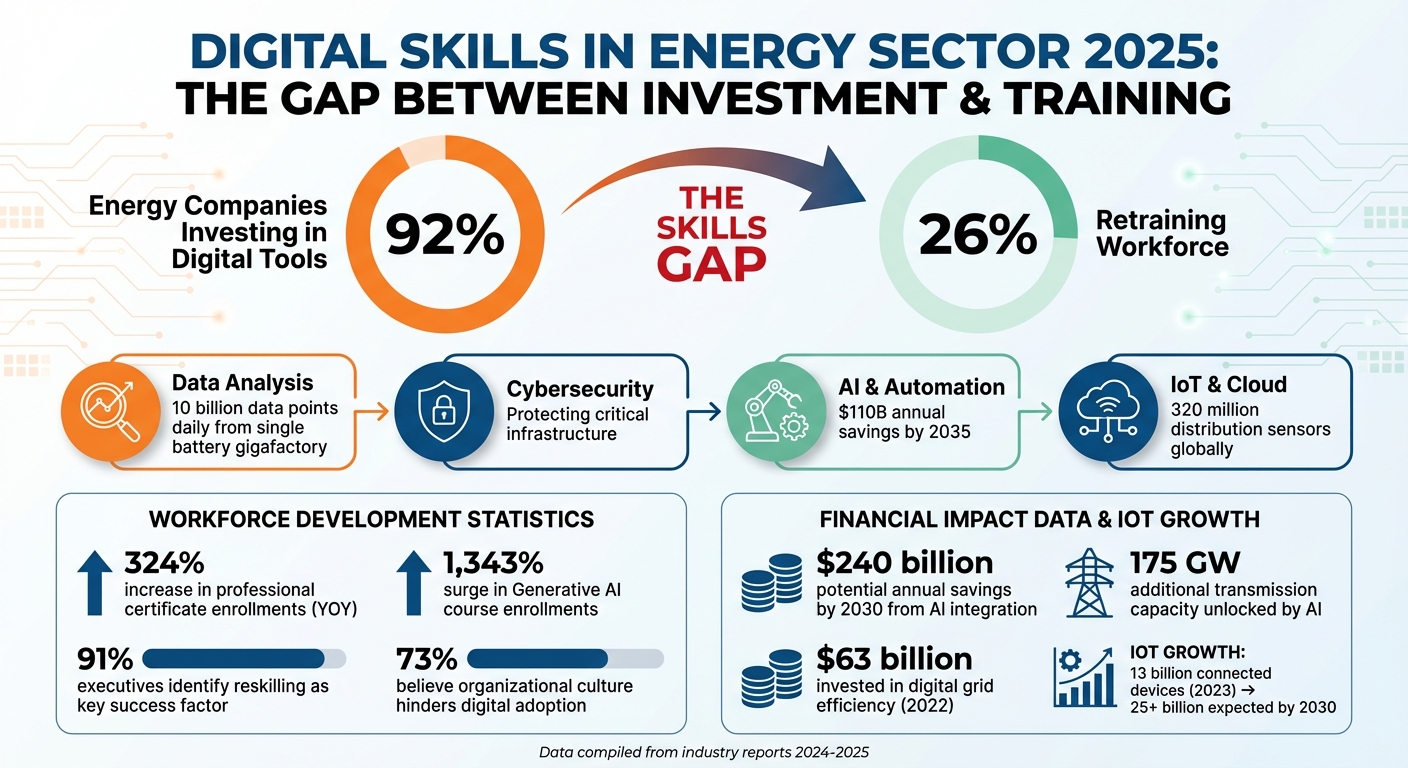
Digital Skills Gap in Energy Sector 2025: Investment vs Workforce Training Statistics
Data Science in the Energy Industry
Data Analysis and Visualization Skills
The energy sector generates an overwhelming amount of data every day. For instance, a single battery gigafactory can produce up to 10 billion data points daily, and the deployment of smart meters and sensors across energy grids has skyrocketed. But here’s the catch: raw data on its own doesn’t solve problems. As the U.S. Department of Energy explains, "Power system sensor data is raw; it requires cleaning, synchronization, and analytics to be actionable". This means that developing skills in data cleaning and contextual analytics is essential for turning this flood of information into meaningful insights.
Energy professionals face the task of transforming massive volumes of data into actionable decisions that reduce costs, prevent system failures, and optimize operations. For example, AI applications in power plants could lead to $110 billion in annual cost savings by 2035 while freeing up 175 GW of transmission capacity.
Energy Data Analytics
Energy data analytics is a diverse field, covering everything from turbine sensors to reservoir simulations. In the oil and gas industry, professionals rely on subsurface data processing and reservoir modeling to improve exploration efficiency while reducing carbon intensity. Meanwhile, in renewable energy, analyzing weather patterns has become critical. Accurate weather forecasting allows operators to better plan energy generation and build resilience as climate conditions evolve.
Analysts are tasked with diagnosing, predicting, and prescribing system behaviors under both normal operations and extreme conditions. This might involve detecting equipment faults before they lead to shutdowns, optimizing production schedules in manufacturing to save 8% in energy consumption by 2035, or managing distributed energy resources like rooftop solar and battery storage systems.
The traditional methods utilities have relied on simply can’t keep pace with the sheer volume, velocity, and variety of data now flowing through energy systems. To stay ahead, professionals need expertise in data cleaning, real-time event detection, and predictive maintenance. Understanding interoperability standards is also key, ensuring that data from different sensors and platforms can work together seamlessly. These skills are the foundation for effective data visualization, which plays a vital role in decision-making.
Visualization Tools and Platforms
Visualization platforms are indispensable for converting raw data into actionable insights in real time. These tools enable operators to make informed decisions by quickly identifying trends and generating alerts.
For example, some platforms analyze corrosion images from pipelines and issue predictive alerts, allowing companies to address infrastructure issues before they escalate into costly failures. In battery manufacturing, AI-powered visualization tools can detect faults and predict performance, reducing risks and costs associated with developing new energy chemistries.
However, the challenge isn’t just about having the right technology. While 98% of companies are experimenting with AI, only 26% have progressed beyond the proof-of-concept stage to derive real value. Breaking down data silos is critical to ensuring that information flows freely across an organization. Energy professionals should focus on mastering tools that support interoperability and real-time diagnostics, enabling them to proactively address critical infrastructure challenges.
Cybersecurity Skills for Energy Systems
As the energy sector embraces digital transformation, cybersecurity expertise has become an essential skill for its workforce.
With more devices connecting to energy infrastructure, threats are evolving. AI-driven attacks now target smart grids, IoT sensors, and distributed energy resources (DERs). The U.S. Department of Energy emphasizes this urgency: "Cybersecurity is an integral underpinning of power system resilience". Without skilled professionals, energy companies risk coordinated attacks that could disrupt power grids and water treatment facilities on a massive scale.
Infrastructure Vulnerabilities
Energy systems face a range of vulnerabilities. The increasing integration of DERs into electric distribution networks introduces new access points for attackers, necessitating specific security measures for operators and aggregators. Meanwhile, legacy operational technology (OT) devices, which often lack built-in security, remain highly susceptible to breaches. Adding to the complexity, post-quantum threats are becoming a concern, as advancements in quantum computing could eventually compromise the cryptographic protections currently safeguarding grid controls and communications.
Professionals in the energy sector must be equipped to tackle these challenges. This includes mastering advanced defense strategies and finding practical solutions for outdated systems. For instance, tools like "bump-in-the-wire" security appliances, such as Module-OT, can enhance cryptographic security for legacy devices that cannot be easily upgraded. Recognizing these vulnerabilities is just the starting point – effective training and proactive protocols are critical to protecting vital infrastructure.
Cybersecurity Training and Protocols
To address these challenges, energy companies are increasingly adopting Cyber-Informed Engineering, a proactive approach that integrates security into the earliest stages of system design. As the National Renewable Energy Laboratory (NREL) advises, "Engineered systems should incorporate security and resilience from initial concept and design as primary features rather than afterthoughts". This shift requires professionals to blend traditional engineering expertise with cybersecurity knowledge.
To support this skill development, the Cybersecurity and Infrastructure Security Agency (CISA) offers a 12-week cohort program designed to build foundational skills for Cyber Defense Analysts. Additionally, energy sector employees can take advantage of free Industrial Control Systems (ICS) training, which provides tools for safeguarding power grids against cyberattacks. These programs range from basic awareness sessions to hands-on cyber range exercises. Organizations can further strengthen their defenses by conducting regular tabletop exercises and participating in large-scale simulations like "Cyber Storm", which help identify weaknesses in incident response plans. Notably, professionals with cloud security expertise can also command salary premiums of over $15,000.
Automation and AI in Energy Operations
Automation and artificial intelligence (AI) are reshaping how the energy sector handles production and grid management. By 2035, AI’s role in power plant operations could save an impressive $110 billion annually. These advancements not only reduce costs but also improve safety, precision, and environmental outcomes.
As highlighted in the Data Analysis section, battery gigafactories produce billions of data points every day. AI models process this data to identify faults and predict performance issues before they escalate into failures. Meanwhile, in the oil and gas industry, 24 of the world’s 500 fastest supercomputers are operated by energy companies. These machines enhance exploration and production by enabling tasks like subsurface data analysis and AI-generated well designs. The result? Lower production costs and reduced carbon emissions per barrel. This digital shift naturally extends to automation technologies that simplify everyday operations.
Automation Technologies in Energy
Automation is revolutionizing daily operations across the energy landscape. In renewable energy, AI plays a key role in optimizing solar and wind integration. It adjusts operations based on weather forecasts and manages Virtual Power Plants (VPPs), which combine decentralized energy resources. For grid operators, AI-driven tools can unlock up to 175 GW of additional transmission capacity in existing power lines. Renewable energy companies have reported efficiency gains of 15% to 25% thanks to these technologies.
"The ultimate vision is to enable autonomous operations, including synthetic seismic data evaluations, AI-generated well designs, and AI-guided operations".
This progress includes AI-powered robots taking on high-risk tasks and real-time chatbots offering technical support to field technicians, streamlining maintenance processes and reducing human error. These advancements highlight the growing demand for energy professionals to develop expertise in automation and AI. Additionally, AI-driven predictive maintenance is further enhancing reliability by minimizing downtime.
AI and Machine Learning for Predictive Maintenance
Predictive maintenance stands out as one of AI’s most impactful applications in the energy industry. Machine learning models analyze sensor data and corrosion images to issue alerts before equipment failures occur, safeguarding both assets and workers. By 2030, integrating AI across energy systems could save $240 billion annually, with total cost reductions potentially reaching $500 billion by 2050.
The success of these tools depends on how companies implement them. Boston Consulting Group suggests following the 10/20/70 rule: allocate 10% of AI investment to algorithms, 20% to data and technology, and 70% to people, processes, and cultural adaptation. Companies focusing on practical, high-impact use cases – like reducing equipment downtime – are seeing quicker adoption and better results.
"The true driver of market leadership will be the capability of the organization’s people to rapidly and flexibly adopt new technologies for disruptive applications".
sbb-itb-aa28329
Cloud Computing and IoT in Energy
Cloud platforms and IoT devices are reshaping how energy is monitored and managed. In 2023, there were roughly 13 billion connected devices equipped with automated sensors, and that number is expected to exceed 25 billion by 2030. This rapid growth in connected devices is driving operational advances across the energy sector.
The financial stakes are just as striking. In 2022, investments in digital grid efficiency hit a record $63 billion. By 2030, combining AI with IoT could result in annual energy savings of up to 3,700 TWh, translating to nearly $240 billion in cost reductions each year. Currently, utilities analyze only about 2% to 4% of the data they collect. The integration of IoT and cloud computing is paving the way for real-time diagnostics and greater operational flexibility.
IoT Sensors in Energy Systems
IoT sensors act as the nerve center of modern energy systems. Globally, around 320 million distribution sensors are installed in power grids. These sensors gather detailed data, enabling operators to align energy supply with demand in real time. This capability is especially vital for incorporating renewable energy sources like wind and solar, which can vary depending on weather conditions.
These sensors track everything from voltage changes and equipment vibrations to corrosion patterns. This data supports predictive maintenance strategies, which can cut equipment downtime by 30% to 50%.
"The energy system is complex and evolving. It is becoming increasingly electrified, digitalised, connected and decentralised, with mounting cost pressures".
Cloud-Based Energy Management
The immense data generated by IoT sensors requires robust cloud infrastructure to be effectively processed and utilized. Cloud computing offers the scalability needed to manage these vast data streams. On average, energy companies spend $37 million annually on cloud services, making it the second-highest spending sector after healthcare. The global cloud computing market in energy is projected to grow to $3.7 billion by 2034, fueled by the demand for flexible, real-time energy management solutions.
Cloud platforms also support innovative models like Virtual Power Plants (VPPs), which consolidate distributed energy resources. This trend is steering the industry toward what Boston Consulting Group calls "autonomous operations", featuring AI-driven designs and operations.
However, this digital transformation comes with environmental challenges. Data centers, transmission networks, and connected devices accounted for approximately 330 Mt CO2 equivalent emissions in 2020, representing 0.9% of energy-related greenhouse gas emissions. With data center expansion expected to drive a 15% to 20% annual increase in U.S. electricity consumption through 2030, the energy sector must weigh the benefits of digital efficiency against its environmental footprint.
Combining Technical Expertise with Digital Skills
The energy sector is undergoing a transformation, requiring workers to combine traditional technical know-how with digital proficiency. For example, field technicians now analyze data from IoT sensors, while power plant operators integrate AI-driven predictive maintenance into their daily routines. Despite 92% of energy companies planning to invest in digital technologies, only 27% are actively retraining their current workforce, highlighting a significant skills gap. Reskilling has become critical, with 91% of power and utilities executives identifying it as a key factor for success. This shift is creating hybrid roles that blend technical and digital expertise across the energy workforce.
Hybrid Roles in the Energy Workforce
Energy jobs are no longer confined to traditional roles – they now demand a mix of technical and digital skills. Take smart grid engineers, for instance. They manage real-time data streams while maintaining a deep understanding of electrical distribution systems. Similarly, renewable energy analysts utilize tools like Microsoft Power BI to monitor solar and wind energy performance, combining their digital skills with a solid grasp of energy production fundamentals. Even electricians and supervisors are adapting, incorporating digital reporting and remote monitoring into their daily tasks.
These hybrid roles are already reshaping hiring practices in the industry. Employers increasingly prioritize candidates who can navigate both physical systems and digital platforms. For example, a wind turbine technician who can troubleshoot mechanical issues while analyzing sensor data from cloud-based systems has a clear edge over someone with only mechanical expertise. The same is true for oil and gas professionals, who are now using supercomputing and AI to process subsurface data and simulate reservoirs. To stay competitive, energy professionals are turning to targeted certification programs that enhance their digital capabilities.
Upskilling and Certification Programs
To address the digital skills gap, energy professionals are pursuing certifications at unprecedented rates. By early 2025, enrollments in professional certificate programs within the energy sector had surged by 324% year-over-year – the highest growth across all industries. Popular certifications include the Google Data Analytics Certificate, Microsoft Power BI Data Analyst, and Google Cybersecurity Professional Certificate. These credentials offer tangible proof of digital expertise that employers can immediately recognize.
One notable example comes from Reliance Industries Limited, a Fortune 500 energy company. In early 2025, the company launched a comprehensive digital learning initiative aimed at equipping managers with the skills needed to navigate technological advancements and regulatory changes. Led by Sumegha Lazarus, SGM & Head of Content and Digital Learning, this program focused on fostering sustainability and profitability through enhanced digital capabilities. Meanwhile, enrollments in Generative AI courses for energy professionals skyrocketed by 1,343% year-over-year, underscoring the growing importance of AI literacy in the sector.
"The challenge is to shorten the skills gap, incorporate continuous learning into the regular operating rhythm of companies and underscore its importance when setting strategic priorities." – Timothy Haskell, EY Americas People Consulting Leader for Power & Utilities
Beyond formal certifications, energy workers are turning to platforms like Coursera, Udemy, and LinkedIn Learning for flexible, self-paced training. Webinars and mentorship programs also provide valuable opportunities to learn from digitally skilled colleagues. However, 73% of power and utilities companies believe their organizational culture hinders the adoption of digital technologies. This highlights the need for companies to pair individual upskilling efforts with a commitment to fostering a culture of continuous learning and adaptation. Building digital literacy is essential for effectively using tools in data analytics, AI, and cybersecurity – topics explored throughout this guide.
How ABLEMKR Supports Digital Workforce Deployment

In the energy sector’s push toward digital transformation, one of the biggest hurdles is deploying skilled workers at the right time and place. ABLEMKR’s mobile-first platform steps in to solve this by connecting pre-vetted, qualified workers with critical energy projects across the U.S. It simplifies hiring, onboarding, and compliance for industries like oil & gas, utilities, mining, and heavy infrastructure – where getting the right crew in place quickly can make or break project deadlines.
Mobile-First Technology for Rapid Workforce Assembly
ABLEMKR uses geo-location technology to match workers with nearby projects, cutting down on travel time and speeding up crew mobilization. This feature is especially crucial in a competitive labor market, where 40% of companies report challenges in finding skilled workers among the 8.5 million employed in the power grid sector. For example, solar photovoltaic projects alone accounted for 40% of power-sector job additions in 2024, emphasizing the need for efficient, tech-driven solutions to workforce deployment.
The platform also ensures workers are pre-vetted, with certifications and safety training verified before they’re deployed. For workers, this means access to flexible, well-paying opportunities with guaranteed on-time payments. For companies, it means faster staffing without compromising on quality or compliance – ensuring that every project has the right expertise on-site, when and where it’s needed.
Connecting Digital Skills to Energy Projects
What sets ABLEMKR apart is its focus on aligning workers’ digital skills with the demands of modern energy projects. The platform’s smart matching system considers certifications, safety training, availability, and location to ensure companies get workers who are not only technically skilled but also proficient in digital tools like IoT data management and cloud monitoring.
As energy companies increase their investments in digital technologies, the need for workers who can bridge the gap between traditional fieldwork and advanced digital operations has never been greater. ABLEMKR addresses this by showcasing verified worker profiles that highlight both digital credentials and traditional qualifications. This gives employers confidence that the teams they deploy can handle the physical and digital challenges of today’s energy projects.
Conclusion
The energy sector’s shift toward digital transformation is more than just adopting new technologies – it’s about cultivating a workforce that’s fluent in digital skills. The numbers speak volumes: enrollments in courses like Generative AI have skyrocketed by 1,343%, while professional certificate enrollments have grown by 324%. Timothy Haskell, EY Americas People Consulting Leader, highlights the urgency of this shift:
"The challenge is to shorten the skills gap, incorporate continuous learning into the regular operating rhythm of companies and underscore its importance when setting strategic priorities".
The data makes one thing clear: reskilling isn’t a one-and-done effort. It’s a continuous process, woven into the fabric of workforce development. Companies that embrace this mindset – treating upskilling as an ongoing priority – are the ones positioned to thrive as the energy sector evolves. The need for adaptability within the workforce is greater than ever.
A standout example of this evolution is ABLEMKR, which bridges the gap between digital expertise and practical application. With 88% of power and utilities executives planning to rely more on external vendors and contractors to address digital skill shortages, ABLEMKR’s model offers a clear advantage. By leveraging mobile-first technology and verified digital credentials, they enable energy companies to efficiently connect pre-vetted workers with the right qualifications to high-priority projects. This approach not only meets immediate industry needs but also supports the broader transition to a more agile and digitally capable workforce.
The future of the energy sector depends on workers who can seamlessly combine technical know-how with digital expertise. Whether it’s a technician managing IoT sensors in the field or an engineer using AI to predict and prevent equipment failures, the ability to operate across both physical and digital spaces is no longer optional. Companies that prioritize digital fluency and rapid workforce deployment will set the pace for the industry’s future.
FAQs
What digital skills will be in high demand in the energy sector by 2025?
By 2025, the energy sector is set to focus heavily on digital expertise to support cutting-edge technologies and ensure secure operations. Professionals skilled in artificial intelligence (AI) and machine learning (ML) will be in high demand, especially for applications like predictive maintenance, optimizing energy grids, and forecasting renewable energy output. Alongside these, data analytics will play a crucial role, as companies depend on experts to turn massive amounts of sensor and market data into meaningful insights.
As energy systems become more interconnected, cybersecurity skills will be vital to safeguard critical infrastructure, including SCADA systems, IoT devices, and cloud-based platforms. Proficiency in digital twins, cloud computing, and IoT integration is also becoming increasingly important for simulating assets and managing distributed energy resources. Moreover, understanding mobile-first workforce allocation tools is emerging as a valuable skill, helping companies efficiently deploy their workforce while staying compliant in a rapidly evolving industry.
How can energy companies bridge the digital skills gap in their workforce?
Energy companies can tackle the digital skills gap by rethinking traditional training methods and embracing fresh approaches. Short-form learning opportunities, like micro-credentials and AI-powered courses, offer a fast and effective way to teach workers essential skills such as data analytics, cybersecurity, and AI-based operations. At the same time, mentorship programs that pair retiring industry veterans with younger employees can help pass along vital expertise while speeding up on-the-job learning.
Another game-changer is the use of data-driven workforce platforms, which enable companies to quickly match certified professionals to specific projects. This ensures that compliance and safety standards are met while bypassing the lengthy timelines of traditional training programs. Collaborating with educational institutions to design specialized curricula, such as for energy-data analysts, can further strengthen the talent pool. By blending these strategies, energy companies can effectively fill critical positions, uphold safety, and navigate the energy transition with confidence.
Why is cybersecurity critical for modern energy systems?
The growing digitalization of power grids has made them smarter and more efficient, but it has also exposed them to cyber threats. With energy systems now heavily reliant on interconnected software, a cyberattack could have devastating consequences. Imagine losing control over critical equipment, facing infrastructure damage, or experiencing massive outages that disrupt hospitals, transportation, and other essential services.
As the energy sector integrates advanced technologies like AI-driven analytics, IoT sensors, and automated control systems, the need for specialized cybersecurity measures has never been greater. Without strong defenses, these systems could become vulnerable to breaches, leading to safety risks, supply chain interruptions, and hefty financial or regulatory penalties. The shift toward a low-carbon energy future demands not only innovation but also a skilled workforce capable of safeguarding the nation’s evolving energy infrastructure.


