
Need workers fast? Digital staffing platforms can deploy pre-vetted workers within 2–7 days, while traditional hiring often takes 4–8 weeks. This time savings is critical for industries like construction, oil & gas, and heavy infrastructure, where delays can cost millions.
Digital staffing platforms like ABLEMKR simplify hiring by automating job matching, identity verification, and payroll. They also provide real-time workforce data and compliance tracking, reducing hiring costs by up to 25%. In contrast, traditional hiring involves manual processes, slower timelines, and higher administrative costs.
Key Takeaways:
- Speed: Digital staffing reduces hiring time by 30%, enabling same-day or next-day deployment.
- Cost Efficiency: Automates payroll and compliance, cutting cost-per-hire by 25%.
- Transparency: Offers real-time tracking of workers and automated credential management.
- Worker Benefits: Flexible schedules, timely payments, and performance-based opportunities.
Quick Comparison:
| Feature | Digital Staffing | Traditional Hiring |
|---|---|---|
| Hiring Time | 2–7 days | 4–8 weeks |
| Cost-per-Hire Reduction | Up to 25% | Higher administrative costs |
| Compliance | Automated | Manual, prone to errors |
| Worker Flexibility | High | Limited |
| Payroll & Payments | Automated, accurate | Manual, often delayed |
For short-term or urgent projects, digital staffing is a faster, more cost-effective option. For long-term roles, traditional hiring may still be better suited. Each approach has its place – choose based on your project needs.
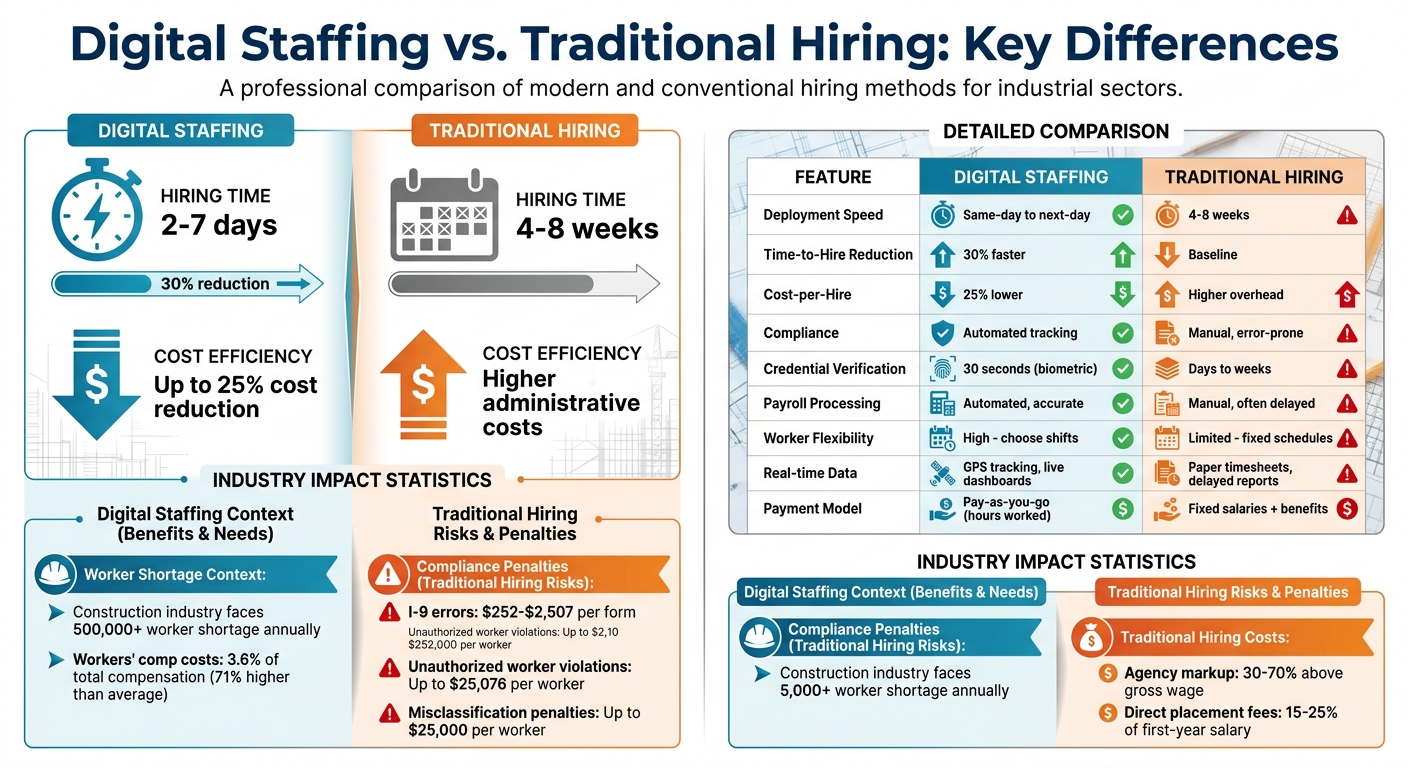
Digital Staffing vs Traditional Hiring: Speed, Cost, and Efficiency Comparison
Speed: Digital Staffing vs. Traditional Hiring Timelines
Traditional hiring can take anywhere from 4 to 8 weeks, while digital staffing platforms bring that timeline down to just 2 to 7 days. This difference can mean the world when it comes to keeping projects on track and avoiding costly delays. Let’s dive into why digital platforms are so much faster and how traditional methods struggle to keep up.
Fast Crew Deployment with Digital Platforms
Digital staffing platforms cut out the inefficiencies of manual hiring processes. Take ABLEMKR, for example. It uses AI-driven matching algorithms to pair companies with workers based on certifications, safety training, availability, and location. Forget spending weeks reviewing resumes or scheduling interviews – these platforms offer a pool of pre-vetted workers ready to go.
The tech behind this speed is impressive. With biometric voice verification, a worker’s identity can be confirmed in as little as 30 seconds. Compare that to the much slower, manual background checks of traditional hiring. Even team fit is assessed through behavioral analysis, which evaluates pace and clarity, reducing the need for multiple interview rounds. Companies using these platforms report cutting their time-to-hire by as much as 30%.
"Speed is no longer just a competitive edge. It often determines whether you win or lose great talent."
- Elbert Jolio, Glints
For urgent projects – like an unexpected pipeline shutdown or the development of a remote site – this speed isn’t just convenient; it’s essential. ABLEMKR’s mobile-first platform gives real-time updates on worker status, enabling same-day or next-day crew mobilization. Meanwhile, traditional hiring methods are still bogged down in scheduling initial interviews.
Time Delays in Traditional Hiring Processes
While digital platforms excel at fast deployment, traditional hiring methods are slowed by a series of manual steps. Each stage involves coordination across multiple departments, often leading to what’s known as "calendar churn" – delays caused by scheduling conflicts.
Credential verification is a major sticking point. The manual process can drag on, especially if documentation is incomplete. By the time qualifications are verified, project schedules may already be in jeopardy. Digital platforms, on the other hand, maintain verified trade histories and certifications before workers even apply.
Another hurdle is manual payroll and compliance checks, which add further delays to traditional hiring. In industries already grappling with a shortage of over 500,000 workers each year, these delays can create significant operational challenges. Digital staffing platforms are specifically built to address and overcome these issues.
sbb-itb-aa28329
Transparency: Real-Time Data vs. Manual Tracking
Having immediate access to accurate, centralized information about worker locations and activities is crucial. Digital staffing platforms offer this kind of real-time visibility, while traditional methods often require piecing together fragmented data from multiple sources. This streamlined access to information speeds up decision-making and complements the operational advantages discussed earlier.
Live Workforce Data and Automated Reporting
Platforms like ABLEMKR provide dashboards that display real-time workforce data. Employers can quickly check worker availability, track costs as they accumulate, and ensure compliance – all without the need for manual intervention.
Key features include automated alerts for expired credentials and GPS-verified mobile clock-ins, which confirm workers are on-site and eliminate errors like "buddy punching." This real-time system not only accelerates deployment but also improves overall efficiency, as previously highlighted.
ABLEMKR also integrates payroll workflows into its centralized dashboard, offering live updates on labor costs, worker statuses, and compliance tracking – all in one place. Additionally, performance ratings from supervisors build a detailed, data-backed profile for each worker. This level of precision is simply unattainable with manual tracking. Teams using these digital tools have reported a reduction in cost-per-hire by about 25%.
"Recruiters gain auditable records, clean logs, and consistent proof of candidate authenticity. That level of transparency reassures both internal stakeholders and clients."
Manual Timesheets and Tracking Errors
Traditional methods, on the other hand, rely heavily on outdated processes. Paper timesheets and manual data entry are prone to errors and disputes over hours worked. Workers often fill out their timesheets from memory at the end of the week, leading to inaccuracies.
Compliance is another major challenge with manual systems. Expired licenses or OSHA certifications can easily go unnoticed since these systems lack automated alerts or reminders. The risks are significant – penalties for I-9 paperwork errors range from $252 to $2,507 per form, and fines for knowingly employing unauthorized workers can climb as high as $25,076 per violation.
Manual systems also lack real-time insights. For example, if you need to check current labor costs or verify the availability of certified workers for an upcoming shift, you’re stuck waiting for manually compiled reports. By the time you receive the data, it may already be outdated. Digital platforms solve this problem by providing up-to-the-minute information, ensuring you have what you need exactly when you need it.
Worker Benefits: Digital Platforms vs. Traditional Employment
The differences between digital platforms and traditional employment go beyond just operational efficiency. How workers find jobs, get paid, and manage their schedules plays a major role in shaping their financial stability and overall well-being.
Worker Control and Payment Security
Digital platforms give workers the freedom to pick jobs that align with their skills, location, and availability. Through mobile apps, workers can browse opportunities and choose roles that suit their needs. For instance, ABLEMKR uses a W-2 model, acting as the legal employer to handle taxes, workers’ compensation, and timely payments.
This setup removes many common payment issues. Tasks like processing payroll taxes, managing workers’ compensation, and ensuring accurate time tracking are automated. Payments are prompt, and GPS-verified time tracking adds a layer of accuracy. Additionally, workers who consistently perform well can earn higher ratings from supervisors, giving them access to better-paying opportunities – a system that rewards skill and professionalism. On the other hand, traditional employment often locks workers into rigid schedules, limiting their flexibility.
Limited Flexibility in Traditional Hiring
Traditional hiring methods come with several drawbacks, especially for workers seeking flexibility. Lengthy onboarding processes – sometimes taking weeks – delay income, leaving workers without pay during transitions. These roles usually require workers to stick to fixed schedules with a single employer, making it difficult to juggle multiple income streams or personal responsibilities.
Digital platforms, by contrast, match workers to nearby job sites, removing the need for relocations that are often necessary in traditional roles. Payment issues are another challenge in traditional setups. Workers relying on manual timesheets frequently encounter disputes over recorded hours. Some employment agencies even charge workers upfront fees or take a cut of their salary. Digital platforms, however, typically follow an employer-paid model, ensuring workers keep their full earnings. This is particularly relevant in industries like construction, which faces an annual shortage of over 500,000 workers. Traditional hiring methods, with their lack of flexibility and financial security, risk driving skilled workers away from available jobs, highlighting the operational advantages of digital platforms.
Cost and Efficiency Comparison
When it comes to hiring, comparing digital staffing platforms with traditional methods reveals clear differences in cost and efficiency. Digital platforms not only streamline operations but also help businesses save money by reducing overhead, minimizing compliance risks, and improving labor cost management.
Lower Costs with Digital Staffing Platforms
Digital staffing platforms offer a more cost-effective approach by automating processes and simplifying billing. Instead of handling individual payrolls, companies receive a single, consolidated invoice that includes payroll taxes, workers’ compensation insurance, and onboarding paperwork. This approach can cut the cost-per-hire by up to 25%.
Automation also helps reduce costly errors. Mobile time tracking ensures accurate labor cost calculations, while automated credential management flags expiring certifications before they create compliance issues. Platforms like ABLEMKR manage the entire employment lifecycle – from I-9 verification to workers’ compensation claims – reducing what used to take days to just a few clicks. This also protects companies from hefty fines: misclassifying workers can lead to penalties of up to $25,000 per worker, and I-9 form errors can cost between $252 and $2,507 per form. By acting as the W-2 employer, digital platforms take on these compliance risks, lifting the burden off contractors.
Time-to-hire is reduced by as much as 30% through automated screening and access to pre-vetted worker pools. This means projects can start sooner, and downtime is minimized. Plus, the pay-as-you-go model ensures businesses only pay for the hours worked, avoiding the costs of maintaining full-time staff during slower periods. This flexibility is especially valuable in industries with fluctuating demand. By combining cost savings with operational efficiency, platforms like ABLEMKR help businesses deploy a workforce quickly, accurately, and in compliance with regulations, leading to better project outcomes.
Higher Administrative Costs in Traditional Hiring
Traditional hiring methods come with hidden costs that add up fast. Tasks like manual resume reviews, phone screenings, and interview scheduling consume valuable recruiter time that could be spent on strategic initiatives. Construction companies, for example, already spend 3.6% of total compensation costs on workers’ compensation insurance – 71% higher than the average for goods-producing industries. On top of that, managing claims and renewals adds to the administrative load.
Paper-based timesheets often lead to errors, requiring HR teams to spend extra time reconciling discrepancies. Managing individual payrolls for each hire further increases the workload. Staffing agencies charge 30% to 70% above the worker’s gross wage to cover these administrative costs, while direct placement fees can range from 15% to 25% of the worker’s first-year salary. Companies also face the full responsibility for compliance tasks like background checks and credential verification – areas where digital platforms excel through automation. Traditional methods result in higher overhead, slower hiring processes, and greater exposure to regulatory fines, such as penalties of up to $25,076 per worker for knowingly hiring unauthorized personnel.
When to Use Digital Staffing vs. Traditional Hiring
Deciding between digital staffing and traditional hiring comes down to factors like project timelines, workforce requirements, and industry-specific needs. Each approach serves distinct purposes, helping you save money and avoid project delays. Here’s how to determine which option works best for your situation.
Digital Staffing for High-Demand Industries
Digital staffing platforms shine when you need to ramp up quickly and navigate compliance-heavy requirements. Industries like oil & gas, mining, utilities, and heavy infrastructure often experience fluctuating project demands that traditional hiring just can’t handle efficiently. For example, urgent tasks like pipeline repairs or mining projects often require same-day or next-day worker deployment, which digital staffing makes possible.
Platforms like ABLEMKR simplify the process by automatically verifying specialized certifications such as H2S Safety, TWIC clearance, and MSHA Part 46/48 training. This automation ensures compliance and helps you avoid costly site shutdowns or fines due to expired credentials. The ability to quickly mobilize workers while staying compliant is a game-changer for industries with pressing needs.
Another advantage of digital staffing is its flexible cost structure. You only pay for the hours worked on active projects, which helps you avoid fixed labor expenses during slower periods.
Traditional Hiring for Permanent Positions
While digital staffing is perfect for immediate and short-term needs, traditional hiring remains essential for building long-term, cohesive teams. This approach is ideal for roles that require a deeper commitment and alignment with company culture. Positions such as project managers, estimators, and foremen benefit from the thorough vetting process that traditional hiring provides. Although this method can take several weeks, it’s worth the effort when a poor hire could disrupt project timelines, team dynamics, or client relationships.
Traditional hiring allows for in-depth interviews and careful evaluation of both technical skills and cultural fit. The cost of direct placement typically falls between 15% and 25% of the worker’s first-year salary, reflecting the effort invested in finding the right match. Some companies also use a "temp-to-perm" strategy, where they assess workers for 30–90 days through digital staffing platforms before transitioning them to permanent roles. This hybrid approach combines the speed of digital staffing with the thorough evaluation of traditional hiring.
Conclusion
The difference between digital staffing and traditional hiring becomes obvious when you compare aspects like speed, transparency, cost, and adaptability. Digital platforms can match workers to jobs in just 2–7 days, while traditional hiring methods often stretch out to 4–8 weeks. This speed is invaluable for urgent situations like last-minute shutdowns or remote pipeline repairs. On top of that, digital staffing reduces the cost-per-hire by 25% and trims time-to-hire by 30%.
Beyond speed and cost, digital platforms simplify compliance and enhance data accuracy. These platforms offer real-time data and verified credentials that traditional methods just can’t match. For instance, ABLEMKR employs biometric verification and behavioral intelligence to confirm worker identities. Features like GPS time tracking and automated compliance checks (covering H2S Safety, TWIC clearance, etc.) ensure instant workforce visibility, eliminating the headaches of payroll and tax administration.
This level of efficiency is a game-changer in industries with high demands, such as oil & gas, mining, utilities, and heavy infrastructure. These sectors, including the U.S. construction industry, grapple with an annual shortfall of over 500,000 workers. Digital staffing allows businesses to scale teams as projects progress, pay only for hours worked, and sidestep the legal risks tied to worker misclassification – all things traditional hiring struggles to achieve.
For companies working under tight deadlines and strict compliance requirements, ABLEMKR’s mobile-first platform offers precise, real-time workforce management. It connects businesses with pre-vetted workers based on certifications, safety training, and location, enabling fast and transparent crew deployment. Whether you’re planning a scheduled mining project or addressing an urgent site issue, digital staffing provides the tools to mobilize labor efficiently and with confidence.
FAQs
How do digital staffing platforms verify worker credentials fast?
Digital staffing platforms rely on real-time, mobile-focused technology to efficiently verify worker credentials. These platforms connect pre-screened workers with job sites by considering factors like certifications, safety training, availability, and proximity. This approach ensures workers are fully qualified before being assigned, simplifying the onboarding process and allowing for quick deployment on projects with urgent staffing needs.
What compliance risks does digital staffing help reduce?
Digital staffing platforms help tackle compliance risks such as worker misclassification, payroll tax mistakes, and breaches of local, state, and federal employment laws. Tools like ABLEMKR ensure that workers are thoroughly vetted, checking for certifications, safety training, and geographic eligibility. With features like real-time tracking of worker status and built-in compliance tools, these platforms help employers stay aligned with legal standards – reducing the chances of fines, penalties, or legal troubles tied to payroll or employment law violations.
When should I choose digital staffing instead of traditional hiring?
When you need to fill labor gaps quickly, deploy skilled workers faster, or manage your workforce with greater flexibility, digital staffing platforms can be a game-changer. Tools like ABLEMKR make it easy to mobilize pre-vetted workers based on their certifications and location – often within just a few days.
These platforms don’t just save time; they simplify the entire process. From streamlining onboarding to tracking compliance, they help ensure everything runs smoothly. Plus, with real-time visibility into staffing, they’re perfect for industries dealing with tight deadlines or unpredictable workforce demands.


