
Digital credentialing is transforming the energy and construction industries by replacing outdated paper-based systems with secure, efficient digital platforms. Here’s why it matters:
- Real-Time Verification: Ensures only qualified workers access high-risk areas or critical systems.
- Improved Compliance: Simplifies meeting regulatory standards like OSHA and NERC CIP with automated reporting and permanent audit trails.
- Workforce Mobility: Supports instant credential checks across multiple locations, meeting local and federal requirements.
- Key Technologies: Blockchain, AI, IoT, and mobile apps streamline credential management, enhance security, and reduce errors.
- Adoption Growth: By 2025, 68% of construction firms and most energy CIOs will have adopted advanced credentialing tools.
Platforms like ABLEMKR are leading this shift, offering mobile-first solutions that speed up worker verification, improve safety, and reduce costs. As industries face stricter regulations and labor shortages, digital credentialing is becoming a must-have for efficient, compliant operations.
Towards a digitally enabled personalised construction safety training framework for O&M [….]
Current State of Digital Credentialing in Energy and Construction
The energy and construction industries are undergoing a major shift as they embrace digital credentialing. This shift is driven by persistent workforce shortages and increasingly strict regulations. Historically, these sectors relied heavily on paper-based certification systems. However, the growing complexity of compliance and the need for efficiency have accelerated the adoption of digital solutions, especially in high-risk, compliance-heavy operations.
Adoption Rates and Industry Data
Digital transformation is reshaping the energy and construction sectors. For instance, 94% of power and utility CIOs plan to increase their investments in AI by 2025. Similarly, 68% of construction firms are adopting AI-powered credential management systems. These advancements are critical as industries face a shortage of skilled workers, creating an urgent demand for instant verification tools that can quickly confirm worker qualifications.
In the energy sector, micro-credentials are gaining traction. These targeted certifications focus on specialized skills like cybersecurity, renewable energy management, and digital systems expertise. Unlike traditional certifications, micro-credentials allow workers to showcase specific competencies, which can be instantly verified through digital platforms. This approach not only saves time but also ensures that companies can quickly identify the right talent for specialized roles.
The scale of digital credentialing adoption is evident in benchmarks like LEED Volume. Since 2011, it has certified over 240 million square feet of assets, showcasing the potential of third-party digital certification systems in the built environment. By 2025, digital ID wallets and driving licenses are expected to be as common as smartphones, signaling that digital credentialing is becoming a mainstream practice.
Companies like ABLEMKR are stepping up to address these trends with mobile-first platforms that simplify worker verification. These platforms connect pre-vetted workers with critical projects, ensuring that only certified and safety-trained individuals are deployed. This approach tackles the immediate need for qualified labor in high-demand sectors while streamlining the hiring process.
These developments highlight the rapid pace of digital adoption while also setting the stage for tighter regulatory oversight.
Regulatory and Compliance Requirements
With the rise of digital credentialing comes increased regulatory scrutiny. In the energy sector, companies must comply with rigorous standards such as ISA/IEC 62443, NERC CIP, ISO/IEC 27001, and the NIST Cybersecurity Framework. These frameworks ensure that operations meet best practices for security and compliance, making digital credentialing systems essential for managing complex requirements.
For high-risk environments, OSHA mandates documented safety training and certifications. Paper-based systems fall short of providing the real-time verification and audit capabilities that regulators demand. Digital credentialing platforms address this gap by offering automated compliance reporting and permanent audit trails, reducing administrative overhead while ensuring regulations are met.
Cybersecurity is adding another layer of urgency. In 2024, cyberattacks targeting energy infrastructure increased by 25%, prompting regulatory bodies to push for stronger credential management and zero-trust security measures. Digital credentialing systems equipped with built-in security features are becoming a necessity, as they can integrate seamlessly with broader cybersecurity frameworks.
The growing integration of energy technologies (ET), operational technologies (OT), and information technologies (IT) further underscores the need for robust credentialing systems. Companies require tools that can verify worker qualifications across these interconnected domains, ensuring that only skilled personnel manage these complex systems.
In the construction industry, state-level licensing mandates and insurance requirements are driving the adoption of verifiable digital records. For companies operating across multiple states, navigating varying credential verification standards can be challenging. Standardized digital platforms offer a solution by providing consistent compliance tools across jurisdictions.
The regulatory landscape is pushing companies to adopt platforms that deliver real-time compliance reporting, automated audit trails, and seamless integration with workforce management systems. These evolving demands make digital credentialing an essential resource for energy and construction companies striving to stay compliant and competitive.
Technologies Behind Digital Credentialing
Digital credentialing relies on a combination of cutting-edge technologies to make worker verification more secure, efficient, and scalable. These tools are transforming how energy and construction companies handle compliance tracking, workforce deployment, and credential management. Let’s dive into how blockchain, mobile solutions, AI, and IoT are coming together to reshape this process.
Blockchain and Cloud-Based Credential Management
Blockchain technology plays a key role in creating a secure and tamper-proof system for credential verification. Platforms like Hedera and LimeChain offer real-time tracking and ensure compliance through smart contracts, which automate tasks like execution and payments, reducing administrative overhead.
Cloud-based platforms complement blockchain by enabling real-time access and collaboration. These systems let HR teams, compliance officers, and field supervisors update and verify credentials from anywhere. They also streamline workflows with automated notifications for expiring credentials and detailed compliance reports. Together, blockchain’s security and the flexibility of cloud platforms form a strong backbone for digital credentialing, particularly in demanding industries. Mobile apps further enhance this setup by enabling seamless on-site verification.
Mobile Applications and Geo-Location
Mobile-first technology has become a cornerstone of on-site worker verification. Workers can display their credentials directly from their smartphones, while supervisors can instantly confirm their qualifications using QR codes or NFC technology. For example, ABLEMKR’s mobile-first platform simplifies this process with instant verification and real-time location tracking.
Geo-location features go a step further by matching workers to job sites based on proximity, availability, and certifications. This is especially helpful in emergencies, such as last-minute shutdowns or remote pipeline repairs, where quick crew mobilization is critical. By combining credential verification with geo-location, companies can allocate their workforce more effectively while improving safety on-site.
AI and IoT for Automation
Artificial Intelligence is streamlining credential verification by cross-checking databases and flagging issues like expired certifications or inconsistencies. This reduces manual errors and ensures compliance. In fact, 94% of power and utility CIOs plan to increase AI investments by 2025, and Gartner predicts that by 2027, 40% of power and utility companies will use AI-driven operators in control rooms to enhance security and minimize human error.
IoT sensors, powered by 5G connectivity, add another layer of safety by sending alerts when unqualified workers enter restricted zones or when safety thresholds are breached. Industrial Control Systems (ICS), such as Programmable Logic Controllers (PLCs), Distributed Control Systems (DCSs), and Supervisory Control and Data Acquisition (SCADA) systems, are increasingly being integrated with credentialing solutions. This ensures that only authorized personnel can operate critical equipment, making it possible to verify credentials even in highly distributed and high-risk environments.
How Digital Credentialing Affects Industry Results
With the rise of digital tools like mobile-first verification and blockchain security, companies in industries like energy and construction are seeing tangible improvements in their operations. The transition to digital credentialing is driving better safety practices, ensuring compliance, and boosting project efficiency – all of which are critical for success in these fields.
Better Worker Safety and Site Access
Digital credentialing plays a key role in improving job site safety by ensuring that only properly certified workers can access restricted areas and operate specialized equipment. Using a "Verified Skills" system, companies can confirm that workers have the exact qualifications needed for their tasks, significantly reducing accidents caused by unqualified personnel. Mobile devices and QR codes now make this verification process instant and reliable.
These systems go beyond access control by tracking who is authorized to handle specific tasks or work in hazardous zones. For example, in energy operations, restricting access to high-voltage equipment or confined spaces to qualified personnel can prevent serious incidents. By ensuring that "the right people are being delivered to do the right work", companies can lower incident rates and respond swiftly during emergencies.
In addition to enhancing safety, these platforms also simplify compliance processes, making them a valuable tool for companies navigating complex regulatory landscapes.
Simplified Compliance and Audits
Regulatory compliance in sectors like energy and construction often involves meeting detailed standards from organizations such as OSHA, NERC CIP, and ISO. Digital credentialing simplifies this process by creating automated logs of certifications, training completions, and compliance updates in real time. These systems can generate detailed compliance reports with minimal effort.
Automation also helps companies stay on top of certification renewals and expiration dates by sending timely reminders, reducing the risk of costly penalties or project delays. By offering transparency and accountability, digital platforms make audits easier for inspectors, who can quickly verify worker qualifications and training records without sifting through piles of paperwork.
Increased Project Efficiency
In industries where time is money, digital credentialing accelerates workforce mobilization, helping companies avoid costly delays. Streamlined onboarding processes mean new hires can be verified and deployed in hours instead of days. This is especially important in construction, where 68% of businesses are already adopting digital tools like credentialing platforms to improve efficiency.
When emergencies arise – like equipment failures or urgent repairs – these platforms quickly identify and deploy the nearest qualified workers based on their certifications and availability. This real-time capability prevents minor issues from escalating into major disruptions. Additionally, project managers gain better control over scheduling and resource allocation, reducing overtime costs and ensuring faster project completion. The result? Happier clients and smoother operations overall.
sbb-itb-aa28329
Case Study: ABLEMKR‘s Digital Credentialing Solutions
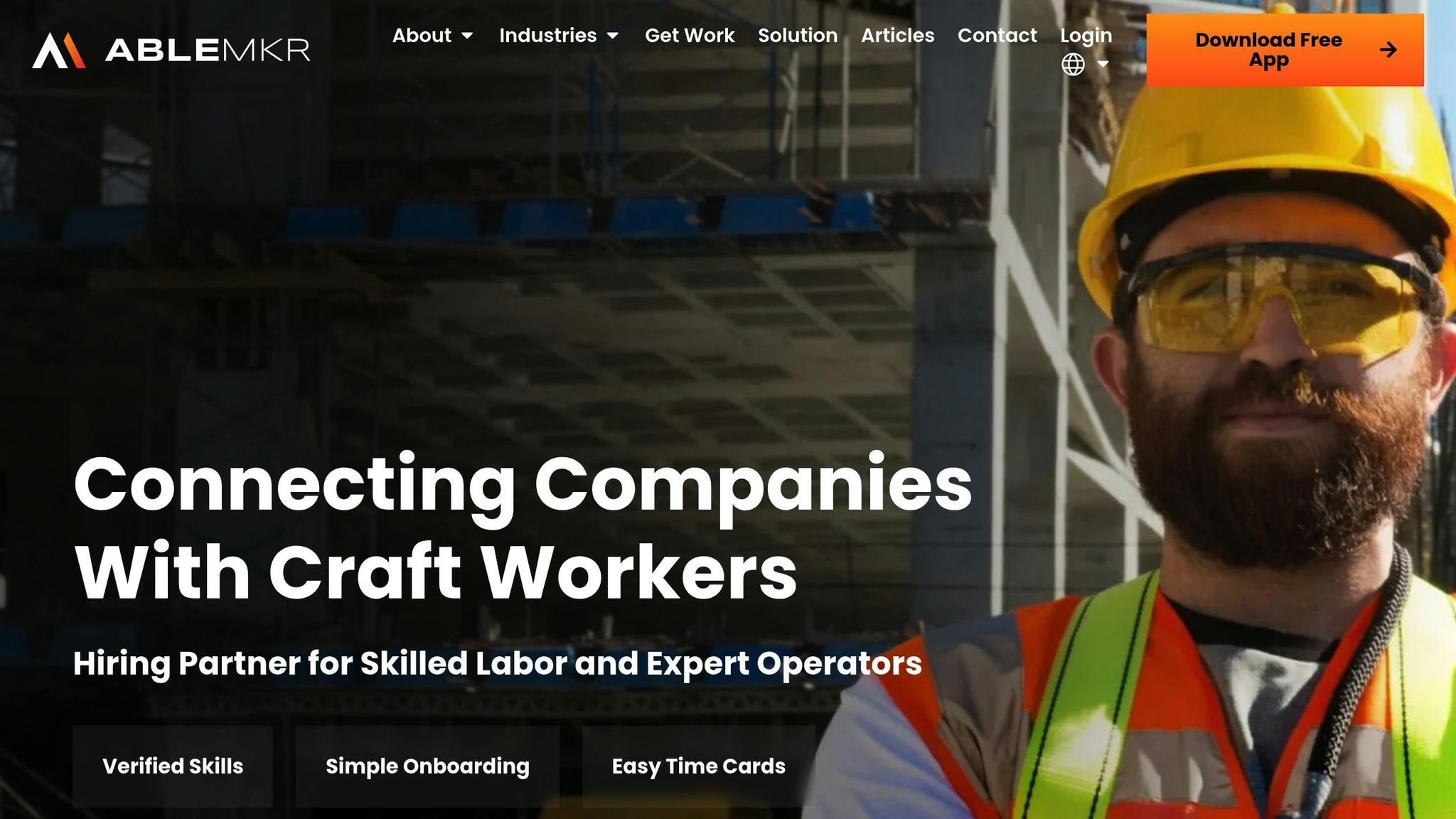
ABLEMKR demonstrates how digital credentialing can transform workforce deployment in the energy and construction sectors. By merging mobile technology with credential verification, the platform addresses key industry challenges, making it easier to match skilled workers with high-demand projects across the United States. Below, we explore ABLEMKR’s standout features and its measurable impact on real-world operations.
ABLEMKR’s Mobile-First Approach
At the heart of ABLEMKR’s platform is its mobile-first design, which connects pre-vetted workers to projects based on verified certifications, safety training, and real-time geo-location. This setup eliminates verification delays and accelerates crew mobilization.
Take, for example, a utility company needing certified welders for a remote pipeline repair. Instead of waiting days to assemble a team, ABLEMKR’s system pinpoints qualified personnel in the area within hours, drastically cutting response times.
For workers, the mobile app offers instant access to job openings, while employers gain full visibility into available talent. This capability is especially critical during emergencies, where rapid crew assembly can prevent costly downtime and ensure operations stay on track.
Integrated Payroll and Compliance Tracking
ABLEMKR takes workforce management a step further with its integrated payroll and compliance tracking system. Features like "Easy Time Cards" automate tasks such as time tracking, wage calculations, and payment processing.
Workers benefit from timely payments, while employers can rest easy knowing that certifications and regulatory requirements are monitored in real time. For instance, the platform ensures compliance with OSHA standards for construction and NERC CIP regulations in energy operations. It also generates audit-ready reports, making documentation instantly accessible to inspectors and reducing the risk of penalties. By eliminating manual paperwork, ABLEMKR helps employers streamline operations and focus on project execution.
Real Results in Energy and Construction
The platform has delivered tangible results for companies across various regions, including Houston, Dallas, and the Permian Basin. Many report a shift from multi-day crew mobilization processes to same-day deployment.
In Nevada, a mining operation achieved 100% compliance with safety training standards while cutting onboarding time by 60% compared to traditional hiring methods. Similarly, an oil and gas contractor in Texas used ABLEMKR for an emergency pipeline repair, assembling a fully compliant crew within hours. This efficiency not only prevented a prolonged shutdown but also reduced labor costs by 30% through automated payroll and precise crew matching.
ABLEMKR’s scalability is another game-changer. It enables companies to oversee workforce deployment across multiple job sites, ensuring consistent compliance, centralized credential tracking, and seamless payroll workflows. This is particularly valuable for large contractors managing dozens of projects across different states, where traditional systems often struggle to maintain consistency and efficiency.
Future of Digital Credentialing
The next decade promises significant changes in digital credentialing for the energy and construction sectors. Companies are increasingly relying on advanced technologies to verify, manage, and deploy skilled workers with greater efficiency.
Market Projections and Growth Drivers
The digital credentialing market is on track for substantial growth, fueled by ongoing adoption and emerging trends. For example, the global market for AI in energy – a critical component of many credentialing systems – is forecasted to grow from $8.91 billion in 2024 to $58.66 billion by 2030, with an impressive compound annual growth rate of 36.9%. Similarly, analysts predict consistent double-digit annual growth for credentialing platforms, as industries embrace digital transformation.
Key factors driving this growth include increasing regulatory pressure for fast and accurate worker verification. The shift toward cleaner energy sources has introduced new job roles and skill requirements, making traditional credentialing methods outdated. Additionally, a shortage of skilled labor is pushing companies to validate qualifications quickly and deploy workers more effectively.
By 2025, digital IDs are anticipated to become as common as smartphones, further integrating digital credentialing into everyday operations.
New Technologies: Biometric Verification and Digital Twins
Emerging technologies like biometric verification and digital twins are set to revolutionize how digital credentialing is conducted. Biometric verification uses tools such as fingerprint scans and facial recognition for real-time, tamper-proof authentication at job sites. This eliminates the need for easily falsified documents and significantly enhances security.
Digital twins – virtual models of physical assets or systems – offer another layer of innovation. These tools can simulate workforce deployment, track credential statuses in real time, and improve workforce planning by predicting needs and reducing administrative tasks. They also hold promise for automating time tracking and ensuring compliance with regulatory standards.
Gartner predicts that by 2027, 40% of power and utility companies will use AI-driven operators in control rooms. This trend could extend to credentialing systems, where AI might flag expired certifications, anticipate training requirements, and optimize worker assignments.
ABLEMKR’s Role in the Energy Transition
ABLEMKR is tapping into these technological advancements to meet the evolving demands of the energy sector. Designed with a mobile-first, scalable approach, the platform excels at deploying skilled workers across diverse energy projects, from traditional oil and gas operations to renewable energy installations.
The energy transition requires adaptable workforce management, and ABLEMKR’s real-time system ensures qualified workers are quickly assigned to critical tasks, whether for urgent repairs or scheduled upgrades. Its geo-location features are particularly valuable in managing geographically dispersed energy projects. By matching pre-vetted workers based on location, certifications, and availability, ABLEMKR helps energy companies maintain efficiency across multiple sites.
Beyond deployment, the platform includes compliance tracking and integrated payroll features to support the dynamic nature of energy projects. As regulatory standards around renewable energy, grid stability, and environmental protection continue to evolve, ABLEMKR helps companies stay compliant while reducing administrative burdens. With a strong presence in key energy corridors and a growing reach in renewable markets, ABLEMKR is building the foundation needed to support the next wave of industrial progress. This positions the platform as a vital tool for enhancing worker verification and operational efficiency in an ever-changing landscape.
Conclusion
Digital credentialing is reshaping the energy and construction industries in significant ways. With 94% of power and utility CIOs planning to boost AI investments by 2025 and 68% of construction businesses already adopting these solutions, the momentum is undeniable.
One of the most immediate benefits is improved safety. By verifying worker qualifications in real time, digital credentialing eliminates the risks tied to outdated, paper-based systems. This not only reduces accident rates but also enhances overall safety in high-risk environments.
On top of that, automated compliance and auditing tools ensure that companies meet critical standards like OSHA and NERC CIP. Real-time reporting cuts down on administrative workloads and helps avoid costly compliance issues. The success of programs like LEED Volume certification – responsible for certifying more than 240 million square feet of assets since 2011 – highlights the scalability and growing demand for these solutions.
Operationally, digital credentialing offers game-changing efficiency. Platforms like ABLEMKR use mobile-first technology to match pre-vetted workers to job sites based on factors like certifications, safety training, availability, and location. This capability allows for rapid crew mobilization, whether it’s for an emergency pipeline repair, a last-minute shutdown, or a scheduled mining project.
As the energy sector shifts toward cleaner energy sources and construction projects become increasingly complex, managing evolving skill sets and addressing labor shortages will be critical. Experts highlight the growing importance of micro-credentials and continuous learning, making flexible and adaptive platforms more valuable than ever. These advancements align with earlier findings on the safety and efficiency benefits of digital credentialing, ensuring companies are ready to meet future challenges.
Organizations that adopt these solutions today will not only stay ahead of industry demands but also maintain the highest standards of safety and compliance. ABLEMKR’s mobile-first approach serves as a clear example of how these trends are already making an impact in the field.
FAQs
How does digital credentialing enhance safety and compliance in energy and construction?
Digital credentialing makes managing a workforce much smoother by ensuring that only properly trained and certified workers are sent to job sites. It allows real-time verification of certifications, safety training, and worker availability, reducing risks and keeping everything aligned with industry standards.
Platforms like ABLEMKR take it a step further by offering employers real-time insights into worker qualifications and compliance tracking. This approach not only helps avoid safety issues but also streamlines hiring and onboarding, ensuring projects stay on schedule and meet all necessary regulations.
How are technologies like blockchain and AI improving digital credentialing in energy and construction?
Technologies such as blockchain and AI are transforming the way digital credentials are managed, bringing more security, accuracy, and efficiency to the table. With blockchain, worker certifications and credentials become tamper-proof and easy to verify, fostering trust between employers and employees. This is particularly crucial in high-risk industries like energy and construction, where safety and compliance are non-negotiable.
Meanwhile, AI is simplifying tasks like matching workers to projects by evaluating factors like certifications, availability, and location. It can even predict workforce needs, helping to minimize downtime and keep projects running smoothly. Together, these tools are reshaping workforce deployment, making it faster, smarter, and more dependable.
Why are micro-credentials gaining popularity in the energy sector, and how do they compare to traditional certifications?
Micro-credentials are gaining traction in the energy sector as a quicker, more adaptable way for workers to showcase specific skills and qualifications. Unlike traditional certifications that often demand long-term commitments, micro-credentials zero in on particular abilities, enabling workers to swiftly prove their expertise in areas such as safety protocols, equipment handling, or meeting regulatory standards.
This system works well for both sides. Employers can efficiently confirm qualifications and ensure compliance, while workers remain competitive by acquiring credentials tailored to the industry’s ever-changing demands. As new technologies and regulations reshape the energy sector, micro-credentials offer a practical way to address workforce training and deployment needs.


