
When emergencies strike, preparation and coordination with local emergency services can mean the difference between a controlled situation and a disaster. Here’s how you can ensure your site is ready:
- Reach Out to Local Services: Identify fire, police, EMS, and utility providers in your area. Secure direct emergency contacts and assign a Responsible Party (RP) to manage communication during incidents.
- Conduct Site Tours: Invite responders to visit your site to familiarize themselves with access points, hazards, and critical infrastructure.
- Develop Emergency Action Plans (EAPs): Create a detailed plan that includes evacuation routes, hazard documentation, emergency shutdown procedures, and personnel accountability systems.
- Define Roles and Communication: Use frameworks like the Incident Command System (ICS) to assign clear roles and establish communication protocols compatible with local responders.
- Schedule Training Drills: Conduct joint drills with emergency services to practice scenarios, refine plans, and identify gaps.
Key Takeaway: Proactive planning, clear communication, and regular training ensure faster, safer responses during emergencies. Start by reaching out to your local emergency contacts today.
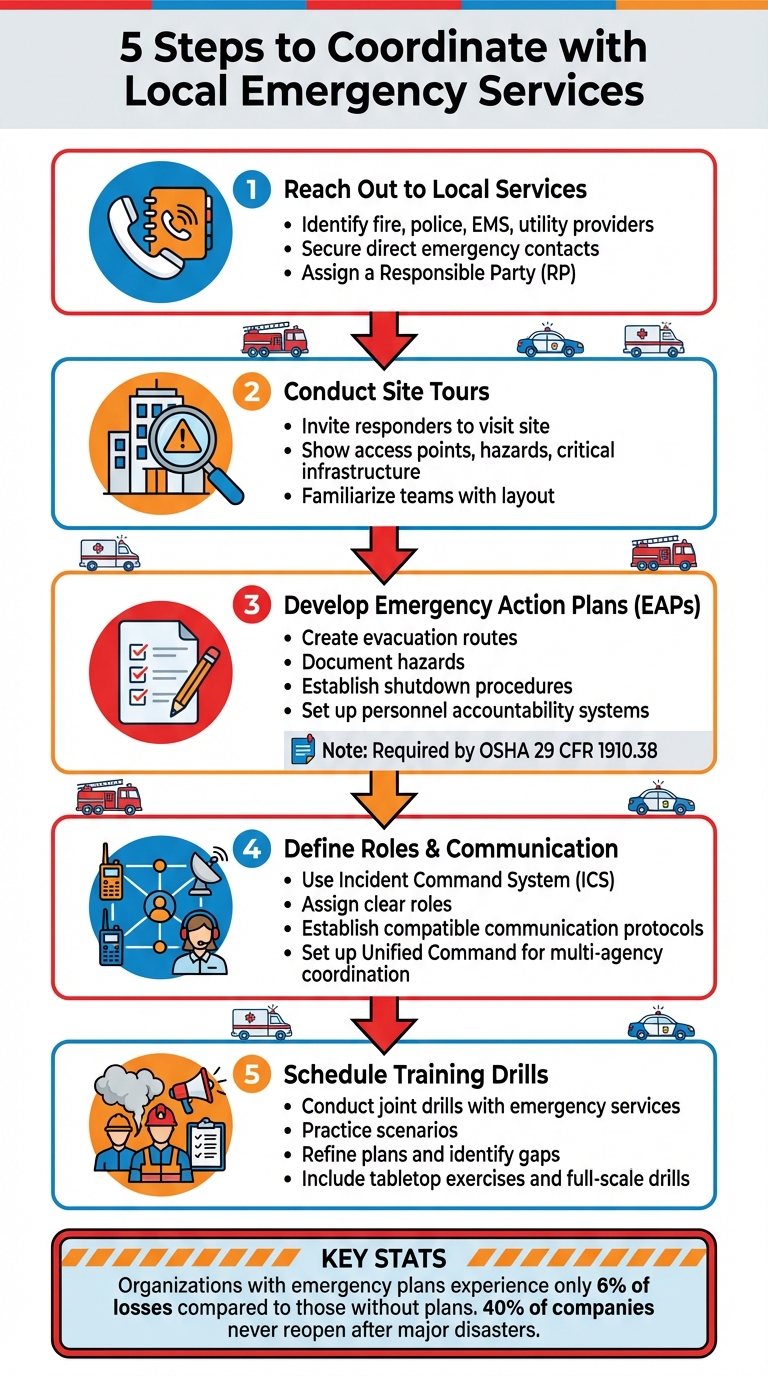
5 Steps to Coordinate with Local Emergency Services
Emergency Response Planning on Construction Projects
sbb-itb-aa28329
Step 1: Find and Reach Out to Local Emergency Services
Start by identifying and contacting the agencies responsible for handling emergencies at your location. This includes reaching out to your local Public Safety Answering Point (PSAP) to coordinate emergency dispatch services. Pinpoint the fire, police, and EMS units that cover your area.
Don’t forget about utility providers – electricity, water, gas, and telecommunications. Establishing connections with these providers is crucial for organizing restoration plans if services are disrupted. For high-risk sites, consider reaching out to specialized responders, such as ARES, to ensure backup communication plans are in place.
Once you’ve identified the relevant contacts, secure direct emergency numbers that bypass standard lines. This can save valuable time during a crisis. Arrange in-person meetings with emergency leaders before work begins. As the Federal Communications Commission advises:
"Meet and get to know these critical players before the need arises."
With your key contacts in place, assign specific roles to streamline communication during emergencies.
Appoint a Responsible Party (RP) who will serve as the main point of contact for local officials during incidents. This person should be ready to communicate key details like potential emergencies, the status of onsite infrastructure, and any resource shortages. FEMA underscores the importance of this coordination:
"Coordination of communication systems and the communications themselves between FSLTT [Federal, State, Local, Tribal, and Territorial] partner agencies and private sector responsible parties is essential for maintaining situational awareness."
For more complex projects, consider formalizing these relationships through mutual aid agreements or lend-lease arrangements. These agreements can grant access to specialized equipment and resources. If your site is classified as critical infrastructure, look into federal programs like the Telecommunications Service Priority (TSP) program, which ensures communications are restored as a priority during emergencies.
Step 2: Arrange Site Tours and Hazard Briefings
Once you’ve connected with local emergency services, the next step is to invite them for an on-site tour. These visits give responders a firsthand look at your facility’s layout – covering access points, hazardous materials, safe zones, and critical infrastructure. It’s the kind of understanding that simply can’t be conveyed through phone calls or documents. Familiarity with your site is essential for emergency responders to act effectively when it matters most.
During the tour, walk emergency personnel through areas with potential risks. Highlight confined spaces, chemical storage areas, high-voltage equipment, and any unstable terrain. Make sure to point out emergency shutoffs, the best routes for emergency vehicles, and staging areas for equipment and personnel. These details help responders better understand how to navigate your site in an emergency.
In-person briefings like these improve responders’ situational awareness and help them allocate resources more effectively during a crisis. As FEMA emphasizes:
"Ultimately, the coordination of decision-making, resource allocation, and other specific activities among these same entities is critical for a successful, efficient, and cost-effective response and recovery."
For simpler facilities, one tour might be enough. However, more complex sites may require regular updates as conditions evolve. These visits not only enhance preparedness but also foster strong working relationships with emergency personnel. Encourage questions, provide written materials for reference, and schedule follow-ups to keep the lines of communication open.
Step 3: Create Shared Emergency Action Plans
Use the insights gathered during on-site tours to craft a detailed emergency action plan (EAP) that works for both your team and local responders. This plan acts as the go-to guide during a crisis and must comply with OSHA regulation 29 CFR 1910.38. According to this regulation, businesses with more than 10 employees need a written EAP, while smaller operations can communicate their plans verbally.
Your EAP should feature clear and distinct alarm systems to signal different types of emergencies. As Nationwide explains:
"The key to reporting and responding to emergency situations is the use of an alarm or other employee notification system. Alarms must use distinct sounds for emergencies, audible above the ambient noise on the jobsite".
Include site-specific evacuation details, such as maps showing primary and secondary exits, assembly points, and designated safe areas for individuals with mobility challenges. Incorporate hazard documentation – like SDS for flammable or toxic substances – and specify where these hazards are located on-site. To help emergency responders act quickly, provide utility shut-off locations and consider installing key boxes for easy access to secured areas.
The plan should also cover emergency shutdown procedures. Identify which employees are responsible for shutting down critical systems like gas lines, electricity, or specialized equipment before evacuating.
Assign onsite emergency coordinators – such as safety officers, foremen, or supervisors – to handle situation assessments, notify emergency services, and collaborate with the Incident Commander. OSHA highlights this collaboration:
"The highest-ranking responder will assume the incident command role and will work with the onsite emergency coordinator, but will be responsible for directing all response activities".
These coordinators must be easy to identify, and all personnel should know who they are.
Finally, establish a system for accounting for all personnel at assembly points. Use tools like sign-in sheets, roll calls, or visitor logs to quickly identify missing individuals, injuries, or hazards. Share the finalized EAP with local fire departments and HAZMAT teams well in advance of any potential emergency. Regularly update the plan to reflect changes in site conditions, ensuring it remains practical and ready for action.
Step 4: Define Roles and Communication Methods
Once your emergency action plan is in place, the next priority is to assign clear roles and establish effective communication channels. This step eliminates confusion when every second matters, ensuring smooth coordination between your team and emergency responders.
To create structure, use the Incident Command System (ICS). ICS offers a standardized framework that can handle everything from minor chemical spills to large-scale evacuations. For situations involving multiple agencies, set up a Unified Command structure. This ensures that fire departments, HAZMAT teams, and your onsite coordinators can collaborate on shared goals while maintaining their individual responsibilities. By doing this, you strengthen your emergency plan and ensure a coordinated response during any crisis.
Your communication methods should reflect the complexity and risk level of your operations. For smaller or routine incidents, weekly check-ins with local emergency services might be enough. But for larger or high-risk projects, more formal and frequent communication is critical. As FEMA highlights:
"Coordination of communication systems and the communications themselves between FSLTT partner agencies and private sector responsible parties is essential for maintaining situational awareness and keeping track of the ever-changing status of critical services, resources, and infrastructure during the response to and recovery from a chemical incident".
After defining roles, document your communication protocols thoroughly. Make sure your communication tools – whether radios, mobile apps, or hotlines – are compatible with those used by local responders. Assign specific contacts, include their direct numbers, radio frequencies, and backup channels, and share this information with local fire departments, police, and emergency medical services. This proactive approach ensures responders are familiar with your setup before an incident occurs. Regularly update these protocols to reflect changes in your team or project, keeping everyone on the same page.
Step 5: Schedule Regular Joint Training Drills
Regular joint training drills are essential for practicing roles, refining communication, and exposing gaps in your emergency plans. They also help build trust between your team and local responders. As FEMA’s Emergency Management Institute states:
"Building relationships and bridging the gap between these two mission areas before an emergency occurs can minimize impacts to drinking water, wastewater and emergency services."
Start with tabletop exercises, which are informal, classroom-style sessions where you work through scenarios alongside fire, police, and EMS personnel. Once comfortable, move on to functional drills that test specific components of your plan, and eventually conduct full-scale exercises that simulate real emergencies – complete with evacuations and simulated casualties. These drills should align with your emergency plan and clearly defined roles to ensure a smooth response when real incidents occur.
It’s important to schedule drills across all shifts, including nights and weekends, to ensure comprehensive preparation. Use tools like an ICS Training Matrix to track participation and identify any gaps in training. After each drill, hold a debrief with all participants to address bottlenecks, communication breakdowns, or equipment issues.
The benefits of this approach are evident in real-world examples. In November 2016, the Orange County Health Department and Orange Water and Sewer Authority (OWASA) in Chapel Hill, NC, conducted a joint exercise with their local emergency management agency. Just three months later, a 12-inch water main break occurred. Thanks to pre-established relationships, they quickly activated their Emergency Operations Center and issued "Do Not Use" notices. This coordination led to a 37% reduction in water consumption during the crisis. Similarly, in 2009, the Dallas Cowboys Stadium management partnered with their local Traffic Management Center during event drills. This collaboration reduced the number of field officers required from 200 to about 90, saving significant resources.
Tailor your drills to address the specific risks your site faces, whether that’s hazardous material spills, structural collapses, or equipment failures. Practice critical shutdown procedures, ensure responders have proper access credentials, and regularly update contact lists. These efforts not only prepare your team for emergencies but also strengthen your ability to leverage technology for maintaining compliance and safety across your workforce.
Using Workforce Technology for Emergency Compliance
In emergencies, responders need quick and accurate information: Who is on-site, where they are, and whether they’re properly certified. Relying on paper logs and binders is too slow and inefficient. Digital workforce platforms step in by offering real-time access to worker certifications, safety training records, and location data – all accessible from any device. ABLEMKR‘s platform is a great example of how these tools provide the visibility needed in critical moments.
ABLEMKR’s mobile-first platform keeps pre-vetted worker profiles that include compliance tracking. This allows project managers to instantly verify certifications such as HAZWOPER or specialized PPE training. In evacuation scenarios, digital check-in systems replace manual headcounts, giving supervisors instant access to real-time rosters. This is especially important considering U.S. employers lose over $130 billion annually due to workplace injuries and violence.
Geo-location tools add another layer of precision, enabling managers to monitor workers in hazard zones in real time. Digital manifests map out exactly where responders should focus their efforts. This ensures that emergency teams can prioritize rescues in high-risk areas. Additionally, cloud-based storage keeps Safety Data Sheets and Job Hazard Analysis forms easily accessible during crises, rather than buried in trailers or filing cabinets.
For industries with lone workers – who make up 15–20% of the workforce – integrated safety monitoring is a game-changer. Wearables equipped with fall detection and inactivity sensors can alert responders within 2 seconds if a worker becomes incapacitated. These devices also enable two-way voice communication, allowing first responders to directly connect with workers during emergencies.
Digital tools also make safety audits and incident investigations more efficient through time-stamped records. As Miceál O’Kane, Founder of Helix EHS, explains:
"Digital advances in safety empower businesses to preemptively address risks and promote a culture of safety".
Conclusion
Collaborating with local emergency services isn’t just a legal obligation under OSHA Standard 1926; it’s also a cornerstone of operational safety. Following these five steps – connecting with local responders, organizing site tours, creating joint action plans, setting clear communication protocols, and conducting joint drills – ensures first responders are familiar with your site’s specific risks. This preparation eliminates delays caused by cold calls during emergencies.
Statistics highlight the importance of preparation: organizations with solid emergency plans experience only 6% of the losses seen by those without plans. Yet, nearly 40% of companies fail to reopen after a major disaster, and 25% close within a year due to inadequate planning. As Landon Kluck and Ben Nelson from Michels explain:
"The best way to respond to an emergency is to have a plan in place long before it’s needed. When contractors and utilities know and trust one another before an unexpected need arises, the customers will benefit."
Modern technology plays a crucial role in strengthening emergency responses. Advanced workforce platforms enhance readiness with real-time personnel tracking, multi-channel communication, and automated alerts. For example, ABLEMKR’s mobile-first platform simplifies compliance with mandates like Kari’s Law and the RAY BAUM’s Act while instantly verifying certifications and tracking locations during evacuations. These tools ensure faster, more efficient responses when every second matters.
Building a robust emergency response system requires effort, but the payoff is invaluable: safeguarding lives, reducing downtime, and meeting regulatory standards. Start today with Step 1 – reach out to your local emergency contacts and initiate that critical first conversation. Your team’s safety starts with proactive planning, not reactive measures.
FAQs
Who should be the Responsible Party (RP)?
The Responsible Party (RP) is the individual or organization tasked with overseeing emergency planning and response efforts. In construction projects, this responsibility usually falls to the project manager or the construction company itself. For industrial sites, the role is often assigned to the facility operator or the leader of the emergency response team. Their duties include developing emergency plans, collaborating with local emergency services, and maintaining clear communication during incidents, as recommended by FEMA and other emergency management guidelines.
What should our EAP include to satisfy OSHA?
To comply with OSHA standards, your Emergency Action Plan (EAP) needs to address several key elements. These include procedures for alerting employees, clearly defined evacuation routes and policies, and the roles of coordinators and wardens responsible for guiding employees during emergencies. Additionally, it should outline methods for accounting for all employees, plans for rescue operations, and protocols for medical assistance when needed.
The plan must also specify employee responsibilities during an emergency, detail training requirements to ensure everyone is prepared, and include steps for coordinating with external emergency services. Covering these aspects not only ensures compliance with OSHA regulations but also equips your workplace to handle emergencies effectively.
How often should we run joint drills with responders?
Regular joint drills with emergency responders play a crucial role in ensuring smooth coordination and readiness in emergencies. Experts suggest holding these exercises at least once a year, though high-risk settings like construction sites or energy facilities may require more frequent practice. These drills help build stronger working relationships, define responsibilities more clearly, and refine response plans to keep pace with changing risks. By committing to consistent and well-structured drills, teams can steadily enhance their ability to respond effectively when it matters most.


