
The construction and energy sectors in the U.S. are facing critical workforce shortages. Here’s what’s happening:
- Construction: As of February 2024, 456,000 positions remain unfilled – the highest in 20 years. Skilled trades like electricians, HVACR technicians, and plumbers are in high demand. Aging workers (22% over age 55) and declining trade school enrollment worsen the gap.
- Energy: Nearly 400,000 energy workers will retire in the next decade. Renewable energy industries need 1.1 million construction workers and 1.7 million operations workers by 2030. Oil and gas roles face a "retirement cliff", while renewable sectors struggle with inexperienced talent.
Both industries face fierce competition for workers, with energy roles offering transferable skills, and construction jobs requiring highly specialized training. Recruitment challenges include outdated perceptions, inconsistent certification requirements, and low interest from younger generations.
Quick Overview:
- Construction: Localized work, slower recruitment (12.7 days on average), and fragmented training systems.
- Energy: Skill transferability (e.g., oil and gas to renewables), longer hiring timelines (6+ months for technicians), and a global talent approach.
Solutions include apprenticeships, reskilling programs, diverse hiring initiatives, and tech-driven platforms like ABLEMKR to match workers with jobs efficiently.
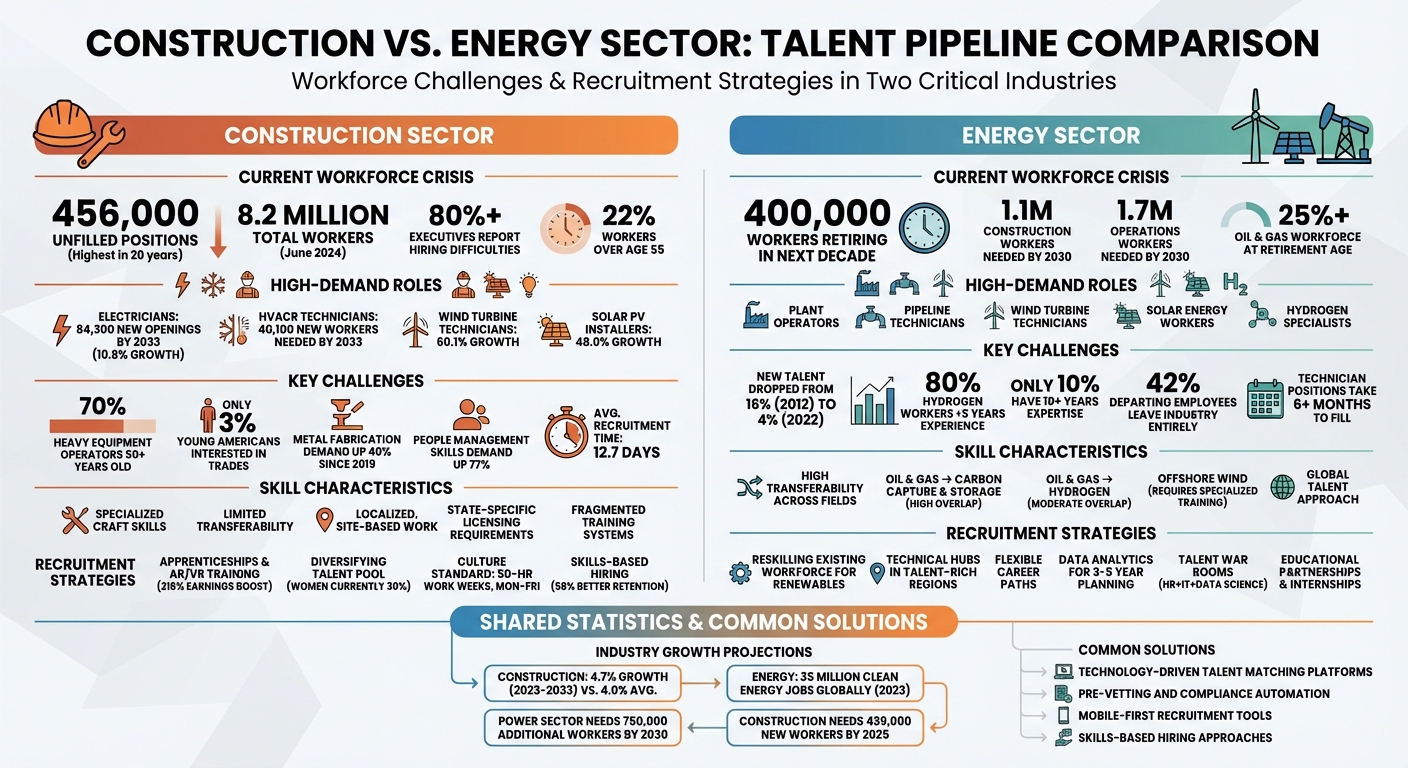
Construction vs Energy Sector Workforce Challenges and Recruitment Strategies Comparison
Workforce Strategies for the Next Energy Economy | Schneider Electric

Construction Labor Shortages: Current and Future Needs
The construction industry hit a workforce milestone of 8.2 million workers in June 2024, yet the gap between available labor and open positions continues to grow. Over 80% of construction executives report difficulties in hiring for critical roles.
Skilled Trades in High Demand
The most acute shortages are in trades vital to modern infrastructure and electrification, including electricians, HVACR technicians, and plumbers. Electricians are particularly in demand, with projections showing 84,300 new job openings by 2033, reflecting a 10.8% growth rate. HVACR mechanics and installers also face high demand, needing 40,100 new workers by 2033 to meet the climate control needs of data centers and residential buildings.
Several factors are driving this surge in demand. The growth of renewable energy is creating a need for specialized roles, with wind turbine service technicians expected to grow by 60.1% and solar photovoltaic installers by 48.0%. AI-driven data centers, projected to consume 9% of U.S. electricity by 2030, require advanced HVAC and electrical systems. Additionally, the rise of electric vehicles is fueling demand for electricians to build and maintain charging networks.
"The construction industry is projected to grow 4.7 percent from 2023 to 2033, faster than the 4.0 percent projected for all industries." – William Lawhorn and Stanislava Ilic-Godfrey, Economists, U.S. Bureau of Labor Statistics
This growing demand is compounded by an aging workforce and increasingly complex certification requirements, which are making it harder to recruit and retain skilled workers.
What’s Causing the Labor Shortages
One major challenge is the aging workforce. For example, 70% of heavy equipment operators are now 50 years old or older. As these experienced workers retire, they take years of technical knowledge with them, leaving a significant gap in expertise.
At the same time, trade school enrollment and the influx of younger workers are not keeping up with the rate of retirements. Complicated and inconsistent certification requirements for specialized roles further discourage potential new entrants. Younger generations, particularly Gen Z, often prioritize flexibility and workplace culture, making traditional trade careers less appealing. Meanwhile, demand for specific skills has skyrocketed – metal fabrication skills have increased by over 40% since 2019, and the need for people management skills has grown by 77%, reflecting the rising complexity of modern projects.
Energy Sector Talent Needs: Growth and Transition
The energy sector faces a dual challenge: maintaining its skilled oil and gas workforce while building a robust talent pool for renewable energy. Over the next decade, approximately 400,000 energy workers in the U.S. are expected to retire, taking with them decades of expertise and institutional knowledge. Simultaneously, renewable energy industries will require an estimated 1.1 million construction workers and 1.7 million operations workers by 2030. This creates two distinct talent challenges – one focused on retention and replacement in oil and gas, and the other on scaling up a relatively new workforce in renewables.
Workforce Gaps in Oil and Gas
The oil and gas industry is staring down "The Retirement Cliff", with over 25% of its workforce nearing or at retirement age. Key roles like plant operators, pipeline technicians, maintenance crews, and rig workers form the backbone of the sector, yet replacing them is proving difficult. Despite offering competitive pay, outdated workplace cultures often deter younger professionals. This is evident in the sharp decline in new talent: the percentage of energy employees with less than two years of tenure dropped from 16% in 2012 to under 4% in 2022.
While the oil and gas sector struggles to rejuvenate its aging workforce, renewable energy industries are grappling with their own set of challenges, including a lack of experienced leadership.
Recruitment Challenges in Renewable Energy
Renewable energy is expanding rapidly, but the workforce often lacks the depth of experience needed to keep pace. In the hydrogen sector, for instance, nearly 80% of workers have less than five years of experience, and only 10% have more than a decade of expertise in the field. High-demand roles – such as wind turbine technicians, solar energy workers, and hydrogen specialists – are often filled by individuals who are still developing the skills required to scale projects efficiently.
However, there’s a silver lining: many skills from traditional oil and gas roles can transfer to renewable energy fields. For example, Carbon Capture and Storage (CCS) demonstrates significant skill overlap with conventional energy roles, and hydrogen projects often align with engineering competencies from oil and gas. Offshore wind, on the other hand, requires more specialized training, as it has lower skill transferability. Recruiting for these roles is also time-intensive, with energy technician positions often taking more than six months to fill.
Retention is another pressing issue. Since 2016, 42% of employees who left energy and materials companies transitioned to entirely different industries. This highlights the urgent need for retention strategies that can keep existing talent engaged while attracting new workers to meet the sector’s growing demands.
Key Differences Between Construction and Energy Talent Pipelines
Skill Transferability and Training Requirements
The energy sector stands out for its ability to transfer skills across different fields. Workers from oil and gas, for instance, often transition seamlessly into areas like Carbon Capture and Storage (CCS). Similarly, hydrogen projects benefit from the expertise of seasoned professionals, while offshore wind projects offer opportunities for experienced workers, though they typically require more specialized training. This adaptability allows energy companies to repurpose their existing workforce as they shift toward renewable energy sources.
In contrast, the construction industry relies heavily on specialized craft skills that don’t easily transfer across roles. Between 2019 and 2023, demand for metal fabrication skills surged by over 40%. Workers in construction need a mix of traditional trade skills and newer digital competencies, but the training landscape remains fragmented, varying by region and trade. To address this, companies are increasingly turning to "skills-based" hiring, which prioritizes specific competencies rather than job titles. This approach has been shown to improve retention rates by 98% for high-performing employees. These differences in skill transferability and training highlight the distinct challenges each sector faces in workforce development.
Demographic Trends and Worker Mobility
Both the energy and construction sectors are grappling with the challenges of an aging workforce, but the nature of these challenges differs significantly. In the energy sector, professionals often work on international projects, and companies are setting up technical hubs in regions with abundant talent rather than keeping employees near physical assets.
In construction, however, workers are more tied to localized projects, with state-specific licensing requirements adding another layer of complexity. Geographic mobility is limited, and interest among younger generations is alarmingly low – only 3% of young Americans express interest in construction trades. These variations in mobility and age demographics require tailored recruitment strategies to build effective talent pipelines for each industry.
sbb-itb-aa28329
Recruitment Strategies for Each Sector
Construction Recruitment Approaches
Construction companies are rethinking how they attract and retain talent as old-school recruiting methods no longer meet current demands.
One major focus is on expanding apprenticeships and hands-on learning opportunities. Research shows that formal training can boost employee earnings by a staggering 218%. To make training more engaging, some firms are using AR/VR technologies to simulate real-world trade scenarios.
Another priority is diversifying the talent pool. With women making up just 30% of the construction workforce, companies are actively working to recruit individuals from underrepresented groups. This includes veterans, immigrants, and even formerly incarcerated individuals, all of whom bring valuable skills to the table.
To stand out, construction firms are going beyond offering competitive pay. They’re improving their employee value proposition by emphasizing worksite safety, mental health resources, and a better work-life balance. One initiative gaining traction is the "Culture Standard" movement, which limits work hours to 50 per week and encourages Monday–Friday schedules to combat burnout. This shift is particularly relevant as studies show that 64% of Australian construction workers put in more than 50 hours weekly.
While construction focuses on practical training and inclusivity, energy companies are tackling their challenges with reskilling and flexible career paths.
Energy Recruitment Approaches
Energy companies face unique hurdles in workforce development, requiring innovative strategies to attract and retain talent.
A top priority is reskilling the current workforce. For example, knowledge from oil and gas is highly transferable to Carbon Capture and Storage projects, and to a lesser extent, hydrogen initiatives. Offshore wind projects, however, demand more specialized training. Interestingly, nearly 80% of workers in the hydrogen sector have less than five years of experience in that field, highlighting the need for continuous learning.
To address talent shortages, energy firms are establishing technical hubs in areas rich with skilled professionals, enabling remote work. This is crucial, as only about one-third of the workforce needed for global wind projects currently meets the required qualifications. Additionally, companies are offering flexible career paths, allowing new hires to rotate between traditional oil and gas roles and renewable energy positions within the same organization.
Data analytics has become a game-changer for strategic talent planning. By identifying "retirement cliffs" and skill gaps 3–5 years ahead, companies can take proactive measures instead of relying on gut instincts. Many firms now operate "talent war rooms", where HR, IT, and data science teams collaborate to refine recruitment strategies and improve employee offerings in real time.
Energy companies are also investing in educational partnerships to inspire future talent. Through internships, collegiate competitions, and career mapping programs, they’re engaging the next generation in a sector that supported approximately 35 million clean energy jobs globally in 2023.
How ABLEMKR Streamlines Workforce Deployment
Technology-Driven Talent Matching
ABLEMKR’s mobile-first platform tackles a major challenge in construction: 62% of firms report a shortage of skilled candidates. By leveraging certifications, safety training, availability, and geo-location data, the platform matches pre-vetted workers to job sites with precision. This approach couldn’t come at a better time, as the construction industry is projected to need 439,000 new workers by 2025 to keep up with demand. Meanwhile, the power sector faces an even steeper climb, requiring 750,000 additional workers by 2030.
What makes ABLEMKR stand out is its ability to address the energy sector’s unique workforce challenges. As the industry shifts from traditional roles to renewable energy projects, the platform’s algorithm identifies workers with overlapping skills in areas like oil and gas, Carbon Capture and Storage (CCS), and hydrogen projects. This is especially valuable given that nearly 80% of hydrogen sector workers have less than five years of experience. By aligning these workers with emerging opportunities, ABLEMKR not only fills immediate gaps but also supports long-term industry growth.
Simplified Hiring and Compliance
Beyond finding the right workers, ABLEMKR simplifies the entire hiring process. Its automated onboarding and compliance tracking cut through the complexity of managing equipment-specific licenses and OSHA certifications – many of which need renewal every five years. This is a game-changer for the 89% of construction employers in the transmission, distribution, and storage sector who struggle with hiring challenges.
One of the platform’s biggest strengths is real-time digital verification. By keeping track of worker certifications and project readiness, companies can avoid costly delays caused by expired permits or missing credentials. This is crucial in an industry where 95% of construction data currently goes unused. ABLEMKR even integrates payroll workflows, reducing administrative bottlenecks in high-turnover environments. With the average recruitment time sitting at 12.7 days, every efficiency counts.
Benefits for Workers and Employers
For workers, ABLEMKR offers more than just jobs – it provides flexibility, competitive pay, and the assurance of on-time payments. The platform’s mobile-first design allows workers to apply for roles, upload certifications, and manage credentials directly from the field. This is critical in a fast-paced market where qualified operators often juggle multiple offers.
Employers, on the other hand, gain peace of mind. The cost of a bad hire can reach 30% of the employee’s annual salary, but ABLEMKR’s pre-vetting process – covering background checks, drug screenings, and license verification – minimizes that risk. Whether facing an urgent pipeline shutdown or planning a mining project, companies can deploy certified crews in days instead of weeks. By bridging labor gaps quickly and efficiently, the platform helps meet the growing demands of both the construction and energy sectors.
"The most critical differentiator for an EPC [engineering, procurement, and construction company] right now is whether they invest in their workforce." – Sonya Montgomery, CEO of The Desoto Group
Conclusion
The energy sector faces a significant shift, with around 400,000 U.S. employees expected to retire over the next decade. Meanwhile, construction continues to contend with persistent labor shortages, as much of its work relies on physical, hands-on skills that are difficult to automate.
Jobs in construction and skilled trades remain largely resistant to automation due to their dependence on on-site work and practical problem-solving – tasks that current technology simply cannot replicate. Globally, while AI may displace 92 million jobs by 2030, it’s also anticipated to create 170 million new roles, resulting in a net gain of 78 million positions. The real challenge lies in ensuring there’s a qualified workforce ready to step into these critical roles.
This makes strategic workforce planning more important than ever. As Deloitte aptly puts it, "Talent management is not just about recruiting and retaining employees; it is about investing in the future of the organization by building a workforce that is agile, adaptable, and ready to meet the challenges of tomorrow". Relying solely on intuition instead of data-driven insights can leave companies unprepared for shifting project demands. Using technology to forecast and adapt to these trends is no longer optional – it’s essential.
Innovative solutions are stepping up to address these challenges. For example, ABLEMKR connects pre-vetted workers to high-priority projects, drastically reducing the time it takes to hire and deploy teams. By streamlining compliance and mobilization, ABLEMKR helps companies assemble crews in days rather than weeks. This approach also highlights the transferable skills between traditional roles in oil and gas and emerging industries like carbon capture, hydrogen, and wind.
The path forward for construction and energy lies in modern recruitment strategies, targeted workforce development, and advanced technology. With the right tools and planning, these industries can secure the talent pipelines needed to drive America’s infrastructure and energy sectors into the future.
FAQs
How can the construction industry tackle workforce shortages caused by an aging workforce and fewer trade school enrollments?
The construction industry can tackle workforce shortages by making talent development a central focus of its business strategy. This means expanding apprenticeship programs, collaborating with community colleges and technical schools, and fostering mentorship opportunities with seasoned tradespeople. To support these initiatives, companies can offer paid internships, tuition assistance, and well-defined career paths that emphasize the value of certifications and hands-on experience.
Technology also plays a crucial role in improving recruitment and retention. Tools like ABLEMKR allow project managers to connect with certified, safety-trained workers in real time, enabling quicker hiring and more efficient crew deployment. When combined with structured training programs and incentive systems, these strategies help construction firms attract younger talent, retain skilled professionals, and secure a steady workforce for the future.
How can energy companies attract and retain skilled workers for renewable energy projects?
Energy companies looking to tackle talent challenges in renewable energy can take several strategic steps to build and maintain a skilled workforce:
- Pinpoint the skills you need: Start by mapping out the exact skills and certifications required for renewable energy projects. From there, invest in training existing employees or bring in new hires who already meet these qualifications.
- Create an attractive employer brand: Showcase the meaningful impact of working in renewable energy, offer competitive salaries, and provide clear paths for career advancement. These elements can help draw in top talent and keep them engaged.
- Collaborate with schools and training programs: Partner with technical schools, community colleges, and apprenticeship programs to expand your talent pool. Offering scholarships or mentorship opportunities can also help bring in workers from underrepresented backgrounds.
- Use technology to your advantage: Tools like ABLEMKR make it easier to connect with pre-vetted, certified workers, ensuring compliance and quick deployment to job sites.
By focusing on skill-building, branding, partnerships, and smart tech solutions, energy companies can attract and retain the workforce they need to succeed in renewable energy projects.
How does the overlap in skills between oil and gas and renewable energy sectors affect workforce development?
The energy industry is experiencing a shift, as skills from oil and gas are proving to be a natural fit for renewable energy projects. Core abilities like project management, safety compliance, and field-service expertise are easily transferable. This means workers from traditional hydrocarbon roles can step into positions at wind farms, solar plants, or battery storage systems with less friction. Not only does this ease labor shortages, but it also supports the rapid expansion of clean energy initiatives.
By investing in focused reskilling programs and streamlining certification processes, companies can cut down hiring expenses and quickly fill essential roles. Platforms such as ABLEMKR make this transition even smoother by connecting pre-qualified workers to projects based on their skills, certifications, and schedules. This creates a dynamic workforce that can seamlessly support both traditional energy operations and the growing clean energy sector.


