
Managing employees across multiple states is challenging due to varying labor laws, tax rules, and compliance standards. Mistakes like worker misclassification or payroll errors can cost businesses an average of $1.2 million annually in penalties. With states using AI audits and stricter enforcement, staying compliant is more critical than ever.
Here’s a quick breakdown of the five key strategies to manage compliance effectively:
- Run HR Audits Regularly: State-specific rules for wages, taxes, and leave policies require frequent reviews. For instance, tax thresholds differ – Maine requires withholding after 12 days of work, while Georgia sets it at 23 days.
- Use Centralized Compliance Tools: Automate location tracking and payroll adjustments with platforms like ABLEMKR to avoid costly errors and ensure accuracy.
- Create State-Specific Checklists: Tailor hiring, tax registration, and labor law adherence to each state’s requirements, especially in industries like construction or energy where workers cross state lines.
- Monitor Law Changes and Train Staff: Employment laws evolve quickly. Use compliance tools for real-time updates and train teams on critical state-specific regulations.
- Set Standard Policies with Local Adjustments: Align federal and state rules by applying the most worker-friendly standards. Use technology to keep policies updated and consistent.
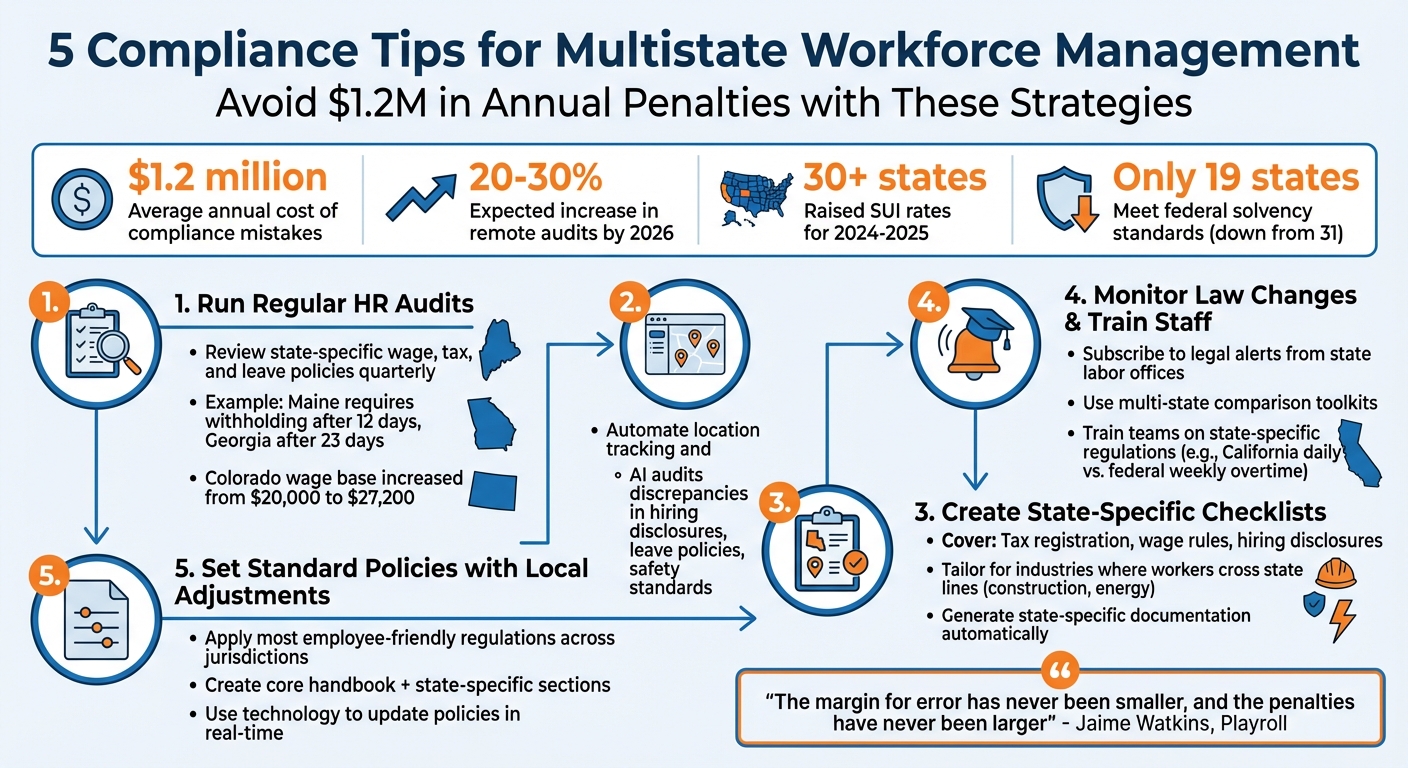
5 Essential Compliance Strategies for Multistate Workforce Management
1. Run Regular HR Audits in Each State
State-Specific Compliance Requirements
Payroll and tax regulations vary widely across states, making compliance a complex task. For instance, in Maine, tax withholding kicks in after 12 days of work and $3,000 in income, while Georgia sets the threshold at 23 days. Colorado has increased its taxable wage base from roughly $20,000 to $27,200, and more than 30 states have raised their State Unemployment Insurance (SUI) rates for 2024–2025.
Audits should also address wage and hour laws that go beyond federal standards. For example, California mandates daily overtime calculations, unlike the weekly totals required federally. Additionally, ensure compliance with state-specific paid leave and disability insurance requirements. States like New York and New Jersey have paid leave programs that differ significantly from the federal Family and Medical Leave Act (FMLA).
These differences highlight the importance of using technology to keep up with compliance demands.
Technology for Real-Time Tracking and Automation
Managing state-specific rules is much easier with automated tracking tools. As Jaime Watkins, Content Specialist at Playroll, points out:
"The rules are being enforced with technology. The margin for error has never been smaller, and the penalties have never been larger".
Tracking where employees perform their work – not just where they live – is critical, as the location of the work determines which state laws apply. Tools like ABLEMKR use geo-location tracking to automatically log work locations, ensuring payroll systems apply the right state tax and labor rules. This level of real-time tracking can help catch errors before they turn into costly compliance issues.
Staying Ahead of Legislative Changes
State laws change frequently, and the pace of remote audits is expected to grow by 20–30% by 2026 as states seek to recover tax revenue. Currently, only 19 states meet federal solvency standards, down from 31. To stay on top of these shifts, conduct quarterly compliance reviews. These reviews should include reconciling work locations, verifying state registrations, and addressing any discrepancies well before year-end filings. Some local jurisdictions even enforce compliance for minimal hours worked. When federal, state, and local laws conflict, apply the "most favorable" rule – choosing the policy that benefits the employee the most – to reduce litigation risks.
Regular audits and proactive adjustments are essential to maintaining compliance and avoiding legal pitfalls across state lines.
Multi State Payroll Compliance for 2025
2. Use Technology to Track Compliance Centrally
Centralizing compliance data builds on proactive HR audits, making regulatory oversight more efficient and accurate.
Real-Time Tracking and Automation Tools
Relying on manual spreadsheets just doesn’t cut it anymore when it comes to managing compliance. State agencies now leverage AI to instantly cross-check wage reports, W-2s, and unemployment filings, quickly identifying any discrepancies. Jaime Watkins, Content Specialist at Playroll, notes:
"Outdated manual methods are replaced by automated audits. States and the IRS now use AI that detects anomalies in real time."
A centralized compliance system minimizes costly errors by maintaining a single, reliable source of information. It automatically applies the correct state tax and labor rules based on where employees physically work.
Take platforms like ABLEMKR, for instance. They integrate geo-location tracking with payroll workflows, automatically recording employee work locations. Say an energy worker moves from Texas to North Dakota – ABLEMKR ensures the correct state thresholds are applied immediately, preventing compliance issues.
But tracking alone isn’t enough. Effective systems must also evolve with ongoing legal changes.
Staying Ahead of Legislative Changes
With laws constantly evolving, compliance systems need to keep up. Modern platforms monitor updates to federal, state, and local regulations – whether it’s a new minimum wage rate or updated leave policies – and automatically adjust tax rates and filing deadlines accordingly.
These systems also flag unusual cases that need human attention. For example, if an employee nears Maine’s 12-day work threshold or Georgia’s 23-day limit, the system alerts HR before payroll is processed. This blend of automation and human oversight helps businesses stay ahead, especially as remote audits are expected to increase by 20-30% in 2026.
3. Create Compliance Checklists for Each State
Centralized systems provide a solid foundation, but state-specific checklists are essential for addressing unique local requirements.
State-Specific Compliance Requirements
When hiring in different states, you’ll encounter a variety of labor laws that kick in immediately. Your checklist should cover key areas like tax registration (including state disability or unemployment insurance if needed), wage and overtime rules, hiring disclosures such as pay transparency requirements, leave policies, and safety standards.
For example:
- California: Include registration for State Disability Insurance, ensure pay ranges are posted for transparency, and strictly enforce meal and rest break rules.
- Texas: Account for the lack of state income tax withholding and adjust for differing workers’ compensation and sick leave regulations.
Industries like energy and construction, where employees often work across state lines, face additional challenges. Digital onboarding packets tailored to each jurisdiction can help avoid errors. Tools like ABLEMKR simplify this process by automatically generating state-specific documentation based on the worker’s job site location. This ensures compliance from the very start and reduces the risk of regulatory missteps.
Consistency in Federal and State Policies
Checklists alone won’t cut it – you also need to align federal and state policies to avoid issues like worker misclassification or inconsistent coverage. Worker classification standards vary significantly by jurisdiction. While some states rely on the strict "ABC test" to determine independent contractor status, others use the more flexible "economic realities" test. Misclassifying even a single worker can lead to back taxes, penalties, and unemployment insurance claims.
Additionally, make sure workers’ compensation coverage is verified. Some states require this coverage even if you have just one employee, so it’s crucial to stay on top of these details. By addressing both federal and local requirements, you can minimize risks and maintain compliance across the board.
sbb-itb-aa28329
4. Monitor Law Changes and Train Your Team
Keeping Up with Legislative Changes
Audits and centralized tracking are just the start of a strong compliance strategy. Staying on top of legal updates and ensuring your team is trained are equally critical. Employment laws evolve constantly – what works today might not work tomorrow. Employers must juggle federal laws like the FLSA and FMLA, state-specific wage and tax rules, and even local ordinances. Missing even one update can lead to fines, back taxes, or legal headaches.
To stay ahead, subscribe to legal alerts or updates from state labor offices. Federal agencies, like the Wage and Hour Division, also provide real-time email updates on new guidance. For businesses operating across multiple states, tools like the "Labor and Employment Multi-State Charts Toolkit" can help compare regulations across different jurisdictions. These resources make it easier to spot changes early and respond quickly, laying the groundwork for automated systems that track these updates in real time.
Using Technology for Real-Time Updates
When managing compliance across multiple states, manual tracking simply doesn’t cut it. Modern compliance platforms can automatically detect changes in tax and HR requirements based on where employees are located, while also keeping track of filing deadlines. For industries like energy and construction, where workers frequently move between job sites, tools like ABLEMKR provide real-time insights into worker locations and embed compliance tracking. This ensures location-specific regulations are applied correctly from the start.
Automated systems can also handle location updates and periodic verifications, ensuring tax withholdings are adjusted promptly. This reduces the risk of costly errors or corrections down the line.
Aligning Federal and State Policies Through Training
Technology is essential, but effective training ensures your team can adapt to evolving regulations. State laws often go beyond federal requirements – California, for instance, mandates daily overtime pay instead of weekly. Regular training sessions should cover key topics like wage compliance, anti-discrimination policies, and workplace safety, tailored to the specific states where your employees work. Managers also need to understand how employee relocations can immediately impact compliance, so they’re prepared to act without delay.
5. Set Standard Policies with State-Specific Adjustments
Audits and checklists can help keep things on track, but having standardized policies is what truly builds a solid foundation for smooth operations.
Balancing Federal and State Policies
Federal laws like the FLSA and FMLA provide the baseline for employee rights. However, state and local laws often go beyond these federal standards. To minimize risks, it’s smart to adopt the most employee-friendly regulations – whether it’s California’s daily overtime rules or New York’s sick leave requirements. As one legal expert explains:
"The most risk-free way an employer can assign work out of an employee’s home state is to comply with the most employee-protective laws of any applicable jurisdiction."
This approach creates a unified corporate policy that respects state-level specifics without sacrificing consistency.
Handling State-Specific Requirements
When it comes to state-specific rules – like tax withholdings or unique benefits – consider creating a core employee handbook with additional state-specific sections. These add-ons address local mandates that can’t be standardized, ensuring compliance without disrupting the overall framework. For example, some states have unique thresholds or eligibility rules that require tailored solutions.
Leveraging Technology for Policy Management
Managing policies across multiple states manually can be overwhelming. Modern platforms simplify this by automatically updating handbooks with state-specific changes in real time. For industries like energy, mining, and construction, where employees often move between sites, tools like ABLEMKR integrate compliance checks into payroll systems. These platforms ensure location-specific regulations are applied correctly. Features like "address update" functions also help keep track of remote employees’ locations, which is crucial since an employee’s physical location determines the laws that apply. These digital tools enhance efficiency while maintaining consistency across state lines.
Conclusion
Managing a multistate workforce is no easy task. Between 2024 and 2025, more than 30 states increased their State Unemployment Insurance rates, and state agencies are now leveraging AI to spot payroll discrepancies in real time. On top of that, remote audits are expected to rise by 20–30%, while only 19 states currently meet federal solvency standards for unemployment insurance. Jaime Watkins, Content Specialist at Playroll, captures the situation perfectly:
"The rules are being enforced with technology that didn’t exist three years ago. The margin for error has never been smaller, and the penalties have never been larger".
The stakes are high – companies face an average of $1.2 million annually in multistate payroll penalties. For industries like energy, mining, and construction, where employees often move between job sites, relying on manual tracking is simply not enough. Tax obligations are determined by the physical location where work is performed, not by a company’s headquarters or an employee’s residence. These challenges make it clear that staying ahead of compliance requirements is no longer optional – it’s essential.
FAQs
How does technology simplify compliance for managing workers across multiple states?
Technology has made managing multistate compliance much easier by centralizing employee data and automating state-specific requirements. Modern HR and payroll systems can automatically determine a worker’s "work state", calculate the correct state income tax withholdings, and produce the necessary wage reports – reducing the chance of manual errors. Additionally, integrated onboarding tools take care of state-specific forms, certifications, and notices as soon as a new employee is onboarded, ensuring compliance from day one.
In industries like construction, energy, and mining, mobile-first platforms such as ABLEMKR go even further. These platforms combine real-time geo-location tracking with compliance monitoring. Workers are assigned to projects based on their certifications and proximity, while payroll and legal requirements – like OSHA training and state licensing – are tracked effortlessly. The result? Faster crew deployment, accurate payroll processing, and minimized compliance risks when working across multiple states.
What challenges do employers face when managing a workforce across multiple states?
Managing a workforce spread across multiple states comes with its fair share of challenges, largely due to the patchwork of employment laws and regulations that vary from one state to another. Employers need to juggle differences in minimum wage, overtime policies, paid leave mandates, and safety training requirements – all of which can shift frequently and differ dramatically between regions.
On top of that, payroll and tax compliance bring additional hurdles. Each state – and sometimes even local governments – has its own withholding rates, unemployment insurance contributions, and reporting timelines. Mistakes in payroll processing can trigger penalties, back payments, or even legal disputes, especially when states have conflicting rules about worker classification or overtime eligibility.
HR teams also face the daunting task of tracking where employees are located, keeping up with state registrations, and ensuring onboarding paperwork aligns with state-specific requirements. To manage these complexities, employers must stay on top of legislative changes, navigate conflicting rules, and adopt tools that offer real-time insights into workforce operations and applicable regulations.
Why is it crucial to align federal and state labor policies when managing a multistate workforce?
Ensuring that federal and state labor policies align is crucial for maintaining compliance with both the baseline federal requirements and the sometimes stricter regulations set by individual states. This alignment not only helps businesses steer clear of hefty fines and legal battles but also safeguards their reputation.
By addressing the gaps and differences between these laws ahead of time, employers can simplify workforce management. This approach minimizes risks and promotes smoother, more efficient operations while staying firmly within legal boundaries.


