
Manual certification tracking is outdated, error-prone, and costly. Digital certification management systems simplify the process, reduce risks, and save time. Here’s why switching to digital is a smart move for industries like construction, oil and gas, and mining:
- Manual tracking issues: Paper records and spreadsheets lead to errors, missed deadlines, and compliance failures. 76% of companies fail audits due to incomplete records.
- Digital advantages: Cloud-based systems centralize data, automate alerts for expiring certifications, and provide real-time access from mobile devices.
- Time and cost savings: Digital systems cut admin time by 90%, improve productivity by 50–60%, and reduce compliance risks tied to fines or safety incidents.
Quick Comparison:
| Feature | Manual Tracking | Digital Management |
|---|---|---|
| Data Access | Office-bound, slow | Mobile-friendly, instant |
| Error Rate | High (88% in spreadsheets) | Minimal with automation |
| Expiration Alerts | Manual reminders | Automated notifications |
| Audit Readiness | Scrambling for records | Instant digital reports |
| Scalability | Difficult for large teams | Easily manages 1,000+ workers |
Switching to digital certification management ensures safer job sites, fewer compliance issues, and smoother operations. Tools like ABLEMKR streamline the process, letting companies focus on safety and efficiency.
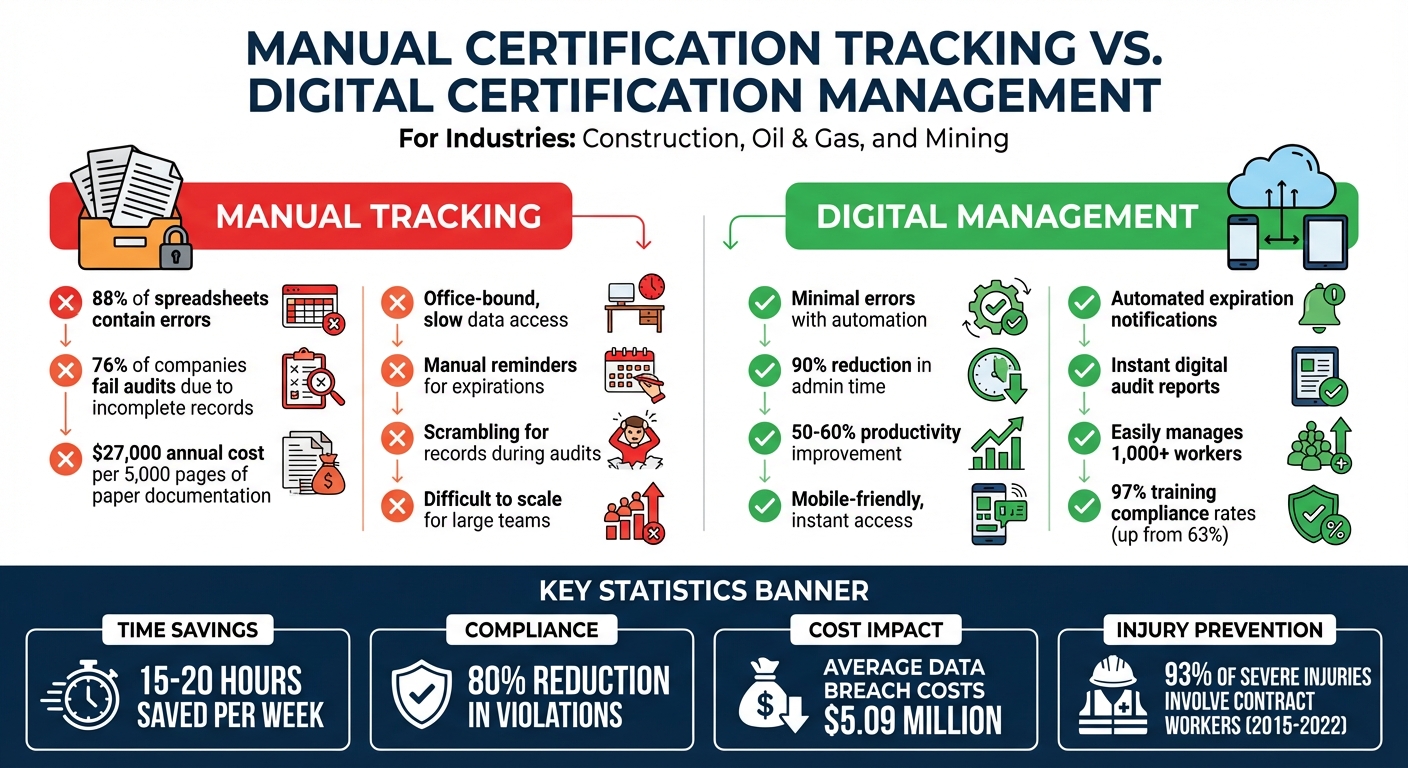
Manual vs Digital Certification Management: Key Differences and Benefits
What is Manual Tracking?
Manual tracking is the old-school way of managing worker certifications. Instead of using a centralized digital system, it relies on spreadsheets, paper files, and binders. Think Excel logs, cabinets full of photocopies, and manual email reminders. This system requires administrators to juggle multiple tools to keep tabs on who’s certified and when those certifications expire. Let’s break down how this process typically works.
How Manual Tracking Works
In a manual setup, administrators enter details like expiration dates and worker qualifications into spreadsheets or similar tracking tools. Physical copies of certifications are stored in filing cabinets or saved as scattered PDF files. When it’s time to renew a certification, someone has to set a calendar reminder, then send emails or Slack messages to follow up with workers.
Field managers often need to verify worker qualifications by cross-referencing HR records with project assignments. If a supervisor needs to check credentials on-site, they might have to call the office and wait while someone digs through physical records to find the information.
Lucie Giroux, Health and Safety Manager at Lafarge, described the frustrations of these systems:
"Our paper FLRA was a monster; a catch-all sheet in small text with ten folds – and a huge barrier to accurate data."
While this process might sound manageable for a small team, it comes with significant challenges.
Problems with Manual Tracking
Manual tracking slows everything down. Studies reveal that 88% of spreadsheets contain errors, and manual data entry is a breeding ground for typos, missed updates, and incorrect dates. These mistakes are more than just annoying – they’re costly. For instance, managing paper documentation can cost a company $27,000 annually for every 5,000 pages. And maintaining a single five-drawer filing cabinet? That’s about $880 per year in storage and upkeep.
Scaling this system is another nightmare. What might work for a small crew of 10 quickly becomes chaotic when managing 100 or even 1,000 workers across multiple sites. The administrative workload grows exponentially, requiring more time, storage, and coordination. Plus, paper records are easily lost, damaged on-site, or even forgotten in vehicles.
Erin Noonan, Executive Assistant at Navillus Contracting, shared her experience:
"The guy who had a valid 32-hour riggers license didn’t have it on him the day that the DOB showed up… If he doesn’t have it on him, they can say you don’t have it."
The biggest issue? Manual systems lack real-time visibility. There’s no way to instantly see who’s qualified and who isn’t. By the time an expired certification is noticed, the worker could already be handling a high-risk task – putting safety and compliance at serious risk.
What is Digital Certification Management?
Digital certification management replaces outdated paper and spreadsheet-based systems with a cloud-based solution that automates tracking worker credentials and compliance. This approach centralizes all certification data, making it accessible from anywhere. Workers can upload their training certificates directly from mobile devices, allowing administrators to verify compliance instantly without digging through piles of paperwork.
Yaz El Hakim, CEO of VerifyEd, puts it this way:
"The shift from manual certificate management to digital systems isn’t just about keeping up with technology – it’s about transforming how organisations handle their entire certification process."
These platforms are particularly suited for industries like construction, mining, and oil and gas, where certification needs are high. By centralizing worker qualifications, they eliminate fragmented communication between HR and field teams. This streamlined process provides real-time visibility into worker qualifications, ensuring only certified individuals enter job sites. Let’s take a closer look at the features that set digital certification management apart from manual methods.
Features of Digital Certification Management
Digital systems come packed with features that make manual tracking a thing of the past. A centralized cloud storage system ensures certifications are securely stored and can be accessed by authorized users from any location. Automated alerts notify users at intervals like 90, 60, and 30 days before a certification expires, helping companies stay ahead of renewal deadlines. The mobile accessibility feature allows field workers to upload certificates while on the job. Some advanced platforms even integrate with site access control systems, preventing uncertified workers from entering restricted or hazardous areas.
Additionally, these systems can seamlessly connect with HR, payroll, and learning management systems (LMS). For instance, when a worker completes a training course, their certification record is automatically updated, eliminating the need for duplicate data entry. This integration ensures that qualifications are accurately reflected in payroll and compliance records.
How Digital Systems Solve Manual Tracking Problems
Digital certification management systems address the common pitfalls of manual tracking by leveraging automation and scalability. Automated alerts ensure that no certification renewal is missed, while bulk certificate uploads and renewal processes make managing teams of any size – from 10 to 1,000 – simple and efficient. In fact, automation can cut down the time spent on certification-related tasks by as much as 90%.
Dashboards provide instant insights, using color-coded indicators to flag workers whose certifications are nearing expiration or are already expired. When audits occur, companies can instantly generate comprehensive digital audit trails, eliminating the chaos of last-minute scrambling. These systems have proven to boost training compliance rates significantly, from 63% to over 97%. By keeping certifications current and verified, the risk of unqualified workers performing dangerous tasks is drastically reduced, enhancing both safety and operational efficiency.
As Corfix Safety aptly states:
"Construction safety doesn’t live in a binder anymore – and it can’t wait for paperwork to make its way back to the office."
Manual Tracking vs. Digital Certification Management
Comparison Table: Manual vs. Digital
Let’s break it down: manual tracking methods – whether old-school paper binders or spreadsheets – can slow you down and leave you open to costly mistakes. On the other hand, digital systems simplify everything with automation and real-time data access. Here’s a closer look:
| Feature | Manual (Paper/Binders) | Spreadsheets | Digital Management System |
|---|---|---|---|
| Organization | Messy, with files stored in cabinets | Scattered files prone to broken links | Centralized cloud storage accessible anywhere |
| Expiration Tracking | Relies on manual checks and sticky notes | Color-coded cells but lacks automated alerts | Sends proactive alerts at 30, 60, and 90 days |
| Approval Workflow | Informal, relying on email or paper trails | Tracked externally, outside the system | Includes built-in workflows with complete audit trails |
| Accessibility | Tied to office locations; files can be hard to find | Limited to users with access to specific files | Mobile-friendly, allowing instant access for field workers |
| Accuracy | Prone to human error and typos | Risks outdated or duplicate data | Real-time updates ensure a single source of truth |
| Site Access Control | Slow, relying on paper logs at entry points | No live connection to check-in systems | Integrates with access kiosks for real-time control |
How Digital Systems Improve Business Operations
Switching to digital certification management offers real, measurable benefits. For instance, businesses can save 15–20 hours of admin work every week while increasing productivity by 50–60%.
Compliance becomes much more reliable, too. 76% of companies have failed compliance audits because of incomplete training records. And when compliance lapses lead to data breaches, the financial hit can be massive – averaging $5.09 million per breach. Digital systems help avoid these pitfalls by maintaining tamper-proof audit trails. These include GPS locations, timestamps, and digital signatures, ensuring your records are always accurate and accessible.
This is especially critical in high-risk industries like oil and gas, where 93% of severe injuries between 2015 and 2022 involved contract workers. Keeping qualifications up-to-date and easily verifiable can make a huge difference in preventing such incidents.
Next, we’ll dive into how ABLEMKR takes these digital advantages to the next level.
sbb-itb-aa28329
How ABLEMKR Handles Certification Management
ABLEMKR’s Certification Management Features
ABLEMKR offers a platform tailored to industries like construction, oil and gas, mining, and utilities, simplifying certification management for high-risk environments. With its mobile-friendly solution, workers can upload their training certificates instantly, while supervisors can verify credentials on-site using smart devices or unique user IDs – cutting out the hassle of paper-based processes.
One standout feature is the automated credential matching system, powered by "Training Matrices." This tool filters workers based on job titles, skills, and certification status, making it easy for managers to locate qualified personnel for urgent tasks like emergency shutdowns or last-minute repairs. No more digging through spreadsheets or physical records.
The platform also tracks compliance in real time, sending automatic alerts before certifications expire. It maintains a tamper-proof audit trail with GPS data, timestamps, and digital signatures, ensuring a reliable record of compliance activities.
Benefits for Employers and Workers
For employers, ABLEMKR reduces the risks tied to manual tracking, such as misplaced records or overlooked expiration dates, which can lead to compliance issues and costly delays. The platform provides instant access to worker qualifications across all job sites, enabling quick verification through mobile devices or QR codes. This ensures that only fully certified individuals handle high-risk tasks.
Workers, on the other hand, gain streamlined access to well-paying jobs that align with their certifications, training, availability, and location. Instead of juggling paper certificates or dealing with outdated manual systems, they can upload their credentials with ease and connect to critical projects. Plus, the platform helps ensure they receive timely payments for their work.
How to Switch from Manual to Digital Certification Management
Review Your Current Certification Process
Start by cataloging your current certification records. These might be scattered across filing cabinets, spreadsheets, or even individual supervisors’ computers. Break them down into categories like individual credentials (e.g., OSHA or CPR), team-level certifications (such as emergency response), and company-wide standards like ISO 9001. This audit will help you uncover incomplete records and identify certifications nearing expiration.
Pay attention to data silos that may exist between teams, as they can lead to miscommunication and compliance issues. Reviewing past audits can shed light on where manual processes have fallen short, especially when it comes to meeting compliance requirements.
Another key step is calculating the costs of your current system. Consider the expenses tied to paper documentation, physical storage, and the time spent managing certifications manually. Think about the hours spent checking expiration dates, making copies, or scrambling to find records during inspections. These numbers will give you a clear starting point for evaluating the benefits of switching to a digital system.
Once you’ve assessed your current setup, moving to a digital certification management system becomes a logical next step.
Set Up a Digital Certification Management System
To address the inefficiencies of manual tracking, configure a digital platform tailored to your certification needs. Start by migrating your data from spreadsheets and paper files into the system. Define the certifications required for each role, set standard expiration terms (e.g., OSHA annually, CPR every two years), and create automated alerts for upcoming expirations – 30, 60, and 90 days in advance.
Make the process easier for workers by enabling them to upload certifications directly from their mobile devices. This reduces the administrative workload and ensures records are updated promptly. Set user permissions and roll out the system in phases to help teams adapt smoothly while fine-tuning workflows. If you already use tools like HR software, payroll systems, or Learning Management Systems, integrate them with the certification platform to maintain consistency across your operations.
For example, Jakes Construction implemented a phased rollout and reported saving over $100,000 in administrative time, paperwork, and training processes within the first year. Their Safety Director, Chris Colley, noted that the crews adjusted with minimal resistance. Providing ongoing support and listening to user feedback are crucial for ensuring long-term success.
Track ROI and Long-Term Results
Once your digital system is in place, measure its effectiveness to ensure you’re achieving lasting benefits. Track key metrics like reduced administrative hours, lower regulatory fines, and improved compliance rates. For instance, one company avoided a $5,000 fine thanks to their digital system.
Also, monitor how quickly qualified workers can be deployed to job sites. Some construction companies have seen productivity improve by 50–60% after automating certification management tasks. Clyde Companies, for example, used digital dashboards to analyze injury trends, leading to a 22.5% reduction in a specific type of injury across their workforce.
Review these metrics quarterly to assess your return on investment. Beyond cost savings, consider the operational improvements – faster deployment of workers, fewer work stoppages due to expired credentials, and better audit readiness. With the average cost of a data breach now at $5.09 million, maintaining compliance through a digital system isn’t just smart – it’s essential for protecting your business from penalties and operational risks.
Conclusion
The shift from manual tracking to digital certification management is more than a matter of convenience – it’s a critical step for operational survival in high-risk industries. Relying on physical binders, scattered spreadsheets, and reactive compliance checks leaves companies exposed to fines, work stoppages, and safety incidents. Digital platforms, on the other hand, provide a centralized hub with automated alerts, real-time verification, and instant audit readiness.
Consider the numbers: digital certification systems can reduce compliance violations by up to 80%, save 15–20 administrative hours per week, and increase productivity by 50–60%. For example, when Safety Manager Morgan adopted a digital system in 2023, the company saved approximately $7,000 on printing costs. Tasks like monthly safety reports, which previously took three days, were completed in just a few hours. These aren’t just efficiency gains – they represent a significant step toward ensuring safety and operational reliability in demanding environments.
Platforms like ABLEMKR highlight the potential of digital solutions. By matching pre-vetted workers to job sites based on certifications, safety training, and availability, ABLEMKR streamlines compliance tracking. Employers gain full visibility into worker status, while workers can upload certifications directly from their phones. This eliminates the delays and inefficiencies of manual tracking, enabling crews to mobilize quickly for critical projects in industries like oil and gas, mining, utilities, and heavy infrastructure.
As HammerTech aptly stated, "The price of change feels higher than the price of staying the same. But when you stop and dig into the build up of costs and risks over time, manual processes can not only affect your current bottom line, but your future ability to grow". Transitioning to digital certification management isn’t just about adopting new technology – it’s about turning compliance into a strategic advantage. It safeguards your workforce, strengthens your operations, and sets the stage for sustainable growth in the years ahead.
FAQs
What are the main advantages of using digital certification management instead of manual tracking?
Switching to digital certification management brings some clear perks compared to old-school manual tracking. One big plus is automation. Digital tools handle tasks like tracking when certifications expire, sending out reminders, and keeping records up-to-date. This not only cuts down on administrative work but also helps avoid those common mistakes you get with spreadsheets or paper files.
Another advantage is real-time visibility. You can instantly check worker certifications, making it much easier to stay on top of compliance and safety requirements. Plus, these systems are scalable, so whether you’re managing a handful of employees or a massive workforce across multiple locations, they can handle it without breaking a sweat. The result? Better accuracy, fewer compliance headaches, less time wasted, and lower admin costs. It’s a win all around for smoother operations.
How do digital certification management systems enhance workplace safety and compliance?
Digital certification management systems streamline workplace safety and compliance by automating the tracking and verification of employee credentials. These tools consolidate certification data in one place, offer real-time updates on qualifications, and send alerts when renewals are needed. This ensures that only properly certified employees handle specific tasks, minimizing mistakes and boosting efficiency.
With accurate, up-to-date records, these systems help prevent safety violations and ensure adherence to regulations like OSHA standards. They also make audits and inspections easier by providing instant access to certification records. In short, they create safer workplaces while cutting down on administrative hassles for employers.
How can a company move from manual to digital certification management effectively?
Transitioning from manual to digital certification management can streamline your processes and reduce headaches, but it takes a few essential steps to get it right. Start by taking a hard look at your current system to spot inefficiencies – things like frequent errors, delays in updates, or compliance risks that could be avoided. Pinpointing these issues will help you understand what needs fixing.
Next, set clear goals for your new system. Think about features that matter most, like real-time tracking, automatic alerts for expiring certifications, and centralized data storage. These tools can make a huge difference in staying organized and on top of deadlines.
When choosing a digital platform, make sure it fits your needs and offers mobile access – flexibility is key. After selecting the right tool, train your team thoroughly so they’re comfortable using it. Don’t forget to migrate all your existing certification records into the new system to keep everything running smoothly.
Set up automated notifications to ensure you never miss a deadline, and make it a habit to review the system regularly. This will help you fine-tune workflows and get the most out of your investment. The result? Improved accuracy, saved time, and easy compliance management – all with less effort.


