
Virtual reality (VR) is transforming safety training in the oil and gas industry, addressing long-standing challenges like low engagement, poor knowledge retention, and gaps in hands-on decision-making. Companies like SANAD have replaced outdated methods, such as lectures and manuals, with immersive VR modules that simulate high-risk scenarios, including fires, gas leaks, and confined space emergencies. This shift has led to:
- 75% knowledge retention after one week (compared to 20% with older methods).
- A 43% reduction in safety-related incidents.
- Training times cut by 75%, with modules lasting only 15–45 minutes.
- A 60% improvement in adherence to safety protocols.
Oil & Gas VR Training: BLEVE Prevention Training in VR – Full Walkthrough
sbb-itb-aa28329
Company Background and Safety Challenges
SANAD, a drilling company, faced safety challenges common across the oil and gas industry. Operating in offshore, onshore, and remote fields, SANAD encountered a wide array of hazards that went beyond what conventional training could address. Workers often dealt with confined spaces, pressurized systems, and heavy machinery – tasks where even a small error could lead to catastrophic outcomes .
The company’s safety record mirrored broader industry issues. The oil and gas sector experiences workplace fatalities at a rate seven times higher than the national average. SANAD realized its traditional training methods weren’t preparing workers to handle the daily risks they faced. Equipment malfunctions, gas leaks, and the looming threat of explosions created a high-stakes environment. A survey revealed that 64% of frontline workers believed better training could have prevented injuries they had witnessed or endured. Confronted with these realities, SANAD began exploring new ways to overhaul its safety protocols.
Training Methods Before VR
Before adopting VR technology, SANAD relied on conventional training methods like classroom sessions, safety manuals, and periodic drills. Workers attended PowerPoint presentations on emergency procedures and watched instructional videos. Quarterly drills offered some practical exposure but couldn’t replicate the high-pressure scenarios of real-life emergencies without endangering participants.
The limitations of this approach were clear. Research indicates that only 20% of information from lecture-based training is retained after one week. Additionally, 90% of employees found these sessions dull and disconnected from their day-to-day responsibilities.
"Traditional learning methods don’t tend well to safety training, resulting in check-box situations where employees read learning material and don’t retain any of their knowledge"
– Luminous XR
While employees understood procedures in theory, they lacked the hands-on decision-making skills needed for real-world situations.
Safety Risks and Regulatory Requirements
These outdated training methods fell short when it came to addressing SANAD’s complex safety and regulatory challenges. Workers faced a variety of hazards, including atmospheric risks like hydrogen sulfide exposure and oxygen-deficient confined spaces, physical dangers such as falls and equipment malfunctions, and operational threats like wellhead blowouts and chemical leaks. In remote locations, fall-related injuries were often exacerbated by delayed emergency responses.
Regulatory compliance added another layer of difficulty. OSHA standards, such as 29 CFR 1910.146 for confined space entry and 1910.119 for Process Safety Management, require workers to demonstrate actual competency – not just attend training sessions. SANAD also needed to adhere to IOGP Life-Saving Rules and API recommended practices. However, traditional methods like sign-in sheets and written quizzes couldn’t prove that workers were capable of executing critical protocols under stressful conditions.
Adding to the urgency, nearly 50% of SANAD’s experienced workforce was expected to retire within five to seven years. This posed a significant risk of losing decades of specialized knowledge unless an effective way to transfer that expertise was implemented. These challenges highlighted the need for a more effective training solution, setting the stage for SANAD’s move to VR-based training.
VR Implementation and Training Transformation
SANAD kicked off its VR journey with an Envisioning Workshop, bringing together leadership, safety teams, and frontline workers. The goal? To identify high-risk scenarios where VR could make the most immediate impact. Instead of overhauling all training at once, they zeroed in on 2–3 critical situations: confined space entry, well control, and emergency evacuations.
During the development phase, SANAD’s safety experts worked closely with XR providers. The team used 3D scanning and modeling to create highly detailed digital twins of their facilities, ensuring the virtual environments mirrored real-world site layouts. This attention to detail allowed workers to build site-specific muscle memory while training in these virtual replicas.
"The gap between knowing and doing is where incidents happen."
– Quinten de Beet, Co-founder, VR Owl
Before rolling out the program on a larger scale, SANAD tested the VR training with 50–150 trainees over a 90-day pilot period. The pilot compared workers trained with VR to those using traditional methods, measuring key metrics like knowledge retention, hazard recognition, and response times. The feedback from this phase helped fine-tune the VR training modules.
Building the VR Training Program
The first step in developing the program was a detailed needs assessment. This helped identify training gaps and certification requirements, focusing on scenarios too risky or impractical to simulate in real life. Examples included wellhead blowouts, hydrogen sulfide leaks, and high-pressure fires. These modules were designed to directly address the safety challenges highlighted during SANAD’s initial assessment.
Each VR module adhered strictly to SANAD’s Standard Operating Procedures (SOPs). Developers crafted realistic scenarios within the virtual environment, allowing workers to practice emergency shutdowns, confined space protocols, and equipment troubleshooting. The system tracked every decision, response time, and procedural step, creating an auditable record of competency. This data was seamlessly integrated into SANAD’s Learning Management System (LMS).
This integration didn’t just streamline training – it also helped SANAD meet regulatory requirements, including OSHA standards like 29 CFR 1910.146 for confined space entry and 1910.119 for Process Safety Management. With compliance ensured, the focus turned to selecting the right technology for deployment.
Technology Selection and Deployment
SANAD opted for standalone VR headsets, specifically the Meta Quest. These devices were chosen because they didn’t require dedicated training rooms or expensive PC setups. This portability allowed workers to train on-site during shift breaks, removing the need for travel to centralized facilities.
After the pilot, SANAD distributed the headsets to field locations and trained site supervisors to manage them. The mobile-first approach enabled workers to complete 15–45 minute training modules between shifts.
The integration with the LMS ensured each training session was automatically logged. Supervisors could track module completions, review performance metrics, and identify employees who needed more practice. This system created a feedback loop for continuous improvement, adapting as equipment or hazards evolved. By combining portability with robust data tracking, SANAD laid the foundation for measurable improvements in safety training.
VR Training Modules and Performance Results
SANAD’s modular VR training system tackled the shortcomings of traditional training methods by offering a hands-on, immersive learning experience. Workers could repeatedly practice critical procedures in a safe, virtual setting, honing their skills and building muscle memory. Every action was tracked and seamlessly integrated into SANAD’s LMS, allowing supervisors to monitor real-time progress. The impact was clear: VR learners retained 75% of their knowledge after one week, compared to just 20% with lecture-based training . Additionally, workers reported a 275% boost in confidence when applying their skills after VR training versus classroom instruction. Below are the key modules that contributed to improved hazard recognition, emergency response, and equipment handling.
Hazard Identification and Site Inspections
The hazard identification module immersed trainees in realistic 3D environments designed to simulate actual work sites. Workers learned to spot chemical leaks, gas releases, and malfunctioning equipment while navigating virtual facilities. They also practiced identifying structural issues, verifying PPE compliance, and locating potential ignition sources. A standout scenario involved BLEVE (Boiling Liquid Expanding Vapor Explosion) prevention, where workers conducted external inspections of spherical pressure vessels to detect conditions that could lead to catastrophic failures. Post-training data revealed better hazard recognition and stricter adherence to inspection protocols.
Emergency Response Training
Building on hazard recognition, the emergency response modules prepared workers for high-stakes situations like refinery fires, wellhead blowouts, and plant-wide blackouts. These simulations recreated real-world challenges, including low visibility, blaring alarms, and time-sensitive decisions . Workers practiced activating emergency shutdown systems, choosing the right fire extinguishers, and coordinating evacuations under pressure. The VR system meticulously tracked their response times and procedural accuracy.
Quinten de Beet, Co-founder of VR Owl, highlighted the importance of bridging the gap between theoretical knowledge and practical application:
"The gap between knowing and doing is where incidents happen"
– Quinten de Beet, Co-founder, VR Owl
SANAD reported a 43% drop in safety-related incidents after implementing these emergency response modules.
Equipment Handling and Maintenance
The equipment handling modules focused on intricate procedures such as Lockout-Tagout (LOTOTO), compressor operations, valve handling, and heat exchanger maintenance . Using digital twins, the VR system replicated SANAD’s actual equipment, including valve configurations, control panels, and safety signage. This ensured workers trained on setups identical to their real-world job sites .
For example, trainees mastered the LOTOTO sequence virtually before transitioning to physical equipment. This method cut training time by 75% and improved procedural adherence by 60%, underscoring VR’s ability to enhance both safety and efficiency .
| Module Category | Specific Training Scenarios |
|---|---|
| Safety & Hazards | Confined Space Entry & Rescue, Work at Height, Hand Injury Prevention, Leak Detection, PPE/Work Permit Compliance |
| Emergency Response | Fire & Explosion Response, BLEVE Prevention, Blowout Drills, Plant Blackout Recovery |
| Technical/Process | Compressor Start-up/Shutdown, Control Valve Operations, Pump Isolation & Handover, Hydrocarbon Sampling, Heat Exchanger Servicing |
| Maintenance | Lockout-Tagout (LOTOTO), Pressure Gauge Replacement, Level Gauge Glass Flushing |
These VR modules not only improved knowledge retention but also delivered measurable improvements in workplace safety and operational performance.
Results and Business Impact
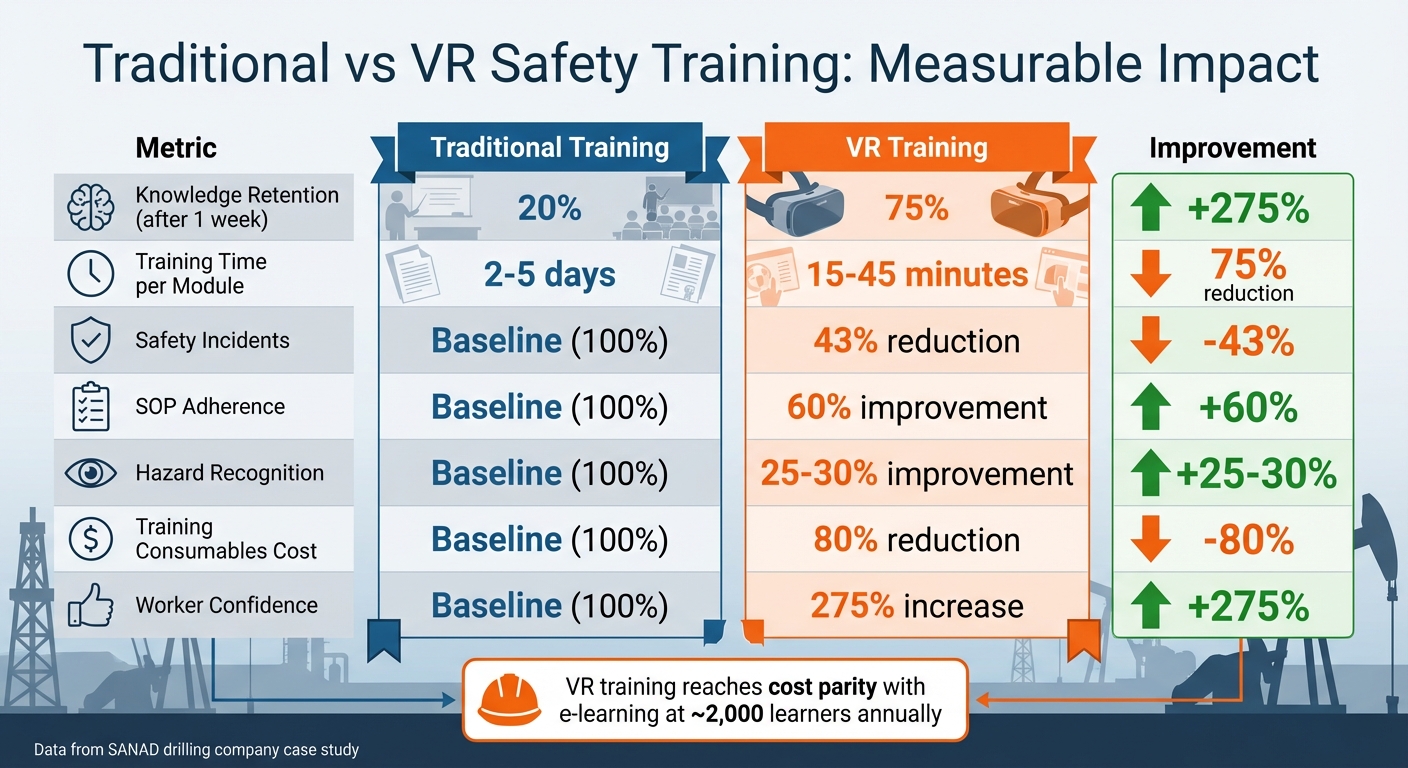
VR vs Traditional Safety Training: Performance Metrics Comparison
SANAD’s implementation of VR training has delivered measurable safety improvements and operational benefits. The program led to a 43% reduction in safety-related incidents, a 25–30% boost in hazard recognition, and a 60% increase in adherence to standard operating procedures (SOPs). These results align with national data, which shows simulation-based training can reduce workplace accidents by 32%.
The program didn’t just enhance safety – it also improved training efficiency and employee confidence. Workers completed training modules four times faster than traditional classroom sessions, with VR scenarios taking only 15–45 minutes compared to multi-day workshops. Automated tracking replaced subjective assessments with precise, data-driven insights on response times and procedural accuracy. This approach created auditable compliance records, meeting OSHA standards like 1910.146 (Confined Space) and 1910.119 (Process Safety Management).
Before and After VR Metrics
The impact of VR training is evident in these performance metrics:
| Metric | Traditional Training | VR Training |
|---|---|---|
| Knowledge Retention (1 week) | 20% | 75% |
| Training Time per Module | 2–5 days | 15–45 minutes |
| SOP Adherence | Baseline | +60% improvement |
| Safety Incidents | Baseline | 43% reduction |
| Hazard Recognition | Baseline | +25–30% improvement |
| Training Consumables | Baseline | 80% reduction |
Cost Savings and Program Scalability
The VR training program also generated significant cost savings and proved highly scalable. It reached cost parity with e-learning at approximately 2,000 learners annually. By eliminating travel and reducing downtime, SANAD cut a portion of the industry’s $50 billion yearly training expenses. Unlike traditional training, where costs grow with instructor fees and facility rentals, VR’s fixed development costs mean the marginal cost per additional learner is nearly zero.
The deployment of standalone headsets, such as the Meta Quest, added another layer of flexibility. These devices allowed training to occur at remote sites – offshore rigs, refineries, and pipeline facilities – without requiring specialized training rooms or high-end PC setups. This setup enabled simultaneous training for entire teams across multiple locations, ensuring consistent quality. By turning compliance into a repeatable, data-driven process, SANAD transformed training from a routine requirement into a tool for building real-world competency.
Expanding VR Training with ABLEMKR
SANAD is taking its VR training initiatives a step further by leveraging ABLEMKR to enhance worker safety and competency in high-risk environments.
ABLEMKR’s Support for VR-Certified Workers
One of the standout features of VR training is its ability to capture detailed performance data, such as response times, accuracy in procedures, and decision-making patterns. ABLEMKR uses this data to verify worker competency before they’re deployed to the field.
The platform ensures that VR-certified workers are assigned to locations where their skills are most needed, particularly for handling emergencies like gas leaks, equipment failures, and blowouts – situations that traditional training methods often fall short in preparing workers for . Through repeated VR simulations, workers develop the muscle memory necessary to perform effectively under pressure, which shortens onboarding periods and reduces operational risks . Additionally, ABLEMKR keeps a digital record of certifications, training sessions, and VR credentials. This not only complements SANAD’s LMS integration but also simplifies OSHA inspections by eliminating the need for manual documentation.
For remote and challenging locations – like offshore rigs, pipeline facilities, and refineries – ABLEMKR incorporates VR-based site inductions. Using digital twins of actual work environments, workers can familiarize themselves with site layouts and equipment before they even set foot on-site. This reduces the learning curve and enhances safety .
This robust certification framework not only strengthens SANAD’s operational safety but also serves as a model for other industries facing similar high-risk challenges.
VR Adoption Across Other High-Risk Industries
While oil and gas remain a focal point, VR training is proving valuable in other sectors like mining, utilities, and heavy infrastructure. With a knowledge gap looming in the oil and gas workforce, VR training offers a way to preserve critical expertise before it’s lost. Platforms like ABLEMKR can extend this approach to other industries as well. Notably, 64% of frontline workers believe that better training could have prevented injuries they’ve witnessed.
Scaling VR training programs requires a phased approach, starting with workshops, moving to pilot projects, and then full-scale deployment. ABLEMKR plays a key role in this process by matching workers certified in high-risk tasks – such as hazardous chemical handling, confined space entry, and working at heights – with projects that demand their verified skills. With persistent injury risks highlighting the need for immersive training, the case for VR-based safety programs becomes increasingly compelling.
Conclusion
This VR safety training program highlights how immersive technology is reshaping worker preparation in the oil and gas industry. By allowing workers to practice in a risk-free environment and develop muscle memory through repeated simulations, VR tackles key safety challenges head-on. The result? Fewer incidents, faster training completion, and sharper hazard recognition.
With the workforce facing a shortage of experienced personnel, VR ensures critical knowledge is passed to new hires in a consistent and reliable manner. Its scalability means every worker – no matter where they are – receives the same high-quality training.
ABLEMKR takes this a step further by ensuring that the skills gained during training translate seamlessly into operational readiness. Through certification tracking and competency verification, workers aren’t just trained – they’re proven ready to handle the specific risks they’ll encounter on the job. This integration of advanced training tools with workforce management also creates a compliance framework that meets OSHA standards while cutting down on administrative work.
The benefits extend beyond safety. By reducing unplanned downtime, VR training delivers a strong return on investment alongside its safety advantages. Together, immersive training and streamlined workforce management drive both safety and efficiency in high-risk industries.
FAQs
What does it cost to build and roll out VR safety training?
The price of VR safety training can vary depending on factors such as the provider and the scale of the project. Typical expenses include hardware, software development, and implementation. Despite the variation in costs, VR training has proven its worth in industries like oil and gas, where it has been shown to reduce incidents by up to 45%. This makes it a smart investment for improving workplace safety and ensuring compliance.
How do you prove VR training meets OSHA competency requirements?
To show that VR training satisfies OSHA’s competency requirements, it’s essential to illustrate how it aligns with OSHA standards and ensures workers fully understand the material. This can be achieved by using immersive and interactive VR training programs that are specifically designed to follow OSHA safety guidelines. Additionally, incorporating OSHA-approved evaluation methods within the VR experience can help validate both compliance and worker competency effectively.
How can ABLEMKR use VR results to deploy the right workers to the right sites?
ABLEMKR leverages VR training data to assess workers’ ability to recognize hazards, their confidence levels, and their understanding of site-specific procedures. By analyzing this data, the platform matches workers to job sites based on their certifications, safety training, and experience. This approach ensures accurate workforce placement and boosts operational efficiency.


