
Public-private partnerships (PPPs) are changing how disasters are managed. By combining government coordination with private sector expertise, these collaborations address challenges like workforce deployment, resource sharing, and recovery efforts. Here’s a quick breakdown:
- What PPPs Do: Governments provide legal frameworks and strategy, while businesses supply skills, technology, and infrastructure.
- Why They Matter: Disasters are becoming more frequent and complex, making joint efforts essential.
- The Financial Case: For every $1 spent on disaster resilience, $4–$7 is saved in recovery costs.
- Real Examples: Louisiana’s LABEOC and Queensland Floods show how these partnerships improve response times and resource management.
- Tech’s Role: Platforms like ABLEMKR streamline workforce deployment, ensuring faster, more accurate responses.
This article explores how PPPs operate, lessons from past disasters, and practical steps to improve future collaborations.
From Preparedness to Recovery: The role of corporate charity partnerships in disaster response
How to Structure Effective PPPs
Building successful disaster workforce public-private partnerships (PPPs) requires thorough planning and frameworks that align the priorities of both sectors. These frameworks must address the distinct needs of government agencies and private companies while ensuring they can work together effectively during emergencies.
At the core of these partnerships is the recognition that government agencies and private companies operate under different pressures and timelines. Public agencies are bound by strict procurement rules and accountability standards, while private companies need flexibility and profit incentives to participate. Bridging these differences requires clear agreements that respect the practical constraints of both sides. Below are the key elements that help create effective PPPs.
Core Elements of PPP Success
To ensure disaster workforce PPPs function smoothly, several foundational elements must be in place:
- Clear governance structures: Establishing joint command centers that include decision-makers from both sectors ensures that coordination begins before a disaster strikes.
- Robust communication protocols: Reliable communication is critical during crises. Redundant systems, such as backup radios and satellite links, ensure continuous contact. Pre-positioned liaison officers can also maintain seamless communication between public and private operations centers.
- Defined resource-sharing mechanisms: Pre-negotiated contracts clarify how costs will be shared, what resources each partner will provide, and how liability will be managed. Standby agreements, which can be activated quickly, help bypass delays caused by emergency procurement processes.
- Financial arrangements that work for both sides: Cost-plus contracts are a common tool in disaster workforce PPPs. These contracts ensure private companies can recover their expenses and earn a reasonable profit, reducing financial risks and motivating full participation.
- Performance metrics and accountability: Clear benchmarks – such as response times, workforce deployment speeds, and service quality – are vital. These metrics should be measurable during real emergencies, not just in training scenarios.
These elements serve as the foundation for the various types of PPP arrangements discussed below.
Different Types of PPP Arrangements
PPPs can take many forms, depending on the needs of the situation and the resources available. Here are some common structures:
- Formal contracts and MOUs: These agreements provide a structured framework for collaboration. Contracts define specific responsibilities, while memorandums of understanding (MOUs) outline general principles for coordination. FEMA offers template agreements that state and local governments can adapt to their needs.
- Ad hoc partnerships: These partnerships arise spontaneously during emergencies when no formal agreements are in place. While they can be effective in certain situations, they often face challenges with coordination and unclear authority. Companies with prior relationships with government agencies typically perform better in these scenarios.
- Sector-specific consortiums: In this model, multiple private companies within an industry work together with government agencies. For example, the construction sector often uses consortiums where general contractors, specialty firms, and equipment suppliers coordinate their disaster response efforts through industry associations.
- Technology-enabled partnerships: Digital platforms can significantly enhance workforce deployment. For instance, ABLEMKR’s mobile-first system connects pre-vetted workers to emergency projects quickly and efficiently. This approach not only speeds up workforce mobilization but also strengthens coordination during crises.
The choice of partnership structure depends on factors such as the scale and complexity of potential disasters, the number of private partners involved, and the legal and regulatory landscape in the region. Many areas adopt a hybrid approach, maintaining formal agreements with key partners while allowing flexibility for ad hoc arrangements when large-scale disasters occur.
Case Study: Louisiana Business Emergency Operations Center (LABEOC)
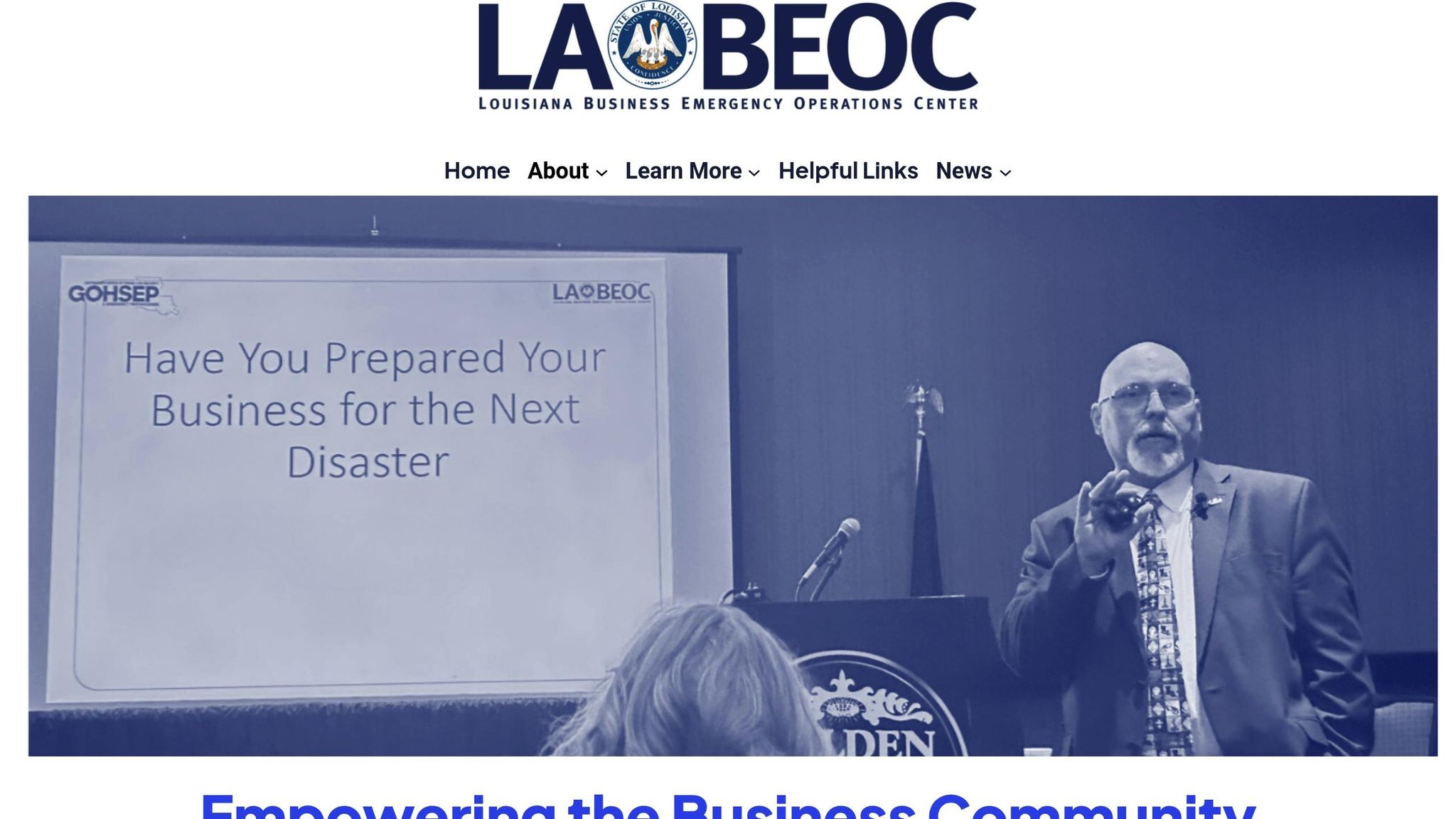
The Louisiana Business Emergency Operations Center (LABEOC) serves as a standout example of how public and private sectors can work together during disasters. It was established in response to the overwhelming impacts of Hurricanes Katrina and Rita in 2005, aiming to close the gap between government emergency management and private sector resources.
LABEOC officially launched on June 1, 2010, through the efforts of the NIMSAT Institute at the University of Louisiana at Lafayette. However, its roots go back to 2008, when NIMSAT’s involvement during Hurricanes Gustav and Ike exposed significant coordination challenges that needed to be addressed.
This center operates as a collaborative effort between the Louisiana Governor’s Office of Homeland Security and Emergency Preparedness (GOHSEP), the NIMSAT Institute, and Louisiana Economic Development (LED). In its first year, the state allocated $262,000 from State Homeland Security Program funds to establish a dedicated LABEOC facility. This funding marked a shift from improvised disaster responses to a structured system for managing emergencies. LABEOC’s foundation has since been key in mobilizing the workforce during crises.
LABEOC’s Role in Workforce Deployment
LABEOC plays a critical role in integrating private sector resources into state disaster operations. By working closely with businesses and non-profits, the center ensures that resources are deployed quickly and in alignment with the state’s emergency needs. This collaborative approach highlights how partnerships can enhance disaster response efforts.
Lessons Learned from LABEOC
LABEOC underscores the importance of having dedicated coordination teams and formal systems in place. The NIMSAT staff, who handle daily operations and maintain strong public-private collaboration, have been essential to the center’s success. LABEOC’s structured approach has proven that formalized partnerships lead to quicker responses, better coordination, and more efficient use of resources compared to the informal methods used in the past.
sbb-itb-aa28329
Case Study: Queensland Floods 2010–2011
The Queensland floods of 2010–2011 showcased how public-private partnerships (PPPs) can unite resources and manpower to tackle the challenges of a large-scale natural disaster. The response required a mix of formal agreements and spontaneous actions, ranging from maintaining critical infrastructure to deploying workers for cleanup efforts. Many private companies stepped up immediately, sometimes without waiting for official government requests, demonstrating a balance between structured coordination and on-the-spot decision-making.
Private Sector Contributions to Disaster Recovery
During the floods, private companies played a crucial role in disaster recovery by reconfiguring their logistical networks to ensure the delivery of essential supplies. Mining companies, for instance, enabled their local teams to assist with flood preparations – such as sandbagging – and even converted worker accommodations into emergency shelters for evacuated communities. Brisbane City Council tapped into social media to recruit private contractors with machinery for debris removal. Beyond logistical support, businesses in sectors like mining, retail, and finance also contributed financially, offering donations to aid both immediate relief efforts and longer-term recovery initiatives.
Challenges and Success Factors
While the collaboration between public and private entities achieved significant outcomes, it wasn’t without hurdles. One major challenge was aligning the rapid, independent actions of private companies with the coordinated strategies of public agencies. In some cases, these independent efforts created overlaps or misalignments with official disaster response plans.
On the flip side, pre-existing relationships between government bodies and major employers proved to be a major advantage. Companies with prior experience working alongside public agencies were able to mobilize their workforce and resources more efficiently. Additionally, businesses leveraged their local expertise and infrastructure – such as mining companies repurposing worker housing and transportation networks or retailers utilizing their supply chains – to adapt quickly to the evolving needs of disaster relief.
The Queensland floods underscored the importance of combining structured coordination frameworks with the ability to pivot quickly in response to changing circumstances. As seen in the case of LABEOC, maintaining ongoing communication between public and private sectors was key to addressing operational gaps and ensuring a more cohesive response.
Technology-Driven Workforce Deployment: The Role of ABLEMKR
Disaster response demands swift and efficient workforce mobilization, a task that traditional methods – like phone calls, spreadsheets, and manual verification – often struggle to handle. These outdated approaches can lead to delays that cost critical time during emergencies. Today, technology is stepping in to bridge these gaps, allowing for faster, more organized responses. By leveraging modern tools, responses that once took days can now happen within hours. This shift not only speeds up mobilization but also enhances the resource-sharing needed for successful public-private partnerships (PPPs).
How ABLEMKR Supports PPP Goals
ABLEMKR’s platform is built to tackle the common hurdles in deploying emergency workforces. At its core is a centralized system that uses a pre-vetted database of workers, ensuring that certifications, safety training, and availability are verified ahead of time. This eliminates much of the guesswork, enabling emergency coordinators to quickly assign skilled workers to urgent tasks.
The platform’s real-time matching system pinpoints workers with the exact skills needed for critical jobs – whether it’s repairing pipelines, clearing debris, or restoring electrical systems. By automating these processes, ABLEMKR significantly reduces the delays associated with manual coordination.
Additionally, its compliance tracking ensures all deployed workers meet safety standards and hold the necessary certifications, minimizing liability risks. Integrated payroll features also guarantee timely and reliable payments, helping maintain workforce availability during extended recovery efforts.
ABLEMKR’s Impact on Workforce Speed and Accuracy
ABLEMKR’s reach extends across major U.S. cities and energy hubs, offering a strong network of skilled professionals. Its mobile-first platform provides real-time updates on worker status and project progress, ensuring that responses are not only fast but also highly coordinated. By combining speed with precision, ABLEMKR strengthens the collaborative framework essential for effective disaster response, making it a critical tool in modern emergency management.
Key Lessons and Best Practices
The case studies highlight some recurring themes that set successful disaster workforce partnerships apart from those that falter under pressure. Organizations that lay the groundwork before a crisis hits are often far better equipped to respond swiftly and effectively when emergencies arise.
Maintaining Cross-Sector Collaboration
Consistent engagement across sectors is a cornerstone of effective disaster response. This means defining clear roles, establishing reliable communication channels with designated points of contact (and backups), and conducting joint training sessions to identify and address potential coordination gaps ahead of time.
When these collaborative systems are in place, they create a strong foundation for leveraging technology to improve response efficiency and accuracy.
Investing in Technology and Training
Modern disaster response demands tools that can quickly mobilize a vetted workforce. Outdated coordination systems simply can’t keep up when the scale of a disaster grows.
Take platforms like ABLEMKR, for example. They illustrate how technology can streamline workforce deployment through features like geo-location matching, compliance tracking, and real-time mobile updates. These tools ensure that the right people are in the right place, fully compliant, and ready to act.
Training is equally important. Cross-training between public and private sector personnel enhances flexibility during emergencies. For instance, when private sector managers understand government procedures, and public sector teams are aware of industry-specific safety standards, partnerships can function more seamlessly – even under intense pressure.
Adapting to New Workforce Challenges
Collaboration and technology are key, but adaptability is what ensures partnerships can meet the demands of evolving disaster scenarios.
Ongoing evaluations are essential for refining these partnerships. Flexible workforce models, supported by geographically diverse labor pools, help reduce dependence on any single provider. This becomes especially critical when disasters impact multiple regions simultaneously.
Resilience isn’t just about having the right tools or materials – it’s also about ensuring workforce availability. Maintaining relationships with labor sources across various locations protects partnerships from disruptions caused by localized disasters.
Additionally, the changing nature of infrastructure threats – such as those posed by climate change, aging systems, and advancing technologies – requires continuous updates to workforce skills. Investing in ongoing training and ensuring financial stability are vital to keeping these partnerships effective and ready for the long haul.
FAQs
How do public-private partnerships (PPPs) enhance disaster workforce response?
Public-private partnerships (PPPs) are a powerful tool for enhancing disaster workforce response. By bringing together the resources, skills, and expertise of both sectors, these partnerships ensure that emergencies are handled more effectively. Skilled workers and essential equipment can be deployed more quickly, ensuring critical tasks are addressed without unnecessary delays.
PPPs also improve communication and coordination among key players, cutting down on inefficiencies and keeping operations on track. By sharing risks and responsibilities, these partnerships create a stronger, more reliable framework for disaster response. Beyond immediate recovery, they also help build better community readiness for whatever challenges may come next.
What challenges do public-private partnerships face when coordinating disaster workforce responses?
Public-private partnerships (PPPs) face a tough balancing act when it comes to coordinating disaster response efforts. The challenge lies in aligning the goals of public agencies with those of private companies, which often have different priorities. This misalignment can make it difficult to integrate disaster response plans into existing systems, deal with the unpredictable nature of disasters, and ensure resources are mobilized quickly and effectively.
On top of that, poor risk allocation can create significant setbacks, such as delays and budget overruns, which only add to the complexity. To tackle these challenges head-on, effective communication, clearly defined roles, and strong contingency planning are critical. These elements help create a smoother, more efficient response when disaster strikes.
How does technology like ABLEMKR improve workforce deployment during disasters?
Technology platforms like ABLEMKR are changing the game when it comes to deploying disaster response teams. By simplifying essential tasks like communication, real-time tracking, and compliance management, ABLEMKR helps organizations quickly mobilize skilled workers while keeping safety protocols firmly in place.
The platform automates key processes such as onboarding, certification verification, and safety training coordination. This not only speeds up response times but also ensures operations run more smoothly. With its ability to match pre-approved workers to job sites based on their availability and location, ABLEMKR ensures a more efficient and organized response during emergencies. This streamlined approach can make a crucial difference, saving both lives and resources when time is of the essence.


