
BOSIET certification is mandatory for anyone working offshore in the oil and gas industry. It equips workers with critical survival skills, such as escaping a submerged helicopter, firefighting, and first aid, ensuring they can handle emergencies in one of the world’s most hazardous work environments. Without this certification, workers cannot access offshore platforms or transport.
Key points about BOSIET:
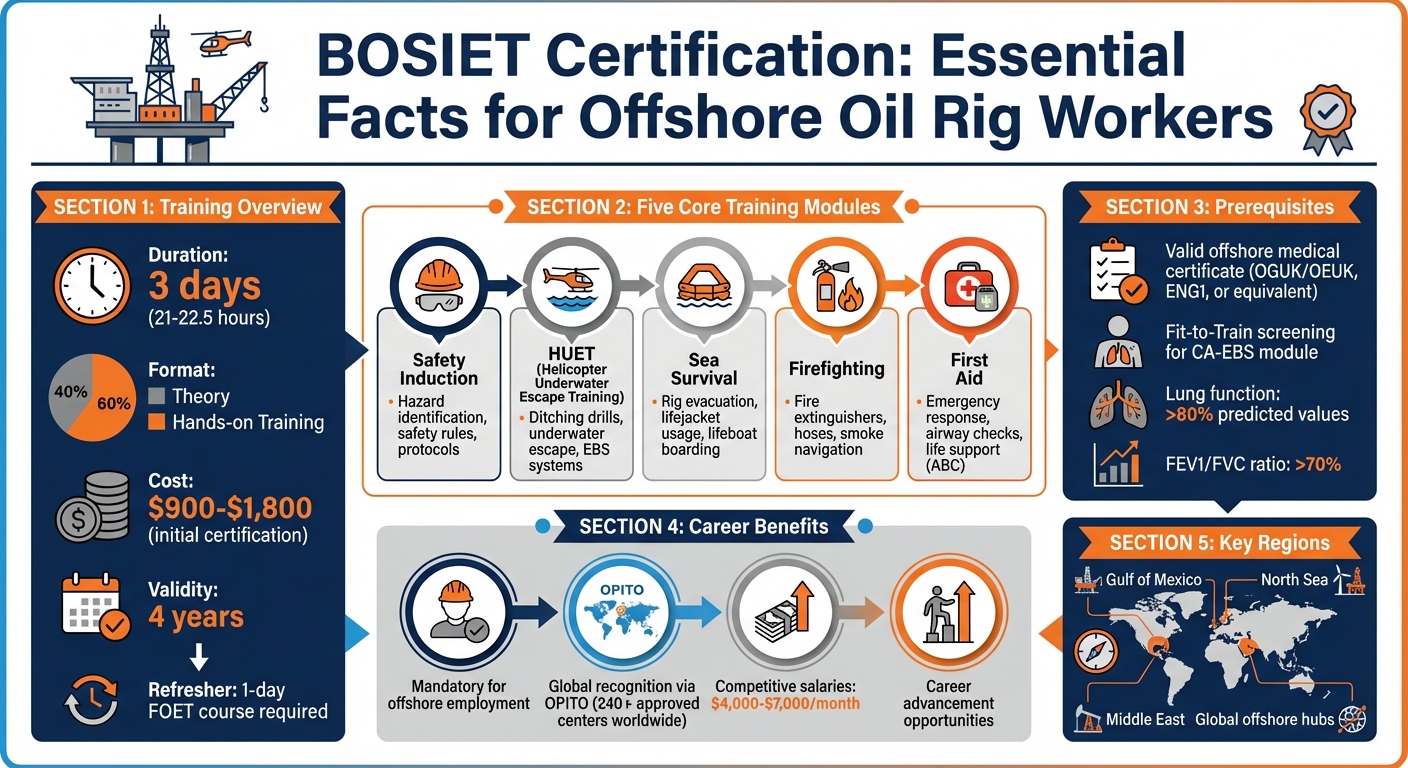
- Duration: 3 days (~22 hours) with 40% theory and 60% hands-on training.
- Modules: Helicopter escape (HUET), sea survival, fire suppression, and first aid.
- Certification Validity: 4 years, with a 1-day refresher (FOET) required to renew.
- Cost: $900–$1,800 for initial training; FOET is less expensive.
- Global Recognition: Overseen by OPITO, accepted in regions like the Gulf of Mexico and North Sea.
BOSIET not only ensures safety but also boosts career opportunities, as certified workers are in high demand. Platforms like ABLEMKR simplify hiring by connecting certified professionals with employers, ensuring safety compliance and quick deployment.
BOSIET Certification Quick Reference Guide for Offshore Workers
BOSIET offshore survival training course in full, all you need to know!
sbb-itb-aa28329
Hazards and Risks on Offshore Oil Rigs
Offshore oil rigs are some of the most challenging workplaces on the planet. The dangers workers face are specific to these extreme environments, where a lack of preparation can have deadly consequences.
Helicopter transport is the primary means of getting workers to and from offshore platforms – and it’s also among the most dangerous. In the event of a ditching, workers have only seconds to escape from an overturned helicopter into frigid waters. Survival hinges on knowing underwater escape techniques and using emergency breathing systems. As OPITO explains:
"The Energy Industry operates in some of the most dangerous environments in the world, and those working offshore face a range of potential hazards, especially during helicopter travel".
Fire and explosion risks are another constant concern. Oil rigs deal with pressurized, highly flammable materials, where even a small spark can ignite devastating fires. Workers may have to navigate smoke-filled corridors to reach evacuation points. Without prior experience in firefighting or smoke escape drills, panic and disorientation can set in, leading to life-threatening mistakes.
Environmental and atmospheric conditions further complicate safety. Workers contend with extreme weather, rough seas, and the risk of rapid hypothermia. Additionally, atmospheric hazards like hydrogen sulfide (H2S) or oxygen-deficient air can cause respiratory failure or unconsciousness in seconds. In some emergencies, survival might mean deploying life rafts, using protective gear, or enduring long hours in open water before rescue teams arrive.
Even with all these risks, the offshore industry in highly regulated areas has achieved impressive safety milestones. For instance, in the North Sea, some installations operate for extended periods without a single lost time incident (LTI). This level of safety is a direct result of rigorous training programs, proving that proper preparation can turn dangerous tasks into manageable challenges.
These realities highlight why comprehensive BOSIET training is critical for anyone working in offshore environments.
What is BOSIET Certification?
Offshore work is no walk in the park – it’s risky and demands rigorous preparation. That’s where BOSIET (Basic Offshore Safety Induction and Emergency Training) comes in. This certification is the global entry-level requirement for newcomers to offshore industries like oil, gas, and renewable energy. If you’re aiming for offshore employment, this training isn’t optional – it’s mandatory.
The course equips workers with the skills they need to handle offshore hazards and respond effectively in emergencies, especially during helicopter transit. As OPITO puts it:
"BOSIET introduces learners to the safety issues and emergency response procedures relevant to offshore installations… ensuring participants are prepared for the specific risks associated with offshore helicopter travel."
Through BOSIET, participants learn to spot dangers like fires, gas leaks, or extreme weather, use safety gear correctly, and perform self-rescue or first aid when every second counts. The training modules break down how individuals can navigate these high-stakes environments.
BOSIET Training Modules
The course spans 21–22.5 hours over three days and covers these critical areas:
| Training Module | Key Components Covered |
|---|---|
| Safety Induction | Identifying hazards, understanding safety rules, waste disposal protocols, and drug/alcohol policies |
| HUET | Helicopter ditching drills, underwater escape training, and using EBS/CA-EBS |
| Sea Survival | Rig evacuation, lifejacket usage, lifeboat boarding (TEMPSC), and survival strategies |
| Firefighting | Operating fire extinguishers, handling fire hoses, and navigating smoke-filled areas |
| First Aid | Basic emergency actions, including airway checks and life support techniques (ABC) |
Training sessions are generally split into 40% classroom theory and 60% practical simulations. The HUET module, in particular, is hands-on and intense. Trainees practice escaping from a simulated helicopter cabin submerged or flipped underwater. They also learn to operate Compressed Air Emergency Breathing Systems (CA-EBS), which are widely used in areas like the North Sea. This practical approach ensures workers develop the muscle memory needed to act swiftly in real emergencies.
Requirements and Certification Validity
Before enrolling, you’ll need a valid offshore medical certificate (such as OGUK/OEUK, ENG1, or an equivalent). The training is physically challenging, especially during water-based exercises. For the CA-EBS module, participants must pass a "Fit-to-Train" (FTT) screening. This includes respiratory and ENT (Ear, Nose, and Throat) assessments to check for barotrauma risks. Lung function must exceed 80% of predicted values, with an FEV1/FVC ratio above 70%. These strict health standards are in place to ensure safety in demanding offshore conditions.
Once certified, your BOSIET credential is valid for four years. To keep it current, you’ll need to complete a 1-day Further Offshore Emergency Training (FOET) refresher course before it expires. Let it lapse, and you’ll have to retake the full 3-day course. The initial certification typically costs between $900 and $1,800, while the FOET refresher is less expensive.
The Offshore Petroleum Industry Training Organisation (OPITO) oversees BOSIET standards and accredits training centers worldwide. With over 240 approved locations, your certification will be recognized across global offshore hubs, from the Gulf of Mexico to the North Sea.
How BOSIET Certification Benefits Oil Rig Workers
BOSIET certification offers practical, real-world advantages for those working on oil rigs.
Hands-On Emergency Preparedness
BOSIET training goes beyond classroom theory by immersing workers in realistic emergency scenarios. One of the standout exercises is the "dunker" simulator, where trainees are strapped into a helicopter cabin mockup, submerged in water, and taught to escape through windows as the cabin flips underwater. They also practice using CA-EBS in controlled submerged environments.
These drills are not just for show – they create muscle memory that can save lives. Workers gain firsthand experience with firefighting equipment, life jackets, and hypothermia prevention techniques. This preparation ensures quicker, more effective responses during real emergencies. For offshore workers, these skills are not just useful – they’re essential for survival and employment.
Required for Offshore Employment
BOSIET certification is non-negotiable for offshore jobs. Without a valid certificate, workers cannot access offshore installations. This certification, recognized globally through OPITO, is the industry’s safety benchmark. Employers rely on it to meet international safety standards and minimize liability.
The global recognition of BOSIET certification is a major plus. Whether you’re applying for jobs in the Gulf of Mexico, the North Sea, or the Middle East, the same certificate is accepted. Mahendra Lanjewar from The HSE Coach sums it up perfectly:
"BOSIET is your passport to offshore safety and success".
Meeting Compliance Standards and Advancing Careers
BOSIET certification doesn’t just meet job requirements – it also opens doors to career growth. Certified workers are in high demand because they help employers comply with safety regulations while reducing risks. Certification also signals professionalism and a commitment to safety.
For offshore workers in the U.S., this training translates to competitive salaries ranging from $4,000 to $7,000 per month. These earnings reflect the hazardous nature of the work and the specialized training involved.
Additionally, maintaining your certification through a 1-day FOET refresher course every four years keeps you compliant and demonstrates your ongoing dedication to safety and career progression. Employers value this commitment, often favoring certified workers for promotions and higher-paying roles.
How ABLEMKR Connects BOSIET-Certified Workers with Employers
Hiring certified workers for offshore projects has often been a slow, manual process full of inefficiencies. ABLEMKR changes that by directly connecting BOSIET-certified workers with oil and gas employers across the U.S. This approach leverages the safety credentials workers earn through BOSIET certification, making the hiring process faster and more reliable.
Matching Workers Based on Certifications
With ABLEMKR’s Verified Skills platform, workers can upload their BOSIET, well control, API, and other safety certifications just once to create a lasting digital profile. A dedicated vetting team checks these credentials directly with issuing authorities like OPITO, ensuring every certificate is valid before workers appear in employer searches. This process not only speeds up hiring but also guarantees that only safety-trained, certified professionals are available for projects.
When new opportunities arise – whether in the Gulf of Mexico or other energy hubs – workers receive real-time project alerts tailored to their qualifications and location. This precise matching system ensures employers see only candidates who meet their specific needs, saving time and reducing the hassle of reviewing unqualified applications. It’s a win-win for both sides, especially when quick crew deployment is essential.
Fast Deployment for Critical Projects
Offshore projects often operate under tight deadlines, especially during emergency shutdowns or urgent pipeline repairs. With ABLEMKR, employers can tap into a pool of pre-screened, verified workers for immediate deployment. This eliminates recruitment delays and ensures crews are ready to mobilize without the usual back-and-forth over paperwork.
The platform’s mobile-first design allows workers to respond to job opportunities instantly, while employers can confirm crew availability in real time. This streamlined process not only supports offshore safety protocols but also helps minimize costly downtime.
Advantages for Employers and Workers
ABLEMKR delivers clear benefits to both workers and employers, as shown below:
| Feature | Benefit for Workers | Benefit for Employers |
|---|---|---|
| Verified Skills Profile | Upload certifications once, no repetitive paperwork | Access to pre-screened, compliant workers |
| Automated Tracking | Alerts for expiring certifications | Real-time compliance monitoring of crews |
| Direct Matching | Faster access to high-paying jobs | Reduced time spent on recruitment processes |
| Vetting Team | Credentials verified for authenticity | Lower liability and trusted safety standards |
For workers, this means greater visibility to multiple employers without the need to repeatedly share their certifications. For employers, it simplifies onboarding, ensures compliance, and provides peace of mind knowing that every worker is fully qualified before stepping onto a rig. ABLEMKR bridges the gap between safety and efficiency, making offshore hiring seamless.
Conclusion
BOSIET certification plays a crucial role in ensuring the safety of offshore workers. This comprehensive training provides essential survival skills, preparing individuals to handle real-life emergencies effectively. As Mahendra Lanjewar, HSE Professional, aptly states:
"BOSIET is your passport to offshore safety and success".
Beyond safety, this certification opens doors to career growth, offering access to higher-paying roles and critical offshore projects without the need for frequent recertification. It’s not just about survival – it’s about thriving in a demanding industry.
When it comes to deploying these certified professionals, efficiency is key. ABLEMKR simplifies the process by automating compliance tracking and streamlining hiring. Workers upload their certifications once and gain access to real-time project alerts tailored to their skills. This system also provides visibility to multiple employers, ensuring certified professionals are always ready for immediate deployment.
This approach creates a win-win situation: workers feel prepared and valued, while employers save time and maintain operational continuity during critical projects. In an industry where downtime can be costly, connecting BOSIET-certified workers to offshore opportunities quickly and effectively makes a world of difference. Safety and efficiency truly go hand in hand.
FAQs
What emergency response skills does BOSIET certification teach oil rig workers?
BOSIET certification provides oil rig workers with the critical skills needed to navigate emergencies in offshore settings. The training covers a range of essential areas, including helicopter safety and escape techniques, sea survival, first aid, firefighting, and self-evacuation procedures.
Participants also practice responding to high-risk scenarios, such as helicopter ditching, ensuring they’re ready to act quickly and effectively when faced with unexpected dangers. These skills play a key role in maintaining safety and meeting compliance standards in the challenging world of offshore operations.
How does BOSIET certification help offshore workers advance their careers?
BOSIET certification is a must-have for anyone aiming to work offshore, especially in the oil and gas industry. Many roles in this sector require it as a baseline qualification to meet strict safety and compliance standards. It ensures workers are equipped to handle emergencies and adapt to the tough conditions that come with offshore environments.
Having a BOSIET certification opens doors to higher-paying jobs and shows employers that you prioritize safety. This can make you stand out in the competitive energy and extractives job market. Beyond job opportunities, it also boosts your confidence in managing the unique challenges of offshore work.
What do I need to know about obtaining and renewing BOSIET certification?
BOSIET, or Basic Offshore Safety Induction and Emergency Training, is a must-have for anyone working offshore. This certification ensures workers are equipped with the knowledge and skills to handle emergencies and stay safe in challenging environments. The initial training typically lasts 2–3 days and covers essential topics such as sea survival, helicopter safety, firefighting, and first aid.
If you’re looking to get certified in the U.S., expect to pay between $900 and $1,800 USD, though prices can vary depending on the training provider and location.
The certification is valid for four years. After this period, you’ll need to renew it by taking the FOET (Further Offshore Emergency Training) refresher course. FOET is shorter – usually just one day – and focuses on reinforcing key safety practices. In some cases, additional training may be required, such as learning to use compressed air emergency breathing systems (CA-EBS) for helicopter travel.
Keeping your BOSIET certification current is not just about compliance – it’s about being fully prepared for the unique risks and demands of offshore work.


