
Credential verification is a critical process, especially in high-risk industries like construction and energy. However, the outdated methods many organizations use are slow, costly, and prone to errors. Blockchain technology offers a faster, more secure, and cost-effective alternative. Here’s a quick breakdown:
- Verification Speed: Manual methods take 3–10 days; blockchain does it in 5 seconds.
- Cost: Traditional verification costs $50–$200 per certificate; blockchain reduces this to $2–$5.
- Fraud Prevention: Traditional systems catch fraud 67% of the time; blockchain ensures 100% accuracy.
- Availability: Manual methods work during office hours; blockchain operates 24/7.
Blockchain decentralizes credential storage, making records tamper-proof and instantly accessible. It also automates verification with smart contracts, eliminating human involvement and reducing errors. For industries requiring quick workforce deployment and strict compliance, blockchain is becoming the go-to solution.
Quick Comparison:
| Metric | Manual Methods | Blockchain Solutions |
|---|---|---|
| Verification Time | 3–10 days | 5 seconds |
| Cost | $50–$200 | $2–$5 (issuance) |
| Fraud Detection | 67% | 100% |
| Availability | Business hours only | 24/7 |
Blockchain addresses inefficiencies, reduces costs, and ensures complete accuracy, making it ideal for high-stakes environments.
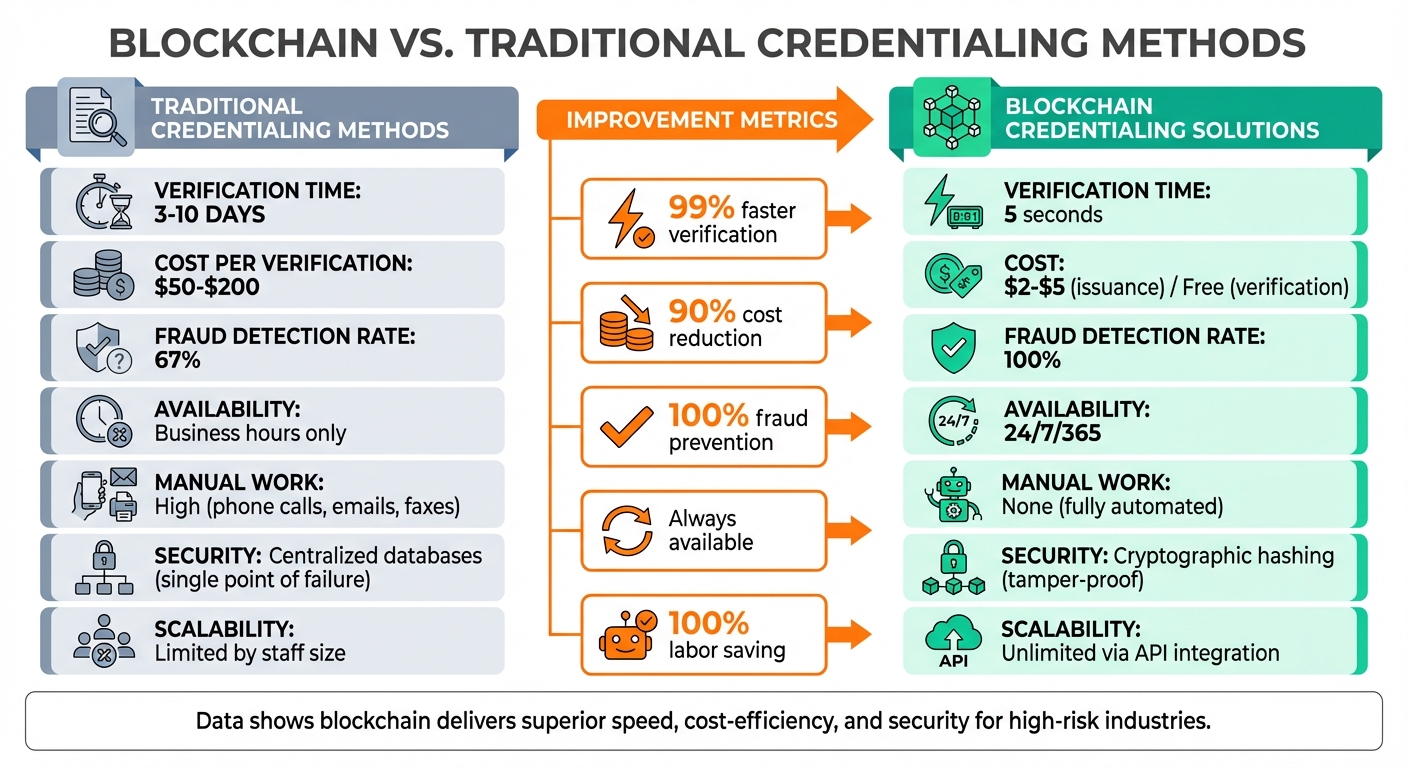
Blockchain vs Traditional Credentialing: Speed, Cost, and Accuracy Comparison
Traditional Credentialing Methods Explained
Manual Verification Processes
Traditional credentialing relies heavily on manual verification. Here’s how it works: When an employer receives a worker’s certificate, they must contact the issuing organization – usually via phone, email, or fax – to confirm its authenticity. On the other end, the issuing organization manually searches its records, which are often stored in centralized databases or even physical filing systems, to verify the credential’s validity.
This process introduces a single point of failure. If the issuing organization’s database becomes inaccessible – whether due to a cyberattack, system outage, or even the organization shutting down – verification grinds to a halt. In cases where training providers go bankrupt or merge with other entities, historical records often disappear entirely, leaving workers unable to prove their qualifications.
"Every traditional method shares a fundamental flaw: trust depends on the issuing organisation’s continued existence, cooperation, and data integrity." – TRUE Original
Problems with Traditional Methods
Manual verification is riddled with inefficiencies that can delay workforce deployment. For instance, organizations using these methods often report spending over 20 hours each week managing credential-related communications. High-volume credential issuers, responsible for verifying tens of thousands of records annually, quickly find themselves overwhelmed. This backlog leads to unanswered requests and hiring delays.
On top of inefficiency, cost and fraud create additional hurdles. Third-party verification services typically charge between $50 and $200 per credential, while the cost of using internal staff ranges from $16 to $54 per verification. Meanwhile, fraudsters have become more sophisticated, using AI to generate fake certificates and even setting up fraudulent verification websites to intercept requests.
"Traditional verification assumes the issuer’s contact information on the certificate is accurate. When fraudsters control that information, the entire system breaks down." – TRUE Original
These inefficiencies and vulnerabilities are especially problematic in industries like construction and energy, where safety certifications are critical. Delays in verification can stall projects and increase compliance risks, making the traditional model ill-suited for fast-paced, high-stakes environments.
Next, we’ll dive into how blockchain technology offers a solution through decentralized and automated verification.
sbb-itb-aa28329
Blockchain Credentialing Systems Explained
Decentralized and Tamper-Proof Records
Blockchain credentialing flips the script on traditional systems. Instead of storing records in a single, centralized database, it spreads them across thousands of nodes worldwide. Each credential is transformed into a unique digital hash using cryptographic algorithms like SHA-256. Once this hash is recorded on a public blockchain – such as Ethereum or Polygon – it becomes permanent and unchangeable. This system ensures authenticity through mathematical proof; any tampering changes the hash, making alterations immediately detectable. Unlike older methods that rely on trusting an issuer’s database or staff, blockchain guarantees authenticity without needing that trust. Plus, the decentralized setup means credentials remain accessible and verifiable around the clock, even if the issuing institution shuts down.
This permanence is a game-changer for industries like construction and energy, where safety certifications often need to be maintained for years. Workers can securely store proof of their qualifications, and employers can verify them instantly – no waiting for office hours or hunting down misplaced records. Sweden’s SSF (Sveriges Stöldskyddsföreningen), an 80-year-old authority on security standards, uses blockchain for its certifications. Maria Dahlstedt, Program Manager at SSF, highlights its importance:
"It has been particularly important for us to be able to ensure that our Proofs of Education… are correct and secure".
On top of this secure framework, smart contracts take the process a step further by automating verification.
Smart Contracts for Verification
Smart contracts simplify credential verification by removing the need for human involvement. Forget about phone calls, emails, or third-party services – scanning a QR code linked to a smart contract verifies credentials against the blockchain in just 5 seconds. Compare that to the traditional wait of 3–5 days, and the difference is clear. These automated checks also slash verification costs, bringing them down from $50–$200 to just $2–$5 – a massive 90% reduction. Beyond cost savings, smart contracts ensure compliance by keeping records up to date. If a certification expires or gets revoked, the blockchain instantly reflects the change. This real-time accuracy is critical in industries where outdated certifications can lead to safety risks or legal trouble.
Fraud prevention also gets a major boost. Traditional systems catch fraudulent credentials about 67% of the time, but blockchain’s cryptographic verification achieves a flawless 100% success rate. With AI-generated fake certificates on the rise, blockchain offers an ironclad solution that doesn’t rely on subjective checks or visual inspections. Instead, it uses cryptographic proof to ensure every credential is genuine.
Blockchain Based Verification of Educational and Professional Certificates
Blockchain vs. Traditional Credentialing: Direct Comparison
Let’s break down how blockchain stacks up against traditional credentialing methods.
Traditional systems rely heavily on manual steps like phone calls, emails, and even faxes to verify credentials. These processes are slow, prone to human error, and costly. Blockchain, on the other hand, uses cryptographic hashing and decentralized networks to verify credentials almost instantly. That means it’s not just faster – it’s also more secure and cost-effective.
Here’s a stark example: traditional verification can take anywhere from 3 to 5 days and costs between $50 and $200 per credential. Blockchain cuts that time down to about 5 seconds and costs only $2 to $5 for the initial issuance. Subsequent verifications? They’re free. When you crunch the numbers, blockchain delivers a 99% time savings and slashes costs by 90%. Plus, blockchain ensures 100% fraud prevention, compared to the 67% detection rate of traditional methods.
Security is another key difference. Traditional systems store records in centralized databases, which are prime targets for hackers. Blockchain, however, distributes records across thousands of nodes, making them tamper-proof and permanent. It also updates in real-time – so if a credential is revoked, the change is immediately visible. Traditional systems, by contrast, are limited to business hours and rely on trust rather than mathematical proof.
Comparison Table: Traditional vs. Blockchain Methods
| Metric | Traditional Method | Blockchain Solution | Improvement |
|---|---|---|---|
| Verification Time | 3–5 days | 5 seconds | 99% faster |
| Cost per Verification | $50–$200 | $2–$5 (issuance) / Free (verification) | 90% reduction |
| Fraud Detection Rate | 67% | 100% | Complete prevention |
| Availability | Business hours only | 24/7/365 | Always available |
| Manual Work | High (phone calls, emails, faxes) | None (fully automated) | 100% labor saving |
| Security Basis | Centralized databases | Cryptographic hashing | Tamper-proof |
| Scalability | Limited by staff size | API integration and batch processing | Unlimited growth |
This side-by-side comparison makes it clear: blockchain dramatically outperforms traditional methods in every major category. For industries facing a 42% yearly increase in verification requests, scaling with traditional systems would require hiring more staff and increasing costs. Blockchain, however, handles unlimited demand through automation, making it the ideal solution for industries where accuracy, speed, and security are non-negotiable.
Benefits of Blockchain for Workforce Deployment
Blockchain technology offers a streamlined approach to workforce deployment, especially in high-risk sectors, by addressing inefficiencies found in traditional methods. It eliminates the need for slow, intermediary-driven processes by automating verification tasks. This means instant mobilization of workers and scalable operations without added costs. With smart contracts, outdated processes like manual paperwork, waiting for office hours, or making endless phone calls become unnecessary. Workers can carry tamper-proof digital credentials on their mobile devices, giving them control over their data while providing employers with instant, verified information.
In industries like oil and gas, mining, and construction, blockchain’s immutable audit trails ensure that only workers with valid and up-to-date certifications are allowed on hazardous sites. This system relies on mathematical certainty instead of institutional trust, which is crucial when safety compliance is non-negotiable. As IBM explains, blockchain is often called a "trustless" network – not because participants distrust each other, but because they don’t need to rely on trust. These efficiencies not only reduce costs and improve speed but also make blockchain an ideal solution for high-risk environments.
Applications in High-Risk Industries
Industries where safety and quick responses are critical benefit the most from blockchain’s capabilities. The technology’s ability to maintain a complete and permanent record of a worker’s skills and certifications is invaluable. For example, in oil and gas operations, where emergencies like pipeline repairs demand immediate action, blockchain ensures that workers with the right qualifications can be mobilized instantly. Unlike traditional paper certificates, these records remain accessible and valid regardless of the issuing entity’s status.
A practical example of blockchain’s application is seen in the healthcare sector. In 2019, the Medical Council of Canada adopted blockchain to verify doctors’ credentials, accelerating the process of ensuring that healthcare professionals are qualified, which in turn enhances patient safety by reducing the risk of unqualified practitioners. Similarly, Home Depot turned to IBM Blockchain technology to resolve vendor disputes and improve supply chain transparency by creating a shared, accessible record of transactions. These same principles are crucial in sectors like construction and energy, where compliance documentation must be accessible and verifiable across multiple job sites.
How ABLEMKR Uses Blockchain Technology
ABLEMKR exemplifies how blockchain can transform workforce deployment for mission-critical projects. ABLEMKR uses blockchain to match pre-vetted workers to job sites based on certifications, safety training, availability, and location. Its mobile-first platform verifies credentials in real time, enabling operators to quickly mobilize crews for critical projects across the U.S. Employers benefit from real-time compliance tracking, gaining instant visibility into worker statuses. For instance, when a certification is updated or revoked, the change is immediately reflected across the network, ensuring no worker with expired credentials is sent to a hazardous site.
Workers also gain significant advantages, as their verified credentials can be instantly shared with multiple employers, removing traditional barriers in labor deployment. The platform supports unlimited verification requests at no additional cost, making it ideal for rapidly scaling on-demand workforce platforms across energy hubs and major cities in the U.S..
Implementation Challenges and Solutions
Switching from traditional credentialing to blockchain-based systems comes with its fair share of hurdles. Legal and regulatory issues, such as the absence of unified blockchain credential standards and potential conflicts with data protection laws like GDPR, make adoption tricky. On the technical side, scalability remains a problem – some blockchain networks process transactions slowly and charge high fees. Security vulnerabilities in smart contracts further add to the risks, potentially exposing sensitive worker data.
Economic concerns also play a role. High upfront costs and uncertainty about return on investment make organizations hesitant to commit. Additionally, many stakeholders lack a clear understanding of blockchain technology, which can lead to mistrust and resistance to change.
Addressing Adoption Barriers
Educating stakeholders is key to tackling these challenges. When people understand blockchain – especially how it benefits them – they’re less likely to resist it. Companies can roll out training programs for everyone, from executives to field workers. As Ioanna Andreoulaki from the National Technical University of Athens puts it:
"The blockchain is considered a disruptive technological breakthrough because of its ability to guarantee reliable transactions without the need for a third party to control the process".
This kind of understanding can ease the transition and build confidence in the technology.
From a technical standpoint, companies don’t have to overhaul their current systems entirely. Deloitte suggests treating blockchain as an "add-on enterprise solution" that enhances value while keeping existing enterprise resource planning (ERP) systems intact. Bridges can connect on-chain smart contracts with off-chain relayers to integrate blockchain with legacy systems. Additionally, cloud providers offering Blockchain as a Service (BaaS) allow organizations to deploy blockchain applications without building new infrastructure from scratch. Using standardized smart contract libraries like OpenZeppelin can save development time and reduce security risks, while bug bounty programs can uncover vulnerabilities before full deployment.
By addressing these gaps in education and technical integration, organizations can set the stage for smoother adoption.
Mobile Platform Integration
Tackling these challenges is crucial to unlocking blockchain’s potential for workforce deployment in high-risk industries.
Mobile technology acts as a bridge between blockchain’s complexity and practical workforce needs. Since workers are more likely to carry smartphones than laptops, mobile wallets are ideal for securely storing digital credentials, presenting them for verification, and signing documents on the go. In industries like oil and gas or construction, where geo-located deployment is common, mobile apps can scan barcodes, filter workers by location and availability, and connect directly to the blockchain for instant credential checks.
Simplifying blockchain for users is critical. Workers don’t need to grasp cryptographic keys or distributed ledgers – they just need an easy-to-use interface. A managed wallet approach, where the platform handles the technical details behind the scenes, significantly improves the user experience. For example, a foreman can verify a worker’s certifications in seconds through a mobile app, eliminating the need for manual paperwork. This seamless interaction not only saves time but also encourages adoption among non-technical users.
Blockchain’s Effect on Construction and Energy Sectors
Blockchain, known for its speed and security, is transforming operations in the construction and energy industries. Using cryptographic techniques, blockchain creates a secure, time-stamped ledger that records every action. This system not only ensures regulatory compliance but also addresses risks tied to outdated, centralized systems – an issue especially critical in these high-stakes sectors.
By shifting from trust-based verification to mathematical certainty, blockchain allows for round-the-clock access to verified certifications. This capability reduces industry-specific risks, such as last-minute crew mobilizations for emergency shutdowns or remote pipeline repairs. Unlike centralized databases that can be disrupted by organizational changes, blockchain ensures continuous and reliable verification.
In the oil and gas sector, companies are increasingly adopting blockchain to cut costs and improve efficiency. Consensys highlights how "the complex network of participants suffers from siloed infrastructures and numerous process inefficiencies". Blockchain tackles these issues by connecting industry players through smart contracts, streamlining data coordination across the supply chain. These advancements are not just theoretical – real-world applications and pilot projects are already showcasing blockchain’s benefits.
Measurable Results and Examples
Blockchain’s impact is evident in measurable results. A pilot project by BTL Group, involving major players like ENI, BP, and Wien Energie, demonstrated a 30–40% reduction in operational costs through improved tracking and settlement processes. In wholesale electricity distribution, blockchain-based platforms have shown the potential to lower consumer bills by about 40%.
One standout example comes from Chile. In April 2018, the Chilean National Energy Commission launched a project using the Ethereum blockchain to record and track energy data, including market and fuel prices. This initiative provided transparent public access to transaction records, reduced financial losses from clerical errors, and safeguarded data against corruption. The immutable ledger also ensured accurate tracking across oil and gas production stages, saving both time and money.
Conclusion: What’s Next for Credentialing
Blockchain-based credentialing is reshaping how verification and workforce deployment are handled, especially in high-risk industries. Traditional methods just can’t keep up with the speed and accuracy that modern projects demand. This gap highlights the growing need for a solution that’s both faster and more secure.
The numbers tell a compelling story. By 2028, the digital credential market is projected to reach $2.8 billion, with blockchain adoption growing at an impressive 56% annually. This technology is tackling major issues like the $7 billion fake diploma crisis and the 85% rate of resume inaccuracies.
In industries like construction and energy, blockchain is proving its worth by enabling faster crew mobilization and cutting down overhead costs. Take ABLEMKR as an example. Their platform connects pre-vetted workers to job sites based on certifications and safety training. Thanks to blockchain, credentials can be verified around the clock, reducing verification time by 99% and slashing costs by 90%. This mobile-first approach shows how blockchain is already meeting the needs of critical projects.
Looking ahead, the integration of blockchain with self-sovereign identity systems will take workforce verification to the next level. These systems allow workers to control their credentials and share only the information that’s necessary. As government agencies begin to accept blockchain verification as a standard, what was once seen as experimental is quickly becoming essential for workforce deployment. For industries operating in high-stakes environments, embracing blockchain isn’t just an option – it’s a necessity to stay competitive.
The real question now is not if blockchain will dominate credentialing, but how quickly industries will adopt it to keep up.
FAQs
Do we have to store personal data on the blockchain?
No, storing personal data directly on the blockchain isn’t necessary. Blockchain works by creating tamper-resistant records for credential verification using minimal data, such as hashes or unique identifiers. This approach ensures both privacy and security, as sensitive personal details remain off the blockchain. Personal data can instead be securely connected through off-chain storage or references, preserving the system’s reliability while safeguarding privacy.
How are revoked or expired certifications updated on-chain?
Revoked or expired certifications are handled through a credential revocation process. This process updates the blockchain system by marking these certifications as revoked, ensuring the information stays current and reliable. This approach helps maintain trust in the system by providing real-time updates.
How can blockchain credentialing integrate with our existing HR/ERP systems?
Blockchain credentialing works seamlessly with HR and ERP systems to simplify workforce management and compliance. By using APIs or integration modules, it allows verified employee credentials to sync directly into these platforms. This eliminates the need for manual data entry, saving time and reducing errors.
The technology’s immutable records ensure the authenticity of credentials, cutting down on fraud and inaccuracies. For industries with strict compliance requirements, this integration not only boosts trust but also streamlines HR processes, making workforce management more efficient and reliable.


